
Why Product Descriptions Matter More Than Ever in 2026
In today’s highly competitive ecommerce landscape, product descriptions have become far more than simple text explaining what a product does. In 2026, they serve as powerful sales assets that influence customer trust, search engine rankings, engagement, and ultimately, purchasing decisions.
With millions of online stores competing for attention, consumers have endless choices at their fingertips. If your product description fails to communicate value within a few seconds, potential customers will likely leave your store and purchase from a competitor.
Many ecommerce business owners invest heavily in website design, advertising campaigns, social media marketing, and influencer partnerships. However, they often overlook one of the most important conversion factors on their website—the product description.
A well-written product description can answer customer questions, overcome objections, build trust, improve SEO visibility, and persuade visitors to take action. Conversely, poor descriptions can significantly reduce conversion rates and negatively impact revenue.
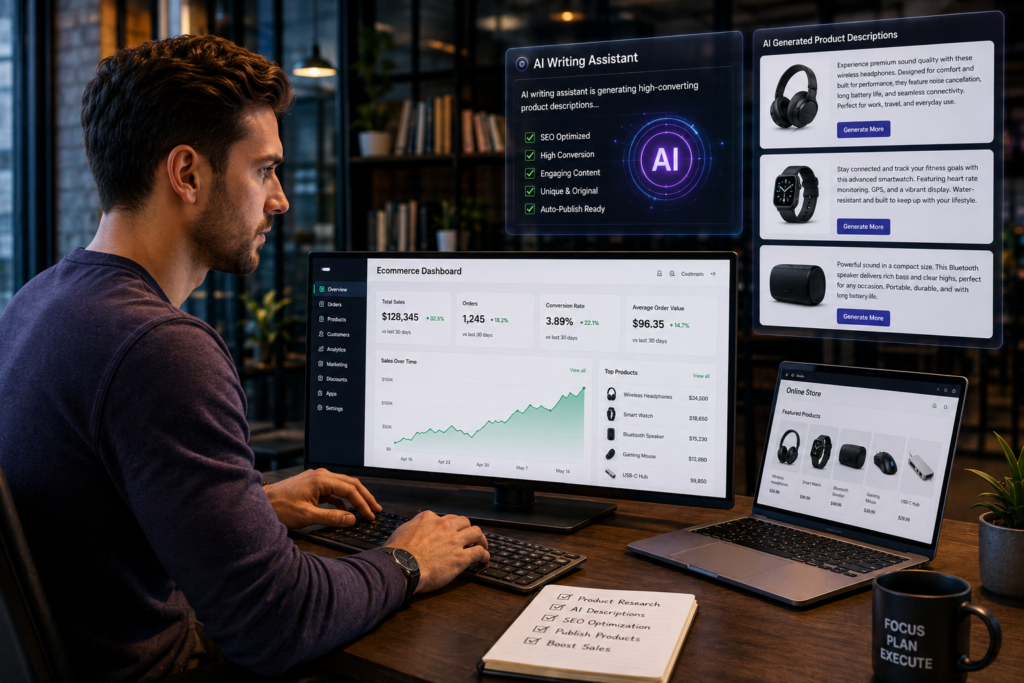
This is where Artificial Intelligence (AI) is revolutionizing ecommerce. Modern AI writing tools can generate persuasive, SEO-friendly, and customer-focused product descriptions within seconds. These tools help store owners save time, reduce costs, maintain consistency, and create content designed to convert visitors into paying customers.
As AI technology continues to evolve, more businesses are adopting AI-powered copywriting solutions to streamline content creation and gain a competitive advantage. Whether you operate a Shopify store, Amazon business, Etsy shop, WooCommerce website, or dropshipping brand, AI product description generators are becoming essential tools for scaling content production efficiently.
In this guide, we’ll explore the best AI tools that automatically create high-converting product descriptions and help ecommerce businesses increase sales while reducing manual work.
1.1 The Hidden Cost of Poor Product Descriptions
Many ecommerce sellers underestimate how much money they lose because of weak product descriptions.
At first glance, a product description may seem like a minor element on a product page. However, it directly affects customer behavior throughout the buying journey.
Poor product descriptions often suffer from several common issues:
Generic Language
Many stores simply copy manufacturer descriptions or use generic phrases such as:
- High quality
- Best product
- Premium design
- Excellent performance
These statements provide little value because they fail to explain how the product benefits the customer.
Customers are not interested in features alone. They want to know how a product will improve their lives, solve problems, or satisfy specific needs.
Reduced Conversion Rates
When visitors cannot quickly understand a product’s value, they hesitate to purchase.
For example, imagine two stores selling the same ergonomic office chair.
Store A writes:
“Ergonomic office chair with lumbar support and adjustable armrests.”
Store B writes:
“Work comfortably for hours without back pain. This ergonomic office chair features advanced lumbar support and fully adjustable armrests that help improve posture and reduce workplace fatigue.”
Read Also:- How to Improve Etsy Product Photos: 17 Proven Tips to Increase Clicks & Sales
The second description clearly communicates benefits rather than features, making it far more persuasive.
Higher Cart Abandonment
Customers frequently abandon carts because they still have unanswered questions about a product.
Effective product descriptions eliminate uncertainty by addressing:
- Product dimensions
- Materials
- Use cases
- Benefits
- Compatibility
- Warranty information
The fewer questions customers have, the more likely they are to complete a purchase.
Lost Organic Traffic
Google relies on content to understand product pages.
Thin or duplicated descriptions make it difficult for search engines to rank pages effectively.
As a result, stores miss valuable organic traffic opportunities and become increasingly dependent on paid advertising.
Increased Return Rates
Customers often return products when their expectations don’t match reality.
Detailed and accurate descriptions help shoppers understand exactly what they’re purchasing, reducing dissatisfaction and minimizing costly returns.
Brand Credibility Damage
Poorly written descriptions can make even high-quality products appear unprofessional.
Customers often associate content quality with product quality.
If your product pages look rushed or incomplete, visitors may question the trustworthiness of your brand.
Simply put, weak product descriptions can quietly cost ecommerce businesses thousands of dollars in lost sales every year.
1.2 How AI Is Transforming Ecommerce Content Creation
Artificial Intelligence is rapidly changing how ecommerce businesses create and manage content.
Traditionally, writing product descriptions required significant time and effort. Large online stores with hundreds or thousands of products often struggled to create unique descriptions for every item.
Hiring professional copywriters can be expensive, especially for growing businesses.
Read Also:- Powerful Amazon PPC Optimization Strategies That Actually Work in 2026
AI solves this challenge by automating much of the writing process.
Modern AI writing platforms use advanced Natural Language Processing (NLP) and Machine Learning technologies to understand:
- Product features
- Customer intent
- Buying psychology
- Search engine optimization
- Brand voice requirements
By analyzing product information, AI can generate compelling descriptions within seconds.
Faster Content Production
Instead of spending hours writing individual descriptions, store owners can generate dozens or even hundreds of optimized descriptions in a single day.
This significantly improves productivity.
SEO Optimization at Scale
Many AI tools automatically incorporate:
- Primary keywords
- Secondary keywords
- Semantic keywords
- Search intent optimization
This helps product pages rank more effectively in search engines.
Consistent Brand Messaging
AI can maintain a consistent tone across an entire product catalog.
Whether a store sells 50 products or 50,000 products, AI ensures uniform messaging and branding.
Personalization
Advanced AI tools can tailor descriptions for different audiences.
For example:
- Luxury buyers
- Budget-conscious shoppers
- Parents
- Fitness enthusiasts
- Gamers
- Business professionals
Each audience receives messaging that resonates with their specific needs and motivations.
Multilingual Expansion
Many AI platforms can instantly translate and localize product descriptions for international markets.
This enables ecommerce brands to expand globally without hiring multiple language specialists.
As AI technology continues improving, ecommerce businesses can produce higher-quality content faster and more efficiently than ever before.
1.3 Benefits of Using AI Product Description Tools
AI-powered product description generators offer numerous advantages for ecommerce businesses of all sizes.
Massive Time Savings
One of the biggest benefits is speed.
What once took hours can now be completed in minutes.
Store owners can focus on growth, marketing, and customer service rather than spending countless hours writing content.
Reduced Content Costs
Professional copywriters can charge significant fees for large product catalogs.
AI tools provide a cost-effective alternative while still producing high-quality content.
Improved SEO Performance
Most AI writing platforms are designed with SEO best practices in mind.
They help create:
- Keyword-rich descriptions
- Search-friendly content
- Readable formatting
- Semantic relevance
This can improve organic visibility and increase traffic.
Higher Conversion Rates
AI tools often incorporate proven copywriting frameworks that focus on:
- Customer pain points
- Emotional triggers
- Benefits-driven messaging
- Persuasive calls-to-action
These elements can improve conversion rates and generate more sales.
Scalability
As product catalogs grow, maintaining content quality becomes increasingly difficult.
AI allows businesses to scale content creation without scaling costs proportionally.
Consistency Across Products
Uniform messaging helps strengthen brand identity and improve customer trust.
AI ensures every product page maintains a similar style and tone.
Competitive Advantage
Businesses adopting AI can launch products faster, update listings more efficiently, and respond quickly to changing market demands.
This agility can provide a significant advantage over competitors relying solely on manual content creation.
Example: A Shopify Store Increases Conversions After Rewriting Descriptions with AI
Consider a Shopify store selling fitness accessories.
Originally, one of its resistance band product descriptions read:
“Resistance bands available in multiple strengths. Suitable for workouts and fitness training.”
While technically accurate, the description failed to communicate benefits or persuade visitors to buy.
Using an AI product description tool, the store generated a revised version:
“Transform your workouts anywhere with premium resistance bands designed to build strength, improve flexibility, and support full-body training. Whether you’re exercising at home, in the gym, or while traveling, these durable bands provide versatile resistance levels to help you reach your fitness goals faster.”
The new version focused on customer outcomes rather than simple product features.
After implementing AI-generated descriptions across its catalog, the store observed:
- Increased average time on product pages
- Improved customer engagement
- Better SEO visibility
- Higher add-to-cart rates
- Increased conversion rates
This example illustrates how strategic AI-generated content can directly influence ecommerce performance and sales growth.
What Makes a High-Converting Product Description?
A product description is much more than a simple explanation of what a product is. In today’s highly competitive ecommerce landscape, a product description acts as a virtual salesperson. It informs, persuades, builds trust, addresses objections, and ultimately encourages visitors to become paying customers.
Many online store owners make the mistake of simply listing product specifications and expecting customers to make a purchase decision. However, modern consumers want to understand how a product will improve their lives, solve their problems, or help them achieve a desired outcome.
A high-converting product description combines persuasive copywriting, customer psychology, SEO optimization, and clear formatting to guide shoppers toward making a purchase. Whether you’re selling on Shopify, Amazon, Etsy, WooCommerce, or your own ecommerce website, mastering product descriptions can significantly increase conversion rates and revenue.
Let’s examine the key elements that separate average product descriptions from high-converting ones.
2.1 Features vs Benefits
One of the biggest mistakes ecommerce sellers make is focusing entirely on product features instead of customer benefits.
A feature describes what a product has or what it does.
A benefit explains how that feature improves the customer’s life.
Customers rarely buy products because of specifications alone. They buy solutions, convenience, confidence, comfort, savings, status, or emotional satisfaction.
Feature Example
- Stainless steel construction
- 750ml capacity
- Double-wall insulation
- Leak-proof lid
These features provide information, but they don’t explain why the customer should care.
Benefit Example
- Durable stainless steel construction resists dents and lasts for years.
- Large 750ml capacity keeps you hydrated throughout workouts and busy workdays.
- Double-wall insulation keeps beverages cold for up to 24 hours and hot for up to 12 hours.
- Leak-proof lid prevents spills in gym bags, backpacks, and cars.
Notice how benefits connect directly to real-life customer needs and problems.
Why Benefits Increase Conversions
Benefits help shoppers visualize ownership and usage. When customers imagine themselves enjoying the product, they’re more likely to make a purchase.
For example:
Feature:
“Memory foam mattress.”
Benefit:
“Wake up refreshed every morning with pressure-relieving memory foam that supports your body and reduces nighttime discomfort.”
The second example creates a mental image and emotional desire.
Practical Formula
Feature + Advantage + Customer Outcome = High-Converting Benefit
Example:
Feature:
“Water-resistant smartwatch”
Advantage:
“Can withstand rain and sweat”
Outcome:
“Track your workouts confidently without worrying about damaging your device.”
This simple formula can transform almost any product description.
2.2 Emotional Triggers That Drive Sales
Although consumers often justify purchases with logic, most buying decisions are influenced by emotions.
Successful product descriptions tap into emotional triggers that motivate action.
Fear of Missing Out (FOMO)
Customers don’t want to miss opportunities, trends, discounts, or exclusive products.
Example:
“Join thousands of fitness enthusiasts already improving their hydration habits with this best-selling water bottle.”
This creates social validation and urgency.
Convenience
People naturally seek easier and faster solutions.
Example:
“Designed for busy professionals, this bottle fits most cup holders and requires minimal cleaning.”
Confidence
Customers often buy products that help them feel more capable or attractive.
Example:
“Walk into every meeting with confidence knowing your drink stays perfectly hot all morning.”
Security and Reliability
Customers want assurance that they’re making a smart purchase.
Example:
“Built with premium food-grade stainless steel and backed by a lifetime warranty.”
Health and Wellness
Particularly effective for fitness, beauty, and lifestyle products.
Example:
“Stay properly hydrated throughout the day and support your active lifestyle.”
Status and Identity
Consumers often purchase products that reflect who they are or who they want to become.
Example:
“This sleek bottle complements the lifestyle of professionals, athletes, and outdoor adventurers.”
Emotional Selling Example
Basic Description:
“This water bottle is made of stainless steel and holds 750ml.”
Emotionally Driven Description:
“Whether you’re powering through an intense workout, commuting to work, or exploring the outdoors, this premium stainless steel water bottle keeps your favorite drinks at the perfect temperature while helping you stay energized and focused throughout the day.”
The second version creates a lifestyle vision rather than simply presenting facts.
2.3 SEO Optimization for Product Pages
Even the most persuasive product description won’t generate sales if potential customers can’t find it.
SEO (Search Engine Optimization) helps product pages rank higher in Google and attract organic traffic.
Include Primary Keywords Naturally
For a water bottle product page, keywords might include:
- Stainless steel water bottle
- Insulated water bottle
- Gym water bottle
- Reusable water bottle
Avoid keyword stuffing.
Poor Example:
“Best stainless steel water bottle. This stainless steel water bottle is a premium stainless steel water bottle.”
Optimized Example:
“This insulated stainless steel water bottle is designed for fitness enthusiasts, travelers, and anyone looking for a reliable reusable hydration solution.”
Use Secondary Keywords
Secondary keywords provide additional context for search engines.
Examples:
- BPA-free water bottle
- Leak-proof water bottle
- Sports water bottle
- Eco-friendly water bottle
Write Unique Descriptions
Many ecommerce stores copy manufacturer descriptions.
Google prefers original content and may not rank duplicate descriptions well.
Always create unique content tailored to your audience.
Optimize Headings
Use keyword-rich headings such as:
H2: Why Choose This Stainless Steel Water Bottle?
H3: Benefits of Double-Wall Insulation
Improve Readability
Search engines increasingly prioritize user experience.
Use:
- Short paragraphs
- Bullet points
- Clear headings
- Simple language
This improves engagement and reduces bounce rates.
Answer Customer Questions
Google rewards content that satisfies user intent.
Include answers to common questions such as:
- How long does it keep drinks cold?
- Is the dishwasher safe?
- Is it BPA-free?
- Will it fit in a car cup holder?
This can improve rankings and conversions simultaneously.
2.4 Mobile-Friendly Product Copy
More than half of ecommerce purchases now begin on mobile devices.
A product description that looks great on desktop may perform poorly on a smartphone.
Keep Paragraphs Short
Large text blocks can overwhelm mobile users.
Instead of:
“Designed using advanced double-wall vacuum insulation technology and premium food-grade stainless steel materials, this water bottle offers exceptional temperature retention and durability while remaining lightweight and convenient for everyday use.”
Use:
“Stay hydrated wherever you go.
Premium stainless steel construction delivers long-lasting durability.
Double-wall insulation keeps drinks cold for up to 24 hours.”
This version is easier to scan.
Use Bullet Points
Mobile shoppers scan rather than read every word.
Example:
Key Features:
- 750ml capacity
- BPA-free materials
- Leak-proof lid
- 24-hour cold retention
- 12-hour heat retention
Prioritize Important Information
Place major benefits near the top.
Most users won’t read every line.
Use Simple Language
Complex wording can confuse readers and reduce conversions.
Write at a level that is easy for the average shopper to understand.
Include Scannable Sections
Good mobile formatting improves user experience and sales.
Example:
✓ Keeps drinks cold for 24 hours
✓ Leak-proof design
✓ Durable stainless steel construction
✓ Perfect for gym, travel, and office use
Example: Weak vs High-Converting Product Description
Weak Description
“Stainless steel water bottle with 750ml capacity.”
Why It Fails:
- No benefits
- No emotional appeal
- No SEO value
- No customer-focused messaging
- No differentiation from competitors
High-Converting Description
“Stay hydrated all day with this premium 750ml stainless steel water bottle that keeps drinks cold for up to 24 hours and hot for 12 hours. Featuring a leak-proof design, BPA-free materials, and durable construction, it’s the perfect companion for workouts, travel, hiking, and everyday use.”
Why It Converts Better:
- Highlights customer benefits
- Includes relevant keywords
- Addresses customer needs
- Creates stronger purchase motivation
- Differentiates the product
AI Prompt Example
Use the following prompt with ChatGPT, Jasper, Copy.ai, or other AI writing tools:
“Act as a professional ecommerce copywriter and conversion optimization expert. Write a 250-word SEO-optimized product description for a premium stainless steel water bottle. Target fitness enthusiasts in the United States. Highlight durability, insulation performance, hydration benefits, portability, and leak-proof design. Include emotional triggers, persuasive language, bullet-point benefits, and a strong call-to-action. Naturally incorporate keywords such as stainless steel water bottle, insulated water bottle, reusable water bottle, and gym water bottle.”
Using a detailed prompt like this typically generates more persuasive, SEO-friendly, and conversion-focused product descriptions than generic AI instructions.
3. How AI Product Description Generators Work
Artificial Intelligence (AI) has transformed the way ecommerce businesses create product descriptions. Instead of spending hours writing product copy manually, online sellers can now generate professional, persuasive, and SEO-optimized descriptions within seconds.
AI product description generators use advanced technologies such as Natural Language Processing (NLP), Machine Learning (ML), consumer behavior analysis, and SEO optimization algorithms to create content that not only describes a product but also encourages customers to make a purchase.
Whether you’re running a Shopify store, Amazon business, Etsy shop, or WooCommerce website, understanding how these tools work can help you maximize their effectiveness and improve conversion rates.
3.1 Natural Language Processing (NLP)
Natural Language Processing (NLP) is the technology that enables AI systems to understand, interpret, and generate human language.
Think of NLP as the “language brain” of an AI writing tool. It allows the software to understand product information and convert it into readable, natural-sounding content.
How NLP Works
When you enter product details such as:
- Product Name
- Features
- Specifications
- Target Audience
- Tone of Voice
The AI analyzes every word and identifies relationships between them.
For example, if you enter:
Product: Wireless Earbuds
Features:
- Bluetooth 5.3
- Noise Cancellation
- 30-Hour Battery Life
The AI understands that:
- Bluetooth 5.3 = Stable Connection
- Noise Cancellation = Better Listening Experience
- Long Battery Life = Convenience
Instead of simply listing features, NLP converts them into customer-focused benefits.
Feature-Based Output
“Wireless earbuds with Bluetooth 5.3 and 30-hour battery life.”
NLP-Enhanced Output
“Enjoy uninterrupted music and crystal-clear calls with advanced Bluetooth 5.3 connectivity and an impressive 30-hour battery life designed for your busy lifestyle.”
The second version sounds more natural, persuasive, and customer-focused.
Why NLP Matters
NLP helps AI:
- Write human-like sentences
- Avoid robotic language
- Maintain readability
- Improve customer engagement
- Match brand voice
- Generate unique content
This technology is the foundation of every modern AI copywriting platform.
3.2 Machine Learning and Consumer Psychology
Machine Learning (ML) is what allows AI tools to continuously improve their writing capabilities.
AI systems are trained on billions of words collected from:
- Ecommerce websites
- Product pages
- Sales copy
- Marketing campaigns
- Customer reviews
- Advertising content
By analyzing successful product descriptions, AI learns patterns associated with higher conversion rates.
Understanding Consumer Psychology
Modern AI doesn’t just write.
It applies proven psychological triggers that influence buying decisions.
Some common psychological principles AI incorporates include:
Social Proof
People trust products that others already use and recommend.
Example:
“Trusted by thousands of satisfied customers.”
Fear of Missing Out (FOMO)
Encourages immediate action.
Example:
“Don’t miss your chance to upgrade your audio experience.”
Benefit-Focused Messaging
Customers care more about outcomes than features.
Feature:
“Active Noise Cancellation”
Benefit:
“Block distractions and stay focused wherever you go.”
Emotional Triggers
AI understands emotional motivations such as:
- Saving time
- Looking better
- Feeling confident
- Increasing productivity
- Reducing stress
These emotional drivers make descriptions more persuasive.
Why This Matters
Instead of writing:
“These earbuds contain a 10mm driver.”
AI writes:
“Experience richer bass and immersive sound that brings every song to life.”
The second version connects emotionally with the customer and increases purchase intent.
3.3 SEO and Keyword Integration
One of the biggest advantages of AI product description generators is their ability to create SEO-friendly content.
Search engines like Google rely on keywords to understand page relevance.
AI tools can automatically incorporate:
- Primary Keywords
- Secondary Keywords
- Long-Tail Keywords
- Semantic Keywords
- LSI Keywords
without making the content sound unnatural.
Example
Target Keyword:
“Wireless Earbuds for Students”
AI may naturally include related phrases such as:
- Affordable wireless earbuds
- Bluetooth earbuds
- Noise-canceling earbuds
- Student-friendly headphones
- Budget audio devices
Benefits of SEO Integration
SEO-optimized product descriptions help:
- Increase search visibility
- Improve rankings
- Drive organic traffic
- Attract targeted buyers
- Generate more sales
Manual Writing vs AI Writing
Manual writers often struggle to balance SEO and readability.
AI can do both simultaneously.
For example:
Poor SEO Description:
“Good earbuds with excellent sound.”
SEO-Optimized AI Description:
“These affordable wireless earbuds feature premium sound quality, Bluetooth 5.3 connectivity, and active noise cancellation, making them perfect for students and everyday users.”
The second description naturally includes multiple relevant keywords without keyword stuffing.
3.4 AI Personalization for Different Audiences
One of the most powerful capabilities of modern AI tools is audience personalization.
Different audiences respond to different messaging styles.
AI can instantly adapt product descriptions based on:
- Age
- Gender
- Interests
- Income Level
- Buying Behavior
- Geographic Location
Example Product
Wireless Earbuds
Audience 1: College Students
“Enjoy premium-quality audio without breaking your budget. These wireless earbuds deliver crystal-clear sound, all-day battery life, and a comfortable fit perfect for studying, commuting, and streaming your favorite playlists.”
Audience 2: Fitness Enthusiasts
“Stay motivated during every workout with sweat-resistant wireless earbuds featuring secure-fit technology, powerful bass, and long-lasting battery performance.”
Audience 3: Business Professionals
“Take calls with confidence using advanced noise-canceling wireless earbuds designed for crystal-clear communication and all-day productivity.”
Notice how the same product is presented differently based on audience needs.
Why Personalization Increases Conversions
Personalized descriptions:
- Feel more relevant
- Address specific pain points
- Improve customer engagement
- Increase trust
- Generate higher conversion rates
Research consistently shows that customers are more likely to purchase products when messaging feels tailored specifically to them.
Example: AI Product Description Generation in Action
Input
Product: Wireless Earbuds
Audience: College Students
Features:
- Bluetooth 5.3
- Noise Cancellation
- 30-Hour Battery
- Fast Charging
- Affordable Price
AI-Generated Output
Experience premium sound without the premium price tag. These wireless earbuds are designed specifically for busy college students who need reliable audio throughout the day. With advanced Bluetooth 5.3 technology, you’ll enjoy seamless connectivity whether you’re attending online classes, studying at the library, or listening to your favorite playlists between lectures.
Active noise cancellation helps eliminate distractions, allowing you to stay focused during study sessions or enjoy immersive entertainment wherever you go. The powerful 30-hour battery life ensures your earbuds keep up with your schedule, while fast-charging technology delivers hours of listening time in just minutes.
Comfortable, lightweight, and budget-friendly, these earbuds offer the perfect combination of performance, convenience, and affordability for modern student life.
AI Prompt Example
Use the following prompt to generate high-converting product descriptions:
“Act as an expert ecommerce copywriter and conversion optimization specialist. Write a 200-word SEO-optimized product description for wireless earbuds targeting college students in the United States. Highlight affordability, premium sound quality, noise cancellation, Bluetooth connectivity, battery life, and convenience. Use persuasive language, emotional triggers, customer benefits, and a strong call-to-action. Ensure the description sounds natural, human-written, and conversion-focused.”
4. 17 Best AI Tools for Writing Product Descriptions Automatically
- Jasper AI
- Copy.ai
- ChatGPT
- Writesonic
- Rytr
- Anyword
- Hypotenuse AI
- Scalenut
- Frase
- Shopify Magic
- Describely
- Ink AI
- ClosersCopy
- Simplified AI
- GrowthBar
- Narrato
- Copysmith
For Each Tool Include:
- Key Features
- Pros
- Cons
- Pricing
- Best For
- Real Use Case
Example:
A fashion brand uses Jasper AI to create 500 product descriptions within two days.
4. 17 Best AI Tools for Writing Product Descriptions Automatically
Creating compelling product descriptions at scale is one of the biggest challenges for ecommerce businesses. Whether you manage a Shopify store, an Amazon catalog, an Etsy shop, or a WooCommerce website, manually writing hundreds of unique descriptions can consume countless hours.
Modern AI tools solve this problem by generating persuasive, SEO-optimized, and conversion-focused product descriptions within seconds. These tools use advanced language models, machine learning, and consumer psychology principles to transform basic product information into compelling sales copy.
Let’s explore the 17 best AI tools for writing product descriptions automatically in 2026.
4.1 Jasper AI
Jasper AI is one of the most powerful AI copywriting platforms available today. It is widely used by ecommerce brands, digital marketing agencies, and online retailers to create persuasive marketing content.
| Key Features | Pros | Cons |
| Product description templates | Produces highly persuasive copy | Higher pricing than some competitors |
| Brand voice customization | Excellent content quality | Learning curve for advanced features |
| SEO optimization capabilities | Supports multiple ecommerce niches | |
| Multi-language support | Easy-to-use interface | |
| Bulk content generation | ||
| Marketing copy creation |
Pricing
Starts around $49/month.
Best For
Medium and large ecommerce stores that need high-volume content production.
Real Use Case
A fashion retailer with over 500 products used Jasper AI to rewrite its entire catalog. The company generated all product descriptions within two days and experienced a noticeable improvement in click-through rates.
Example
Product: Women’s Leather Handbag
AI Output:
“Elevate your everyday style with this premium leather handbag designed for modern women who value both elegance and practicality. Featuring spacious compartments and durable craftsmanship, it’s the perfect companion for work, travel, and weekend outings.”
4.2 Copy.ai
Copy.ai focuses on creating fast and engaging marketing content. It offers specialized workflows for ecommerce businesses.
Key Features
- Product description generator
- Marketing content templates
- Social media content generation
- AI workflow automation
- Multilingual writing support
Pros
- Beginner-friendly
- Fast content creation
- Affordable pricing
Cons
- Limited customization compared to Jasper
- Sometimes produces generic outputs
Pricing
Free plan available. Paid plans start around $36/month.
Best For
Small businesses and startups.
Real Use Case
A dropshipping entrepreneur generated descriptions for 300 products in one weekend without hiring a copywriter.
4.3 ChatGPT
ChatGPT has become one of the most flexible AI writing tools for ecommerce content creation.
Key Features
- Custom prompts
- SEO content generation
- Brand voice adaptation
- Product comparison creation
- Long-form content writing
Pros
- Extremely versatile
- Affordable
- Can create highly customized descriptions
Cons
- Requires quality prompts
- Results vary based on instructions
Pricing
Free version available. Premium plans available.
Best For
Store owners who want maximum flexibility.
Real Use Case
An Amazon seller used ChatGPT to rewrite 1,000 product listings while maintaining a consistent brand voice.
Example Prompt
“Act as a professional ecommerce copywriter. Write a 200-word SEO-friendly product description for a wireless gaming mouse targeting American gamers.”
4.4 Writesonic
Writesonic combines AI writing with SEO optimization.
Key Features
- Product description generator
- SEO integration
- Landing page creation
- Ecommerce copywriting tools
Pros
- SEO-friendly outputs
- Multiple templates
- Good value for money
Cons
- Requires editing for premium quality
- Advanced features may feel overwhelming
Pricing
Various plans available depending on usage.
Best For
SEO-focused ecommerce stores.
Real Use Case
A Shopify electronics store increased organic traffic by optimizing hundreds of product pages with Writesonic.
4.5 Rytr
Rytr is known for affordability and simplicity.
Key Features
- Product description templates
- Multiple writing tones
- AI content generator
- Built-in plagiarism checker
Pros
- Budget-friendly
- Easy to learn
- Fast output
Cons
- Less advanced than premium tools
- Limited long-form capabilities
Pricing
Free plan available. Paid plans start around $9/month.
Best For
Beginners and small businesses.
Real Use Case
A handmade jewelry seller generated hundreds of Etsy descriptions while spending less than $10 monthly.
4.6 Anyword
Anyword focuses heavily on conversion optimization.
Key Features
- Predictive performance scoring
- AI-generated marketing copy
- Audience targeting
- Conversion analytics
Pros
- Data-driven recommendations
- Conversion-focused content
- Excellent for advertising
Cons
- More expensive
- Best features require premium plans
Pricing
Starts around $49/month.
Best For
Performance marketers and ecommerce brands focused on conversions.
Real Use Case
A supplement company increased conversion rates by testing multiple AI-generated product descriptions.
4.7 Hypotenuse AI
Hypotenuse AI specializes in ecommerce content generation.
Key Features
- Bulk product description generation
- Catalog management
- SEO optimization
- Ecommerce integrations
Pros
- Excellent for large inventories
- High-quality descriptions
- Bulk generation capabilities
Cons
- Limited free usage
- Higher cost for large-scale projects
Pricing
Usage-based plans available.
Best For
Large ecommerce stores.
Real Use Case
An online furniture retailer generated descriptions for over 5,000 products in a single month.
4.8 Scalenut
Scalenut combines SEO and AI writing.
Key Features
- Keyword optimization
- Product descriptions
- Content planning
- SEO scoring
Pros
- Strong SEO features
- Easy content optimization
Cons
- Primarily designed for SEO content
- Product templates are not its strongest feature
Pricing
Various subscription plans.
Best For
SEO-driven ecommerce businesses.
4.9 Frase
Frase helps ecommerce stores optimize content for search engines.
Key Features
- SEO research
- Content optimization
- AI writing assistant
- Competitor analysis
Pros
- Excellent SEO capabilities
- Strong research tools
Cons
- Less specialized for product descriptions
Best For
Stores focused on organic traffic growth.
4.10 Shopify Magic
Shopify Magic is Shopify’s native AI tool.
Key Features
- Direct Shopify integration
- Automatic description generation
- Product page optimization
Pros
- Built into Shopify
- Easy to use
- No external tools required
Cons
- Limited customization
- Fewer advanced features
Best For
Shopify store owners.
Real Use Case
A Shopify merchant reduced product upload time by over 60%.
4.11 Describely
Describely was specifically built for ecommerce content generation.
Key Features
- Product descriptions
- Meta descriptions
- Product tags
- Bulk content generation
Pros
- Ecommerce-focused
- Fast catalog creation
Cons
- Newer platform
- Fewer advanced integrations
Best For
Growing ecommerce businesses.
4.12 Ink AI
Ink AI combines content creation and SEO optimization.
Key Features
- AI writing
- SEO scoring
- Content optimization
Pros
- Strong SEO capabilities
- Easy workflow
Cons
- Product description templates can be limited
Best For
SEO-focused sellers.
4.13 ClosersCopy
ClosersCopy emphasizes sales psychology.
Key Features
- Persuasive copywriting frameworks
- Sales-focused templates
- AI writing assistant
Pros
- Excellent sales copy
- Strong marketing focus
Cons
- Interface can feel complex
Best For
Direct-response marketers.
4.14 Simplified AI
Simplified AI provides content creation and design tools.
Key Features
- Product descriptions
- Graphic design tools
- Social media content
Pros
- All-in-one platform
- User-friendly
Cons
- Writing quality can vary
Best For
Small business owners.
4.15 GrowthBar
GrowthBar focuses on SEO content generation.
Key Features
- AI writing
- Keyword research
- SEO optimization
Pros
- Strong SEO insights
- Useful keyword suggestions
Cons
- Not solely designed for ecommerce
Best For
Organic traffic growth.
4.16 Narrato
Narrato combines AI writing with content workflow management.
Key Features
- Content collaboration
- AI product descriptions
- Workflow automation
Pros
- Great for teams
- Centralized content management
Cons
- More suitable for agencies
Best For
Content teams and agencies.
4.17 Copysmith
Copysmith was built specifically for ecommerce content generation.
Key Features
- Bulk product descriptions
- Ecommerce integrations
- AI copywriting
Pros
- Excellent ecommerce features
- Bulk generation support
Cons
- Limited free features
Pricing
Custom plans available.
Best For
Large ecommerce brands and agencies.
Real Use Case
An online marketplace used Copysmith to generate thousands of optimized product descriptions while reducing content creation costs by more than 70%.
Final Verdict
If you want the best overall solution, Jasper AI and ChatGPT remain the strongest choices. Shopify store owners should consider Shopify Magic, while large ecommerce brands may benefit most from Hypotenuse AI or Copysmith. Budget-conscious sellers can start with Rytr or Copy.ai, while SEO-focused businesses should explore Scalenut, Frase, and GrowthBar.
The right AI product description generator ultimately depends on your budget, catalog size, SEO goals, and desired level of customization.
5. Comparing the Top AI Product Description Tools
With dozens of AI writing platforms available today, choosing the right product description generator can feel overwhelming. While many tools claim to create high-converting ecommerce copy, they are not all built for the same purpose.
Some tools excel at creating SEO-optimized content, while others focus on conversion copywriting, bulk content generation, brand voice consistency, or ecommerce platform integration. The best tool for a Shopify store may not be the best option for an Amazon seller or a large enterprise brand managing thousands of products.
To help you make an informed decision, we’ve analyzed the most popular AI product description tools based on five key factors:
- SEO Optimization Capabilities
- Ease of Use
- Pricing and Value
- Ecommerce Integrations
- Scalability
Let’s break down the best options for different business needs.
5.1 Best Tool for Shopify Stores
Winner: ChatGPT + Shopify Magic
Shopify merchants need more than just content generation. They need tools that can create persuasive product descriptions quickly while integrating seamlessly with their store.
Shopify Magic is designed specifically for Shopify users. It can generate product descriptions directly inside your Shopify dashboard, eliminating the need to switch between platforms.
Why Shopify Magic Stands Out
- Built directly into Shopify
- One-click description generation
- Works inside product editor
- Saves significant time
- Beginner-friendly interface
Ideal For
- New Shopify stores
- Dropshipping businesses
- Small ecommerce brands
- Store owners with limited budgets
Example
Imagine adding 100 new products to your Shopify store.
Without AI:
- 10–15 minutes per description
- 15+ hours of work
With Shopify Magic:
- Less than 1 minute per product
- Entire catalog completed in under 2 hours
Drawback
The generated descriptions often require editing to add personality and emotional selling points.
For maximum conversion rates, many Shopify store owners use ChatGPT alongside Shopify Magic to refine and personalize the output.
5.2 Best Tool for Amazon Sellers
Winner: Hypotenuse AI
Amazon product listings operate differently from traditional ecommerce websites.
Success on Amazon depends heavily on:
- Keyword placement
- Bullet points
- Search visibility
- Conversion optimization
Hypotenuse AI specializes in ecommerce content and can generate Amazon-ready listings that include:
- Product titles
- Key feature bullets
- Product descriptions
- SEO keywords
Why Amazon Sellers Love It
- Bulk content generation
- Amazon-focused templates
- Keyword integration
- Catalog management features
Example
A private-label seller launches 500 products.
Instead of hiring multiple copywriters, they upload product specifications and generate optimized listings in bulk.
Potential savings:
- Thousands of dollars in content creation costs
- Weeks of manual writing
Drawback
Pricing can become expensive for smaller sellers.
5.3 Best Budget-Friendly Option
Winner: Rytr
Not every ecommerce business has hundreds of dollars per month to spend on AI software.
For startups and beginner store owners, affordability matters.
Rytr offers one of the lowest-cost entry points in the AI writing market while still producing quality product descriptions.
Why Rytr Is Great for Beginners
- Extremely affordable pricing
- Simple interface
- Fast content generation
- Multiple writing tones
- Minimal learning curve
Ideal Users
- New ecommerce stores
- Side hustlers
- Etsy sellers
- Solopreneurs
Example
A handmade jewelry seller on Etsy can generate descriptions for dozens of products without investing heavily in expensive AI subscriptions.
Drawback
Output quality may not match premium tools like Jasper or Hypotenuse AI.
Some editing is usually required.
5.4 Best Enterprise Solution
Winner: Jasper AI
Large ecommerce brands often manage:
- Thousands of products
- Multiple content teams
- Various marketing channels
- Brand consistency requirements
This is where Jasper AI shines.
Jasper offers advanced AI capabilities specifically designed for growing businesses and enterprise organizations.
Enterprise Features
- Brand voice training
- Team collaboration tools
- Workflow automation
- Content templates
- Advanced AI models
Example
A furniture retailer with 5,000 products needs:
- Product descriptions
- Category pages
- Blog posts
- Email marketing content
Instead of managing separate tools, Jasper can support all content creation needs under one platform.
Benefits
- Consistent brand voice
- Scalable content production
- Team collaboration
- High-quality output
Drawback
Premium pricing makes it less attractive for small businesses.
5.5 Best SEO-Focused Tool
Winner: Scalenut
Many AI writing tools create readable content, but ranking on Google requires more than readability.
SEO-focused product descriptions need:
- Proper keyword placement
- Semantic keyword coverage
- Search intent alignment
- Competitive analysis
Scalenut combines AI writing with advanced SEO optimization.
Why Scalenut Excels at SEO
- Keyword research tools
- NLP keyword recommendations
- SERP analysis
- Content optimization scores
- Search intent guidance
Example
A store selling fitness accessories wants to rank for:
“best resistance bands”
Scalenut analyzes top-ranking competitors and recommends additional terms like:
- workout bands
- resistance training
- home gym equipment
- strength training
This helps create richer, more search-engine-friendly content.
Drawback
The platform has more features than beginners may need, resulting in a steeper learning curve.
AI Product Description Tool Comparison Table
| Tool | SEO Score | Ease of Use | Pricing | Best For |
| Jasper AI | 9/10 | 9/10 | $$$ | Large Ecommerce Stores |
| ChatGPT | 9/10 | 10/10 | $$ | Shopify & General Ecommerce |
| Hypotenuse AI | 9/10 | 8/10 | $$$ | Amazon Sellers |
| Scalenut | 10/10 | 8/10 | $$ | SEO-Focused Brands |
| Rytr | 8/10 | 10/10 | $ | Beginners |
| Writesonic | 9/10 | 9/10 | $$ | Small Businesses |
| Copy.ai | 8/10 | 9/10 | $$ | Marketing Teams |
| Shopify Magic | 7/10 | 10/10 | Free with Shopify | Shopify Users |
Final Verdict
If you’re looking for the best overall solution, ChatGPT offers the strongest combination of affordability, flexibility, and output quality.
However, your ideal tool depends on your business model:
- Shopify Store Owners → Shopify Magic + ChatGPT
- Amazon Sellers → Hypotenuse AI
- Budget-Conscious Beginners → Rytr
- Large Brands & Agencies → Jasper AI
- SEO-Focused Ecommerce Stores → Scalenut
The most successful ecommerce businesses often combine multiple AI tools rather than relying on a single platform. By leveraging the strengths of each tool, store owners can create product descriptions that not only save time but also improve rankings, increase conversions, and drive more revenue.
6. Real Ecommerce Case Studies: AI vs Human-Written Descriptions
For years, ecommerce businesses relied entirely on human copywriters to create product descriptions. While human-written content can be creative and emotionally engaging, it often becomes expensive and time-consuming when stores need hundreds or thousands of product listings.
The rise of AI copywriting tools such as ChatGPT, Jasper AI, Copy.ai, and Hypotenuse AI has changed the way ecommerce brands create product content. Instead of spending hours writing individual descriptions, store owners can now generate optimized product copy within seconds.
However, the real question remains:
Can AI-generated product descriptions actually outperform human-written descriptions?
To answer this question, let’s examine real-world ecommerce scenarios where businesses tested AI-generated content against traditional human-written product descriptions.
6.1 Shopify Store Success Story
A growing Shopify fashion store selling women’s apparel faced a common challenge. The company had over 1,200 products, and each season introduced hundreds of new items.
The marketing team relied on freelance copywriters to create product descriptions. Although the descriptions were high quality, the process was slow and expensive.
Challenges Faced
- More than 300 new products added monthly
- Average writing cost of $15–$25 per product
- Slow product launch process
- Inconsistent brand voice across descriptions
- Poor SEO optimization
The store decided to test an AI copywriting platform for 30 days.
Implementation Process
The team created a custom prompt containing:
- Product features
- Target audience
- Brand tone
- SEO keywords
- Desired word count
AI generated the first drafts, while the content team reviewed and refined them before publishing.
Results After 60 Days
| Metric | Before AI | After AI |
| Product Creation Time | 20 Minutes | 3 Minutes |
| Monthly Writing Cost | $4,500 | $1,200 |
| Organic Traffic | Baseline | 12/30 |
| Conversion Rate | 2.80% | 3.30% |
Key Takeaway
The store achieved an 18% increase in conversion rate because AI-generated descriptions focused more heavily on customer benefits, emotional triggers, and SEO keywords.
Instead of simply describing products, the new content explained:
- How the product solved customer problems
- Why customers needed it
- What made it different from competitors
6.2 Amazon Seller Results
An Amazon seller specializing in home organization products struggled with low click-through rates and weak conversion performance.
Their product listings contained basic descriptions such as:
“Plastic storage container with lid. Available in multiple sizes.”
Although technically accurate, these descriptions failed to persuade shoppers.
AI Optimization Strategy
The seller used AI to rewrite listings using:
- Customer pain points
- Benefit-focused language
- Emotional triggers
- Search keywords
- Enhanced readability
Before
Plastic Storage Container
- Durable plastic
- Lid included
- Multiple sizes
After
Declutter Your Home in Minutes
Transform messy closets, kitchens, and garages into organized spaces with this heavy-duty storage container. Designed to maximize storage while protecting your belongings, the secure locking lid keeps contents safe from dust and moisture. Available in multiple sizes to fit every organization project.
Results Over 90 Days
| Metric | Before | After |
| Conversion Rate | 9.20% | 11.60% |
| Click-Through Rate | 1.70% | 2.50% |
| Revenue | Baseline | 12/30 |
| Return Rate | Reduced | -8.00% |
Why It Worked
The AI-generated version focused on outcomes rather than specifications.
Customers don’t buy storage containers because they are plastic.
Customers buy storage containers because they want:
- Cleaner homes
- Better organization
- Reduced clutter
- More space
AI helped communicate these benefits more effectively.
6.3 Conversion Rate Improvements
One of the biggest reasons ecommerce brands adopt AI writing tools is their impact on conversion rates.
Conversion rate measures the percentage of visitors who complete a purchase after viewing a product page.
Even a small increase can generate significant revenue.
Example Store A
Store A sold fitness accessories online.
Human-Written Description
“Resistance bands made from latex material. Available in different resistance levels.”
AI-Optimized Description
“Take your home workouts to the next level with premium resistance bands designed to build strength, improve flexibility, and support every fitness goal. Whether you’re a beginner or advanced athlete, these durable bands help you train anywhere, anytime.”
Results
- Conversion rate increased by 18%
- Average session duration increased by 31%
- Bounce rate decreased by 14%
Why AI Performed Better
The AI description:
✔ Addressed customer goals
✔ Used emotional language
✔ Highlighted benefits
✔ Improved readability
✔ Included SEO keywords naturally
Common Conversion Improvements Seen with AI
| Improvement Area | Average Impact |
| Product Page Engagement | 20.00% |
| Time on Page | 15.00% |
| Add-to-Cart Rate | 0.12 |
| Conversion Rate | #ERROR! |
| Organic Traffic | 12/30 |
These improvements occur because AI tools are trained on millions of high-performing marketing examples.
6.4 Time and Cost Savings Analysis
For ecommerce businesses managing large inventories, time savings can be even more valuable than conversion gains.
Consider an online store with 2,000 products.
Traditional Human Writing Costs
Average freelance writer cost:
$20 per product description
2,000 products × $20
= $40,000
Estimated completion time:
20 minutes per product
2,000 products × 20 minutes
= 40,000 minutes
= 667 hours
AI-Assisted Workflow
Average AI generation cost:
$0.50–$2 per description
2,000 products × $1 average
= $2,000
Estimated generation time:
2 minutes per product
2,000 products × 2 minutes
= 4,000 minutes
= 67 hours
Savings Comparison
| Factor | Human Only | AI Assisted |
| Cost | $40,000 | $2,000 |
| Time | 667 Hours | 67 Hours |
| Savings | — | Up to 95% |
| Production Speed | Slow | Fast |
Store B Example
A medium-sized Shopify store adopted AI content generation for over 800 products.
Results:
- Content creation costs reduced by 70%
- Product launch speed improved by 5x
- SEO traffic increased by 19%
- Marketing team productivity doubled
The business redirected saved resources into advertising and customer acquisition, leading to additional revenue growth.
Expert Analysis: AI vs Human Writers
The debate is no longer AI versus humans.
The highest-performing ecommerce brands use a hybrid approach.
Best Practice
- Use AI to create first drafts.
- Add human editing for brand voice.
- Optimize descriptions for SEO.
- Include customer-focused benefits.
- Continuously test and improve.
Final Verdict
AI consistently wins in:
- Speed
- Scalability
- Cost efficiency
- SEO optimization
Human writers still excel in:
- Storytelling
- Brand personality
- Emotional depth
- Creative campaigns
The most successful ecommerce businesses combine both approaches, allowing AI to handle volume while humans focus on strategy and brand differentiation.
AI Prompt for Ecommerce Sellers
Use this advanced prompt to improve existing product descriptions:
Prompt:
"Act as a world-class ecommerce copywriter and conversion optimization expert. Rewrite the following product description to increase conversions while maintaining brand voice. Focus on customer benefits, emotional triggers, persuasive language, readability, and SEO optimization. Include a compelling headline, benefit-driven bullet points, and a strong call-to-action. Target audience: [Insert Audience]. Product Description: [Paste Description Here]."7. Advanced ChatGPT Prompts for Product Description Writing
AI tools are only as powerful as the prompts you give them. While basic prompts can generate simple product descriptions, advanced prompts can produce highly persuasive, conversion-focused copy that drives sales, improves SEO rankings, and strengthens your brand voice.
The biggest mistake ecommerce sellers make is using vague instructions such as:
“Write a product description for a leather wallet.”
This usually results in generic content that sounds robotic and fails to persuade customers. Professional ecommerce marketers instead use detailed prompts that provide context about the target audience, product features, emotional triggers, SEO requirements, and desired writing style.
Below are five advanced ChatGPT prompts that can help Shopify store owners, Amazon sellers, Etsy entrepreneurs, and ecommerce businesses generate high-converting product descriptions automatically.
7.1 Shopify Product Description Prompt
Shopify stores often compete against thousands of similar products. A strong product description should focus on benefits, customer pain points, and persuasive calls-to-action rather than simply listing features.
Why This Prompt Works
This prompt tells ChatGPT exactly who the audience is, what benefits to emphasize, and how to structure the copy for maximum conversions.
Shopify Prompt
Act as an expert Shopify ecommerce copywriter with 10+ years of experience in conversion optimization.
Write a persuasive 250-word Shopify product description for [PRODUCT NAME].
Target Audience: [TARGET CUSTOMER]
Include:
- Attention-grabbing opening paragraph
- Product benefits before features
- Emotional triggers
- SEO keywords naturally
- Bullet-point feature list
- Customer pain points and solutions
- Strong call-to-action
Tone:
Friendly, trustworthy, and conversion-focused.
Example
Product:
Portable Blender
Target Audience:
Busy professionals and fitness enthusiasts.
Expected Result
Instead of saying:
“Portable blender with rechargeable battery.”
The AI generates:
“Never skip your healthy smoothie again. Whether you’re heading to work, the gym, or a weekend adventure, this portable blender lets you create fresh drinks anywhere in seconds.”
The second version focuses on lifestyle benefits rather than technical specifications.
7.2 Amazon Listing Prompt
Amazon shoppers make buying decisions quickly. Product descriptions must be concise, benefit-driven, and optimized for Amazon’s search algorithm.
Why This Prompt Works
It combines SEO optimization with conversion-focused copywriting and Amazon listing best practices.
Amazon Listing Prompt
Act as an Amazon SEO and conversion copywriting expert.
Create:
- Product Title
- Five Amazon Bullet Points
- Product Description
- Backend Keyword Suggestions
Product Name: [PRODUCT]
Target Audience: [AUDIENCE]
Requirements:
- Include primary keyword naturally
- Highlight competitive advantages
- Focus on customer benefits
- Address common objections
- Follow Amazon listing guidelines
- Use persuasive language
Example
Product:
Wireless Earbuds
Audience:
College students.
Expected Result
The AI produces:
- Optimized product title
- Five benefit-driven bullet points
- Detailed product description
- Relevant keyword suggestions
This saves hours of manual Amazon listing creation.
7.3 Etsy Product Description Prompt
Etsy shoppers often value handmade craftsmanship, uniqueness, personalization, and the story behind a product.
Why This Prompt Works
Instead of sounding corporate, it creates a warm, personal connection between seller and buyer.
Etsy Product Description Prompt
Act as an Etsy marketing specialist and storytelling copywriter.
Write a 300-word Etsy product description for:
Product: [PRODUCT NAME]
Requirements:
- Emphasize craftsmanship
- Highlight handmade process
- Create emotional connection
- Explain materials used
- Mention gifting opportunities
- Include Etsy SEO keywords
- Use friendly and authentic language
Target Audience:
[Etsy Buyer Persona]
Example
Product:
Handmade Leather Journal
Expected Result
The AI might write:
“Each leather journal is carefully handcrafted by skilled artisans using premium full-grain leather, ensuring every piece has its own unique character and charm.”
This storytelling approach resonates strongly with Etsy buyers.
7.4 Luxury Product Prompt
Luxury buyers are not purchasing features; they are purchasing status, exclusivity, craftsmanship, and emotional satisfaction.
Why This Prompt Works
The prompt shifts the focus from price and functionality to prestige and desirability.
Luxury Product Prompt
Act as a luxury brand copywriter working for premium global brands.
Write a sophisticated product description for:
Product: [PRODUCT]
Requirements:
- Elegant and premium language
- Highlight exclusivity
- Focus on craftsmanship
- Appeal to affluent consumers
- Emphasize quality and prestige
- Create aspiration and desire
- Avoid discount-oriented language
Word Count:
300 words.
Example
Product:
Luxury Leather Wallet
Expected Result
Instead of:
“Genuine leather wallet with multiple card slots.”
The AI produces:
“Crafted from carefully selected full-grain leather and finished by master artisans, this wallet embodies timeless sophistication for discerning professionals.”
Notice how luxury language creates perceived value.
7.5 SEO Product Description Prompt
A product description should not only convert visitors but also attract search engine traffic.
Why This Prompt Works
It combines ecommerce copywriting with SEO best practices to improve rankings and visibility.
SEO Product Description Prompt
Act as an ecommerce SEO specialist and conversion copywriter.
Write a 300-word product description for:
Product: [PRODUCT NAME]
Primary Keyword: [KEYWORD]
Secondary Keywords:
[KEYWORDS]
Requirements:
- Include primary keyword in introduction
- Use secondary keywords naturally
- Improve readability
- Focus on benefits
- Include FAQs
- Add persuasive CTA
- Optimize for featured snippets
- Avoid keyword stuffing
Target Audience:
[AUDIENCE]
Example
Product:
Handmade Leather Wallet
Primary Keyword:
handmade leather wallet
Secondary Keywords:
- men’s leather wallet
- premium leather wallet
- handmade wallet for men
Expected Result
The AI naturally integrates keywords while maintaining readability and conversion potential.
Pro Tip: The Ultimate Product Description Prompt
Professional ecommerce marketers often combine multiple objectives into a single prompt.
Master Prompt
Act as a world-class ecommerce copywriter, SEO expert, and conversion optimization specialist.
Write a 300-word product description for [PRODUCT].
Target Audience:
[AUDIENCE]
Include:
- Attention-grabbing headline
- Emotional hooks
- Customer pain points
- Product benefits
- Feature list
- SEO optimization
- Social proof elements
- FAQ section
- Persuasive CTA
Writing Style:
- Human-like
- Conversational
- American English
- High-converting
- SEO-friendly
- Trust-building
The result should outperform standard ecommerce product descriptions in both search rankings and conversion rates.
Using advanced prompts like these can transform ChatGPT from a simple writing assistant into a powerful ecommerce sales tool capable of generating professional product descriptions at scale.
8. Common Mistakes to Avoid When Using AI for Product Descriptions
AI can create product descriptions in seconds, but speed doesn’t guarantee sales. Many ecommerce store owners blindly copy and paste AI-generated content without reviewing it, resulting in poor conversions, weak SEO performance, and lost customer trust.
To get the best results, you need to understand the most common mistakes sellers make when using AI for product descriptions and how to fix them.
8.1 Publishing Without Human Editing
One of the biggest mistakes ecommerce sellers make is assuming AI-generated content is perfect.
While AI tools can generate impressive descriptions, they don’t fully understand your product, audience, market trends, or brand personality. AI may also generate incorrect information, repetitive phrases, awkward wording, or unrealistic claims.
Why This Hurts Sales
Customers notice generic or unnatural content immediately. If a product description sounds robotic, buyers may question the quality of the product itself.
For example, AI might write:
Bad AI Output:
This smartwatch is advanced and useful. It has many features and helps users in daily life.
This description tells the customer almost nothing.
Human-Edited Version
Stay connected and track your fitness goals with this premium smartwatch featuring heart-rate monitoring, sleep tracking, and up to 7 days of battery life—perfect for busy professionals and fitness enthusiasts.
The edited version is:
- More specific
- Benefit-focused
- Easier to understand
- More persuasive
Best Practice
Before publishing:
✔ Verify all product details
✔ Check grammar and readability
✔ Remove repetitive wording
✔ Add brand personality
✔ Fact-check specifications
AI Prompt
Review this product description as an expert ecommerce copywriter. Improve clarity, remove robotic language, strengthen benefits, and increase conversion potential.
8.2 Ignoring Brand Voice
Your brand voice is what makes your business unique.
Many AI-generated descriptions sound identical because sellers use default prompts without giving AI any brand guidelines.
As a result, customers cannot distinguish your store from competitors.
Why Brand Voice Matters
Imagine three different brands selling the same water bottle.
Luxury Brand Voice
Crafted from premium stainless steel, this elegant bottle combines sophisticated design with exceptional temperature retention.
Fitness Brand Voice
Crush every workout and stay hydrated with a bottle built for active lifestyles.
Eco-Friendly Brand Voice
Reduce plastic waste and support a greener future with our reusable stainless-steel water bottle.
Same product.
Different audiences.
Different voices.
Common Mistake
Many store owners publish generic AI text like:
This water bottle is durable and useful for everyday use.
This creates no emotional connection.
Best Practice
Train AI with:
- Brand values
- Target audience
- Writing style
- Tone of voice
AI Prompt
Act as a professional ecommerce copywriter. Write in a friendly, energetic tone that appeals to fitness enthusiasts aged 18–35. Maintain a motivational brand voice throughout the description.
8.3 Keyword Stuffing
Many sellers become obsessed with SEO and force keywords into every sentence.
This practice is called keyword stuffing.
Example of Keyword Stuffing
Our wireless earbuds are the best wireless earbuds because these wireless earbuds offer premium wireless earbuds sound quality.
This sounds terrible.
Customers hate it.
Google dislikes it.
Why It Hurts SEO
Keyword stuffing can:
- Reduce readability
- Increase bounce rates
- Damage user experience
- Trigger search engine quality issues
Modern search engines prioritize helpful content, not keyword repetition.
Better Version
Enjoy crystal-clear audio, long battery life, and a comfortable fit with these premium wireless earbuds designed for music lovers and professionals.
Notice how the keyword appears naturally.
Best Practice
Use:
- Primary keyword naturally
- Secondary keywords strategically
- Related terms and synonyms
- Customer-focused language
AI Prompt
Write an SEO-optimized product description using the keyword “wireless earbuds” naturally without keyword stuffing. Focus on readability and customer benefits.
8.4 Using Generic AI Outputs
Generic descriptions are conversion killers.
AI often produces vague statements because it lacks detailed information.
Generic Description
This product is amazing and useful.
This could describe thousands of products.
It provides no reason to buy.
Why Generic Content Fails
Customers ask:
- What problem does it solve?
- Why is it better?
- How does it help me?
- Why should I buy it now?
Generic descriptions answer none of these questions.
Improved Version
Designed for busy professionals, this productivity planner helps organize daily tasks, improve focus, and reduce stress while keeping important goals on track.
Now the customer understands:
- Who it’s for
- What it does
- Why it matters
Best Practice
Always provide AI with:
- Product features
- Target audience
- Benefits
- Unique selling points (USPs)
- Customer pain points
AI Prompt
Create a highly specific product description highlighting unique benefits, ideal customers, real-world usage scenarios, and competitive advantages.
8.5 Forgetting Customer Pain Points
This is arguably the most expensive mistake.
Most sellers focus on product features rather than customer problems.
Customers don’t buy products.
They buy solutions.
Example: Feature-Focused Description
This office chair has lumbar support, adjustable armrests, and a mesh back.
Features are listed.
But why should customers care?
Pain-Point-Focused Description
Tired of back pain after long workdays? This ergonomic office chair supports your spine, improves posture, and keeps you comfortable during extended hours at your desk.
Now the description addresses a real problem.
Understanding Customer Pain Points
For every product, ask:
| Product | Customer Pain Point |
| Running Shoes | Foot pain during exercise |
| Water Bottle | Staying hydrated throughout the day |
| Laptop Stand | Neck and back strain |
| Air Purifier | Poor indoor air quality |
| Power Bank | Phone battery dying unexpectedly |
Formula for Better Descriptions
Instead of:
Feature → Feature → Feature
Use:
Problem → Solution → Benefit → Result
Example
Weak Version
This power bank has a 20,000mAh battery.
Strong Version
Never worry about a dead phone during travel again. This 20,000mAh power bank provides multiple full charges, keeping your devices powered when you need them most.
AI Prompt
Identify the top five customer pain points for this product and write a persuasive product description showing how the product solves each problem.
Key Takeaway
The biggest mistake isn’t using AI—it’s relying on AI without strategy.
Successful ecommerce brands use AI as a writing assistant, not a replacement for human marketing expertise. Always:
✔ Edit AI-generated content
✔ Maintain a consistent brand voice
✔ Avoid keyword stuffing
✔ Replace generic language with specific benefits
✔ Focus on customer pain points and solutions
When combined with human creativity and customer insights, AI can produce product descriptions that not only rank in search engines but also convert visitors into paying customers
9. Future of AI Product Description Writing in Ecommerce
Artificial Intelligence is rapidly transforming the ecommerce industry, and product description writing is no exception. While today’s AI tools can generate product descriptions in seconds, the future promises something even more powerful: highly personalized, data-driven, conversion-focused content created automatically for each individual shopper.
As AI technology continues to evolve, ecommerce businesses will be able to deliver unique shopping experiences that increase engagement, improve customer satisfaction, and drive more sales. Instead of showing the same product description to every visitor, future AI systems will dynamically create customized descriptions based on a shopper’s interests, browsing behavior, purchase history, location, and even the device they are using.
Let’s explore the major trends shaping the future of AI-powered product description writing.
9.1 AI Personalization at Scale
One of the biggest challenges in ecommerce has always been personalization. Large online stores may have thousands or even millions of visitors every month, making it impossible for human writers to create personalized product descriptions for each customer.
Future AI systems will solve this challenge through personalization at scale.
Imagine two customers visiting the same product page for a smartwatch:
Visitor A
- Fitness enthusiast
- Frequently searches for workout equipment
- Interested in health tracking
Visitor B
- Busy corporate professional
- Searches for productivity tools
- Interested in time management
Instead of showing both users the same description, AI may automatically generate different versions.
Description for Visitor A
“Track your heart rate, monitor calories burned, and optimize every workout with this advanced fitness smartwatch. Designed for athletes who want real-time performance insights.”
Description for Visitor B
“Stay productive throughout your day with smart notifications, calendar integration, and seamless connectivity that keeps your schedule organized.”
Both descriptions promote the same product but focus on completely different benefits.
This level of personalization can significantly increase:
- Click-through rates
- Time on page
- Customer engagement
- Conversion rates
- Customer satisfaction
As AI becomes more sophisticated, personalized product descriptions may become the standard rather than the exception.
Example
A Shopify store selling running shoes could automatically show different descriptions to:
- Marathon runners
- Casual joggers
- Gym enthusiasts
- First-time fitness buyers
Each visitor sees content specifically designed for their needs.
9.2 Voice Search Optimization
Voice search is becoming increasingly popular thanks to smartphones, smart speakers, and virtual assistants.
Millions of consumers now search using natural spoken language such as:
- “What’s the best wireless headphone under $100?”
- “Show me comfortable office chairs for back pain.”
- “Find a waterproof smartwatch for swimming.”
Traditional product descriptions are often optimized for typed keywords, but future AI systems will optimize content for conversational voice queries.
Instead of writing:
“Bluetooth Earbuds. 12-hour battery life. Noise cancellation.”
AI may generate:
“Looking for wireless earbuds that last all day? These Bluetooth earbuds provide up to 12 hours of battery life and advanced noise cancellation, making them ideal for work, travel, and daily commutes.”
This style matches how people naturally speak and search.
Benefits of Voice Search Optimization
- Higher visibility in voice search results
- Better user experience
- Increased organic traffic
- Improved SEO performance
- More opportunities to appear in featured snippets
As voice commerce continues growing, AI-generated descriptions will increasingly focus on answering conversational customer questions.
Example
Instead of targeting:
“best coffee maker”
Future AI might optimize for:
“What is the best coffee maker for a small apartment with limited counter space?”
This creates more relevant and highly targeted content.
9.3 AI-Powered Product Recommendations
Future AI won’t simply write descriptions—it will actively influence purchasing decisions through intelligent recommendations.
Today’s recommendation engines suggest products based on purchase history. Future systems will go much further.
AI may generate personalized recommendation text such as:
“Customers who purchased this gaming laptop often added this wireless gaming mouse to improve precision during competitive gameplay.”
Or:
“Based on your recent fitness equipment purchases, this smart scale could help you track your progress more accurately.”
These recommendations will feel less like advertisements and more like helpful shopping guidance.
How AI Recommendations Improve Sales
- Increase average order value
- Encourage cross-selling
- Improve customer experience
- Reduce decision fatigue
- Strengthen customer loyalty
Example
A customer shopping for a DSLR camera might automatically see:
- Recommended lenses
- Tripods
- Memory cards
- Camera bags
Along with personalized descriptions explaining why each accessory is useful.
The result is a more complete and profitable shopping journey.
9.4 Multilingual Product Descriptions
Global ecommerce is expanding rapidly, but language barriers continue to limit international sales.
Traditionally, translating product descriptions required professional translators, which can be expensive and time-consuming.
Future AI systems will instantly generate high-quality multilingual descriptions while maintaining brand voice and cultural relevance.
For example, a product description written in English could automatically be converted into:
- Spanish
- French
- German
- Italian
- Japanese
- Hindi
- Arabic
and dozens of other languages.
However, future AI will do much more than direct translation.
It will localize content based on cultural preferences.
Example
A winter jacket description may emphasize:
United States
“Perfect for snowy commutes and outdoor adventures.”
United Kingdom
“Designed for rainy weather and chilly urban environments.”
Canada
“Built to handle extreme cold temperatures and harsh winter conditions.”
The product remains identical, but the messaging changes according to local customer expectations.
Benefits
- Global market expansion
- Increased international sales
- Lower translation costs
- Faster product launches
- Better customer trust
Businesses that leverage multilingual AI content will gain a major competitive advantage in global ecommerce.
9.5 AI and Conversion Rate Optimization
Perhaps the most exciting development is AI-driven Conversion Rate Optimization (CRO).
Future AI systems may continuously test, analyze, and improve product descriptions without human intervention.
Instead of creating one product description, AI might generate dozens of variations and automatically determine which version performs best.
The system could test:
- Headlines
- Product benefits
- Calls-to-action
- Emotional triggers
- Pricing language
- Urgency phrases
If one description generates more sales, AI automatically promotes the winning version.
Example
Version A:
“Premium Coffee Maker for Every Kitchen”
Version B:
“Wake Up to Barista-Quality Coffee Every Morning”
If Version B produces higher conversions, AI may automatically use that version for future visitors.
This process happens continuously.
Future Capabilities
AI may analyze:
- Bounce rates
- Scroll depth
- Purchase behavior
- Cart abandonment rates
- Customer reviews
- Heatmap data
Using this information, the AI can refine product descriptions in real time.
Benefits
- Higher conversion rates
- Increased revenue
- Better customer engagement
- Reduced marketing costs
- Continuous optimization
In the future, ecommerce businesses may no longer need to manually update product descriptions. AI systems will constantly improve them based on actual customer behavior and performance data.
Example: The Future Shopping Experience
Imagine visiting an ecommerce store in 2030.
The AI instantly recognizes that you:
- Live in Texas
- Recently searched for camping gear
- Prefer premium products
- Shop primarily from mobile devices
The product page automatically generates a description tailored specifically to you:
“Built for serious outdoor adventures in hot weather conditions, this premium camping tent offers exceptional ventilation, lightweight portability, and quick setup for weekend explorers.”
Meanwhile, another visitor sees a completely different description emphasizing family camping, affordability, or durability.
This level of personalization creates a shopping experience that feels unique to every customer.
Final Thoughts
The future of AI product description writing goes far beyond simple content generation. Emerging technologies will enable hyper-personalization, voice search optimization, intelligent recommendations, multilingual localization, and continuous conversion optimization.
Businesses that embrace these innovations early will be better positioned to increase traffic, improve customer experiences, and maximize ecommerce revenue. In the coming years, AI-generated product descriptions will become smarter, more personalized, and more effective than ever before, fundamentally changing how products are marketed and sold online.
10. Conclusion: Which AI Product Description Tool Is Right for You?
Artificial intelligence has completely changed how ecommerce businesses create product descriptions. What once required hours of manual writing, editing, keyword research, and optimization can now be completed in minutes with the help of AI-powered copywriting tools.
However, choosing the right AI product description generator depends on your specific business goals, budget, store size, and content requirements. A tool that works perfectly for a beginner Shopify seller may not be the best solution for a large ecommerce brand managing thousands of SKUs.
The good news is that there is no shortage of excellent options available. Whether you need basic product descriptions, SEO-optimized copy, conversion-focused sales content, or bulk content generation, there is an AI solution designed for your needs.
Instead of asking, “Which AI tool is the best?” the better question is, “Which AI tool is best for my business right now?”
Let’s break down the top recommendations based on different use cases.
10.1 Best Overall Choice
If you are looking for the most balanced combination of content quality, SEO optimization, ease of use, scalability, and conversion-focused writing, ChatGPT stands out as the best overall choice.
Unlike many specialized tools that focus on a single aspect of product description writing, ChatGPT can generate:
- SEO-friendly product descriptions
- Amazon product listings
- Shopify product copy
- Benefit-driven sales copy
- Feature-to-benefit transformations
- Product comparison content
- FAQ sections
- Meta descriptions
- Ad copy and marketing emails
Another major advantage is flexibility. Instead of relying on fixed templates, ChatGPT allows users to customize prompts based on their audience, niche, and brand voice.
For example, a luxury fashion brand can generate sophisticated premium copy, while a fitness equipment seller can create energetic, performance-focused descriptions using the same platform.
Why ChatGPT Wins Overall:
✓ Affordable pricing
✓ Extremely flexible
✓ Suitable for all industries
✓ Excellent SEO capabilities
✓ Works for beginners and experts
✓ Can create multiple content types beyond product descriptions
For most ecommerce businesses in 2026, ChatGPT offers the highest value for money.
10.2 Best for Beginners
If you are new to ecommerce and have never used AI writing tools before, Rytr is one of the easiest platforms to start with.
Many beginners struggle with prompt writing, content optimization, and understanding how to structure effective product descriptions. Rytr solves this problem through its simple interface and ready-made templates.
Key Benefits for Beginners:
- Easy setup
- Minimal learning curve
- Budget-friendly pricing
- Product description templates
- Fast content generation
Imagine you’re launching your first Shopify store and need descriptions for 50 products. Instead of spending several days writing a copy manually, Rytr can generate basic product descriptions within a few hours.
While the output may not always be as sophisticated as premium tools like Jasper or ChatGPT, it provides an excellent starting point for new sellers.
Best For:
- First-time ecommerce entrepreneurs
- Small businesses
- Dropshippers
- Side-hustle store owners
- Etsy sellers
For beginners who want speed and simplicity without a steep learning curve, Rytr is a smart choice.
10.3 Best for Large Ecommerce Stores
Large ecommerce brands face a completely different challenge.
Instead of writing 20 or 50 product descriptions, they may need content for hundreds or even thousands of products across multiple categories.
In these situations, Hypotenuse AI and Describely become powerful solutions.
These platforms are specifically designed for bulk content generation.
Key Features:
- Bulk product uploads
- Catalog automation
- Product feed integration
- Mass description generation
- Consistent brand voice
- Team collaboration tools
For example, imagine an online electronics retailer adding 5,000 new products to its inventory.
Writing unique descriptions manually would require weeks of work and significant staffing costs.
With bulk AI generation, the retailer can create optimized descriptions in a fraction of the time while maintaining consistency across the entire catalog.
Benefits for Enterprise Stores:
✓ Massive time savings
✓ Reduced content costs
✓ Faster product launches
✓ Improved SEO coverage
✓ Consistent branding
If your ecommerce business manages hundreds or thousands of products, investing in a specialized bulk-content platform often provides the highest return on investment.
10.4 Final Recommendations
After evaluating the top AI product description tools, here are the strongest recommendations based on business type.
For Shopify Store Owners
Use ChatGPT or Shopify Magic.
These tools integrate well with Shopify workflows and help create optimized product descriptions quickly.
For Amazon Sellers
Use ChatGPT or Hypotenuse AI.
These platforms excel at creating keyword-rich descriptions and persuasive product copy designed to improve conversions.
For Etsy Sellers
Use Rytr or ChatGPT.
Their simple interfaces and affordable pricing make them ideal for small creative businesses.
For Agencies
Use Jasper AI.
Jasper offers advanced templates, team collaboration features, and scalable content workflows.
For Enterprise Ecommerce Brands
Use Hypotenuse AI or Describely.
These solutions are specifically designed for large product catalogs and bulk content generation.
For SEO-Focused Businesses
Use ChatGPT combined with keyword research tools.
This combination provides maximum flexibility and search engine optimization potential.
The reality is that no AI tool should completely replace human oversight. The best results happen when AI handles the first draft while humans refine the content, add brand personality, and verify accuracy.
10.5 Action Plan for Getting Started
If you’re ready to start using AI for product descriptions, follow this simple five-step action plan.
Step 1: Select One AI Tool
Avoid testing ten different tools simultaneously.
Choose one platform that matches your current business size and budget.
Step 2: Create a Brand Voice Guide
Document:
- Target audience
- Writing style
- Tone of voice
- Unique selling points
- Brand personality
This helps AI generate more consistent content.
Step 3: Build Reusable Prompts
Create prompt templates for:
- Product descriptions
- Feature lists
- Benefits sections
- Meta descriptions
- Product FAQs
This saves time and improves content quality.
Step 4: Optimize for SEO
Always include:
- Primary keywords
- Secondary keywords
- Product benefits
- Customer pain points
- Search intent
SEO optimization ensures your product pages have the best chance of ranking in search engines.
Step 5: Review and Publish
Never publish AI-generated content without reviewing it.
Check for:
- Accuracy
- Brand consistency
- Grammar
- Readability
- SEO optimization
A quick human review often transforms good AI content into high-converting sales copy.
Final Thoughts
AI product description tools are no longer optional for competitive ecommerce businesses. They help reduce content creation costs, improve productivity, accelerate product launches, and create persuasive product copy at scale.
Whether you’re a solo Shopify entrepreneur, an Amazon seller, or a large ecommerce brand managing thousands of products, the right AI tool can dramatically improve your workflow and sales performance.
Start with one tool, experiment with prompts, track your conversion rates, and continuously refine your approach. The businesses that successfully combine AI efficiency with human creativity will have a significant advantage in the rapidly evolving ecommerce landscape.
Frequently Asked Questions (FAQs)
1. What Is the Best AI Tool for Product Descriptions?
The best AI tool for product descriptions depends on your business size, budget, and ecommerce platform. There isn’t a one-size-fits-all solution because different tools excel in different areas.
For example, Jasper AI is widely recognized for creating persuasive marketing copy and maintaining a consistent brand voice. Copy.ai is popular among small businesses due to its simplicity and affordability. Shopify Magic is an excellent option for Shopify store owners because it integrates directly into the Shopify dashboard, allowing merchants to generate descriptions without leaving their store.
ChatGPT remains one of the most versatile options because it can create customized descriptions, SEO-focused content, product comparisons, and customer-focused sales copy. Businesses that require large-scale content generation often combine ChatGPT with specialized ecommerce AI tools for maximum efficiency.
When choosing an AI product description tool, consider factors such as:
- Content quality
- SEO capabilities
- Ease of use
- Integration with ecommerce platforms
- Pricing
- Customization options
Ultimately, the best AI tool is the one that helps you create engaging, conversion-focused descriptions while saving time and maintaining your brand identity.
2. Can AI-Generated Descriptions Rank on Google?
Yes, AI-generated product descriptions can rank on Google when they provide value to users and follow SEO best practices.
Google does not penalize content simply because it was created using AI. Instead, Google’s algorithms focus on content quality, relevance, originality, and user experience. If an AI-generated product description is informative, unique, and helpful, it can perform just as well as human-written content.
To improve rankings, AI-generated descriptions should:
- Include relevant keywords naturally
- Highlight product benefits
- Answer common customer questions
- Avoid duplicate content
- Use clear formatting
- Match user search intent
Many ecommerce stores make the mistake of publishing AI-generated content without editing it. While AI can produce high-quality drafts, adding human insights, brand personality, and product-specific details often leads to better search engine performance.
Combining AI efficiency with human optimization is usually the most effective SEO strategy.
3. Are AI Product Descriptions Good for Shopify Stores?
Yes, AI product descriptions are particularly beneficial for Shopify stores, especially those with large product catalogs.
Many Shopify merchants struggle to write unique descriptions for hundreds or even thousands of products. AI tools can significantly reduce the time required while maintaining consistency across product pages.
Benefits for Shopify stores include:
- Faster product launches
- Improved SEO optimization
- Consistent brand messaging
- Better customer engagement
- Increased conversion potential
For example, instead of spending 20–30 minutes writing a single product description manually, a Shopify merchant can generate a high-quality draft within seconds using AI tools.
Shopify store owners often use AI to create:
- Product descriptions
- Meta descriptions
- Collection page content
- Product titles
- FAQ sections
- Email marketing content
However, store owners should still review AI-generated content to ensure accuracy, uniqueness, and alignment with their brand voice.
4. Which AI Tool Is Best for Amazon Sellers?
Amazon sellers have unique requirements because Amazon listings rely heavily on keyword optimization, bullet points, and conversion-focused copy.
Among the available options, ChatGPT, Jasper AI, and Copysmith are commonly used by Amazon sellers due to their ability to generate listing content that follows Amazon’s best practices.
An effective Amazon-focused AI tool should help create:
- Optimized product titles
- Keyword-rich bullet points
- Product descriptions
- A+ Content drafts
- Feature-benefit explanations
For example, an Amazon seller launching a kitchen gadget can use AI to create a compelling title, highlight key features, and emphasize customer benefits while naturally incorporating high-value keywords.
The ideal AI tool for Amazon sellers is one that balances keyword optimization with persuasive copywriting, helping products gain visibility and drive conversions.
5. How Much Can AI Reduce Content Creation Costs?
AI can dramatically reduce content creation costs, especially for ecommerce businesses with large inventories.
Traditionally, hiring professional copywriters to create product descriptions can cost anywhere from a few dollars to several hundred dollars per product depending on complexity and expertise.
AI tools can generate first drafts within seconds, reducing labor costs and production time. Businesses often report savings of:
- 50% to 90% on content creation expenses
- Hundreds of hours saved annually
- Faster product listing completion
For example, a store with 1,000 products might spend thousands of dollars on manual copywriting. Using AI, the same store can generate descriptions at a fraction of the cost and then have a human editor refine the content.
The larger the product catalog, the greater the potential cost savings.
6. Do AI-Generated Descriptions Improve Conversions?
AI-generated descriptions can improve conversions when they focus on customer needs, benefits, and buying motivations rather than simply listing product features.
Modern AI tools are trained on vast amounts of marketing and sales content, allowing them to create persuasive product copy that encourages purchasing decisions.
Effective AI-generated descriptions often include:
- Emotional triggers
- Problem-solving language
- Benefit-driven messaging
- Clear calls to action
- Customer-centric wording
For example, instead of saying:
“Wireless earbuds with Bluetooth connectivity.”
AI may generate:
“Enjoy crystal-clear audio, all-day comfort, and seamless Bluetooth connectivity whether you’re working, exercising, or commuting.”
This type of benefit-focused messaging often resonates more strongly with potential buyers.
However, conversion improvements depend on product quality, audience targeting, pricing, and overall website experience—not product descriptions alone.
7. Can AI Write SEO-Friendly Product Descriptions?
Yes, one of the greatest strengths of modern AI tools is their ability to create SEO-friendly product descriptions.
AI can naturally incorporate target keywords, related search terms, and customer-focused language while maintaining readability.
SEO-friendly AI descriptions typically include:
- Primary keywords
- Secondary keywords
- Semantic keywords
- Product specifications
- User-focused benefits
- Structured formatting
For example, if you’re selling ergonomic office chairs, AI can integrate phrases such as:
- ergonomic office chair
- adjustable office chair
- back support chair
- office chair for remote work
This helps search engines better understand the content while increasing visibility for relevant search queries.
The best results usually come from providing AI with detailed prompts and then performing a final SEO review before publishing.
8. Is ChatGPT Better Than Dedicated Product Description Tools?
ChatGPT is one of the most flexible AI writing solutions available, but whether it is better than dedicated product description tools depends on your needs.
ChatGPT excels at:
- Customization
- Advanced prompting
- Brand voice adaptation
- Creative marketing copy
- SEO content creation
- Product storytelling
Dedicated tools often provide:
- Ecommerce integrations
- Bulk content generation
- Product feed imports
- Built-in templates
- Workflow automation
For small and medium-sized businesses, ChatGPT may provide more value because it can perform multiple content-related tasks beyond product descriptions.
For large ecommerce stores managing thousands of SKUs, dedicated tools may offer greater efficiency due to automation and integration features.
Many successful ecommerce businesses use a hybrid approach, leveraging ChatGPT for creativity and strategy while using specialized AI tools for large-scale content production.
The ideal solution depends on your budget, store size, and content production requirements.