
Running Amazon ads in 2026 is no longer just about increasing bids and hoping for sales. Competition is fiercer, advertising costs are rising fast, and Amazon’s AI-driven algorithm now rewards sellers who use smarter optimization techniques instead of outdated PPC tactics. Many sellers waste thousands of dollars every month because they fail to understand what actually works in today’s marketplace.
That’s why mastering Amazon PPC Optimization Strategies 2026 has become essential for every serious Amazon seller. Whether you’re a beginner launching your first product or an experienced FBA brand trying to reduce ACOS and increase profits, the right PPC strategy can completely transform your business growth.
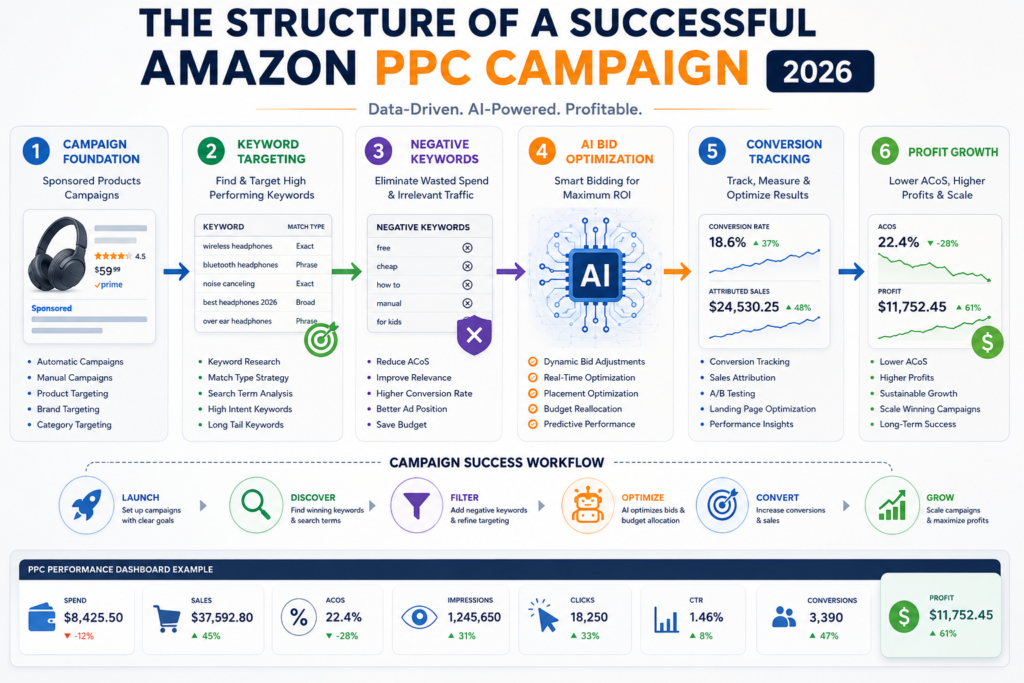
In this guide, you’ll discover powerful, real-world Amazon advertising techniques that successful sellers are using to improve conversions, lower wasted ad spend, and scale profitable campaigns faster. From AI-powered bid optimization and keyword targeting to negative keyword strategies and advanced campaign structures, this article covers everything you need to stay ahead in the evolving ecommerce landscape.
According to Amazon Ads Official Website, optimized PPC campaigns can significantly improve product visibility and customer reach when managed correctly. If your ads are struggling to generate profitable results, this guide will help you fix the problem with proven, data-driven solutions that actually work in 2026.
Introduction
Amazon advertising has become more competitive than ever before. In 2026, simply launching a Sponsored Products campaign and increasing bids is no longer enough to generate profitable sales. Thousands of sellers are entering the marketplace every day, which means advertising costs continue to rise while conversion rates become harder to maintain. This is exactly why many brands struggle to survive despite spending heavily on ads.
One of the biggest reasons most campaigns fail is poor optimization. Sellers often target broad keywords, ignore negative keywords, use weak product listings, or rely on outdated bidding strategies that no longer work with Amazon’s AI-driven advertising system. As a result, they experience rising ACOS, wasted clicks, low ROI, and shrinking profit margins. Understanding modern Amazon PPC Optimization Strategies 2026 is now essential for staying competitive and scaling successfully.
Another major challenge is the new reality of Amazon advertising costs. Cost-per-click prices have increased across nearly every category, especially in competitive niches like electronics, beauty, home décor, and fitness products. According to Amazon Ads Official Platform, advertisers are increasingly using automation, audience targeting, and AI-powered bidding to improve campaign efficiency and maximize visibility.
In this guide, you’ll learn practical, data-driven PPC strategies that actually work in 2026. We’ll cover keyword research, bid optimization, campaign structures, negative keyword tactics, AI automation tools, and conversion-focused listing improvements that help reduce wasted ad spend while increasing profitability. You’ll also discover how successful ecommerce brands are scaling Amazon campaigns using smarter advertising systems instead of blindly increasing budgets.
You can also read our related guide on Amazon SEO Checklist for Beginners to improve your organic rankings alongside PPC performance.
The Hidden Truth About Amazon PPC in 2026
Amazon advertising has changed dramatically over the last few years, and many sellers are struggling to keep up with the platform’s AI-driven ecosystem. In 2026, simply running automatic campaigns or increasing bids is no longer enough to generate profitable results. Amazon’s advertising algorithm has become smarter, more competitive, and heavily focused on customer behavior signals, making Amazon PPC Optimization Strategies 2026 more important than ever before.
How Amazon’s AI Advertising System Has Changed
Amazon now uses advanced machine learning and predictive AI to determine which products deserve more visibility. The platform analyzes shopper intent, click behavior, conversion history, product relevance, and even customer retention patterns before deciding which ads appear at the top of search results.
This means sellers who optimize their listings, target the right keywords, and maintain strong conversion rates are rewarded with lower advertising costs and better placements. According to Amazon Ads Official Guide, ad relevance and customer engagement now play a major role in campaign performance.
Why Old PPC Strategies No Longer Work
Many outdated PPC methods that worked in 2022 or 2023 are now destroying seller profits. Aggressive broad-match targeting, poor campaign structures, and “set it and forget it” bidding strategies often lead to wasted ad spend and rising ACOS.
In today’s marketplace, successful sellers focus on:
- Data-driven keyword optimization
- AI-assisted bid adjustments
- Negative keyword filtering
- Conversion-focused product listings
- Search term analysis
If you’re still relying on old advertising tactics, your campaigns may generate clicks without producing profitable sales. That’s why modern sellers are combining PPC optimization with strong Amazon SEO strategies. You can also read our internal guide on “Amazon SEO Checklist for Beginners” to improve organic rankings alongside paid advertising.
The Biggest Mistakes Killing Seller Profits
One of the most common mistakes sellers make is scaling campaigns too quickly without analyzing conversion data. Others ignore negative keywords, causing ads to appear for irrelevant searches that drain budgets fast.
Another major problem is poor listing optimization. Even the best PPC campaign will fail if your product images, title, pricing, and bullet points do not convince shoppers to buy.
Understanding ACOS, TACoS, CTR, and Conversion Rate
To succeed with Amazon PPC Optimization Strategies 2026, sellers must understand the core advertising metrics:
- ACOS (Advertising Cost of Sales): Measures how much you spend on ads to generate sales.
- TACoS (Total Advertising Cost of Sales): Tracks ad spend compared to total revenue.
- CTR (Click-Through Rate): Shows how many people click your ad after seeing it.
- Conversion Rate: Measures how many clicks turn into actual purchases.
Monitoring these metrics regularly helps sellers identify weak campaigns, reduce wasted spending, and scale profitable keywords more effectively in 2026.
Powerful Amazon PPC Campaign Structures That Maximize ROI
Building the right campaign structure is one of the most important parts of successful Amazon PPC Optimization Strategies 2026. Many sellers fail because they throw all keywords and products into a single campaign without understanding how Amazon’s advertising algorithm works. A well-organized PPC structure improves targeting, lowers wasted ad spend, and increases long-term profitability.
Sponsored Products Campaign Setup
Sponsored Products ads remain the highest-converting ad type on Amazon because they target shoppers with strong buying intent. In 2026, top sellers are separating campaigns by keyword match type, product category, and profitability level. For example, keeping exact-match keywords in separate campaigns allows sellers to control bids more effectively and improve ROI.
Read also :- 5 Powerful AI Prompts to Analyze Competitor Products on Etsy and Amazon
Many advanced sellers also use “testing campaigns” to discover new keywords before moving winning search terms into high-budget scaling campaigns. This approach reduces risk while maximizing performance.
Sponsored Brands Strategy for Authority Building
Sponsored Brands ads are no longer just optional branding tools. They now play a major role in building trust and increasing click-through rates. These ads help sellers showcase multiple products, custom headlines, and storefront pages, making them powerful for brand recognition.
If you want to improve long-term customer loyalty, Sponsored Brands campaigns should focus on your best-selling products and highest-converting keywords. According to Amazon Ads Learning Console, strong brand-focused campaigns can improve overall product discovery and repeat customer engagement.
Sponsored Display Ads for Retargeting
One of the most underrated Amazon PPC tips 2026 is using Sponsored Display Ads for retargeting. These campaigns allow sellers to reconnect with shoppers who previously viewed products but didn’t purchase. Retargeting helps recover lost traffic and improve conversion rates without relying entirely on new customer acquisition.
Top sellers often create separate retargeting campaigns for cart abandoners, competitor audiences, and repeat customers to maximize efficiency.
Single Keyword Ad Groups vs Multi Keyword Campaigns
Single Keyword Ad Groups (SKAGs) provide better bid control and cleaner data analysis. They are ideal for high-performing keywords with strong conversion history. On the other hand, multi-keyword campaigns work well for testing new search terms quickly.
A smart strategy is to start with broader multi-keyword campaigns, identify profitable search terms, and then move them into dedicated SKAG campaigns for aggressive scaling.
Campaign Segmentation Secrets Top Sellers Use
Successful Amazon sellers segment campaigns based on product performance, profit margins, keyword intent, and audience behavior. This allows them to optimize bids more precisely and avoid overspending on low-converting traffic.
For deeper ecommerce growth strategies, you can also read our internal guide on “Best AI Tools for Amazon Sellers” to learn how automation tools are transforming PPC management in 2026.
Smart Keyword Research Strategies That Drive Buyer Traffic
One of the biggest secrets behind successful Amazon advertising campaigns is smart keyword targeting. Without the right keywords, even the best products can fail to generate sales. In 2026, sellers using advanced Amazon PPC Optimization Strategies 2026 are focusing on buyer-intent keywords instead of chasing random high-volume search terms.
How to Find High-Converting Buyer Keywords
The best Amazon keywords are the ones buyers type right before making a purchase. These are known as high-converting commercial keywords. Instead of targeting broad phrases like “wireless headphones,” experienced sellers target more specific searches such as “wireless noise cancelling headphones for gym.” These keywords usually attract buyers who are ready to purchase immediately.
You can find profitable keywords by using Amazon autocomplete suggestions, analyzing competitor listings, and studying customer reviews. Search terms with strong buying intent often contain words like “best,” “premium,” “durable,” or “for beginners.”
Long-Tail Keywords That Cost Less and Convert More
Long-tail keywords are extremely powerful because they usually have lower competition and cheaper PPC costs. They also help improve conversion rates since they target highly specific customer needs. For example, “organic dog treats for small puppies” will often convert better than simply targeting “dog treats.”
Long-tail targeting is one of the most effective ways to reduce wasted ad spend while improving ROI. Many successful sellers use this strategy to lower ACOS and rank products faster.
Competitor Keyword Stealing Techniques
A smart way to discover profitable keywords is by analyzing competitor listings and ads. Tools like Helium 10 and Jungle Scout allow sellers to uncover competitor search terms, ranking keywords, and sponsored ad strategies.
Look at competitor product titles, bullet points, backend keywords, and sponsored placements to identify hidden opportunities. This technique helps you target proven keywords already generating sales in your niche.
Using Amazon Search Term Reports Effectively
Amazon Search Term Reports are one of the most valuable PPC optimization tools available. These reports show exactly which search queries generate clicks, conversions, and wasted spending. Sellers who regularly analyze search term reports can quickly pause poor-performing keywords and increase bids on profitable ones.
Reviewing these reports weekly is essential for long-term campaign growth and better profitability.
AI-Powered Keyword Research Tools for 2026
AI-driven keyword tools are changing Amazon advertising completely. Modern platforms now use predictive analytics and machine learning to identify trending keywords before competition increases. AI tools can also recommend bid adjustments, negative keywords, and profitable search terms automatically.
If you want to improve your advertising strategy further, check out our internal guide on “Best AI Tools for Amazon Sellers” to discover advanced automation tools that help scale ecommerce businesses faster.
By combining buyer-intent keywords, long-tail targeting, competitor research, and AI-powered optimization, sellers can create smarter campaigns that generate higher conversions and long-term Amazon growth in 2026.
Advanced Bid Optimization Tactics to Reduce ACOS Fast
One of the biggest challenges Amazon sellers faces in 2026 is controlling rising advertising costs while still generating profitable sales. This is where advanced bid optimization becomes a gamechanger. Smart bidding strategies can dramatically reduce wasted ad spend, improve conversions, and help sellers achieve a lower ACOS without sacrificing visibility. In fact, mastering these techniques is now a critical part of successful Amazon PPC Optimization Strategies 2026.
Manual Bidding vs Dynamic Bidding
Manual bidding gives sellers complete control over keyword bids, making it ideal for experienced advertisers who understand their conversion data. However, Amazon’s Dynamic Bidding feature uses AI to automatically increase or decrease bids based on the likelihood of a sale. For beginners, “Dynamic Bids – Down Only” is often the safest option because it reduces overspending on low-converting clicks.
According to Amazon Ads Campaign Bidding Guide, dynamic bidding can help improve campaign efficiency when optimized correctly.
Best Bid Adjustment Strategies for Beginners
New sellers often make the mistake of bidding aggressively on every keyword. Instead, start with moderate bids and gradually increase spending only on keywords that generate profitable conversions. Focus on high-intent buyer keywords rather than broad, expensive search terms. A smart rule is to increase bids by 10–15% only after consistent sales performance.
You should also monitor CTR (Click-Through Rate) and conversion rate weekly. If a keyword gets clicks but no sales, lower the bid immediately to protect your ad budget.
Dayparting Techniques to Stop Wasting Ad Spend
Dayparting is one of the most underrated Amazon PPC tactics in 2026. This strategy involves running ads during the hours when shoppers are most likely to purchase. Many sellers waste money overnight or during low-converting hours. By analyzing campaign reports, you can identify profitable time periods and reduce bids during weak traffic hours.
This simple optimization method helps lower ACOS while improving overall campaign efficiency.
Placement Bid Optimization Secrets
Amazon allows sellers to adjust bids for different placements such as “Top of Search” and “Product Pages.” Top-of-search placements often deliver the highest conversion rates, but they can also become expensive quickly. Instead of increasing all bids, focus only on keywords already producing strong sales.
For example, increasing top-of-search placement bids by 20–30% for winning keywords can significantly improve visibility without destroying profitability.
How to Scale Winning Keywords Without Losing Profit
Scaling Amazon PPC campaigns requires balance. Never double budgets overnight. Instead, gradually increase bids and budgets while closely tracking TACoS and profit margins. Many successful sellers scale only their top-performing keywords and pause weak search terms regularly.
You can also combine these bid optimization techniques with advanced listing optimization strategies discussed in our internal guide on “Amazon SEO Checklist for Beginners” to improve both organic rankings and ad performance simultaneously.
Using smart bid optimization is no longer optional. It is one of the most powerful ways to build profitable, long-term Amazon advertising campaigns in 2026.
The Ultimate Negative Keyword Strategy to Stop Bleeding Money
One of the biggest reasons Amazon sellers struggle with rising ACOS and low profits is poor negative keyword management. In 2026, Amazon’s advertising ecosystem has become more competitive and AI-driven than ever before. If you are not actively filtering irrelevant traffic, your campaigns can waste hundreds or even thousands of dollars every month on clicks that never convert. That’s why mastering negative keyword optimization is now a critical part of successful Amazon PPC Optimization Strategies 2026.
Why Negative Keywords Are Critical in 2026
Negative keywords help prevent your ads from appearing for irrelevant customer searches. Instead of paying for low-quality traffic, you focus your budget only on high-intent buyers who are more likely to purchase your product. This improves click-through rates, lowers wasted ad spend, and increases overall campaign profitability.
For example, if you sell premium leather office chairs, you may want to block terms like “cheap office chair,” “used chair,” or “gaming chair” because those shoppers are searching for different products. Without proper filtering, Amazon’s algorithm may continue spending your budget on irrelevant clicks.
According to Amazon Ads Official Guide, negative keywords help advertisers improve targeting precision and campaign efficiency.
Exact Negative vs Phrase Negative Keywords
Understanding the difference between exact and phrase negative keywords is extremely important.
- Exact Negative Keywords block only a specific search term exactly as entered.
- Phrase Negative Keywords block any search containing that phrase.
For tighter campaign control, many advanced sellers combine both match types to reduce unnecessary traffic while maintaining keyword reach.
Search Terms You Should Immediately Block
Some search terms often generate clicks but no sales. Common examples include:
- Free
- Cheap
- DIY
- Manual
- Used
- Replacement parts
- Competitor product categories unrelated to your listing
Blocking these terms early can dramatically improve your campaign ROI.
How to Find Wasteful Clicks Fast
The fastest way to identify wasteful traffic is by reviewing your Amazon Search Term Report weekly. Focus on keywords with:
- High clicks
- High spend
- Zero conversions
- Extremely high ACOS
These are usually the first candidates for negative keyword placement.
You can also combine this strategy with our internal guide on Amazon SEO and listing optimization to improve conversion quality and reduce wasted ad traffic even further.
Weekly Negative Keyword Optimization Workflow
Successful Amazon sellers treat PPC optimization as a weekly process, not a one-time setup. A simple workflow includes:
- Download Search Term Reports
- Identify non-converting keywords
- Add irrelevant terms as negatives
- Increase bids on profitable keywords
- Monitor ACOS and CTR changes
By following this process consistently, sellers can build smarter campaigns that generate higher profits with lower advertising waste. In today’s competitive marketplace, negative keyword optimization is no longer optional — it’s essential for long-term Amazon PPC success.
High-Converting Product Listing Optimization for Better PPC Results
One of the biggest reasons Amazon ads fail in 2026 is poor product listing optimization. Many sellers focus heavily on bidding strategies and keywords but completely ignore the customer experience after the click. Even the best PPC campaign cannot generate profitable sales if your product page fails to build trust, create emotional connection, or clearly explain product benefits. That’s why successful sellers combine strong advertising with high-converting listings as part of their complete Amazon PPC Optimization Strategies 2026 plan.
Why PPC Fails Without Listing Optimization
When shoppers click your ad, Amazon tracks how they interact with your listing. If your conversion rate is low, Amazon increases your advertising costs because the algorithm sees your product as less relevant. This leads to higher ACOS, lower impressions, and wasted ad spend. A poorly optimized listing can destroy even a perfectly targeted PPC campaign.
To improve performance, your listing must instantly answer customer questions, highlight benefits, and create buying confidence. Sellers who optimize listings properly often see better rankings, lower CPC, and stronger organic visibility.
Writing Emotion-Driven Product Titles
Your title should do more than describe the product. It should trigger emotions and solve problems. Instead of simply listing features, focus on customer outcomes and benefits. Use powerful words like “Premium,” “Advanced,” “Professional,” “Fast,” or “Ultimate” to make your product stand out in crowded search results.
For example, instead of writing:
“Wireless Earbuds Bluetooth 5.3”
You could write:
“Premium Wireless Earbuds with Deep Bass & 40-Hour Battery for Workouts and Travel”
This approach improves click-through rates and supports better Amazon advertising performance.
Bullet Point Strategies That Increase Conversions
Your bullet points should focus on solving customer pain points. Each bullet should explain one key benefit clearly and quickly. Use short sentences, emotional triggers, and easy-to-read formatting.
Effective bullet points often include:
- Problem-solving benefits
- Product durability
- Time-saving advantages
- Comfort and usability
- Warranty or trust-building elements
Remember, customers scan listings quickly. Clear and persuasive bullet points can dramatically improve conversion rates.
Product Image Optimization Tips
Images are often more important than keywords in Amazon conversions. High-quality product photos improve trust and increase sales from PPC traffic. Use clean white-background main images, lifestyle photos, infographics, comparison charts, and zoomed-in feature visuals.
According to Amazon Ads Creative Guidelines, optimized product images can significantly improve shopper engagement and ad performance.
A+ Content Tricks That Improve Ad Performance
A+ Content helps increase buyer confidence by using premium visuals, comparison tables, storytelling, and branded content. It can reduce customer hesitation and improve conversion rates from sponsored ads.
You can also strengthen your overall ecommerce growth strategy by linking this section internally to articles like “Best AI Tools for Amazon Sellers” or “Amazon SEO Checklist for Beginners” to keep readers engaged longer on your website.
AI-Powered Amazon PPC Optimization Strategies That Actually Work
Artificial intelligence is transforming the way sellers manage Amazon advertising campaigns. In 2026, relying only on manual optimization is no longer enough to stay competitive. Successful brands are now using advanced automation, predictive analytics, and AI-driven software to improve ad performance, lower ACOS, and increase long-term profitability. That’s why modern Amazon PPC Optimization Strategies 2026 focus heavily on combining human decision-making with AI-powered tools.
One of the biggest advantages of AI is speed. Manual keyword analysis and bid adjustments can take hours every week, especially for sellers managing hundreds of products. Tools like Helium 10, Jungle Scout, and Perpetua help automate keyword discovery, competitor analysis, and campaign optimization. These platforms use machine learning to identify profitable search terms and recommend smarter bidding strategies based on real-time market data.
Automation rules are another game-changing strategy for Amazon sellers. Instead of manually monitoring campaigns every day, sellers can create rules that automatically increase bids for high-converting keywords or pause ads with poor performance. This not only saves time but also reduces emotional decision-making that often leads to wasted ad spend. Many top-performing Amazon brands now use automation to manage large-scale PPC campaigns more efficiently.
AI bid optimization is especially powerful in competitive niches. Advanced software can analyze click-through rates, conversion rates, customer behavior, and historical campaign performance to predict which keywords are most likely to generate profitable sales. This process helps sellers reduce wasted clicks while improving return on ad spend (ROAS). Predictive analytics also allows businesses to scale campaigns strategically instead of blindly increasing budgets.
However, the smartest Amazon sellers do not depend entirely on automation. They combine AI tools with human creativity and strategic thinking. AI can analyze data quickly, but human expertise is still necessary for branding, customer psychology, seasonal trends, and product positioning. The most profitable sellers use AI to handle repetitive tasks while focusing their own time on business growth and marketing strategy.
If you want to improve your ecommerce growth even further, check out our internal guide on “Best AI Tools for Amazon Sellers” and “Ecommerce Automation Strategies” to discover additional techniques for scaling your online business faster. According to Amazon Ads, advertisers using data-driven optimization techniques often achieve stronger campaign efficiency and better long-term visibility on the platform.
Proven Scaling Strategies to Explode Amazon Sales Profitably
Scaling Amazon ads successfully in 2026 requires more than simply increasing your daily budget. Many sellers make the costly mistake of scaling too aggressively, which often leads to rising ACOS, wasted clicks, and declining profits. The smartest brands focus on sustainable growth using data-driven Amazon PPC Optimization Strategies 2026 that improve both visibility and long-term profitability.
When to Increase Your PPC Budget
You should only increase your Amazon PPC budget when your campaigns show consistent profitability for at least 7–14 days. Key indicators include stable conversion rates, profitable ACOS, strong click-through rates, and growing organic rankings. Instead of doubling budgets overnight, increase spending gradually by 10–20% every few days. This allows Amazon’s algorithm to adjust without destabilizing campaign performance.
A smart scaling strategy also involves reinvesting profits into top-performing campaigns rather than spreading the budget across weak keywords. If you are still learning campaign optimization, check out our internal guide on Amazon SEO Checklist for Beginners to build a stronger foundation before scaling aggressively.
How to Scale Without Destroying ROI
One of the best Amazon PPC tips 2026 is to scale winning keywords individually instead of increasing the budget across an entire campaign. High-performing keywords should be isolated into dedicated campaigns with optimized bids and placements. This gives you better control over performance metrics and helps protect your return on investment.
Using automated bidding tools and AI-based optimization platforms can also improve scaling efficiency. According to Amazon Ads Learning Console, advertisers who continuously optimize keyword targeting and bidding strategies often achieve stronger long-term advertising performance.
Expanding Into International Amazon Marketplaces
International expansion has become one of the most powerful growth opportunities for Amazon sellers. Platforms like Amazon UK, Canada, Germany, and Australia now offer lower competition compared to the US marketplace. Sellers using advanced Amazon PPC Optimization Strategies 2026 are increasingly diversifying globally to reduce dependence on one market.
Read Also- The Real Reasons New Amazon Sellers Fail in the First 90 Days – Prompts For Sellers
Before launching internationally, optimize your product listings with localized keywords and region-specific buyer intent. Even small PPC campaigns in international marketplaces can unlock profitable traffic with lower advertising costs.
Retargeting Strategies That Recover Lost Buyers
Most shoppers don’t purchase during their first visit. That’s why retargeting campaigns are critical for recovering lost traffic and increasing conversions. Sponsored Display ads allow sellers to reconnect with shoppers who viewed products but did not complete a purchase.
Retargeting works especially well when combined with discounts, improved product images, and persuasive copy. This strategy helps increase conversion rates while lowering customer acquisition costs over time.
Portfolio-Level PPC Optimization Techniques
Top Amazon brands no longer manage campaigns individually. Instead, they organize campaigns into portfolios based on product categories, profit margins, or business goals. Portfolio-level optimization makes it easier to monitor overall ad spend, identify weak campaigns, and scale profitable products faster.
Advanced sellers also use AI-powered analytics tools to track TACoS trends, keyword profitability, and portfolio performance in real time. These insights help businesses make smarter scaling decisions while maintaining strong ROI and sustainable growth.
Common Amazon PPC Problems and Powerful Solutions
Even experienced sellers struggle with Amazon advertising because PPC campaigns constantly evolve. In 2026, increasing competition and AI-driven ad systems make optimization more important than ever. Understanding the most common PPC issues can help sellers improve performance faster and avoid wasting money. These Amazon PPC Optimization Strategies 2026 are designed to solve the biggest problems hurting seller profits today.
High Clicks but No Sales
One of the most frustrating Amazon PPC problems is getting plenty of clicks but very few conversions. This usually happens when your product listing is weak or your keywords are poorly targeted. If shoppers click your ad but don’t buy, Amazon sees your product as less relevant, which can eventually increase advertising costs.
To solve this issue, optimize your product title, images, bullet points, and pricing. Focus on buyer-intent keywords instead of broad traffic keywords. You should also test A+ Content and improve social proof through reviews. For deeper listing optimization tips, read our guide on “Amazon SEO Checklist for Beginners.”
Rising ACOS and Falling Profits
A rising ACOS (Advertising Cost of Sales) is a warning sign that your campaigns are becoming inefficient. Many sellers continue increasing bids without analyzing conversion data, which leads to lower profits.
A powerful solution is to regularly remove underperforming keywords and lower bids on expensive search terms that fail to convert. Using negative keywords can dramatically reduce wasted ad spend. According to Amazon Ads Learning Console, improving keyword relevance and conversion rates can help reduce ACOS over time.
Low Impressions on Good Products
Sometimes great products receive very low visibility because bids are too low or campaigns are poorly structured. In many cases, sellers target highly competitive keywords where new products struggle to rank.
To increase impressions, use long-tail keywords with lower competition and create separate campaigns for exact match and phrase match targeting. Sponsored Products campaigns are especially effective for improving discoverability in competitive categories.
Expensive Keywords With Poor Conversion
Not every high-volume keyword is profitable. Many sellers waste huge budgets targeting broad keywords simply because they have a large search volume. However, traffic without conversions destroys ROI.
Instead, focus on search terms that generate actual sales. Analyze your search term reports weekly and pause expensive keywords with low conversion rates. AI-powered PPC tools can also help identify profitable buyer-intent keywords faster.
Campaigns Spending Budget Too Quickly
If your daily budget disappears within hours, your bids may be too aggressive or your targeting may be too broad. This problem often prevents ads from running during peak conversion times.
To fix this, use dayparting strategies, lower bids on weak placements, and prioritize top-performing campaigns. Smart sellers also separate testing campaigns from scaling campaigns to maintain better budget control.
Mastering these problem-solving techniques is essential for successful Amazon PPC Optimization Strategies 2026 and long-term ecommerce growth.
Future-Proof Amazon PPC Strategies for Long-Term Growth
Amazon advertising is evolving faster than ever, and sellers who fail to adapt will struggle to stay profitable in the coming years. In 2026, successful sellers are no longer relying on outdated bidding tricks or random keyword stuffing. Instead, they are focusing on smarter, data-driven Amazon PPC Optimization Strategies 2026 that combine automation, AI technology, and long-term brand building.
One of the biggest upcoming Amazon advertising trends is the rise of AI-powered shopping experiences. Amazon’s algorithm is becoming increasingly intelligent at understanding buyer behavior, purchase intent, and voice-based search patterns. As more shoppers use Alexa and mobile voice assistants to search for products, sellers must optimize listings for conversational keywords and natural-language search phrases. This means targeting longer, buyer-focused search terms instead of relying only on short competitive keywords.
Another major shift is ecommerce automation. Modern Amazon sellers are now using advanced automation tools to optimize bids, pause underperforming keywords, monitor competitor activity, and scale profitable campaigns automatically. These systems help reduce wasted ad spend while improving campaign efficiency. According to Amazon Ads Official Website, advertisers using data-driven optimization strategies often achieve stronger visibility and better conversion performance over time.
Building a sustainable Amazon brand in 2026 also requires more than just PPC advertising. Sellers need high-converting product pages, strong customer reviews, premium product images, and consistent branding across every listing. Amazon now rewards brands that provide better customer experiences and higher engagement metrics. If your listing quality is weak, even the best PPC campaigns may struggle to generate profitable results.
For long-term success, focus on balancing profitability with scalability. Instead of chasing only aggressive sales growth, smart sellers track TACoS, customer lifetime value, repeat buyers, and organic ranking improvements. Combining PPC with SEO-driven listing optimization creates a powerful long-term strategy that continues generating traffic even when advertising costs increase.
If you want to improve your overall ecommerce strategy, you can also read our internal guide on “Best AI Tools for Amazon Sellers” and “Amazon SEO Checklist for Beginners” to strengthen both your paid and organic traffic systems.
The final expert recommendation is simple: treat Amazon PPC as a long-term business investment rather than a quick sales hack. The sellers who continuously test campaigns, adopt automation, optimize for AI-driven search, and focus on brand trust will dominate Amazon in 2026 and beyond.
FAQ Section
How much should beginners spend on Amazon PPC in 2026?
Beginners should typically start with a daily Amazon PPC budget between $10 and $30 per product, depending on product competition and profit margins. The goal during the first few weeks is data collection rather than immediate profitability. Smart sellers using Amazon PPC Optimization Strategies 2026 focus on identifying high-converting keywords and eliminating wasted ad spend early.
What is a good ACOS for Amazon sellers?
A “good” ACOS depends on your business goals and profit margins. For many sellers, an ACOS between 15% and 30% is considered healthy. However, newer brands may temporarily accept a higher ACOS to improve rankings and gain visibility. Long-term success comes from balancing ACOS with total revenue growth and TACoS performance.
Which Amazon ad type performs best?
Sponsored Products usually perform best for most Amazon sellers because they target high-intent shoppers directly inside search results. However, Sponsored Brands and Sponsored Display campaigns can dramatically improve brand awareness and retargeting performance when combined strategically.
Are AI tools worth using for Amazon PPC?
Yes, AI tools are becoming essential in 2026. Advanced automation tools help sellers optimize bids, discover profitable keywords, and reduce manual work. Popular platforms like Helium 10 and Amazon’s own advertising dashboard provide powerful analytics for campaign optimization.
How often should PPC campaigns be optimized?
Most successful sellers optimize campaigns at least once or twice weekly. High-budget campaigns may require daily monitoring to adjust bids, pause underperforming keywords, and improve targeting efficiency. Consistent optimization is one of the most important Amazon PPC Optimization Strategies 2026 for maintaining profitability.
Can small sellers compete with big brands using PPC?
Absolutely. Small sellers often outperform larger brands by targeting long-tail keywords, optimizing listings better, and focusing on niche audiences. Smart keyword targeting and strategic bidding can help smaller businesses achieve impressive ROI without massive budgets.
What is the fastest way to reduce wasted ad spend?
The fastest way is to aggressively use negative keywords and pause non-converting search terms. Sellers should regularly analyze search term reports to identify irrelevant clicks that waste advertising budgets. Better listing optimization also improves conversion rates and lowers unnecessary spending.
How long does Amazon PPC take to show results?
Most campaigns begin generating useful performance data within 7–14 days. However, profitable scaling often takes 30–90 days of continuous optimization. Patience, testing, and data analysis are critical for long-term success with Amazon advertising.
For more ecommerce growth strategies, check out our internal guide on:
➡️ Best SEO Tips for Beginners: Complete Step-by-Step Guide for Higher Rankings – Prompts For Sellers