
Most eCommerce sellers struggle not because of bad products, but because they don’t understand their competitors. Top sellers on Etsy and Amazon constantly analyze competitor listings, pricing strategies, and customer reviews to stay ahead. This is where AI prompts to analyze competitor products can give you a huge advantage. By using the right AI prompts to analyze competitor products, you can uncover hidden insights, identify winning strategies, and improve your own listings quickly.
🚀 Competitor research brings traffic… but conversions make money. Learn how to turn visitors into buyers with AI prompts for Shopify product descriptions.
📖 Introduction
Competitor analysis is one of the most powerful strategies in eCommerce. Whether you’re selling on Etsy or Amazon, understanding what works for top sellers can help you optimize your listings and increase conversions.
However, manual research takes time and effort. With the help of AI prompts to analyze competitor products, you can automate this process and get valuable insights within minutes.
In this guide, you’ll discover 5 high-impact AI prompts to analyze competitor products that help you improve your product listings, pricing, and marketing strategy.
🔥 5 AI Prompts to Analyze Competitor Products
- 1. Competitor Product Breakdown Prompt
Understanding a competitor’s product in detail is the first step toward improving your own listing. Many sellers only look at the product title and price, but deeper analysis reveals what truly drives conversions. Using AI prompts to analyze competitor products, you can break down every important element of a competitor’s listing.
This includes analyzing product features, benefits, target audience, pricing strategy, and overall positioning. By doing this, you can identify what makes the product successful and apply those insights to your own listings.
AI Prompt
“Act as an eCommerce expert. Analyze this competitor product: [paste product link or details]. Break down its features, benefits, pricing strategy, target audience, and unique selling points. Explain why this product is successful and what makes it attractive to customers.”
- 2. Customer Review Analysis Prompt
Customer reviews are a goldmine of insights. They reveal what customers love, what they dislike, and what improvements they expect. Many successful sellers use AI prompts to analyze competitor products to extract valuable insights from reviews.
By analyzing reviews, you can identify common complaints and improve your product accordingly. You can also discover features that customers value the most, which can help you highlight those benefits in your listing.
AI Prompt
“Analyze the customer reviews of this product: [paste reviews]. Identify common positive points, negative feedback, and customer expectations. Suggest how to improve the product based on these insights.”
Smart sellers don’t just analyze competitors—they also optimize their content. Learn how to improve your blog SEO using AI prompts for blog optimization.
- 3. Pricing Strategy Analysis Prompt
Pricing plays a crucial role in conversions. Setting the right price can significantly impact your sales. Using AI prompts to analyze competitor products, you can understand how competitors price their products and why.
This includes analyzing whether they use premium pricing, discount strategies, or bundle offers. You can also identify patterns in pricing across similar products and adjust your pricing accordingly.
AI Prompt
“Analyze the pricing strategy of this competitor product. Compare it with similar products and explain whether it uses premium, competitive, or discount pricing. Suggest the best pricing strategy for a new seller.”
- 4. Keyword & SEO Analysis Prompt
Keywords determine whether your product appears in search results. By analyzing competitor keywords, you can discover what is driving traffic to their listings. Many sellers use AI prompts to analyze competitor products to identify high-performing keywords.
This includes analyzing product titles, descriptions, tags (Etsy), and bullet points (Amazon). You can then use these keywords to optimize your own listing.
Many successful sellers study top listings on Etsy to understand what products are trending and how they are positioned.
AI Prompt
“Analyze this competitor product listing and extract important keywords used in the title, description, and tags. Suggest high-ranking keywords that can improve visibility.”
- 5. Conversion Optimization Prompt
Even if your product gets traffic, it won’t sell without proper optimization. Conversion optimization focuses on improving elements that influence buying decisions. Using AI prompts to analyze competitor products, you can identify what makes a listing convert.
This includes analyzing images, descriptions, reviews, and CTAs. By understanding these elements, you can create a more persuasive listing.
AI Prompt
“Analyze this product listing and identify factors that improve conversion rates. Suggest improvements in images, descriptions, and call-to-action to increase sales.”
⚠️ Common Mistakes Sellers Make When Using AI Prompts to Analyze Competitor Products
Many sellers start using AI prompts to analyze competitor products, but they don’t get results because they use them incorrectly. Avoid these mistakes if you want real growth.
- 1. Copying Competitors Instead of Learning From Them
The biggest mistake is blindly copying competitor listings. Just because something works for them doesn’t mean it will work for you. Every product has a different audience, positioning, and brand voice. When using AI prompts to analyze competitor products, your goal should be to understand the strategy, not copy it.
👉 Fix:
Use insights to create a better and more unique version of your listing.
- 2. Ignoring Customer Reviews (Huge Mistake)
Customer reviews are the most valuable data source, yet many sellers ignore them. Reviews reveal real customer problems, expectations, and emotions. If you skip this step, you miss critical insights.
👉 Fix:
Always analyze at least 20–50 reviews using AI prompts to identify patterns.
- 3. Focusing Only on Price
Many sellers think lowering price will increase sales. But pricing is not just about being cheaper—it’s about perceived value. High-performing products often sell at premium prices because they offer better positioning.
👉 Fix:
Use AI prompts to analyze competitor products to understand value, not just price.
- 4. Not Using Keywords Properly
Even if your product is great, poor keyword usage can make it invisible. Many sellers don’t analyze competitor keywords deeply enough.
👉 Fix:
Extract keywords from titles, tags, and descriptions, and optimize your listing strategically.
- 5. Using AI Without Strategy
AI is a tool, not a solution. If you use it randomly, you will get random results. Many beginners generate insights but don’t apply them properly.
👉 Fix:
Use a structured approach:
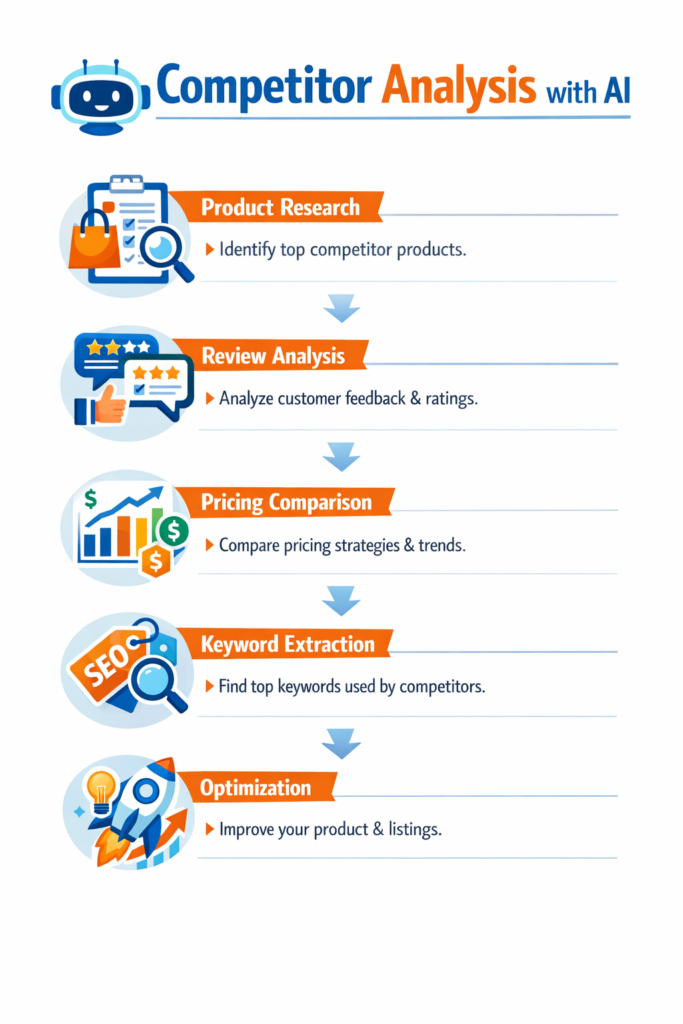
- Analyze competitors
- Extract insights
- Apply improvements
- Test results
🚀 Advanced Tips to Dominate Competitor Analysis Using AI
To truly benefit from AI prompts to analyze competitor products, you need to go beyond basic analysis. Here are advanced strategies used by top sellers.
1. Analyze Multiple Competitors (Not Just One)
Never rely on a single competitor. Instead, analyze 5–10 top listings to identify patterns.
👉 Look for:
- Common keywords
- Repeated benefits
- Pricing ranges
This gives you a data-backed strategy, not assumptions
Top sellers don’t just sell products—they solve problems. Reviews often reveal hidden pain points that competitors are not addressing fully.
👉 Example:
If customers complain about durability, you can position your product as “extra durable.”
Using AI prompts to analyze competitor products, you can uncover these insights quickly.
3. Create a Better Value Proposition
Instead of competing on price, compete on value.
👉 Improve:
- Packaging
- Features
- Presentation
- Messaging
AI helps you identify what competitors are missing so you can stand out.
4. Reverse Engineer Best-Selling Listings
Break down successful listings into components:
- Title
- Images
- Description
- Reviews
Then improve each element.
👉 This is one of the most powerful ways to scale using AI prompts to analyze competitor products.
5. Combine AI Insights with Testing
Analysis alone is not enough. You must test your improvements.
👉 Test:
- Titles
- Images
- Pricing
- Descriptions
AI gives direction, but testing gives results
6. Use AI for Continuous Optimization
Competitor analysis is not a one-time task. Markets change, trends evolve, and new competitors emerge.
👉 Regularly:
- Re-analyze competitors
- Update listings
- Improve content
This keeps your store competitive.
📌 Conclusion
Understanding your competitors is one of the fastest ways to improve your eCommerce business. Instead of guessing what works, you can learn directly from top-performing listings. By using AI prompts to analyze competitor products, you can uncover valuable insights about pricing, keywords, customer preferences, and conversion strategies.
However, the real advantage comes from applying these insights strategically. Don’t just copy—improve. Don’t just analyze—test. When you combine AI-powered analysis with smart execution, you can create listings that not only attract traffic but also convert visitors into buyers.If you want to grow faster in 2026, start using AI prompts to analyze competitor products today and build a data-driven strategy that gives you a competitive edge.
FAQ
1. What are AI prompts to analyze competitor products?
AI prompts are structured instructions that help analyze competitor listings, reviews, and pricing using AI tools.
2. Can AI help in Etsy and Amazon competitor research?
Yes, AI can quickly analyze listings, reviews, and keywords to provide actionable insights.
3. How many competitors should I analyze?
At least 5–10 competitors for accurate insights.
4. Do AI prompts improve sales?
Yes, they help optimize listings, pricing, and keywords, which increases conversions.
5. What is the biggest mistake in competitor analysis?
Copying competitors instead of improving their strategy.
6. How often should I analyze competitors?
At least once every 2–4 weeks to stay competitive.