
You can have a genuinely useful digital product, a polished sales page, and a reasonable price—and still struggle to make sales. The problem may not be your product at all. Digital product positioning can determine whether a potential customer immediately thinks, “This is exactly what I need,” or simply moves on to the next offer.
That’s where many creators get stuck. They add more features, lower their prices, redesign their graphics, or try another marketing channel. But if the product feels too broad, sounds like everything else, or fails to make its value obvious, more traffic rarely fixes the real problem. You may be attracting people who are interested but giving them no compelling reason to choose your product.
The good news is that effective positioning doesn’t require reinventing your product. A few strategic changes in how you define the customer, frame the problem, communicate the outcome, and differentiate a digital product can completely change how your offer is perceived. And when your positioning is clear, your digital product value proposition becomes much easier to communicate across your sales page, content, email, and other marketing.
So, how to position a digital product without making the process complicated? Let’s break down the simple strategy that can help your product become clearer, more relevant, and much easier for the right customer to say yes to.
What Digital Product Positioning Really Means for Etsy Sellers
Digital product positioning is the way you deliberately define who your product is for, what problem it solves, what outcome it delivers, and why someone should choose it over similar options. On Etsy, that matters because shoppers rarely spend much time trying to figure out what makes one digital download different from dozens of others.
Imagine two listings selling nearly identical wedding planners. One says, “Printable Wedding Planner PDF — 85 Pages.” The other says, “The Stress-Free Wedding Planner for Busy Couples — Organize Vendors, Budget, Timeline, and Guest Details in One Place.” The products may contain many of the same pages, but the second listing gives the buyer a clearer reason to care.
That difference is positioning.
Digital Product Positioning vs. Product Features, Pricing, and Marketing
It is easy to confuse positioning with the things surrounding your product. They are connected, but they are not the same.
| Element | What it answers | Example |
| Product | What are you selling? | Printable wedding planner |
| Features | What does it include? | Budget tracker, checklist, timeline |
| Pricing | What does the buyer pay? | $12.99 |
| Marketing | How do people discover it? | Etsy SEO, Pinterest, email |
| Positioning | Why is this the right product for this buyer? | A simple planner for busy couples who want one place to manage their wedding |
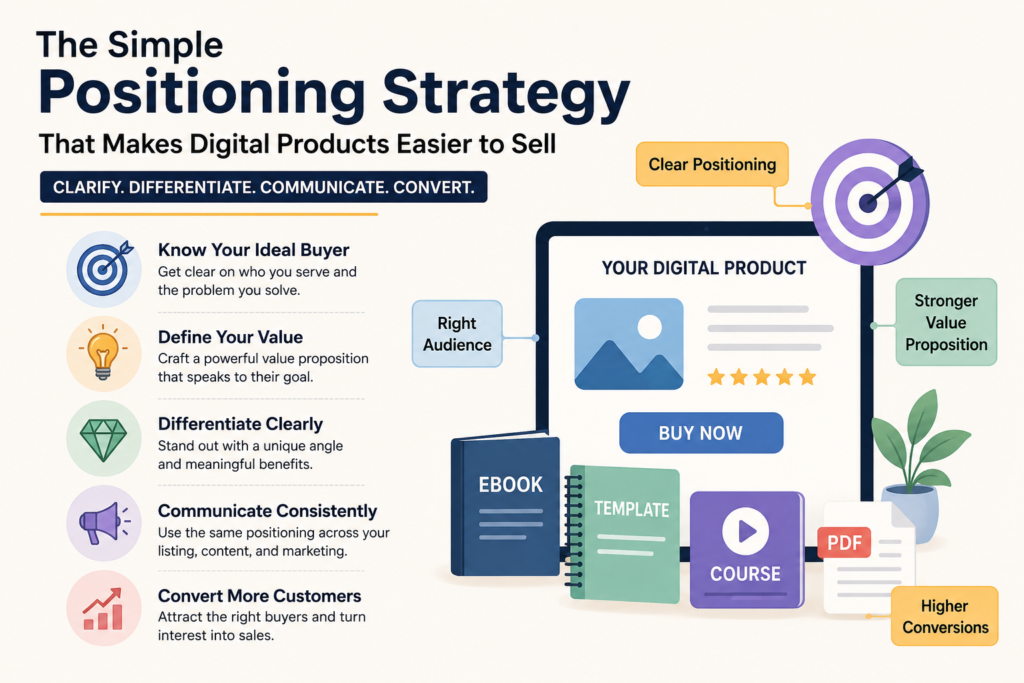
The distinction is important because adding more features does not automatically create more value.
A seller might notice weak sales and respond by adding 20 more templates. But if buyers already struggle to understand who the original product is designed for, additional pages can make the offer feel more complicated—not more desirable.
Positioning works at a different level. It shapes the perception of the product before the customer evaluates all its individual features.
For example, consider a digital meal-planning product.
- “30-Day Meal Planner” is broad.
- “30-Day Meal Planner for Busy Working Moms” is more specific.
- “30-Day Budget Meal Planner for Busy Families Trying to Cut Grocery Costs” is even more focused.
The product itself may not change. The audience, problem, and promised outcome become clearer.
That clarity is especially valuable when you’re competing in a crowded Etsy category.
And if you’re trying to make your product feel more valuable without simply adding more pages or lowering the price, it helps to understand the broader principles behind perceived value. Our guide on digital product value and the small changes that can make an offer feel more valuable can help you build that foundation.
Why Good Etsy Products Still Struggle to Get Sales
A useful product can still struggle because being useful and being easy to choose are two different things.
An Etsy shopper may see your listing and think:
“This looks nice, but is it actually for me?”
That question is where weak positioning can become a conversion problem.
Some common warning signs include:
- Your product targets almost everyone.
- Your title describes the file but not the buyer’s goal.
- Your description focuses heavily on features.
- Your listing looks similar to competing products.
- Your main image doesn’t communicate the product’s specific benefit.
- You are attracting views but very few purchases.
- You keep changing your price without understanding the real objection.
Suppose you sell a digital budget spreadsheet.
Your current positioning might be:
“Personal Budget Spreadsheet | Monthly Finance Tracker | Excel Budget Template.”
That’s understandable, but it doesn’t give the buyer much context about why this particular spreadsheet deserves their attention.
A stronger position could be:
“Simple Monthly Budget Spreadsheet for Couples Who Want to Stop Overspending and Build Savings Together.”
Now the product has a clearer audience, problem, and desired outcome.
This doesn’t mean every Etsy listing needs to become extremely narrow. The goal is to find the most commercially meaningful audience you can serve well.
A good positioning test is simple:
- Who is this specifically for?
- What problem are they trying to solve?
- What result do they want?
- What makes this product a better fit for that situation?
- Can a shopper understand those answers within a few seconds?
If you cannot answer those questions clearly, more traffic may not solve the problem.
In fact, sending additional visitors to an unclear offer can simply give you more people who leave without buying.
AI Prompt: Identify the Best Position for Your Digital Product
You can use an AI assistant such as Chat GPT, Gemini, or Claude as a positioning partner. The goal isn’t to let AI invent a random marketing angle. Give it the actual details of your product and ask it to identify positioning opportunities based on the buyer, problem, outcome, and competitive context.
Copy and customize this prompt:
Act as a digital product positioning strategist specializing in Etsy. Analyze my product and identify the strongest positioning opportunity.
Product name: [Product name]
Product type: [Template, planner, printable, spreadsheet, ebook, etc.]
Target audience: [Who you currently think will buy it]
Main problem it solves: [Problem]
Key features: [List the main features]
Desired customer outcome: [What the buyer wants to achieve]
Price: [Price]
Etsy niche/category: [Niche]
Main competing products: [Briefly describe 3–5 competitors]
Determine:
- The most specific profitable buyer this product could serve.
- The strongest problem or use case to position around.
- The most compelling customer outcome.
- Three meaningful ways to differentiate the product without adding unnecessary features.
- Three positioning statements using this structure: “For [specific buyer] who [problem], this [product] helps them [outcome] by [key advantage].”
- Which positioning angle is strongest and why.
- What messaging I should avoid because it is too generic.
Keep the recommendations practical for an Etsy seller. Do not invent product features or make unsupported claims.
Before changing your listing, compare the AI’s suggestions with actual customer language, competitor listings, reviews, and your own sales data. Positioning should clarify what is already valuable about your product—not manufacture a promise the product cannot deliver.
Once that position is clear, the next question becomes more important: How do you build that position around the right buyer instead of trying to appeal to everyone?
Why Digital Products Are Hard to Sell When the Position Is Unclear
A digital product can be useful, well-designed, and genuinely worth the price—and still fail to sell. One of the most common reasons is that the buyer cannot quickly understand who the product is for, what problem it solves, or why it is a better fit than the alternatives.
That is the hidden problem with weak digital product positioning. The product may be clear to its creator because they spent weeks building it. But customers do not have that background. They judge an offer in seconds, often while comparing several similar products at once. If your message feels broad or interchangeable, the buyer has little reason to stop and investigate further.
Too Broad: When Your Product Tries to Serve Everyone
Trying to appeal to everyone sounds like a smart way to increase sales. In practice, it often makes the product less compelling.
Imagine you sell a digital planner. Your listing says:
“A complete digital planner for anyone who wants to organize their life.”
It sounds useful, but it is difficult for a specific customer to feel that the product was made for them.
Now consider a narrower position:
“A simple digital weekly planner for busy freelance designers who need to manage client deadlines, revisions, and personal tasks in one place.”
The second offer is not necessarily a better product. It is simply more specific.
That specificity helps the right customer recognize themselves immediately. A freelance designer may think, “That’s exactly my problem.” Once that connection happens, the product becomes easier to evaluate.
A useful positioning test is to ask:
- Who is this product specifically designed for?
- What frustrating problem does that person already have?
- What result are they hoping to achieve?
- What makes this product particularly suitable for that situation?
- What alternative would they use if they did not buy it?
If you cannot answer those questions clearly, your positioning probably needs work.
This does not mean you should artificially restrict your audience. It means you should identify the primary buyer rather than writing your message for an imaginary audience of “everyone.”
There is also an important distinction between a product being broadly useful and being broadly positioned. A budgeting spreadsheet might help students, families, freelancers, and small-business owners. But its marketing can still lead with one specific use case. Once that core position attracts the right customer, the product can mention additional applications.
Feature-Focused Messaging vs. Customer-Focused Outcomes
Another reason digital products are hard to sell is that creators often describe what they built instead of what the customer gets from using it.
Consider a resume template with:
- 12 editable pages
- Multiple font combinations
- ATS-friendly formatting
- Cover letter templates
- Matching references page
- Microsoft Word and Google Docs versions
Those details matter. But they are features, not the main reason someone buys.
A job seeker is more interested in the outcome:
“Create a polished, professional resume faster without starting from a blank page.”
The difference is subtle but powerful. Features answer “What’s included?” Outcomes answer “Why should I care?”
Your product page should still explain the features, but the features should support a meaningful customer benefit.
| Feature | Customer-focused outcome |
| 50 Canva templates | Create professional content without designing from scratch |
| 30-page budget spreadsheet | See where your money is going and plan monthly spending faster |
| 100 social media prompts | Generate useful content ideas when you don’t know what to post |
| Editable meal planner | Plan weekly meals without rebuilding your schedule each week |
A strong digital product value proposition connects these two layers: what the customer receives and why receiving it matters.
If your product already has strong features but sales remain disappointing, resist the urge to add even more. First ask whether the existing value is being communicated clearly. You may find useful guidance in this breakdown of 21 small changes that can make digital products feel more valuable.
AI Prompt: Diagnose Why Your Digital Product Is Not Converting
If you are struggling to identify the positioning problem yourself, an AI assistant can help you audit the offer from a buyer’s perspective. The goal is not to ask AI to magically fix your sales. Instead, give it enough information to challenge your assumptions.
Copy and adapt this prompt:
Act as a digital product positioning and conversion strategist. Analyze my product as if you were a potential customer seeing it for the first time.
Product name: [name]
Target customer: [describe your ideal buyer]
Main problem it solves: [problem]
Desired customer outcome: [outcome]
Product features: [list features]
Current product description: [paste description]
Price: [price]
Main competitors or alternatives: [list them]
Identify:
- Who the product appears to be for.
- Who it should be positioned for instead, if different.
- The clearest problem it solves.
- The strongest customer outcome.
- Which features are distracting from the main value.
- What makes the offer sound generic or interchangeable.
- Three possible positioning angles.
- A concise value proposition for the strongest angle.
Be specific and critical. Do not recommend adding features unless the existing offer genuinely lacks something necessary for the target customer.
The most valuable part of this exercise is often the gap between what you intended to sell and what a new customer thinks you are selling. Once that gap becomes visible, figuring out how to position a digital product becomes much easier—and the next step is finding a position that gives your offer a meaningful reason to stand apart.
How to Position a Digital Product Around the Right Buyer
A digital product becomes easier to sell when the right buyer can recognize themselves in the offer almost immediately. That sounds simple, but many creators start from the product instead of the person buying it. They think, “I made a planner,” “I created a template bundle,” or “I sell an ebook.” The buyer, however, is not shopping for a file. They are shopping for a solution to a specific problem.
For an Etsy seller, that distinction matters. Two shops can sell nearly identical products and get very different results because one speaks directly to a specific buyer while the other tries to appeal to everyone.
Define the Specific Etsy Buyer You Want to Attract
The first step in digital product positioning is narrowing down who the product is really designed to help.
Avoid descriptions such as:
- “For small business owners”
- “For anyone who wants to get organized”
- “For Etsy sellers”
- “For entrepreneurs”
These audiences are too broad to create strong positioning. Instead, identify the buyer’s situation.
For example, instead of targeting “Etsy sellers,” you might target:
Beginner Etsy sellers who have products listed but struggle to find relevant keywords and get consistent search traffic.
Now the positioning becomes much clearer. You know what the buyer is trying to accomplish, what stage they’re in, and what problem your product needs to solve.
A useful buyer profile should answer five questions:
- Who are they?
Beginner Etsy seller, handmade business owner, digital-product creator, etc. - What are they trying to accomplish?
Increase visibility, create better listings, save time, organize their business, or generate more sales. - What is stopping them?
Limited SEO knowledge, lack of time, confusing tools, weak product messaging, or uncertainty about what buyers want. - What have they already tried?
Generic keyword advice, social media posts, templates, tutorials, or trial-and-error. - What would make them feel successful?
More qualified traffic, easier listing creation, better conversion rates, or less time spent figuring everything out themselves.
This level of specificity also helps with Etsy SEO because your product messaging can reflect the language your intended customer actually uses.
Identify the Problem, Desired Outcome, and Buying Motivation
Once you know who the buyer is, go one level deeper. What are they really buying?
Imagine an Etsy seller creates a 100-page Etsy SEO workbook. The obvious description might focus on the contents:
“100 pages of Etsy SEO worksheets, keyword exercises, checklists, and planning templates.”
That explains what the product contains, but it doesn’t explain why the buyer should care.
A stronger positioning approach connects three elements:
Problem → Desired outcome → Buying motivation
For the same product:
- Problem: “I don’t know which keywords to target.”
- Desired outcome: “I want to create listings that have a better chance of reaching relevant shoppers.”
- Buying motivation: “I want a simple system instead of spending hours guessing which keywords to use.”
Now the product has a reason to exist in the buyer’s mind.
This is also where your digital product value proposition becomes stronger. The goal isn’t to make exaggerated promises such as “Get thousands of Etsy sales overnight.” It’s to communicate a believable improvement that matters to the intended customer.
If you’re unsure whether your product communicates enough value, compare it against the principles in this guide on 21 Small Changes That Make Your Digital Products Feel Instantly More Valuable. The same principle applies here: perceived value increases when buyers clearly understand how the product connects to an important outcome.
A simple positioning worksheet can help:
| Question | Example |
| Who is it for? | Beginner Etsy sellers |
| What problem do they have? | They struggle to find useful keywords |
| What do they want? | More relevant Etsy search visibility |
| What frustrates them? | Confusing SEO advice and keyword research |
| What does your product provide? | A guided keyword research workflow |
| Why choose it? | It simplifies the process for beginners |
Notice what changed. The product itself did not need to change. The context around the product became clearer.
AI Prompt: Build a Customer-Focused Digital Product Positioning Statement
Once you’ve identified the buyer, problem, desired outcome, and motivation, use an AI assistant to turn those details into a positioning statement.
Paste this prompt into ChatGPT, Gemini, Claude, or another capable AI tool:
Act as a product positioning strategist for digital products sold on Etsy. Based on the information below, create a clear customer-focused positioning statement. Identify the specific target buyer, their primary problem, desired outcome, buying motivation, strongest product benefit, and most credible differentiator. Avoid generic marketing language and exaggerated claims. Then create 3 positioning statement options that clearly explain why this product is relevant to this specific buyer.
Product: [describe your product]
Target buyer: [describe the buyer]
Main problem: [describe the problem]
Desired outcome: [describe what they want]
What the product includes: [list the main components]
Why you created it: [explain the reason]
Competitors or alternatives: [describe them]
Don’t simply copy the AI’s first answer into your Etsy listing. Use it as a strategic starting point. Check whether the positioning sounds specific, believable, and useful to an actual buyer.
The best positioning statement should make the reader think, “This was made for someone in my exact situation.” Once you have that clarity, you can use it to shape your listing title, description, visuals, and broader digital product marketing strategy.
How to Differentiate a Digital Product in a Crowded Etsy Market
Standing out on Etsy does not necessarily mean creating something nobody else sells. In many categories, buyers are already surrounded by similar planners, templates, printables, spreadsheets, and digital downloads. The real opportunity is to make your product feel like the better fit for a specific buyer and a specific need.
That starts with understanding what competing sellers are promising, then finding an angle your product can own.
Analyze Competing Etsy Listings Without Copying Them
Before deciding how to differentiate a digital product, spend time studying the listings competing for the same customer. The goal is not to copy their keywords, descriptions, images, or offers. Instead, look for patterns.
Choose 5–10 competing products that appear relevant to your target buyer. Then examine:
| What to Analyze | What to Look For |
| Product title | Repeated promises, use cases, and buyer language |
| Product images | Features emphasized visually |
| Description | Problems, benefits, and outcomes sellers mention |
| Reviews | What customers praise, question, or wish were better |
| Pricing | Common price ranges and package sizes |
| Product format | PDF, Canva template, spreadsheet, Notion template, etc. |
| Target customer | Who the product appears designed for |
| Reviews and complaints | Gaps that competitors may not be addressing |
The reviews are particularly valuable because they reveal the customer’s language rather than the seller’s marketing language.
Imagine you sell a budgeting spreadsheet. Competitors may repeatedly describe their products as “easy,” “simple,” and “complete.” But after reading customer reviews, you might notice buyers repeatedly asking for something designed specifically for couples, freelancers, or people with irregular income.
That is a positioning opportunity.
You are no longer competing only on the spreadsheet itself. You can create a clearer reason for a particular customer to choose yours.
Look for three types of gaps:
- Audience gaps: A product category serves everyone but speaks directly to no one.
- Problem gaps: Competitors solve the broad problem but overlook a specific use case.
- Experience gaps: Products contain useful features but are difficult, confusing, or time-consuming to use.
This approach is especially useful for beginners because differentiation does not always require adding dozens of new features. Sometimes the strongest advantage comes from making the existing solution more relevant, easier to use, or better suited to a particular customer.
Find Your Product’s Most Meaningful Differentiator
Once you understand the competitive landscape, identify the one difference that matters most to your ideal buyer.
Not every difference is a differentiator.
“Includes 40 pages” is a feature.
“Includes editable templates” is a feature.
“Available as a PDF” is a feature.
A meaningful differentiator answers a more important question:
Why should this customer choose this product instead of the alternatives?
A useful way to find that answer is to compare your product across four dimensions:
- Who is it specifically for?
- What problem does it solve particularly well?
- What outcome does it help the buyer achieve?
- What makes the experience meaningfully different?
For example, imagine two Etsy sellers offering social media templates.
Seller A:
“100 Instagram Canva Templates for Small Businesses”
Seller B:
“30-Minute Social Media Kit for Solo Service Businesses — 50 Canva Templates With Ready-to-Use Content Prompts”
Both products may contain excellent templates. But Seller B has created a more specific position. The offer speaks to a particular customer, emphasizes speed, and connects the templates with the bigger problem of figuring out what to post.
That specificity can make the product easier to understand and easier to remember.
Your differentiator could come from:
- A narrower audience
- A specific use case
- A faster workflow
- A simpler format
- Better organization
- A unique bundle
- A specialized outcome
- Beginner-friendly instructions
- A particular customer problem
- A distinctive method or framework
Avoid manufacturing a difference simply to appear unique. The best differentiator is one customers actually care about.
If you need to strengthen the perceived value of the offer itself, you can also review these practical ideas for [making a digital product feel instantly more valuable] Digital Product Value: 21 Small Changes That Make Your Digital Products Feel Instantly More Valuable.
A simple test is to finish this sentence:
“This product is a better choice for ______ because ______.”
If you cannot fill in both blanks with a specific answer, your positioning probably needs more work.
AI Prompt: Discover Hidden Differentiation Opportunities in Your Etsy Niche
AI can help you organize competitor research, but it should not replace your judgment or real customer research. Give it actual listing information, customer-review patterns, and details about your own product rather than asking it to invent a competitive analysis.
Use this prompt:
Act as an Etsy product positioning strategist. I sell [PRODUCT] to [TARGET CUSTOMER]. My main competitors offer [DESCRIBE 3–5 COMPETING PRODUCTS]. Based on the information below, identify realistic differentiation opportunities without recommending misleading claims or copying competitors.
Analyze:
- Common promises competitors make
- Features they emphasize
- Customer problems they appear to address
- Gaps or underserved use cases
- Repeated customer complaints or requests
- Opportunities to narrow the target audience
Then provide:
- Five potential differentiation angles
- The customer problem each angle addresses
- Why the angle could matter to buyers
- The strongest positioning opportunity
- A one-sentence positioning statement
- Three ways to communicate that position in an Etsy listing
Important: Do not suggest copying competitor wording, designs, product concepts, or unique intellectual property. Focus on genuine customer value and meaningful differentiation.
My product details: [INSERT DETAILS]
Competitor research: [INSERT YOUR NOTES]
The output should give you several hypotheses to test—not a final answer to accept blindly. Compare those ideas with actual buyer behavior, reviews, questions, and sales data. The strongest positioning is usually the one that makes a real customer’s choice simpler, not merely the one that sounds most impressive.
Build a Strong Digital Product Value Proposition That Converts
A strong product does not automatically communicate its value. Buyers have to understand why the product matters to them, what problem it solves, and what changes after they buy it. That is where your value proposition becomes one of the most important parts of your digital product positioning.
Your value proposition is not simply a catchy sentence or a list of features. It is the bridge between what you created and what your customer actually wants. A useful value proposition answers a simple question from the buyer’s perspective: “Why should I choose this product instead of the other options available to me?”
For example, imagine you sell a digital budget planner.
A weak message might be:
“A 25-page digital budget planner with monthly worksheets, expense trackers, and savings pages.”
That tells the customer what is included, but not why they should care.
A stronger version might be:
“A simple digital budget planner for busy beginners who want to organize their monthly spending, find unnecessary expenses, and build a realistic savings habit.”
The second version connects the product to a specific customer, specific problem, and specific outcome. That difference can make an ordinary listing feel much more relevant.
Turn Product Features Into Clear Customer Benefits
One of the most common mistakes digital sellers make is confusing features with benefits.
Features describe what the customer receives. Benefits explain what those features help the customer accomplish.
| Product Feature | Customer Benefit |
| 30 editable Canva templates | Create professional-looking content without designing every post from scratch |
| Monthly financial worksheets | See where your money is going and plan upcoming expenses |
| 100 meal-planning recipes | Spend less time deciding what to cook each week |
| Printable wedding checklist | Keep important planning tasks organized in one place |
| Etsy SEO keyword guide | Find relevant search terms to improve listing visibility |
This distinction becomes especially important when you’re trying to figure out how to position a digital product.
Start by listing every major feature of your product. Then ask three questions for each one:
- What does this feature help the customer do?
- What problem does that solve?
- Why does solving that problem matter to this buyer?
Keep moving from the feature toward the real-life result.
For example:
Feature: 50 editable social media templates
↓
Benefit: Create content faster
↓
Problem solved: The customer doesn’t have to design every post from zero
↓
Outcome: They can maintain a consistent social presence while spending less time creating content.
That final outcome is usually far more persuasive than the original feature.
If you want to go deeper into the psychology of perceived value, you can also reference your existing guide on 21 small changes that make digital products feel instantly more valuable. The two concepts work together: positioning helps customers understand why your product is relevant, while perceived value helps them understand why it is worth paying for.
Connect Your Promise to a Specific Buyer Outcome
A compelling digital product value proposition should not promise everything. It should make one important promise to the right person.
Consider two versions of a productivity planner.
Version A:
“An all-in-one productivity planner designed to help you organize your life.”
Version B:
“A weekly digital planner for overwhelmed freelancers who need to prioritize client work, deadlines, and personal tasks without keeping everything in their head.”
Version B is narrower—but that is precisely why it can be stronger.
The first message could apply to almost anyone. The second gives a particular buyer a reason to recognize themselves in the offer.
This is also why how to differentiate a digital product is not simply a matter of adding more features. Your differentiation can come from the customer you serve, the problem you focus on, the outcome you emphasize, or the way you help the customer reach that outcome.
A useful positioning formula is:
For [specific customer] who [specific problem], my [product] helps them [desired outcome] through [distinctive approach or advantage].
For example:
“For first-time Etsy sellers who struggle to write search-friendly listings, this SEO template helps them organize keywords, product benefits, and buyer-focused copy before publishing.”
Notice what this does. It doesn’t claim the product will magically guarantee sales or reach the top of Etsy search. Instead, it makes the product’s role clear and connects it to a meaningful customer need.
Before finalizing your value proposition, run it through this quick test:
- Specific: Does it clearly identify who the product is for?
- Relevant: Does it address a problem that buyer actually cares about?
- Outcome-focused: Does it explain what the buyer can accomplish?
- Distinctive: Does it give the buyer a reason to choose this offer?
- Credible: Can you realistically deliver what you promise?
- Clear: Could someone understand the offer within a few seconds?
If the answer is yes across the board, your messaging is doing more than describing a product—it is helping the right customer understand its value.
AI Prompt: Create a High-Converting Digital Product Value Proposition
You can use an AI assistant to turn your raw product information into several positioning options, but give it specific inputs rather than simply asking it to “write a value proposition.”
Use this prompt:
Act as a product positioning strategist. I sell [PRODUCT NAME], a digital product for [TARGET CUSTOMER]. The main problem it helps solve is [PROBLEM]. Its key features are [FEATURES]. The customer wants to achieve [DESIRED OUTCOME]. Competing products typically [COMPETITOR APPROACH]. My product is different because [DIFFERENTIATOR]. Create 5 clear value propositions using plain American English. For each one, identify the target customer, problem, primary benefit, desired outcome, and differentiator. Avoid exaggerated claims, generic marketing language, and unsupported promises. Then recommend the strongest option and explain why it is likely to resonate with the target buyer.
The goal is not to copy the AI’s first suggestion. Compare the options against real customer needs and your actual product.
The strongest positioning is usually the one that makes the buyer say, “That was made for someone like me.” Once that connection is clear, your product title, description, sales page, and marketing messages become much easier to build around the same promise.
Turn Your Positioning Into an Etsy Listing and Marketing Strategy
A strong product position only becomes valuable when customers can see it consistently. If your positioning says your product is designed for busy first-time Etsy sellers, but your title, description, images, and social posts speak to “everyone who wants to grow a business,” the message becomes diluted.
Your Etsy listing should make the same promise from several different angles. The title helps establish relevance, the keywords help shoppers discover the listing, the description explains the value, and the images make the offer easier to understand. Together, they turn digital product positioning from a strategy on paper into a buying experience.
Align Your Etsy Title, Keywords, Description, and Images
Think of your Etsy listing as a chain. Every element should lead the shopper toward the same conclusion:
“This product was made for someone like me.”
For example, imagine you sell a digital Etsy SEO checklist.
A generic listing might say:
“Etsy SEO Checklist | SEO Guide for Sellers | Digital Download”
It describes the product, but the positioning is weak. It doesn’t clearly communicate who needs it or what problem it solves.
A more strategically positioned version could focus on beginner Etsy sellers who are overwhelmed by keywords and want a simple process for optimizing their listings.
That positioning can then influence every part of the listing:
| Listing Element | Positioning Role |
| Title | Clearly communicate the product and relevant search terms |
| Keywords | Reflect the language your target buyer actually uses |
| Description | Explain the problem, solution, benefits, and ideal buyer |
| Images | Show what the buyer receives and how it helps |
| Mockups | Make the product feel tangible and easy to understand |
| Call to action | Reinforce the next logical step |
The important distinction is that SEO and positioning should work together, not compete with each other.
Don’t try to cram every possible keyword into your title or description. Instead, identify the search terms that accurately represent the product and align with the buyer you’re trying to reach. Your keywords should bring the right people to the listing, while your positioning should help those people recognize its relevance.
Your description can follow a simple sequence:
- Identify the buyer: Who is this product designed for?
- Name the problem: What frustrating task or obstacle does it address?
- Present the solution: What does the product help them accomplish?
- Explain the benefits: What becomes easier, faster, or clearer?
- Show what’s included: What exactly will the customer receive?
- Set expectations: Is it editable, printable, downloadable, or compatible with a particular tool?
- Reinforce the outcome: What should the buyer be able to do after using it?
Your images should tell the same story visually. Instead of showing only attractive mockups, use some image space to answer the questions a hesitant buyer is likely to have: What is this? Who is it for? What’s included? How does it work? Why would I need it?
If you’re unsure whether your product actually feels valuable from the buyer’s perspective, review the principles in Digital Product Value: 21 Small Changes That Make Your Digital Products Feel Instantly More Valuable. The goal isn’t simply to make the listing look better. It’s to make the value easier to recognize.
Use the Same Positioning Across Content, Email, and Social Media
Your Etsy listing shouldn’t be the only place where your positioning appears.
Suppose your product helps beginner Etsy sellers create better product listings without spending hours trying to understand SEO. Your marketing content should reinforce that same idea.
A Pinterest post might address the frustration of choosing keywords.
An Instagram post might show three listing mistakes beginners commonly make.
An email might explain how better search relevance can help a seller attract more qualified shoppers.
A blog post might teach a simple Etsy SEO workflow.
These are different pieces of content, but they can all point toward the same buyer, problem, and desired outcome.
This consistency creates recognition. When someone encounters your product several times, they don’t have to reconstruct what you sell from scratch. They begin associating your brand with a specific problem and solution.
A useful test is to complete this sentence:
“I help [specific buyer] solve [specific problem] so they can [specific outcome].”
Now compare that statement with your Etsy title, listing description, product images, social posts, and email campaigns.
If each channel communicates a noticeably different promise, your positioning needs more work.
You also don’t need to publish completely different messages on every platform. Start with one core positioning statement and adapt the presentation to the channel. The digital product marketing strategy becomes much easier when every piece of content has the same strategic foundation.
The real advantage is that you’re no longer trying to convince everyone to buy. You’re repeatedly communicating why the right buyer should care.
AI Prompt: Turn Your Positioning Into an SEO-Optimized Etsy Listing
Once you’ve defined your audience, problem, outcome, and differentiator, an AI assistant can help translate that positioning into listing copy. The important part is to give it strategic information first rather than simply asking it to “write an Etsy description.”
Use this prompt with ChatGPT, Gemini, Claude, or another AI assistant:
Act as an Etsy SEO copywriter and conversion strategist. Help me create an Etsy listing that reflects my product positioning without keyword stuffing.
Product: [describe your digital product]
Target buyer: [specific type of customer]
Primary problem: [problem the buyer wants to solve]
Desired outcome: [result they want]
Key differentiator: [what makes this product different]
What is included: [list the deliverables]
Primary keyword: [keyword]
Secondary keywords: [keywords]
Competitor positioning: [brief description]
Create:
- An Etsy title that clearly communicates the product and target buyer.
- A compelling opening description focused on the customer’s problem and desired outcome.
- A complete, easy-to-scan product description.
- Benefit-focused bullet points.
- A list of relevant Etsy tags based on the provided product and search terms.
- Suggestions for 5–7 listing images that communicate the product’s value.
Keep the messaging specific, natural, and customer-focused. Do not invent product features, guarantees, or results. Prioritize relevance and clarity over keyword repetition.
Use AI as a messaging assistant, not as a replacement for your positioning decisions. You decide who the product is for and why it matters; AI can help you turn that strategy into clearer copy faster.
When your title, keywords, description, images, and marketing content all reinforce the same positioning, your listing stops feeling like another generic digital download. It starts communicating a clear reason for the right shopper to pay attention—and that is exactly what effective positioning is supposed to accomplish.
Common Positioning Mistakes and a Simple Action Plan
Positioning Mistakes That Make Digital Products Harder to Buy
Sometimes the product itself is not the reason sales are slow. The bigger problem is that buyers cannot quickly understand who the product is for, what problem it solves, or why it is worth choosing over similar options. That is a positioning problem.
One of the most common mistakes is trying to appeal to everyone. A product described as “The Ultimate Business Planner for Entrepreneurs” sounds useful, but it gives a buyer very little reason to believe it was created specifically for them. Compare that with “The Weekly Business Planner for Solo Creators Who Need to Organize Client Work and Content.” The second version narrows the audience, but that can actually make the offer more relevant and persuasive.
Another mistake is leading with features instead of outcomes. Buyers may care that your product contains 75 pages, 40 templates, or 12 modules, but those details are rarely the real reason they purchase. They want to know what those components will help them accomplish.
A useful test is to look at your product page and separate everything into two columns:
| Feature-focused message | Outcome-focused message |
| 50 editable templates | Create professional content without starting from scratch |
| 80-page guide | Follow a clear process instead of figuring everything out yourself |
| 30 budgeting worksheets | Plan monthly spending with less guesswork |
| 100 AI prompts | Generate useful ideas faster and avoid starting from a blank page |
Features still matter. They provide evidence of what the customer receives. But the positioning should make the desired outcome clear first.
A third mistake is trying to compete by adding more. When competitors offer 50 templates, you may feel pressured to create 75. When someone sells a 100-page ebook, you may think yours needs 150 pages. That creates a race based on quantity rather than relevance.
More content does not automatically create more value. Your existing digital product may already be strong enough; it may simply be positioned too broadly or communicated poorly. In fact, your own digital product value strategy can help you identify presentation and perceived-value improvements without rebuilding the product from scratch.
Watch for these warning signs:
- Your product description could apply to dozens of competing products.
- Your headline describes what the product contains but not what it helps accomplish.
- You cannot clearly describe your ideal customer in one sentence.
- Your differentiation is based mainly on having “more.”
- Your marketing talks about the product more than the buyer.
- Customers frequently ask questions that your listing should already answer.
- You keep changing your price or adding bonuses without addressing the core message.
The most damaging mistake, however, may be changing the product before testing the positioning. If people understand the offer but do not want the outcome, you may have a product-market problem. But if they never understand why the product matters, creating another version will not necessarily solve anything.
Test and Refine Your Positioning Without Changing the Entire Product
Digital product positioning should be treated as a hypothesis, not a permanent decision. You do not need to redesign your entire business every time your sales are disappointing. Instead, change one important part of the message, observe the response, and learn from the results.
Start with your current positioning statement:
“I help [audience] solve [problem] with [product].”
Now make it more specific:
“I help [specific audience] achieve [specific outcome] without [major frustration] using [product].”
For example, instead of:
“I sell social media templates for small businesses.”
Try:
“I help solo service providers create a month of professional social content without spending hours designing every post.”
The product may be almost identical. What changed is the perceived relevance.
Test your positioning across the places where potential customers encounter your offer:
- Product title or headline: Does it immediately identify the product’s purpose?
- First image or visual: Can someone understand the main benefit without reading the entire listing?
- Opening description: Does it address the buyer’s problem before listing features?
- Benefits: Does each major feature connect to a useful outcome?
- Call to action: Does the next step feel logical after the value has been explained?
- Marketing content: Does your social, email, or search traffic promise the same outcome as the product page?
Give the revised message enough exposure to produce meaningful feedback. Do not change your headline today, your price tomorrow, and your product next week, then try to decide which change worked. You will have no reliable way to identify the cause.
Instead, create a simple testing log:
| Test | What changed? | What to watch |
| A | Product headline | Click-through or engagement |
| B | First product image | Listing visits and interactions |
| C | Benefit-focused description | Add-to-cart or purchase behavior |
| D | Audience-specific positioning | Qualified traffic and conversions |
The goal is not to manipulate buyers. It is to reduce uncertainty and make the offer easier to understand.
If your revised positioning attracts more of the right people but sales remain weak, investigate other factors such as pricing, product quality, trust, or the buying experience. If engagement improves significantly, you have evidence that the original message was not communicating the product’s value effectively.
That is a much smarter approach than assuming why digital products are hard to sell and immediately creating something new.
AI Prompt: Audit and Improve Your Digital Product Positioning
AI can help you identify positioning problems you may be too close to notice yourself. Give an AI assistant your product information and ask it to evaluate the offer from the buyer’s perspective.
Use this prompt:
Act as a senior digital product positioning strategist and conversion copywriter. Audit my product positioning as if you were a first-time customer.
Product name: [Insert product name]
Product type: [Ebook, template, course, prompt pack, planner, etc.]
Target customer: [Describe the ideal buyer]
Main problem: [What problem does it solve?]
Desired outcome: [What does the buyer want to achieve?]
Current product description: [Paste description]
Main features: [List features]
Price: [Insert price]
Main competitors: [List competitors if known]
Identify:
- What is unclear about my current positioning.
- Whether the target customer is specific enough.
- Which features should be reframed as customer benefits.
- What makes the product meaningfully different from alternatives.
- Any vague, generic, or overused claims.
- The strongest customer outcome I should emphasize.
- Three alternative positioning statements.
- A concise value proposition for my product.
- The biggest reason a qualified buyer might hesitate.
- The three highest-priority positioning changes I should test first.
Do not recommend creating a new product unless the existing offer clearly fails to solve a meaningful customer problem. Focus first on improving the audience, problem, outcome, differentiation, and messaging.
The best use of this prompt is not to blindly accept AI’s recommendations. Treat its output as a diagnostic tool. Compare its suggestions with customer questions, reviews, search behavior, sales data, and your own knowledge of the market. Your goal is to discover where your current message creates friction—and then make the smallest change that makes the product easier for the right buyer to understand and choose.