
Many online sellers dream about growing their business faster, increasing sales, and finally escaping the endless cycle of repetitive daily work. But behind every successful ecommerce store is a long list of exhausting tasks — writing product descriptions, replying to customers, creating SEO titles, handling emails, updating listings, and managing marketing campaigns. A few months ago, I found myself spending more time managing my store than actually growing it. That’s when I decided to experiment with AI prompts for ecommerce store tasks, and the results completely changed the way I work. What started as simple curiosity quickly became one of the smartest productivity decisions I’ve ever made as an online seller. Instead of wasting hours on repetitive work, I began using AI-powered prompts to automate customer replies, generate high-converting product descriptions, brainstorm marketing ideas, and improve my store’s SEO performance. The most surprising part? Tasks that once took 30–40 minutes were suddenly getting completed in just a few minutes without sacrificing quality. As AI tools continue transforming the ecommerce industry, more sellers are now adopting automation to stay competitive and save valuable time. According to Shopify, AI is becoming one of the biggest drivers of productivity and personalization for online businesses worldwide.
At first, I honestly believed AI would produce robotic content that customers could easily recognize. I thought it would lack emotion, creativity, and the human touch required for a successful ecommerce business. But after testing different workflows and refining my prompts, I realized the real power of AI is not replacing sellers — it’s helping them work smarter. Using AI prompts for ecommerce store tasks helped me organize my workflow, reduce stress, improve consistency, and focus more on strategy instead of repetitive manual work. I started generating SEO-friendly product descriptions faster, creating engaging email campaigns in minutes, and even handling difficult customer support situations with more confidence. The biggest shift wasn’t just productivity; it was mental clarity. Instead of feeling overwhelmed every day, I finally had more time to focus on store growth, branding, and customer experience. In this article, I’ll share exactly what happened when I started using AI prompts daily, the mistakes I made, the tasks I handled best, and the lessons every ecommerce seller should know before depending on automation. If you’re an online seller searching for practical ways to save time, increase efficiency, and simplify your daily workflow, this experience may completely change the way you run your business.
Introduction: Why I Decided to Try AI Prompts for Store Tasks
Running an online store sounds exciting from the outside, but behind every successful ecommerce business is a mountain of repetitive daily work that most people never see. Before I started using AI prompts for ecommerce store tasks, my entire day felt like a nonstop cycle of writing product descriptions, answering customer messages, creating SEO titles, researching keywords, fixing product tags, updating inventory notes, and trying to keep marketing campaigns alive. Some days, I spent more time managing small operational tasks than actually growing the business. The pressure became even worse during busy sales periods because every tiny delay affected customer experience, search rankings, and overall productivity. I realized that if I continued doing everything manually, burnout was not just possible — it was guaranteed. That’s when I started exploring how sellers were using AI tools like ChatGPT to simplify store management, automate repetitive workflows, and reduce mental exhaustion without sacrificing quality. At first, I was skeptical because most AI content online sounded robotic, generic, or overhyped. But after reading several case studies and experimenting with a few prompts myself, I discovered something surprising: the real power of AI wasn’t replacing human creativity — it was removing the repetitive tasks that drain energy every single day. That shift completely changed the way I approached ecommerce operations. Instead of staring at blank screens trying to write descriptions or emails from scratch, I could generate structured ideas, improve customer communication, and create optimized content within minutes. If you are struggling with similar challenges, you should also read my detailed guide on “What Is Shopify SEO and How It Works” because SEO and AI automation now work hand in hand for modern online sellers.
The biggest reason I decided to fully commit to using AI prompts for ecommerce store tasks was simple: time had become my most expensive problem. I wasn’t running a huge company with a massive support team. Like many ecommerce sellers, I was handling multiple responsibilities alone — customer support, SEO optimization, social media planning, product uploads, blog content, and marketing campaigns. Every small task demanded attention, and by the end of the day, I felt productive but still incomplete because new tasks kept appearing faster than I could finish them. That constant pressure pushed me to search for smarter systems instead of harder work. Once I began testing AI prompts consistently, I noticed immediate improvements in workflow speed, content quality, and overall focus. Product descriptions became more persuasive. Customer replies sounded more professional. SEO metadata took minutes instead of hours. Even brainstorming promotional ideas became easier because AI helped organize my thoughts instantly. More importantly, AI allowed me to spend less time on repetitive writing and more time thinking strategically about business growth. However, I also learned that success with AI depends heavily on the quality of prompts you use. Generic prompts produce generic results, while detailed prompts create powerful, conversion-focused content that actually helps ecommerce sellers compete in crowded markets. Over time, I built a collection of customized prompts specifically designed for online store management, and many of them became daily productivity tools that I still use today. Looking back, starting this experiment with AI was one of the smartest operational decisions I made for my ecommerce workflow because it transformed chaos into structure and saved countless hours every week.
Master Prompt for Ecommerce Sellers
“Act like a professional ecommerce growth expert and help me manage my online store tasks efficiently. Create SEO-friendly product descriptions, customer support replies, high-converting email copy, social media captions, keyword-rich meta descriptions, and workflow automation ideas for my ecommerce business. Keep the tone human, persuasive, professional, and optimized for conversions while saving maximum time for daily store operations.”
The Daily Ecommerce Tasks That Were Wasting My Time
Running an online store looked exciting from the outside, but behind the scenes, my daily routine was slowly turning into a never-ending cycle of repetitive work, mental exhaustion, and productivity loss. Before discovering AI prompts for ecommerce store tasks I was spending hours every single day handling small but time-consuming responsibilities that drained my energy before I could even focus on growing the business. Writing product descriptions, replying to customer emails, creating SEO titles, researching keywords, updating product tags, checking competitor pricing, and managing social media captions became overwhelming. What shocked me most was how much time disappeared into tasks that didn’t directly increase sales. Instead of building marketing strategies or improving customer experience, I was trapped doing repetitive manual work that felt impossible to escape. Some days, I spent nearly 4–5 hours just rewriting product information in different styles because I wanted every listing to sound unique and optimized for search engines. At the same time, customer messages kept piling up, and delayed replies started affecting trust and conversion rates. That was the moment I realized my store wasn’t suffering from a lack of effort — it was suffering from a lack of automation.
The biggest problem was not the workload itself; it was the constant switching between tasks. One minute I was designing product titles, the next minute I was answering refund questions, then suddenly researching trending keywords for better rankings. This chaotic workflow destroyed my focus and slowed down everything. I knew there had to be a smarter way to manage the business without hiring a full team or spending thousands of dollars on expensive software. That’s when I started exploring AI prompts for ecommerce store tasks, and honestly, it changed the way I approached daily operations. Instead of staring at a blank screen trying to write the perfect product description, I could generate multiple professional versions in seconds. Instead of manually brainstorming SEO-friendly meta descriptions, AI helped me create optimized content faster while keeping it natural and engaging. Even customer support became easier because I could quickly generate polite, professional, and personalized responses without sounding robotic. One of the most powerful lessons I learned during this process was that AI doesn’t replace creativity — it removes repetitive friction so sellers can focus on high-impact decisions. If you’re struggling with ecommerce SEO and content optimization, you should also read my detailed guide on “Keyword Research for Shopify SEO (Step-by-Step Guide” because keyword research became significantly easier once I started combining SEO strategy with AI-powered workflows. After only a few weeks, my daily schedule became more organized, less stressful, and surprisingly more profitable because I finally had time to focus on growth instead of surviving task overload.
Master Prompt: Daily Ecommerce Task Assistant
Act as a professional ecommerce assistant for my online store. Help me manage daily ecommerce store tasks efficiently using AI-powered workflows.
Your tasks include:
* Writing SEO-optimized product descriptions
* Creating engaging product titles
* Generating meta descriptions and tags
* Writing customer support replies
* Creating promotional email copy
* Suggesting social media captions
* Improving product page SEO
* Generating upsell and cross-sell ideas
* Creating FAQ sections
* Rewriting content in a human, persuasive tone
Requirements:
* Use clear and professional US English
* Keep content plagiarism-free and human-like
* Optimize all content for SEO naturally
* Use persuasive ecommerce copywriting techniques
* Make the content beginner-friendly and conversion-focused
* Avoid robotic language and keyword stuffing
* Include emotional triggers where needed
* Focus on increasing clicks, engagement, and sales
Before generating content, always ask:
1. Product name
2. Target audience
3. Store niche
4. Tone preference
5. Focus keyword
6. Word count requirement
7. Platform (Shopify, Etsy, Amazon, WooCommerce, etc.)
What Are AI Prompts and How Do Sellers Use Them?
In today’s ultra-competitive ecommerce world, speed, consistency, and smart automation can completely change how a business performs online. That’s exactly where **AI prompts for ecommerce store tasks** are becoming a game-changing weapon for modern sellers. An AI prompt is simply an instruction or command given to AI tools like ChatGPT to generate useful content, automate repetitive work, or solve business-related problems in seconds. Instead of spending hours manually writing product descriptions, replying to customers, brainstorming ad copy, creating SEO titles, or organizing marketing ideas, sellers can now use powerful prompts to get high-quality results instantly. For many ecommerce entrepreneurs, AI prompts are no longer just “helpful tools” — they’ve become digital assistants that reduce workload, improve productivity, and save valuable time every single day. Before using AI prompts, many online sellers struggle with burnout because repetitive store tasks quietly consume hours without producing real business growth. But once sellers learn how to communicate effectively with AI, tasks that previously took 30 minutes can often be completed in less than 2 minutes. That productivity boost is one of the biggest reasons why AI-powered ecommerce workflows are rapidly growing across platforms like Shopify, Etsy, WooCommerce, and Amazon.
Sellers use AI prompts in surprisingly creative and profitable ways. Some use them to write persuasive product descriptions that improve conversions, while others use them for customer support replies, SEO optimization, social media captions, email campaigns, blog content, and even competitor analysis. For example, instead of manually creating product titles and meta descriptions for hundreds of listings, a seller can simply provide product details to AI and receive optimized, keyword-rich content almost instantly. This makes **AI prompts for ecommerce store tasks** especially powerful for small business owners who don’t have large teams or expensive marketing agencies. One of the smartest strategies is creating reusable “master prompts” that automate entire workflows with minimal editing. Sellers are also combining AI with automation tools to streamline daily operations and focus more on scaling revenue instead of handling repetitive admin work. If you’re still learning how AI fits into ecommerce, you should also read our detailed guide on “What Is Shopify SEO and How It Works” because SEO and AI now work together to drive massive organic traffic for online stores. The biggest advantage of using AI prompts is not replacing human creativity — it’s removing unnecessary friction so sellers can focus on smarter business decisions, stronger branding, and faster growth. As AI tools continue evolving, sellers who learn prompt engineering early will likely gain a major competitive advantage in the ecommerce industry over the next few years.
Master Prompt for Ecommerce Sellers
Act as an experienced ecommerce growth expert and help me manage my online store tasks professionally. Create SEO-optimized product descriptions, persuasive sales copy, customer support replies, email marketing content, social media captions, and keyword-rich meta descriptions. Use a friendly but high-converting tone, focus on customer pain points, include emotional triggers, and make the content suitable for ecommerce platforms like Shopify, Etsy, WooCommerce, and Amazon. Always improve readability, increase conversion potential, and optimize content for search engines.
The AI Tools I Used for My Online Store
When I first started experimenting with AI prompts for ecommerce store tasks I honestly didn’t expect such a dramatic transformation in my daily workflow. Like many online sellers, I was overwhelmed with repetitive tasks that quietly consumed hours every single day. Writing product descriptions, answering customer messages, creating SEO titles, planning promotional emails, generating social media captions, and researching keywords had become mentally exhausting. That’s when I decided to test a few AI-powered tools to see whether they could genuinely improve productivity or if they were just another overhyped trend. Surprisingly, within the first week, I noticed a huge difference in how efficiently I managed my store operations. Instead of spending hours staring at a blank screen, I started completing tasks in minutes using smart prompts and AI-generated workflows.
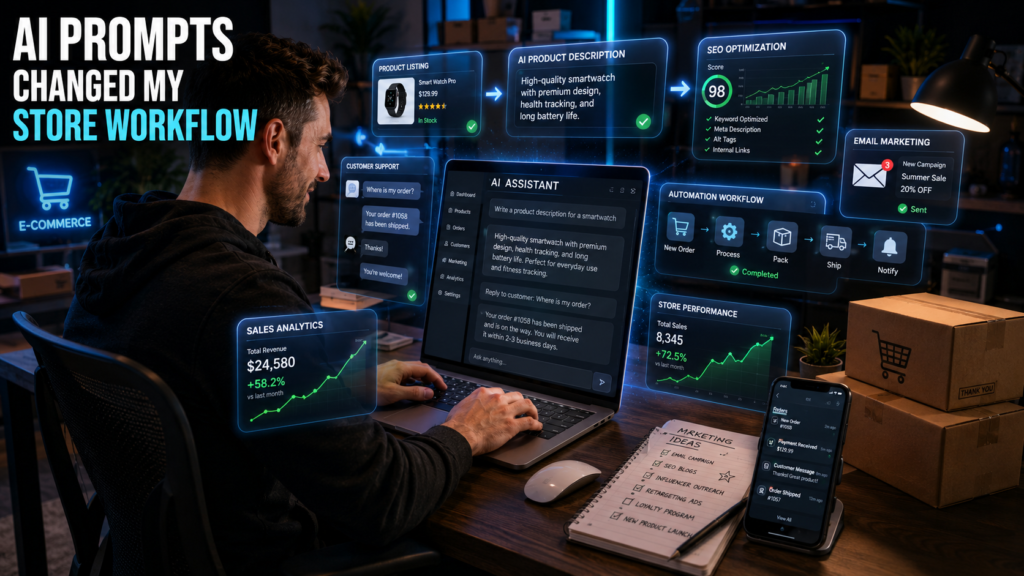
The main tool I relied on was ChatGPT because of its flexibility and ability to handle multiple ecommerce tasks with detailed prompts. I used it daily to generate high-converting product descriptions, customer support replies, FAQ content, abandoned cart email drafts, and even SEO-friendly blog ideas.
For graphic design and social media visuals, I used Canva with AI features that helped me create promotional banners and Instagram posts much faster than before.
I also tested Grammarly to polish my product content and make it sound more professional and trustworthy.
Another powerful tool was Google Gemini, which I occasionally used for brainstorming fresh marketing angles and ecommerce campaign ideas.
These tools didn’t completely replace human creativity, but they eliminated a massive amount of repetitive work that usually drains energy from small business owners. If you want to understand how search optimization works alongside AI-generated content, you should also read my guide on What Is Shopify SEO and How It Works, because combining SEO with AI-generated workflows can seriously improve your store visibility and organic traffic.
One of the biggest benefits of using these tools was speed. Before using AI, creating ten product descriptions could easily take three to four hours, especially when trying to make every listing sound unique and SEO-friendly. After implementing AI prompts for ecommerce store tasks I reduced that workload to less than an hour while still maintaining quality. More importantly, AI helped me stay consistent. Consistency is one of the hardest challenges for ecommerce sellers because managing inventory, customer service, marketing, and content creation at the same time can quickly become overwhelming. AI tools acted like a virtual assistant that helped organize my workflow without increasing my operating costs. I also noticed improvements in customer communication because AI-generated responses were faster, more structured, and easier to personalize. Instead of sounding robotic, the responses became clearer and more professional after I refined my prompts.
Another powerful discovery was how AI improved my content strategy. I began using AI tools not just for writing tasks but also for generating keyword ideas, structuring blog posts, creating Pinterest pin titles, and planning promotional campaigns for seasonal sales. The more detailed my prompts became, the better the results were. That’s when I realized that success with AI isn’t just about using advanced tools — it’s about learning how to communicate effectively with them. Sellers who simply type short commands usually get average results, while sellers who use detailed master prompts can generate highly targeted and conversion-focused content. Over time, these tools helped me save hours every week, reduce burnout, and focus more on growth-related activities instead of repetitive daily store tasks.
Master Prompt I Used for Daily Ecommerce Tasks
Act as an experienced ecommerce growth expert and help me manage my online store professionally. Generate SEO-optimized product descriptions, high-converting email marketing ideas, customer support replies, social media captions, blog post ideas, FAQ content, and promotional campaigns. Use persuasive but natural language, focus on customer pain points, highlight product benefits clearly, and maintain a trustworthy brand voice. Make all content beginner-friendly, engaging, conversion-focused, and optimized for search engines using the focus keyword “AI prompts for ecommerce store tasks.” Also suggest ways to improve store productivity, customer trust, and organic traffic.
How I Used AI Prompts for Product Descriptions
One of the biggest breakthroughs I experienced while using AI prompts for ecommerce store tasks was creating high-converting product descriptions without spending hours staring at a blank screen. Before using AI, writing descriptions for my online store felt repetitive, exhausting, and frustrating. Every product needed unique wording, emotional appeal, SEO optimization, and customer-focused benefits. On busy days, I would either rush the content or copy a similar structure from older listings, which made my store look generic and less engaging. That changed completely when I started using carefully crafted AI prompts. Instead of manually writing every line, I began giving AI detailed instructions about my target audience, product features, tone of voice, and desired keywords. Within seconds, I started receiving polished descriptions that sounded natural, persuasive, and conversion-focused. The most impressive part was how AI could transform simple product details into emotionally compelling sales copy that actually connected with shoppers. Rather than saying, “This chair is comfortable,” the AI would generate something more powerful like, “Experience all-day comfort with an ergonomic design built for long working hours and modern living spaces.” That small difference completely changed how professional my listings looked. I also noticed that AI-generated descriptions helped me maintain consistency across my entire catalog, which improved my store branding and customer trust. To make the content even stronger, I edited the outputs with personal touches and real-life use cases. This combination of AI speed and human creativity became a game changer for my workflow. If you want to understand how sellers are using artificial intelligence beyond product writing, you should also read my guide on How AI Prompts Changed My Daily Ecommerce Store Tasks, where I explain the full workflow in detail.
Another reason these AI prompts became so valuable was their impact on SEO and customer engagement. Earlier, my product pages had weak descriptions with very few keywords, which meant they were not helping my store rank in search engines. After using structured prompts, I started naturally including my focus keyword, related phrases, emotional triggers, and buying intent words inside every product description. This improved readability while making the pages more search-engine friendly at the same time. I began creating descriptions that answered customer questions before they even asked them. Instead of only listing specifications, I focused on benefits, lifestyle improvements, and real-world usage. For example, if I was selling a desk organizer, the AI would highlight how it reduces workspace clutter, increases productivity, and creates a cleaner environment for remote workers.
These details made the products feel more valuable instead of ordinary. I also used AI prompts to generate multiple description styles for different platforms like Shopify, Etsy, Amazon, and social media shops. This saved an incredible amount of time every week. The best part was scalability. Whether I needed five descriptions or fifty, AI helped me maintain speed without sacrificing quality. Over time, I realized that using AI prompts for ecommerce store tasks was not about replacing creativity — it was about removing repetitive work so I could focus on growing my business strategically. For online sellers managing multiple products daily, this approach can dramatically improve efficiency, branding, and content quality without hiring expensive copywriters.
Master Prompt
“Act as a professional ecommerce copywriter. Write a high-converting SEO-friendly product description for [PRODUCT NAME]. Target audience: [TARGET AUDIENCE]. Highlight emotional benefits, practical use cases, pain points, and unique selling points. Use a persuasive yet natural tone. Include the focus keyword naturally throughout the content. Add a compelling hook, scannable formatting, and a strong call-to-action. Make the description human-like, engaging, plagiarism-free, and optimized for conversions.”
Using AI for Customer Support Replies
Before I started using AI prompts for ecommerce store tasks, customer support felt like a never-ending cycle of repetitive questions, delayed responses, and frustrated buyers. Every morning, my inbox was filled with messages asking about shipping times, refund policies, order tracking, product availability, and payment issues. At first, I tried handling everything manually because I believed personalized replies created better customer relationships. But as my store traffic increased, replying to every message started consuming hours of my day. Instead of focusing on marketing, product research, or improving my store, I was stuck writing the same answers repeatedly. That’s when I decided to experiment with AI-generated customer support prompts. Surprisingly, the results were faster, smoother, and more professional than I expected. Using AI prompts for ecommerce store tasks allowed me to create human-like replies within seconds while still keeping the conversation warm and helpful. Customers received faster responses, my stress levels dropped, and I finally had time to focus on growth-oriented tasks instead of repetitive communication.
The biggest advantage was consistency. Earlier, my replies depended on my mood, energy level, or workload. Sometimes I sounded professional, while other times my replies became short and rushed. I completely changed that. I created master prompts for refunds, damaged products, shipping delays, exchange requests, and even angry customer complaints. Instead of typing from scratch, I simply adjusted a few details and generated polished replies instantly.
This improved my response speed dramatically and helped create a more trustworthy shopping experience. I also noticed fewer refund disputes because AI-generated replies sounded calmer, clearer, and more solution-focused. Another hidden benefit was that AI helped me maintain a professional brand voice across every customer interaction. Even during busy sales periods, replies stayed fast, detailed, and empathetic. If you’re struggling with repetitive support tasks, you should also read my detailed guide on “How AI Prompts Changed My Daily Ecommerce Store Tasks” because it explains how automation transformed my overall workflow. Today, customer support no longer feels exhausting. Instead, it feels organized, scalable, and surprisingly efficient thanks to AI prompts for ecommerce store tasks.
Master Prompt
“Act as a professional ecommerce customer support agent. Write a polite, human-like, solution-focused reply for a customer asking about [issue]. Keep the tone friendly, trustworthy, empathetic, and concise while maintaining a professional brand voice.”
How AI Helped Me Write SEO Titles, Meta Descriptions & Tags
One of the most frustrating parts of managing an online store was creating SEO-friendly titles, meta descriptions, and product tags consistently. I knew SEO was essential for organic traffic, but after uploading multiple products daily, my creativity would completely disappear. Most of my titles sounded repetitive, weak, or overly keyword stuffed. Sometimes I spent more time thinking about titles than actually listing products. That’s when I started using AI prompts for ecommerce store tasks specifically for SEO optimization. Honestly, this was one of the smartest decisions I made for my store. AI helped me generate attention-grabbing product titles, compelling meta descriptions, optimized blog headings, and strategic keyword tags within minutes. Instead of staring at a blank screen, I could instantly generate multiple SEO variations tailored to my target audience. The process became faster, smoother, and far more strategic. More importantly, my listings started looking professional and search-engine optimized without sounding robotic or spammy.
The real game changer was how AI balanced creativity with SEO structure. Earlier, I either focused too much on keywords or too much on readability. AI helped combine both naturally. For example, instead of writing generic product titles like “Wireless Earbuds Black,” AI generated more compelling options like “Premium Wireless Earbuds With Deep Bass & Long Battery Life.” That simple improvement made my listings more clickable and visually attractive in search results. AI also helped me write meta descriptions that sounded persuasive while still including important keywords.
Over time, I noticed better click-through rates, improved product visibility, and increased organic impressions. Another major benefit was speed. Tasks that previously took hours now required only minutes. I could optimize entire product collections quickly without sacrificing quality. If you want to improve your ecommerce content strategy further, check out my article on “Keyword Research for Shopify SEO (Step-by-Step Guide)” because it pairs perfectly with AI-powered optimization workflows. Looking back, AI prompts for ecommerce store tasks didn’t just help me save time — they helped me create smarter, more competitive SEO content that actually supported long-term store growth.
Master Prompt
“Act as an ecommerce SEO expert. Generate 5 high-converting SEO titles, a compelling meta description under 160 characters, and optimized keyword tags for this product: [product name/details]. Keep the language natural, persuasive, click-worthy, and search-engine friendly.”
The Impact of AI Prompts on My Store Productivity
When I first started experimenting with AI prompts for ecommerce store tasks, I expected small improvements. Maybe a little faster writing or better product descriptions. But after using AI consistently for 30 days, I realized the real transformation was productivity. My entire workflow changed. Before AI, most of my day was consumed by repetitive tasks like replying to customers, brainstorming titles, writing descriptions, organizing ideas, and creating marketing content. By evening, I often felt mentally exhausted without accomplishing high-value business tasks. AI changed that pattern completely. Instead of spending hours doing repetitive manual work, I could complete major store operations in significantly less time. This gave me more energy to focus on strategic growth activities like product research, ad optimization, competitor analysis, and content planning. The difference felt massive. Rather than working harder every day, I finally started working smarter. AI didn’t replace my creativity — it amplified it by removing unnecessary workload and decision fatigue.
The productivity boost became even more obvious during busy sales periods. Earlier, seasonal campaigns used to overwhelm me because I had to manage listings, emails, support, SEO, and promotions simultaneously. With AI prompts, many of those tasks became streamlined and predictable. I built reusable prompt templates for emails, product launches, promotional campaigns, FAQs, and blog content. Instead of starting from zero every time, I simply customized existing prompts and generated polished content instantly. This saved hours every single week. More importantly, I became more consistent. Even on low-energy days, my store operations continued smoothly because AI reduced creative burnout. I also noticed that faster workflows helped me publish more optimized content regularly, which improved overall store activity and engagement. If you want deeper insights into automation strategies, I highly recommend reading “What Is Shopify SEO and How It Works” because combining SEO systems with AI workflows creates powerful long-term results for sellers. Looking back, using AI prompts for ecommerce store tasks was not just a productivity hack — it became a scalable system that helped me manage my store more efficiently, professionally, and confidently than ever before.
Master Prompt
“Act as an ecommerce productivity assistant. Create a step-by-step workflow using AI tools to automate daily ecommerce store tasks including customer support, SEO writing, product descriptions, marketing content, and task management. Keep the workflow practical, time-saving, and beginner-friendly.”
Mistakes I Made When Using AI Prompts at First
When I first started using AI prompts for ecommerce store tasks, I honestly believed AI would instantly solve every problem inside my online business. I thought one simple prompt could create perfect product descriptions, generate high-converting ad copy, handle customer support, and even improve my SEO rankings overnight. That excitement quickly turned into frustration because I was using AI the wrong way. My biggest mistake was giving weak and unclear instructions. Instead of writing detailed prompts, I typed generic requests like “write a product description” or “create a sales email.” The results sounded robotic, repetitive, and completely disconnected from my brand voice. At that moment, I realized AI is powerful, but it still depends on the quality of the input. Poor prompts create poor outputs. Another major mistake was copying AI-generated content directly into my store without editing it. Some product descriptions looked polished on the surface, but they lacked emotional triggers, customer pain points, and real selling psychology. A few even included repetitive keywords that could hurt SEO performance. That was a wake-up call for me. AI should assist online sellers, not replace human thinking completely. Once I started refining prompts carefully, adding context, target audience details, tone instructions, and SEO requirements, the results improved dramatically.
Another mistake I made was trying to automate too many store tasks at once. I wanted AI to manage customer replies, write blog posts, generate Instagram captions, optimize SEO metadata, and create email campaigns simultaneously. Instead of improving my workflow, it created confusion and inconsistency. I also ignored fact-checking in the beginning. AI occasionally generated inaccurate product details or exaggerated marketing claims that could have damaged customer trust if published without review. One of the smartest changes I made was creating a repeatable workflow where AI handled the first draft while I added human creativity, emotional storytelling, and brand personality afterward. That balance completely changed my ecommerce productivity. I also learned that AI performs much better when you treat it like a skilled assistant instead of a magical shortcut. Today, before creating any content, I provide detailed context, customer demographics, SEO keywords, and conversion goals inside every prompt. That single adjustment saved me hours of editing and improved my content quality significantly. If you want to understand how AI can improve ecommerce efficiency even further, read my detailed guide on How AI Prompts Changed My Daily Ecommerce Store Tasks, where I explain the exact workflow that helped me streamline repetitive business operations and reduce daily stress.
Master Prompt
“Act as a professional ecommerce marketing expert. Create an SEO-optimized product description for my online store using emotional triggers, persuasive language, customer pain points, and conversion-focused copywriting. Include a compelling headline, benefits, features, and a strong call-to-action. Write in a human tone suitable for American online shoppers. Avoid robotic language and keep the content engaging, trustworthy, and easy to read.”
Tasks AI Couldn’t Fully Replace in My Business
Even though AI prompts for ecommerce store tasks transformed many parts of my workflow, I quickly discovered that some business responsibilities still require genuine human judgment, emotional intelligence, and real-world experience. One of the biggest examples was customer relationship building. AI can generate fast replies and professional responses, but it cannot fully understand human emotions the way a real business owner can. When customers were angry about delayed orders or confused about product quality, automated AI responses sometimes sounded too formal or emotionally disconnected. In those moments, personal communication mattered far more than speed. Customers wanted empathy, reassurance, and authentic problem-solving — not just polished sentences. Another area AI struggled with was brand storytelling. AI could generate attractive marketing content, but it couldn’t fully capture the deeper personality and emotional identity I wanted my store to represent. My audience connects with real experiences, honest opinions, and authentic stories. That human connection still comes from the seller, not from automation. I realized AI works best as a support system, while the heart of the brand still depends on human creativity and decision-making.
Inventory decisions and trend analysis were also difficult to automate completely. AI tools can analyze patterns and suggest trending products, but they cannot fully predict customer behavior, seasonal emotional buying triggers, or sudden market shifts. Sometimes I had to rely on instinct, customer feedback, and industry experience rather than data alone. Creative visual branding was another challenge. AI-generated images and designs were useful for brainstorming ideas, but they lacked the emotional uniqueness needed for strong branding. I still needed to manually review graphics, thumbnails, product photos, and advertising creatives to ensure they aligned with my store identity. Most importantly, AI could not replace strategic thinking. Business growth requires long-term planning, competitive analysis, pricing decisions, customer psychology understanding, and risk management. Those areas still demand human leadership. Over time, I stopped expecting AI to run my entire business automatically. Instead, I started using it strategically to eliminate repetitive tasks while keeping human involvement in high-impact decisions. That balance created a much healthier workflow. If you want a deeper breakdown of how sellers can balance automation and creativity, check out my article on Using AI Prompts for Store Tasks: My Real Experience as an Online Seller, where I explain which ecommerce tasks should stay human-driven and which ones can be automated safely for maximum productivity.
Master Prompt
“Act as an ecommerce operations consultant. Analyze which daily online store tasks should be automated using AI and which tasks should remain human-managed for better customer trust, branding, and long-term business growth. Provide detailed recommendations for customer support, marketing, product management, branding, and decision-making.”
The Best AI Prompts That Saved Me the Most Time
The moment I learned how to use high-quality AI prompts for ecommerce store tasks, my daily workflow changed completely. Before AI, I spent hours writing product descriptions, replying to repetitive customer messages, brainstorming social media captions, and creating SEO titles manually. Most days felt exhausting because repetitive tasks consumed my energy before I could focus on actual business growth. But once I started using structured AI prompts strategically, I noticed a dramatic improvement in speed, consistency, and productivity. One of the best prompts I ever used was for SEO product descriptions. Instead of spending 40–60 minutes writing each listing, AI could create a strong first draft within seconds. Another massive time-saver was customer support automation. I trained AI prompts to generate polite, professional, and conversion-focused replies for refund requests, shipping questions, order updates, and customer complaints. This reduced mental fatigue and helped me maintain a consistent communication style across all platforms. Social media content creation also became significantly easier. AI prompts helped me generate hooks, captions, hashtag ideas, and promotional content much faster than manual brainstorming. Instead of staring at a blank screen every day, I could focus on refining ideas and improving brand strategy.
💰 Turn ChatGPT into Your Personal Wealth Machine!
Are you still using ChatGPT just for writing content?
You’re missing a massive opportunity.
Smart people are already using AI to build income streams, automate tasks, and grow online businesses — and you can do the same.
🚀 What You’ll Learn Inside This eBook:
- ✔ How to make money using ChatGPT (step-by-step)
- ✔ Beginner-friendly AI income strategies
- ✔ Real methods used by online earners
- ✔ How to automate work using AI tools
- ✔ Zero technical skills required
🎯 Who Is This For?
- ✔ Beginners who want to start earning online
- ✔ eCommerce sellers & freelancers
- ✔ Anyone who wants passive income using AI
⚠️ Most people waste AI potential — don’t be one of them.
This guide shows you exactly how to turn AI into real income.
👉 Get Instant Access Now✔ Instant download | ✔ Beginner friendly | ✔ Actionable steps
SEO optimization became another game-changing advantage. I used AI prompts to generate keyword-rich titles, meta descriptions, blog outlines, and FAQ sections for my ecommerce content. This not only improved productivity but also strengthened my search engine visibility. One prompt helped me create email marketing sequences for abandoned carts, product launches, and seasonal promotions in minutes instead of hours. Another powerful prompt generated content ideas based on customer pain points, which improved engagement across my blog and social media platforms. However, the biggest lesson I learned was that the best prompts are extremely detailed. Generic instructions produce generic content. The more context, audience details, emotional triggers, and SEO requirements I included, the better the results became. Today, AI acts like a digital assistant inside my ecommerce business, handling repetitive operations while allowing me to focus on growth, customer experience, and strategic planning. If you want more practical prompt ideas, read my complete guide on Why Every Online Seller Should Use AI Prompts for Daily Tasks, where I share advanced prompt frameworks that can help ecommerce sellers save time, improve workflow efficiency, and scale content production faster.
Master Prompt
“Act as a senior ecommerce growth strategist and AI automation expert. Create a complete daily workflow system for my online store using AI prompts. Include SEO product descriptions, customer support replies, blog ideas, email marketing content, social media captions, keyword optimization, and promotional campaigns. The content should sound natural, persuasive, conversion-focused, and optimized for ecommerce growth.”
How AI Changed My Daily Ecommerce Workflow After 30 Days
After using AI prompts for ecommerce store tasks consistently for 30 days, the biggest transformation I noticed was not just speed — it was mental clarity. Before integrating AI into my workflow, every single day felt chaotic. I spent hours replying to repetitive customer questions, writing product descriptions from scratch, brainstorming social media captions, updating SEO metadata, and trying to stay consistent with store management. By the end of the day, I often felt exhausted without actually growing my business. Once I started using structured AI prompts, my workflow became dramatically smoother and more organized. Tasks that previously consumed three to four hours suddenly required less than one hour. Instead of staring at a blank screen, I had instant ideas, polished drafts, keyword suggestions, and professional responses ready within seconds. The productivity boost felt almost unreal during the first week itself. More importantly, I finally had enough time to focus on strategic tasks like improving my product pages, testing marketing ideas, and understanding customer behavior. That shift alone completely changed how I operated my online store.
Another powerful change was consistency. Most ecommerce sellers struggle because they work randomly without a repeatable system. AI helped me build repeatable daily workflows that reduced decision fatigue. For example, I created dedicated prompts for customer support, abandoned cart emails, SEO product titles, Pinterest descriptions, and even product comparison tables. Instead of doing everything manually every day, I simply customized proven prompts according to the situation. This saved energy and helped maintain brand quality across my store.
My content started sounding more professional, my listings became more SEO-friendly, and customer response times improved significantly. One surprising benefit was how AI improved my creativity rather than replacing it. It gave me fresh angles, emotional hooks, and stronger marketing ideas that I probably would not have discovered alone during stressful workdays. If you want to understand how AI-powered workflows can improve seller productivity even further, you should also read our guide on “How AI Prompts Changed My Daily Ecommerce Store Tasks” because it explains the exact systems modern sellers are now using to compete faster online. By the end of those 30 days, I no longer viewed AI as just another tool — I saw it as a reliable digital assistant that helped me scale daily operations without feeling overwhelmed.
Master Prompt for Ecommerce Workflow Automation
“Act as a professional ecommerce business assistant. Help me manage my online store tasks efficiently. Generate SEO-optimized product descriptions, customer support replies, persuasive marketing copy, social media captions, email campaigns, FAQ answers, product titles, and conversion-focused content based on my product details. Use a professional yet human tone that builds trust and improves engagement. Always optimize content for readability, SEO, and ecommerce conversions.”
Pros and Cons of Using AI Prompts for Ecommerce Sellers
Using AI prompts for ecommerce store tasks can feel like unlocking a productivity superpower, especially for solo entrepreneurs and small online sellers trying to manage everything alone. One of the biggest advantages is the incredible amount of time AI can save every single day. Tasks that once required hours of brainstorming, editing, and rewriting can now be completed in minutes with the right prompts. Product descriptions become faster to create, customer service responses become more professional, and social media content becomes easier to scale consistently. AI also helps eliminate creative burnout, which is one of the most common struggles ecommerce sellers face after managing stores for months or years. Instead of feeling mentally drained every time you need fresh content ideas, AI can instantly generate new perspectives, hooks, headlines, and promotional concepts. Another major advantage is cost efficiency. Many small businesses cannot afford a full-time copywriter, SEO expert, or marketing team. AI tools give smaller sellers access to high-quality assistance without massive financial investment. This creates a more competitive environment where even beginners can produce professional-level content for their stores.
However, despite the powerful advantages, AI is not perfect and should never be treated as a complete replacement for human judgment. One common mistake sellers make is copying AI-generated content without reviewing or customizing it properly. Generic content can reduce brand authenticity and sometimes create repetitive or inaccurate information. AI works best when combined with human creativity, emotional understanding, and real business experience. Another challenge is overdependence. Some ecommerce sellers start relying on AI for every tiny decision, which can weaken originality over time. Search engines and customers still value unique experiences, genuine storytelling, and personal insights. That is why successful sellers use AI as an assistant instead of a replacement. Additionally, beginners may struggle initially because weak prompts often produce weak results. Learning how to write clear and strategic prompts is an important skill for long-term success. If you want better results, you should also explore our article on “The Truth About Using AI Prompts for Ecommerce Store Tasks”, where we explain the most effective prompting methods used by modern online sellers. Overall, the pros of AI dramatically outweigh the cons when sellers use it intelligently. The key is balance — combining automation with human creativity to build a smarter and more scalable ecommerce business.
Master Prompt for Balanced AI Content Creation
“Act as an experienced ecommerce growth strategist. Create professional, SEO-friendly, and conversion-focused content for my online store while maintaining a natural human tone. Avoid robotic language, repetitive phrases, or generic marketing copy. Include emotional triggers, persuasive wording, readability optimization, and customer-focused messaging. Ensure the final content feels authentic, trustworthy, and optimized for ecommerce growth.”
Tips for Beginners Starting With AI Prompts
If you are completely new to using AI prompts for ecommerce store tasks, the most important thing to understand is that results depend heavily on the quality of your instructions. Many beginners fail because they type extremely short requests like “write product description” and expect magical results instantly. AI performs significantly better when you provide context, goals, audience type, product information, and desired tone. Think of AI like a highly intelligent assistant that still needs proper direction to deliver outstanding work. Start small instead of trying to automate your entire business in one day. Focus first on repetitive tasks that consume the most time, such as customer support replies, product titles, social media captions, and SEO meta descriptions. Once you become comfortable writing prompts, you can expand into advanced areas like email marketing, keyword research, and sales funnel content. Another beginner-friendly strategy is creating reusable templates. Instead of writing new prompts daily, build a collection of tested prompts for common store activities. This creates consistency and saves even more time over the long term. The sellers who achieve the best results are usually the ones who continuously refine and improve their prompts based on real customer interactions and store performance.
Another essential tip is to always edit and personalize AI-generated content before publishing it. While AI can produce impressive drafts quickly, adding your own experiences, opinions, and brand personality makes the content far more trustworthy and engaging. Customers connect with authenticity, not robotic perfection. You should also avoid keyword stuffing because modern SEO rewards natural readability and helpful content. Use your focus keyword strategically throughout the article without forcing it unnaturally. Beginners should also experiment with different AI tools instead of depending on only one platform. Each tool has unique strengths for content writing, image generation, SEO planning, and customer communication. Tracking performance is equally important. Monitor which AI-generated product descriptions improve clicks, which email campaigns increase conversions, and which social posts generate engagement. This helps you understand what actually works in your niche. If you want a deeper understanding of beginner-friendly prompt systems, you should also read our detailed guide on Why Every Online Seller Should Use AI Prompts for Daily Tasks because it explains simple frameworks that even non-technical sellers can start using immediately. The ecommerce industry is evolving rapidly, and sellers who learn AI skills early will gain a massive advantage in productivity, branding, and business growth over the next few years.
Master Prompt for Beginners
“Act as a beginner-friendly ecommerce AI assistant. Help me complete daily ecommerce store tasks step by step. Generate simple, SEO-friendly, and conversion-focused content for product descriptions, customer replies, social media posts, and marketing campaigns. Use clear language, persuasive wording, and professional formatting while keeping the content natural, human-like, and optimized for online store growth.”
Should Online Sellers Really Use AI Prompts Every Day?
The ecommerce industry is moving faster than ever, and online sellers who still rely completely on manual work are slowly falling behind. After using AI prompts for ecommerce store tasks every single day, one thing became very clear: AI is no longer just a “bonus tool” for big companies. It has become a practical daily assistant for small business owners, dropshippers, Etsy sellers, Shopify store owners, Amazon resellers, and even beginners running side hustles from home. The biggest reason online sellers should use AI prompts daily is simple — repetitive tasks consume too much valuable time. Writing product descriptions, replying to customer questions, creating SEO titles, generating marketing emails, brainstorming social media captions, and organizing workflows can easily take hours every day. AI dramatically reduces that workload while helping sellers stay consistent and productive. Instead of spending mental energy on repetitive writing, sellers can focus on strategy, customer experience, and growing revenue. That shift alone can completely transform how an ecommerce business operates.
Another powerful advantage of using AI prompts daily is speed. In ecommerce, speed often determines sales opportunities. A seller who quickly updates product listings, responds faster to customer concerns, and publishes optimized content regularly usually gains a stronger competitive advantage. AI tools help remove delays that slow businesses down. For example, instead of spending 45 minutes writing a product description manually, an optimized AI prompt can generate a high-quality draft in seconds. Sellers can then personalize and improve it instead of starting from zero. This workflow saves both energy and decision-making fatigue. Daily AI usage also improves consistency across the store. Product pages sound more professional, customer support becomes faster, and SEO optimization becomes easier to manage. Over time, these small improvements create a more trustworthy brand image. If you already read our guide on “What Is Shopify SEO and How It Works,” you’ll understand how consistency and optimization directly affect store visibility and long-term organic traffic.
Still, online sellers should avoid depending on AI blindly. AI is a tool, not a replacement for human judgment. The best results come when sellers combine AI efficiency with human creativity, emotions, and experience. AI-generated content should always be reviewed, edited, and customized before publishing. Customers still want authentic brands, relatable communication, and trustworthy shopping experiences. If everything sounds robotic or generic, trust can decrease quickly. Smart sellers use AI to improve productivity — not to eliminate the human touch completely. Daily AI prompts work best when they become part of a balanced workflow. Think of AI as a digital assistant helping you move faster, stay organized, and reduce stress while you remain the decision-maker behind the business.
Master Prompt for Online Sellers
“Act as an experienced ecommerce business assistant. Help me manage my online store by creating SEO-optimized product descriptions, customer support replies, social media captions, email marketing copy, product titles, FAQ answers, and conversion-focused promotional content. Use persuasive language, clear formatting, strong calls-to-action, and beginner-friendly wording. Make the content human-like, engaging, and optimized for ecommerce SEO while matching my brand tone.”
Final Thoughts: Was Using AI Prompts Worth It?
After 30 days of consistently using AI prompts for ecommerce store tasks, the results were impossible to ignore. The biggest improvement was not just faster content creation or automated writing — it was the reduction of daily stress. Many ecommerce sellers underestimate how mentally exhausting repetitive store management tasks can become. Constantly writing product descriptions, replying to customers, updating SEO metadata, generating marketing ideas, and managing workflows drains both creativity and motivation. AI prompts helped simplify these repetitive responsibilities and created a more organized daily workflow. Instead of feeling overwhelmed by endless tasks, store management started feeling more strategic and efficient. The amount of time saved each week created more opportunities to focus on product research, customer engagement, branding, and scaling the business. In many ways, AI became a productivity multiplier rather than just another software tool.
One surprising benefit was improved confidence in content creation. Many online sellers struggle with writing persuasive copy, especially beginners who are not comfortable with SEO or marketing language. AI prompts helped generate strong starting points that made writing easier and faster. Instead of staring at a blank screen, sellers can instantly generate structured ideas, optimized headlines, email campaigns, or customer support templates. This reduces procrastination and helps maintain consistency across the business. However, the real success came from learning how to guide AI properly with clear instructions and editing the output carefully. Sellers who simply copy and paste everything without reviewing it may struggle with originality and branding. But those who use AI strategically can create high-quality workflows that save time while maintaining authenticity. AI is not replacing ecommerce entrepreneurs — it is helping them work smarter in a highly competitive market.
For sellers wondering whether AI prompts are truly worth using every day, the answer depends on how seriously they want to grow their business. If your goal is to save time, improve productivity, create SEO-friendly content faster, and reduce burnout, then AI prompts can become one of the most valuable tools in your daily workflow. The ecommerce landscape is becoming more competitive every year, and businesses that adapt to new technology often gain an important advantage. Sellers who learn how to use AI effectively today may outperform competitors who continue handling every task manually. Whether you run a Shopify store, Etsy shop, WooCommerce business, or Amazon storefront, integrating AI into your workflow can create long-term benefits when used responsibly and strategically.
Frequently Asked Questions (FAQs)
How do ecommerce sellers use AI prompts?
Ecommerce sellers use AI prompts to automate repetitive store tasks such as product descriptions, SEO titles, email marketing, customer support replies, ad copy, social media captions, and keyword research. AI helps sellers save time while improving consistency and productivity.
Can AI prompts help increase online store sales?
Yes, AI prompts can help improve conversions by creating more persuasive product descriptions, stronger calls-to-action, optimized SEO content, and faster customer communication. Better content and quicker responses often improve customer trust and shopping experience.
Which AI tool is best for ecommerce store tasks?
Popular tools include ChatGPT, Gemini, and Claude AI. Many sellers prefer ChatGPT because it works well for ecommerce writing, SEO optimization, workflow automation, and content brainstorming.
Are AI-generated product descriptions good for SEO?
AI-generated descriptions can be very effective for SEO when edited properly. Sellers should naturally include focus keywords, customer benefits, readability improvements, and unique product details instead of publishing generic AI text without customization.
Can ChatGPT automate customer support replies?
Yes, ChatGPT can help generate quick and professional customer support responses for refunds, shipping updates, product inquiries, return requests, and order tracking. Sellers should still review replies before sending them to customers.
Is using AI for ecommerce safe and reliable?
AI is generally safe when used responsibly. Sellers should avoid sharing sensitive customer information and should always review AI-generated content for accuracy, tone, and originality before publishing.
How much time can AI save online sellers daily?
Depending on workflow, AI can save sellers anywhere from 1 to 5 hours per day by reducing repetitive writing and administrative tasks. The biggest savings usually come from content creation and customer communication.
What are the best AI prompts for beginners?
Beginners should start with prompts for:
- Product descriptions
- SEO meta descriptions
- Social media captions
- Customer support templates
- Email marketing campaigns
- Ecommerce blog ideas
- Store policy explanations
Simple, clear prompts usually produce the best results for new sellers learning AI workflows.