
What if a few small changes to your Etsy listings could put your products in front of thousands more shoppers—without spending a dime on ads? That’s exactly why Etsy SEO matters. Every day, millions of buyers search Etsy for products they’re ready to purchase, but only a fraction of listings earn those valuable first-page spots. If your shop isn’t showing up where customers are searching, you’re leaving sales on the table.
Whether you’re opening your first shop or struggling to generate consistent traffic, understanding how Etsy SEO works is one of the most valuable skills you can learn in 2026. The good news? You don’t need to be an SEO expert or marketing professional to improve your visibility. With the right strategy, even new sellers can compete with established shops by optimizing their listings for the Etsy search algorithm.
In this Etsy SEO guide, you’ll discover exactly how Etsy ranks listings, what factors influence search visibility, and the most effective Etsy SEO tips for beginners. You’ll also learn how to rank higher on Etsy using practical techniques that can increase clicks, attract qualified buyers, and grow your sales over time.
Ready to start ranking higher on Etsy and turn more searches into sales? Let’s dive in and master Etsy SEO together.
Etsy SEO: What It Is and Why It Matters in 2026
If you want your products to appear in front of shoppers without spending money on ads, understanding Etsy SEO is no longer optional. As Etsy continues refining its search experience in 2026, sellers who optimize their listings correctly have a much better chance of earning consistent organic traffic and increasing sales.
Unlike traditional search engines, Etsy’s marketplace focuses on connecting buyers with the most relevant products based on search intent, listing quality, and shopping behavior. Learning how Etsy SEO works helps you create listings that both Etsy’s algorithm and potential customers can easily understand.
What Is Etsy SEO and Why Every Seller Should Understand It
Etsy SEO (Search Engine Optimization) is the process of optimizing your Etsy listings so they appear higher in Etsy Search results when shoppers search for products. The goal is simple: improve your search visibility, attract qualified buyers, and increase organic sales without relying solely on Etsy Ads.
A well-optimized listing isn’t just about adding keywords. It combines relevant search terms with compelling product information and a positive customer experience to improve your ranking over time.
An effective Etsy SEO guide focuses on optimizing several important elements, including:
- Relevant keyword research for your products
- Clear and descriptive product titles
- Accurate Etsy tags
- Informative product descriptions
- High-quality product photography
- Strong customer reviews and shop reputation
When these factors work together, your listings become more relevant to buyer searches, improving both visibility and conversions.
Why Etsy SEO Matters More Than Ever in 2026
Competition on Etsy continues to grow every year. Thousands of new products are published daily, making it harder for unoptimized listings to gain visibility.
Investing time in Etsy SEO offers several long-term benefits:
- Increase organic traffic without paying for every click
- Reach shoppers actively searching for your products
- Improve your listing’s click-through rate (CTR)
- Boost your conversion rate through better optimization
- Build sustainable sales instead of depending entirely on advertising
The better your listings match buyer intent, the more likely Etsy is to recommend them in search results.
How Etsy SEO Works: Understanding the Etsy Search Algorithm
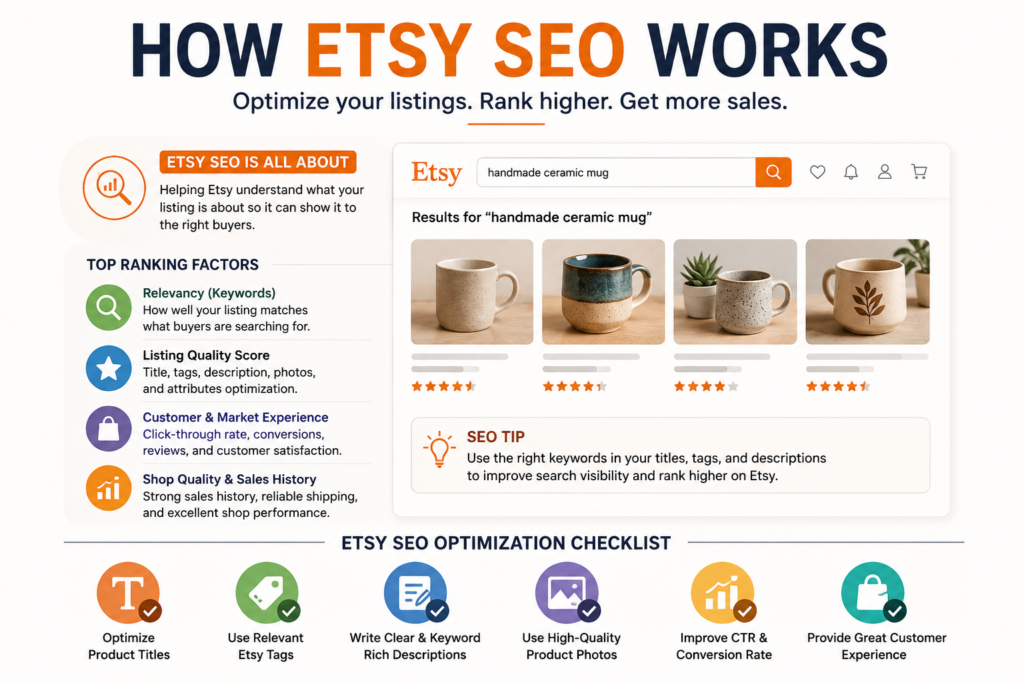
To succeed on Etsy, it’s important to understand how Etsy SEO works. Every time a shopper enters a search query, the Etsy search algorithm evaluates millions of listings and determines which ones are most relevant.
Although Etsy doesn’t publicly reveal every ranking signal, the platform consistently prioritizes listings that provide the best shopping experience.
Some of the most important ranking factors include:
- Relevancy: Your keywords should closely match what shoppers are searching for.
- Listing Quality Score: Listings that receive more clicks, favorites, and purchases tend to rank better.
- Customer Experience: Positive reviews, fast shipping, and reliable customer service help build trust.
- Shop Quality: A well-maintained shop with complete policies and consistent performance signals credibility.
- Sales History: Listings with a proven record of successful sales often gain additional ranking advantages.
In simple terms, Etsy wants to display products that shoppers are most likely to click, purchase, and enjoy. That’s why optimizing every part of your listing—not just adding keywords—is essential.
Instead of trying to “game” the algorithm, focus on creating listings that genuinely answer shoppers’ needs. Over time, this strategy improves your relevance, strengthens your marketplace performance, and helps you rank higher on Etsy naturally.
Etsy SEO Guide: Optimize Your Listings for Better Search Visibility
If you want consistent, long-term sales on Etsy, mastering Etsy SEO starts with optimizing every part of your listing. While great products matter, they won’t generate organic traffic if buyers can’t find them. A well-optimized listing helps the Etsy search algorithm understand what you’re selling and match it with shoppers who are ready to buy.
This section of our Etsy SEO guide explains how to conduct effective keyword research and optimize your product titles, Etsy tags, and product descriptions to improve search visibility and help you rank higher on Etsy.
Keyword Research for Etsy Listings and Finding Long-Tail Keywords
Keyword research is the foundation of successful Etsy SEO. Every search begins with a shopper typing words into Etsy Search, and your goal is to use the same language your target customers naturally use.
Instead of guessing keywords, focus on understanding search intent. Think about what someone would type if they were actively looking to buy your product.
For example, instead of using a broad keyword like:
- Handmade mug
A better long-tail keyword would be:
- Personalized ceramic coffee mug
- Custom coffee mug for teachers
- Funny coffee mug gift
- Handmade pottery coffee cup
These phrases are more specific, face less competition, and usually attract shoppers who are closer to making a purchase.
Why Long-Tail Keywords Matter
Long-tail keywords improve your chances of appearing in relevant searches because they closely match buyer intent. They also help your listings compete against larger, more established Etsy shops.
Benefits include:
- Higher search relevancy
- Better qualified traffic
- Improved click-through rate (CTR)
- Higher conversion rate
- Stronger long-term organic traffic
This is one of the biggest reasons experienced sellers consistently outperform beginners.
Where to Find Etsy Keywords
Start by collecting keywords from multiple sources instead of relying on a single tool.
Good places to research include:
- Etsy Search autocomplete suggestions
- Related searches on Etsy
- Competitor listings
- Customer reviews
- Etsy category pages
- Google search suggestions
You should also use dedicated keyword research software to discover search volume, competition, and seasonal trends.
Before choosing your target keywords, explore our guide on best Etsy keyword research tools to compare the top research platforms for sellers in 2026.
How to Choose the Right Keywords
As you build your keyword list, prioritize phrases that balance relevance and competition.
Look for keywords that:
- Accurately describe your product
- Match buyer intent
- Have healthy search demand
- Face moderate or low competition
- Can naturally fit inside your title, tags, and description
Remember, Etsy SEO rewards relevance more than simply adding dozens of keywords.
How to Optimize Product Titles, Etsy Tags, and Product Descriptions
Once you’ve identified your target keywords, it’s time to optimize the parts of your listing that influence how Etsy SEO works.
Every element sends signals to the Etsy search algorithm, helping determine whether your product deserves a place in search results.
Write Product Titles That Match Search Intent
Your product title is one of the strongest ranking signals.
Place your primary keyword near the beginning of the title while keeping it readable for shoppers.
Instead of writing:
Beautiful Handmade Necklace for Women Gift Jewellery
Write:
Personalized Birthstone Necklace | Handmade Gift for Mom | Custom Silver Jewelry
This title naturally includes descriptive keywords without sounding spammy.
A strong title should:
- Lead with your primary keyword
- Describe the product clearly
- Include relevant secondary keywords
- Remain easy to read
- Appeal to both shoppers and the Etsy algorithm
Optimize Your Etsy Tags
Etsy allows multiple tags, giving you additional opportunities to reinforce your listing’s relevance.
Rather than repeating the exact same phrase, use variations that target different search queries.
Examples include:
- Personalized mug
- Teacher gift
- Ceramic coffee cup
- Custom coffee mug
- Handmade mug
- Pottery mug
- Gift for coworker
- Office coffee cup
Well-optimized Etsy tags help expand your visibility across multiple searches while supporting your overall Etsy SEO strategy.
Write Product Descriptions for Humans First
Many sellers make the mistake of stuffing keywords into their descriptions.
Instead, write naturally while answering the questions buyers are most likely to ask.
Include information such as:
- Product materials
- Dimensions
- Color options
- Personalization details
- Shipping information
- Care instructions
- Intended use
Search engines and shoppers both value helpful, informative descriptions.
A strong product description also improves customer experience, which can indirectly support better engagement and stronger conversion rates.
Use Keywords Naturally Throughout the Listing
One of the biggest misconceptions about Etsy SEO is that repeating keywords dozens of times improves rankings.
It doesn’t.
Instead, place your keywords naturally throughout:
- Product title
- Etsy tags
- Product description
- Image alt text (where applicable)
- Attributes and categories
When every element works together, Etsy gains a clearer understanding of your listing, improving its chances of appearing for relevant searches.
Don’t Ignore Listing Quality Signals
Keywords alone won’t help you rank if shoppers aren’t engaging with your listings.
The Etsy search algorithm also evaluates factors such as:
- Listing Quality Score
- Customer Experience
- Shop Quality
- Sales History
- Relevancy
- Click-Through Rate (CTR)
- Conversion Rate
If people click your listing but leave without purchasing, Etsy may interpret that as a weaker result for that search query.
If you’re already getting traffic but struggling to convert visitors into customers, read our guide on Why Your Etsy Shop Gets Views but No Sales (And How to Fix It). It explains the most common conversion problems and practical steps to turn views into sales.
Key Takeaways
Successful Etsy SEO isn’t about gaming the algorithm—it’s about creating listings that accurately match what shoppers are searching for. By performing thorough keyword research, targeting long-tail phrases, writing descriptive titles, optimizing Etsy tags, and creating helpful product descriptions, you’ll improve your search visibility and build a stronger foundation for sustainable organic growth.
When you consistently apply these best practices, you’ll not only understand how Etsy SEO works but also increase your chances of attracting qualified buyers and ranking higher on Etsy over time.
Etsy SEO Tips for Beginners to Rank Higher on Etsy
If you’re new to selling on Etsy, mastering Etsy SEO doesn’t have to be overwhelming. The most successful shops focus on optimizing every part of a listing—from product photos and keywords to customer experience and listing quality. Small improvements made consistently can significantly increase your search visibility and help you rank higher on Etsy over time.
Product Photography, Listing Optimization, and Marketplace SEO Best Practices
High-quality visuals are one of the fastest ways to improve your listing’s performance. While images aren’t direct ranking factors, they strongly influence click-through rate (CTR) and conversion rate, both of which signal to the Etsy search algorithm that shoppers find your listing valuable.
To strengthen your Etsy SEO, follow these best practices:
- Use bright, high-resolution images with clean, distraction-free backgrounds.
- Make your first photo instantly communicate what you’re selling.
- Add lifestyle images to show the product in real-world use.
- Include close-up shots to highlight materials, texture, and craftsmanship.
- Maintain consistent branding across all product photography.
Need help creating better product images? Check out our guide on Etsy product photography tips in How to Take High-Converting Etsy Product Photos.
Beyond visuals, every element of your listing should support your Etsy SEO guide strategy.
Optimize these areas:
- Write descriptive Product Titles that naturally include your primary keyword.
- Use all available Etsy Tags with relevant long-tail keywords.
- Create detailed Product Descriptions that answer common buyer questions.
- Choose accurate categories and attributes to improve relevancy.
- Refresh older listings regularly to keep information current and competitive.
These simple improvements make it easier for Etsy to understand your products while giving shoppers a better buying experience.
If you’re managing dozens of listings, automation can save hours each week. Learn how to streamline repetitive tasks in our guide on How to Automate Etsy SEO, Listings, and Customer Messages.
Common Etsy SEO Mistakes Beginners Should Avoid
Many new sellers focus only on keywords and overlook the broader factors that influence Etsy SEO. While keyword research is essential, it’s only one piece of a successful optimization strategy.
Avoid these common mistakes:
- Stuffing Product Titles with repetitive keywords.
- Using unrelated or overly broad Etsy Tags.
- Ignoring listing quality by uploading low-resolution images.
- Writing short, incomplete Product Descriptions that don’t answer customer questions.
- Neglecting customer service, resulting in poor reviews and reduced Shop Quality.
- Failing to update listings as trends and buyer behavior change.
- Skipping keyword research before publishing new products.
Remember, How Etsy SEO works is based on more than just keywords. The Etsy search algorithm evaluates listing quality, shopper engagement, Sales History, Customer Experience, and overall shop performance when deciding which listings deserve higher placement.
The best approach is to treat Etsy SEO as an ongoing process rather than a one-time task. Regularly refine your listings, monitor performance, test new keywords, and improve your content based on buyer behavior. Over time, these consistent efforts will increase organic traffic, strengthen your marketplace SEO, and help your shop achieve sustainable long-term growth.
How to Rank Higher on Etsy in 2026
Ranking higher on Etsy isn’t about finding one secret trick—it’s about consistently optimizing every part of your shop. A strong Etsy SEO strategy combines keyword optimization, high-quality listings, excellent customer experience, and ongoing performance tracking. If you’re new to selling, this simple checklist will help you build a solid foundation while improving your chances of earning more organic traffic from Etsy Search.
A Simple Etsy SEO Checklist for New Sellers
Before publishing or updating any listing, make sure you’ve covered these essential Etsy SEO best practices:
- Conduct keyword research to identify relevant long-tail keywords buyers actually search for.
- Include your primary keyword naturally in product titles, Etsy tags, and the first few lines of your product descriptions.
- Write clear, benefit-focused descriptions that answer common buyer questions.
- Upload high-quality product photography with multiple angles and good lighting.
- Select the most accurate categories and attributes to improve listing relevancy.
- Use all available Etsy tags without repeating the same keyword unnecessarily.
- Price your products competitively while maintaining healthy profit margins.
- Keep your processing times and shipping details accurate.
- Encourage positive reviews to strengthen your shop quality and customer trust.
- Regularly refresh older listings by updating photos, keywords, or descriptions to keep them competitive.
Following this checklist helps improve your search visibility while sending stronger quality signals to the Etsy search algorithm. Over time, these improvements can increase your click-through rate (CTR), conversion rate, and overall listing performance.
If you’re looking for practical ways to attract more shoppers, don’t miss our How to Get More Views on Etsy in 2026 (Beginner Guide with AI Tips). It complements your Etsy SEO strategy with actionable traffic-building techniques.
Tracking Organic Traffic and Measuring SEO Performance
Optimizing your listings is only half the job. The other half is measuring what’s working so you can make smarter decisions based on real data.
Start by monitoring these key performance metrics:
- Organic traffic from Etsy Search
- Listing impressions
- Click-through rate (CTR)
- Conversion rate
- Best-performing keywords
- Top-selling listings
- Favorites and customer engagement
- Repeat purchases and overall sales trends
Review your Etsy Shop Stats regularly to identify listings that consistently attract visitors but generate few sales. In many cases, improving product images, pricing, or descriptions can significantly boost conversions without changing your keywords.
For deeper insights into how visitors interact with your website or external traffic sources, explore Google Analytics for beginners. Learning the basics of analytics helps you understand where your traffic comes from, which marketing channels perform best, and where your optimization efforts deliver the highest return.
Remember that Etsy SEO is an ongoing process rather than a one-time task. As buyer behavior, competition, and the Etsy search algorithm evolve, regularly reviewing your data and refining your listings will help you rank higher on Etsy and build sustainable growth throughout 2026 and beyond.
Final Thoughts: Build a Long-Term Etsy SEO Strategy
Success on Etsy rarely comes from one quick optimization. The sellers who consistently grow their shops understand that Etsy SEO is an ongoing process of testing, improving, and adapting to changes in buyer behavior and the Etsy search algorithm. Instead of chasing shortcuts, focus on building listings that are relevant, helpful, and designed to deliver a great customer experience.
Next Steps for Growing Your Etsy Shop with SEO
If you’re just getting started, don’t try to optimize everything at once. Follow a simple, repeatable process that strengthens your shop over time and improves your search visibility.
Here are the most effective next steps:
- Perform keyword research regularly. Find relevant long-tail keywords that match what shoppers are actually searching for, then naturally incorporate them into your Product Titles, Etsy Tags, and Product Descriptions.
- Optimize every listing individually. Every product should target a unique search intent. A well-written listing with accurate keywords, compelling copy, and strong Product Photography has a better chance of improving its Listing Quality Score.
- Monitor your performance. Track impressions, clicks, favorites, and sales to understand how your Etsy SEO efforts are impacting Organic Traffic, Click-Through Rate (CTR), and Conversion Rate. Small improvements in these metrics can lead to better rankings over time.
- Keep your shop active. Refresh older listings, update seasonal keywords, improve photos, and refine descriptions based on customer feedback. An active shop often performs better because it stays relevant to current search trends.
- Prioritize customer satisfaction. Fast shipping, accurate product descriptions, positive reviews, and responsive communication all contribute to Shop Quality, which can indirectly support better performance within Etsy Search.
Remember that an effective Etsy SEO guide isn’t about gaming the system—it’s about making your listings easier for both shoppers and the Etsy search algorithm to understand. As you consistently apply proven Etsy SEO tips for beginners, you’ll build stronger listing relevance and create more opportunities to rank higher on Etsy.
To accelerate your growth beyond search optimization, explore our complete Etsy marketing guide, where you’ll learn how to combine SEO with social media, email marketing, and promotional campaigns for sustainable sales growth.
If your immediate goal is increasing traffic before making advanced marketing investments, don’t miss our How to Get More Views on Etsy in 2026 (Beginner Guide with AI Tips). It complements this Etsy SEO guide with practical, AI-powered strategies to attract more visitors and turn them into loyal customers.
The most successful Etsy sellers don’t treat Etsy SEO as a one-time checklist—they make it part of their long-term business strategy. Continue refining your listings, studying customer behavior, and adapting to marketplace trends. Over time, consistent optimization, quality products, and a customer-first approach will help your shop earn greater visibility, stronger rankings, and sustainable growth in an increasingly competitive marketplace.
Frequently Asked Questions (FAQs)
1. What is Etsy SEO?
Etsy SEO is the process of optimizing your Etsy listings with relevant keywords, product titles, tags, and descriptions to improve search visibility and attract more organic traffic from Etsy Search.
2. How does the Etsy search algorithm work?
The Etsy search algorithm ranks listings based on keyword relevancy, listing quality score, customer experience, shop quality, sales history, and conversion signals to deliver the most relevant results.
3. How can beginners improve Etsy SEO?
Start with keyword research, optimize product titles, Etsy tags, and descriptions, use high-quality product photography, and regularly update listings. Following an Etsy SEO guide helps beginners build consistent visibility.
4. How long does Etsy SEO take to work?
Most sellers notice improvements within a few weeks, but results vary based on competition, listing quality, keyword optimization, and how frequently your Etsy shop receives engagement and sales.
5. How do I rank higher on Etsy?
To rank higher on Etsy, use relevant long-tail keywords, optimize every listing element, improve click-through and conversion rates, and maintain excellent customer service to strengthen your shop’s overall performance.