
Have you ever opened your Etsy dashboard, seen hundreds of visitors, and thought, “If people are clicking, why isn’t anyone buying?” You’re not alone. Thousands of Etsy sellers face the exact same frustration every day. Your etsy shop gets traffic but no sales, your analytics look promising, yet your revenue refuses to grow. It can feel like you’re doing everything right while your competitors continue making consistent sales.
The truth is, traffic alone doesn’t pay the bills. Many successful-looking Etsy shops suffer from Etsy views but no sales because of hidden conversion problems that most sellers never notice. From weak product positioning and confusing listings to trust issues and pricing mistakes, there are dozens of reasons Etsy traffic but no orders happens—even when your SEO is working.
If you’ve been asking yourself, “Why is my Etsy shop not making sales?”, this guide will give you clear answers. We’ll break down the 11 most overlooked reasons why Etsy customers don’t buy, explain how each issue impacts your shop’s performance, and show you practical strategies you can implement immediately.
By the end of this article, you’ll know how to increase Etsy conversion rate, turn more visitors into paying customers, and stop wasting valuable traffic. If your shop is getting noticed but your sales aren’t reflecting it, these insights could completely change the way you optimize your Etsy business.
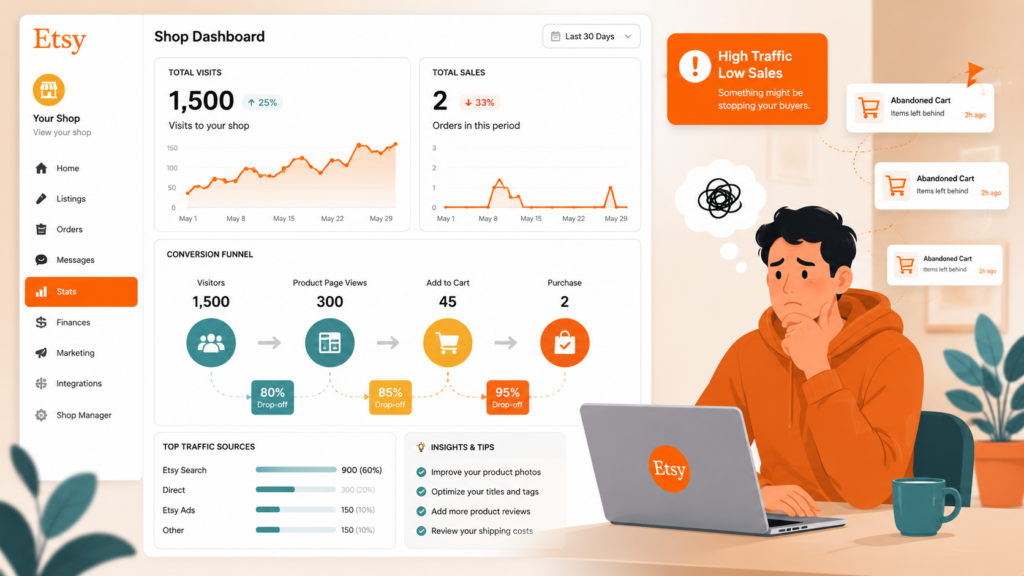
Why Your Etsy Shop Gets Traffic but No Sales
Getting visitors to your Etsy store is a major accomplishment—but it’s only half the battle. If your etsy shop gets traffic but no sales, the issue usually isn’t visibility. It’s conversion. Many sellers spend months improving SEO, only to discover that more traffic doesn’t automatically lead to more orders.
Understanding the difference between attracting shoppers and convincing them to buy is the first step toward building a profitable Etsy business.
The Difference Between Traffic and Conversions
Traffic measures how many people visit your Etsy shop or listing. A conversion happens when one of those visitors completes a purchase. You can have thousands of monthly visitors and still struggle if your listings fail to inspire confidence or meet buyer expectations.
Think of it this way:
- Traffic answers: How many people found your shop?
- Conversions answer: How many people actually bought something?
Many sellers focus almost exclusively on increasing traffic through SEO and keywords. While that strategy is important, sustainable growth comes from improving what happens after someone clicks your listing.
Why Etsy Views but No Sales Is a Common Problem
Seeing Etsy views but no sales is far more common than most new sellers realize. Etsy shoppers compare multiple listings before making a purchase, and even small weaknesses can push them toward a competitor.
Some of the most common reasons include:
- Product photos don’t create enough trust.
- Titles attract the wrong audience.
- Descriptions answer features but not buyer questions.
- Pricing feels too high—or suspiciously low.
- Shipping costs or delivery estimates create hesitation.
- Reviews don’t provide enough social proof.
When sellers ask, “Why is my Etsy shop not making sales?“, the answer is rarely just one problem. Instead, several small issues combine to reduce buyer confidence throughout the shopping journey.
Many of these conversion issues become even more obvious when compared with higher-performing competitors. A detailed competitive analysis is covered in Why My Etsy Products Are Not Selling: 17 Reasons Competitors Keep Winning More Sales in 2026, which explains how product positioning, buyer trust, pricing, and listing quality influence purchasing decisions across the Etsy marketplace.
The Hidden Cost of Low Conversion Rates
A low conversion rate costs much more than missed sales. Every visitor who leaves without buying represents marketing effort, search visibility, and potential revenue that never turns into profit.
When Etsy traffic but no orders becomes a long-term pattern, it often leads to:
- Lower overall return on your SEO efforts.
- Slower business growth despite increasing traffic.
- Wasted time optimizing keywords instead of buyer experience.
- Reduced confidence when launching new products.
- Difficulty identifying which listings actually need improvement.
Many sellers assume they need more traffic when, in reality, converting existing visitors would produce a much larger impact on revenue.
What Successful Etsy Sellers Do Differently
Top-performing Etsy sellers understand that SEO gets shoppers through the front door—but conversion optimization closes the sale.
Instead of chasing views alone, they consistently:
- Use high-quality images that answer buyer questions before they’re asked.
- Write listings that focus on customer benefits rather than product features.
- Build trust with detailed policies, authentic reviews, and consistent branding.
- Price products based on perceived value instead of simply undercutting competitors.
- Regularly test photos, descriptions, and pricing to improve performance.
- Monitor conversion metrics as closely as traffic metrics.
If your etsy shop gets traffic but no sales, don’t assume your SEO has failed. In many cases, your keywords are doing exactly what they’re supposed to do—they’re bringing qualified shoppers to your listings. The real opportunity lies in improving the shopping experience so visitors feel confident enough to buy.
Once you begin optimizing for conversions instead of traffic alone, you’ll better understand why Etsy customers don’t buy and, more importantly, how to increase Etsy conversion rate without relying on a constant stream of new visitors.
11 Hidden Reasons Why Etsy Customers Don’t Buy
If your etsy shop gets traffic but no sales, the problem often isn’t visibility—it’s what shoppers experience after they click. Many sellers spend months improving SEO only to realize their listings still fail to convert. Below are five of the most common reasons why Etsy customers don’t buy, along with practical ways to fix each one.
Reason 1: Your Product Photos Don’t Build Trust
Your product photos are the first impression buyers have of your shop. Even if your listing ranks well in Etsy search, low-quality or unclear images can instantly create doubt. This is one of the biggest reasons sellers experience Etsy views but no sales.
Common photo mistakes include:
- Dark or poorly lit images
- Low-resolution or blurry photos
- Busy backgrounds that distract from the product
- Missing lifestyle images showing real-world use
- Not including close-up shots of important details
Today’s shoppers expect to understand exactly what they’re buying before they spend a dollar. If your photos don’t answer their questions, they’ll simply move on to another seller.
To improve trust:
- Use bright, natural lighting whenever possible.
- Show the product from multiple angles.
- Include size comparison images.
- Add lifestyle photos that help buyers imagine owning the item.
- Highlight unique features with detailed close-ups.
Better photos don’t just attract clicks—they convince hesitant shoppers that your product is worth purchasing.
Reason 2: Your Listings Don’t Match Buyer Intent
Getting found in search is only half the battle. If your listing doesn’t deliver what shoppers expect after clicking, they’ll leave without buying.
Many sellers optimize for high-volume keywords but overlook search intent. That’s why Etsy traffic but no orders remains a frustrating reality for many shops.
For example:
- A buyer searching for a “minimalist wedding invitation template” expects modern, editable digital files—not floral printable cards.
- Someone looking for a personalized gift wants customization options clearly explained.
- Buyers searching for handmade products expect authentic craftsmanship, not generic descriptions.
When your title, thumbnail, photos, and description send mixed signals, shoppers lose confidence quickly.
To better match buyer intent:
- Write titles that accurately describe the product.
- Use photos that reflect exactly what’s being sold.
- Clearly explain materials, dimensions, personalization, and delivery.
- Focus on solving the customer’s problem instead of stuffing keywords.
The closer your listing aligns with shopper expectations, the higher your conversion rate becomes.
Reason 3: Your Pricing Creates Buyer Hesitation
Price isn’t always the deciding factor—but perceived value is.
Many Etsy sellers immediately assume they’re charging too much when they ask, “Why is my Etsy shop not making sales?” In reality, both overpriced and underpriced products can discourage buyers.
High prices raise expectations. Low prices often create suspicion about quality.
Ask yourself:
- Does your pricing match similar products in your niche?
- Do your photos justify the price?
- Are shipping costs unexpectedly high?
- Is the value clearly explained?
Instead of competing solely on price, communicate value.
Show buyers:
- Premium materials
- Handmade craftsmanship
- Personalization options
- Gift-ready packaging
- Durability and longevity
When customers understand why your product costs what it does, they’re far more willing to purchase.
Reason 4: Your Shop Lacks Social Proof and Credibility
Trust is one of the strongest drivers of online sales.
Even if your etsy shop gets traffic but no sales, shoppers may simply not feel confident buying from a store they don’t know.
Buyers often look for evidence before making a purchase, including:
- Positive customer reviews
- High-quality product ratings
- Complete shop policies
- Professional branding
- A detailed About section
- Clear shop announcements
A shop with little credibility forces customers to take a risk. Most won’t.
Build stronger trust by:
- Encouraging satisfied customers to leave reviews.
- Responding professionally to buyer questions.
- Keeping your branding consistent across every listing.
- Completing every section of your Etsy shop profile.
- Displaying accurate processing times and policies.
The more trustworthy your shop appears, the easier it becomes to convert visitors into customers.
Reason 5: Your Shipping Policies Drive Customers Away
Shipping is one of the final hurdles before checkout—and often the reason buyers abandon their purchase.
Unexpected shipping fees, confusing delivery estimates, or vague return policies create unnecessary friction.
Warning signs include:
- High shipping costs compared to competitors
- Long processing times without explanation
- Unclear delivery estimates
- Complicated return or exchange policies
- Missing international shipping information
Modern shoppers expect transparency.
Improve your shipping strategy by:
- Showing estimated delivery dates upfront.
- Offering free shipping when financially possible.
- Combining shipping discounts for multiple purchases.
- Explaining processing times clearly.
- Writing easy-to-understand return policies.
Small improvements in shipping transparency can significantly improve buyer confidence and help increase Etsy conversion rate. When customers know exactly what to expect, they’re much more likely to complete their purchase instead of leaving your shop empty-handed.
More Reasons Your Etsy Traffic but No Orders Continues
Even after fixing photos, pricing, and trust signals, many sellers still wonder why their etsy shop gets traffic but no sales. The answer often lies in the finer details of your listings and overall shopping experience. These next six reasons are frequently overlooked but can have a major impact on your conversion rate.
Reason 6: Your Product Descriptions Don’t Sell Benefits
A surprising number of Etsy descriptions simply list features instead of explaining why those features matter.
For example, saying a mug is “made from 15-ounce ceramic” tells shoppers what it is. Saying it’s “large enough for your morning coffee and built to keep your favorite drink warmer longer” explains why they should care.
Strong product descriptions should:
- Solve a customer’s problem.
- Answer common buying questions.
- Highlight quality and craftsmanship.
- Explain how the product improves everyday life.
- End with a confident purchasing message.
Avoid giant blocks of text. Use short paragraphs, bullet points, and easy-to-scan formatting. Buyers often skim before they read.
When customers immediately understand the value of your product, they’re much more likely to move from browsing to buying.
Reason 7: Your Variations Confuse Buyers
Too many choices can reduce sales instead of increasing them.
Many Etsy sellers offer multiple sizes, colors, materials, fonts, or personalization options without clearly explaining the differences. Instead of feeling excited, shoppers become overwhelmed and postpone their decision.
Common problems include:
- Unclear size charts.
- Similar color names with no visual examples.
- Personalization instructions that are difficult to follow.
- Missing preview images for different options.
- Required selections that confuse first-time buyers.
Simplify the buying process by:
- Using easy-to-understand option names.
- Including reference photos for every variation.
- Providing measurement guides.
- Showing personalization examples.
- Removing unnecessary choices whenever possible.
A simple checkout experience reduces hesitation and helps eliminate Etsy traffic but no orders.
Reason 8: Your Listings Target the Wrong Audience
Not every visitor is your ideal customer.
Many sellers focus entirely on getting more clicks without asking whether those clicks come from people who actually want to buy. That’s one reason Etsy views but no sales can happen even when traffic continues to grow.
Ask yourself:
- Who is this product designed for?
- Does my title speak directly to that buyer?
- Do my photos match their style?
- Does my description address their needs?
For example, a minimalist home decor product should attract shoppers looking for modern interiors—not customers searching for colorful farmhouse decorations.
The more accurately your listings target the right audience, the higher your conversion rate will be.
Reason 9: Your Shop Isn’t Mobile-Friendly
More than half of Etsy shoppers browse and purchase from their phones.
If your listings are difficult to read on a small screen, buyers may leave before they even finish reviewing your product.
Watch for issues such as:
- Long, cluttered descriptions.
- Important details hidden at the bottom.
- Tiny text inside product images.
- Photos that don’t clearly show the product on mobile devices.
- Confusing formatting.
Optimize every listing for mobile users by:
- Writing short paragraphs.
- Using bullet points.
- Placing key information near the top.
- Making your first image clean and eye-catching.
- Ensuring every photo remains clear on smaller screens.
A better mobile experience directly contributes to how to increase Etsy conversion rate.
Reason 10: Your Competitors Offer More Value
Buyers rarely compare just one product.
Before making a purchase, many shoppers open several Etsy listings and evaluate them side by side. If another seller offers better value—even at a slightly higher price—you could lose the sale.
Compare your listings with top competitors by looking at:
- Product photography.
- Number of images.
- Customer reviews.
- Processing times.
- Shipping costs.
- Product bundles.
- Branding.
- Overall presentation.
Value isn’t always about charging less.
You can stand out by offering:
- Premium packaging.
- Bonus digital downloads.
- Gift-ready options.
- Faster shipping.
- Better personalization.
- Outstanding customer service.
The goal is to give shoppers a compelling reason to choose your shop over dozens of similar listings.
Reason 11: You Aren’t Giving Buyers a Reason to Buy Now
Many shoppers intend to purchase later—but later often turns into never.
Without urgency or a strong reason to act today, customers may favorite your product and forget about it entirely.
Effective ways to encourage immediate purchases include:
- Limited-time sales.
- Seasonal collections.
- Holiday deadlines.
- Low-stock notifications.
- Free shipping promotions.
- Product bundles with added value.
Avoid fake urgency or misleading scarcity. Modern shoppers recognize those tactics quickly, and they can damage your credibility.
Instead, focus on genuine reasons to purchase now while reinforcing the value your product provides.
When urgency is paired with trust, strong photography, competitive pricing, and clear product messaging, you’ll dramatically reduce the chances that your etsy shop gets traffic but no sales.
Fixing these hidden issues helps answer the question, “Why is my Etsy shop not making sales?” and creates a smoother path from visitor to loyal customer.
Why Is My Etsy Shop Not Making Sales? How to Diagnose the Real Problem
If your etsy shop gets traffic but no sales, guessing won’t solve the problem. Successful Etsy sellers rely on data—not assumptions—to identify what’s preventing visitors from becoming buyers. Before changing your pricing, SEO, or product lineup, take a systematic look at how shoppers interact with your store.
Check Your Etsy Conversion Rate First
Your conversion rate tells you how effectively your shop turns visitors into customers. A listing with strong traffic but weak conversions signals that your SEO is attracting people, but your listing isn’t convincing them to purchase.
Start by reviewing:
- Total visits versus total orders
- Conversion rate by listing
- Best-selling versus low-performing products
- Seasonal performance trends
Many sellers experiencing Etsy views but no sales focus exclusively on increasing traffic when the real opportunity lies in improving conversion performance. Even a modest increase in conversion rate can produce more sales without generating a single additional visitor.
Analyze Traffic Sources and Buyer Behavior
Not all traffic has the same value. Understanding where your visitors come from helps explain why your Etsy traffic but no orders problem exists.
Pay attention to:
- Etsy Search traffic
- Etsy Ads traffic
- Pinterest or social media visitors
- Google Search traffic
- Direct visitors returning to your shop
Ask yourself a simple question: Are these visitors actively looking to buy, or are they simply browsing for ideas?
For example, shoppers arriving from a highly specific Etsy search often have stronger purchase intent than someone casually clicking through social media. Matching your listings to buyer intent can dramatically improve sales.
Review Your Search Terms and Customer Intent
One of the biggest reasons sellers ask, “Why is my Etsy shop not making sales?”, is because they’re ranking for the wrong keywords.
A keyword may generate thousands of searches while attracting shoppers who want something completely different from what you’re selling.
Review whether your titles, tags, and descriptions match the intent behind the search:
- Are buyers looking for handmade or digital products?
- Are they shopping for gifts or personal use?
- Are they comparing options or ready to purchase today?
- Does your primary image match what shoppers expect to see?
When your keywords align with customer intent, your listings attract visitors who are far more likely to convert.
Audit Your Listings Like a First-Time Shopper
It’s surprisingly easy to overlook problems when you’ve looked at your own listings hundreds of times.
Open your listing in a private browser window and evaluate it as if you’ve never seen it before.
Ask yourself:
- Does the first photo instantly communicate value?
- Is the title easy to understand?
- Are the product benefits obvious within seconds?
- Is pricing competitive without appearing suspiciously low?
- Would you personally trust this shop enough to spend money?
This exercise often reveals small friction points that explain why Etsy customers don’t buy, even when your listings receive steady traffic.
For a deeper breakdown of common conversion mistakes and practical optimization strategies, see our editorial guide, Why Your Etsy Shop Gets No Sales (Fix It Using 15 AI Prompts That Actually Work). It expands on many of the issues discussed here with AI-assisted workflows designed to streamline listing improvements.
Compare Your Shop Against Top Competitors
Your customers aren’t evaluating your listings in isolation. They’re comparing them with dozens of similar products before making a purchase.
Study the highest-performing competitors in your niche and compare:
- Product photography quality
- Listing titles
- Pricing strategy
- Product descriptions
- Customer reviews
- Shipping options
- Shop branding
- Frequently asked questions
Don’t copy successful shops. Instead, identify the standards buyers have come to expect and look for opportunities to exceed them.
If your etsy shop gets traffic but no sales, a competitive audit often exposes weaknesses that aren’t obvious from inside your own business. Combined with conversion data and customer intent analysis, this approach gives you a clear roadmap for deciding what to optimize first—and ultimately how to increase Etsy conversion rate with changes backed by evidence rather than guesswork.
How to Increase Etsy Conversion Rate Without Buying More Traffic
If your etsy shop gets traffic but no sales, the answer usually isn’t to chase more visitors—it’s to convert the ones you already have. Even a small increase in your conversion rate can significantly boost revenue without spending more on ads or SEO. The strategies below focus on turning existing traffic into paying customers by improving the shopping experience from the first click to checkout.
Optimize Your Listing Photos for Higher Conversions
Product photos are often the deciding factor between a sale and a lost customer. Buyers can’t touch or test your product, so your images must eliminate uncertainty and build confidence immediately.
To increase conversions:
- Make your first image clean, bright, and attention-grabbing.
- Show the product from multiple angles.
- Include close-up shots to highlight quality and craftsmanship.
- Add lifestyle images that demonstrate the product in real use.
- Include size comparison photos whenever dimensions matter.
Many cases of Etsy views but no sales happen because shoppers can’t clearly understand what they’re buying. Great photography answers questions before they’re asked and reduces hesitation.
Remember, your photos should sell the experience—not just the product.
Write Titles and Descriptions That Persuade Buyers
SEO gets shoppers to your listing. Persuasive copy convinces them to purchase.
A strong Etsy title should accurately describe the product while matching the words buyers actually search for. Once they land on your listing, your description should explain why the product solves their problem or improves their life.
Effective product descriptions should:
- Lead with the biggest customer benefit.
- Clearly explain features and materials.
- Answer common buyer questions.
- Set realistic expectations.
- End with reassurance about quality and customer support.
If you’re wondering, “Why is my Etsy shop not making sales?”, weak product copy is often one of the biggest hidden reasons.
For sellers looking to improve listing optimization beyond basic SEO, our editorial guide, Etsy Listings Not Ranking? Use These 16 AI Prompts to Fix It Fast (2026 Guide), explains practical ways to strengthen titles, descriptions, and keyword targeting while maintaining a natural shopping experience.
Build Trust with Reviews, Policies, and Branding
Customers rarely buy from a shop they don’t trust.
When etsy shop gets traffic but no sales becomes a recurring problem, credibility is one of the first areas to audit.
Focus on building buyer confidence by:
- Displaying authentic customer reviews.
- Completing every shop policy section.
- Adding a professional shop banner and logo.
- Writing an engaging “About” section.
- Responding politely and promptly to customer messages.
Trust signals reduce perceived risk. When buyers feel confident they’ll receive exactly what they expect, conversions naturally improve.
Improve Pricing, Offers, and Shipping Strategy
Pricing isn’t just about being cheaper than competitors. It’s about communicating value.
Many sellers experiencing Etsy traffic but no orders unknowingly create friction through confusing pricing or unexpected shipping costs.
Review these areas regularly:
- Compare your pricing with similar top-performing listings.
- Bundle complementary products to increase perceived value.
- Offer free shipping when financially practical.
- Be transparent about processing times.
- Clearly communicate return and exchange policies.
Buyers appreciate predictability. Eliminating surprises during checkout often leads to higher conversion rates.
Test, Measure, and Continuously Improve Your Listings
Successful Etsy sellers rarely assume their listings are “finished.” They continually test, analyze, and refine based on real customer behavior.
Monitor key performance metrics such as:
- Listing conversion rate
- Click-through rate
- Favorites versus purchases
- Cart abandonment trends
- Traffic source performance
Small adjustments can produce meaningful improvements over time. Test one change at a time—such as updating your primary photo, refining a title, or improving product descriptions—then measure the results before making additional changes.
Knowing how to increase Etsy conversion rate is an ongoing process, not a one-time fix. When you consistently optimize every part of the buyer journey, you’ll often discover that the solution to etsy shop gets traffic but no sales isn’t more traffic at all—it’s creating a shopping experience that makes customers feel confident enough to click Buy Now.
Final Takeaways: Turn Etsy Traffic into Consistent Sales
Getting visitors is only half the battle. If your etsy shop gets traffic but no sales, the problem usually isn’t visibility—it’s conversion. Every click represents a potential customer who trusted your listing enough to visit. Your goal now is to remove the friction that prevents them from completing a purchase.
Instead of chasing more traffic, focus on improving the experience your current visitors have. Small improvements to your listings, branding, pricing, and customer trust signals can dramatically increase conversions over time. If you’re experiencing Etsy views but no sales, the strategies in this guide provide a practical roadmap for turning browsers into buyers.
Quick Checklist to Fix Low-Converting Listings
Before spending money on ads or creating more products, audit your existing listings.
- □ Use high-quality, professional product photos that clearly show every angle.
- □ Make your main image stand out in Etsy search results.
- □ Write keyword-rich titles that also appeal to human buyers.
- □ Focus descriptions on benefits, not just features.
- □ Clearly explain sizing, materials, and customization options.
- □ Review your pricing against similar successful listings.
- □ Offer competitive shipping whenever possible.
- □ Complete every shop policy section.
- □ Collect and showcase positive customer reviews.
- □ Test your listings on mobile devices.
- □ Improve weak listings before publishing new ones.
If your Etsy traffic but no orders continues after completing this checklist, review your analytics to identify where shoppers are dropping off. For a deeper optimization process, you can also reference our complete Etsy SEO checklist while auditing your listings.
The Biggest Mistakes to Avoid Going Forward
Many sellers unintentionally repeat the same mistakes that limit long-term growth. Avoid these common pitfalls:
- Prioritizing traffic over conversions.
- Constantly changing keywords before gathering enough data.
- Using low-quality or inconsistent product photography.
- Ignoring customer questions and reviews.
- Copying competitors instead of creating a unique value proposition.
- Pricing based only on cost instead of perceived value.
- Neglecting seasonal updates and listing refreshes.
If you’ve been wondering, “Why is my Etsy shop not making sales?”, remember that success usually comes from consistently improving dozens of small details—not finding one magic trick.
Ready to Turn More Visitors Into Paying Customers?
If you’ve made it this far, you already know that getting traffic isn’t the hardest part—converting that traffic into sales is. While the tips in this article can help you fix common conversion problems, long-term growth requires a complete SEO strategy that attracts qualified buyers and ranks your products consistently.
That’s exactly why I created The Ultimate Shopify SEO Blueprint for 2026—a step-by-step playbook designed to help online sellers increase organic traffic, optimize product pages, improve conversion rates, and build a sustainable sales engine without relying entirely on paid ads.
Inside the eBook, you’ll learn how to:
- Build an SEO strategy that attracts high-intent buyers
- Find profitable keywords your competitors miss
- Optimize product pages for Google and AI-powered search
- Improve store architecture and technical SEO
- Increase conversions with proven on-page optimization techniques
- Create a long-term growth system for consistent ecommerce sales
If you’re serious about growing your ecommerce business beyond Etsy—or you’re already selling on Shopify—this guide will save you months of trial and error.
👉 Get your copy of The Ultimate Shopify SEO Blueprint for 2026 here:
Shopify SEO eBook – Sales Page
Your 30-Day Etsy Conversion Improvement Plan
Rather than changing everything at once, follow a simple month-long improvement strategy.
Week 1: Audit Your Shop
- Review your lowest-converting listings.
- Compare them with top competitors.
- Identify missing trust signals and weak photos.
Week 2: Improve Listings
- Rewrite titles and descriptions.
- Replace outdated product images.
- Clarify shipping, returns, and personalization options.
Week 3: Build Buyer Confidence
- Request reviews from recent customers.
- Update your shop banner and About section.
- Strengthen your branding across every listing.
Week 4: Measure and Optimize
- Monitor Etsy Shop Stats.
- Track conversion rate improvements.
- Continue testing one change at a time.
Following a structured plan makes it much easier to understand how to increase Etsy conversion rate without wasting time or advertising budget.
Frequently Asked Questions About Etsy Sales and Conversions
Why does my Etsy shop get traffic but no sales?
This usually indicates a conversion problem rather than a visibility problem. Common causes include weak product photos, unclear descriptions, pricing issues, lack of trust signals, or listings that don’t match buyer intent.
Is Etsy views but no sales normal for new shops?
Yes. New shops often need time to build credibility through reviews, consistent branding, and optimized listings. However, regular traffic without purchases should prompt a full listing audit.
How can I increase my Etsy conversion rate?
Focus on improving listing quality instead of simply increasing traffic. Better images, persuasive descriptions, competitive pricing, strong reviews, and transparent shop policies all contribute to higher conversion rates.
Why do Etsy customers don’t buy even after clicking?
Shoppers may leave because they don’t trust the listing, find the price too high, don’t understand the product, see expensive shipping, or find a better alternative before checking out.
Should I focus on SEO or conversion optimization first?
Both matter, but if your etsy shop gets traffic but no sales, conversion optimization should become your priority. Bringing in more visitors won’t increase revenue unless your listings convince buyers to complete the purchase.
1 thought on “Etsy Shop Gets Traffic but No Sales? 11 Hidden Reasons Nobody Is Buying (And How to Fix Them)”