
Many Etsy sellers reach a frustrating point where their Etsy shop isn’t growing feels less like a temporary setback and more like a mystery. You keep adding listings, refining keywords, updating photos, and showing up every day—yet your traffic barely moves and sales remain unpredictable. After weeks or even months of effort, it’s easy to wonder, Why is my Etsy shop stagnant? More importantly, why do other shops seem to gain momentum while yours stays stuck?
The truth is, hard work alone doesn’t guarantee growth on Etsy. Small issues that are easy to overlook—like weak search intent, inconsistent branding, low click-through rates, or listing optimization gaps—can quietly limit your shop’s potential. That’s also why so many sellers search for answers to questions like why my Etsy shop isn’t getting sales, even when they’re doing everything they believe is “right.” The good news is that most growth problems are fixable once you know what to look for.
In this guide, you’ll uncover the hidden reasons your shop may have plateaued, learn practical Etsy shop growth tips backed by current best practices, and discover the changes that can create steady, long-term progress instead of short-lived spikes. Whether you’ve just opened your shop or you’ve been selling for years, the next section will help you identify where your growth is stalling—and what to do about it.
Is Your Etsy Shop Not Growing? Start by Identifying the Real Problem
Feeling stuck is one of the most frustrating parts of running an Etsy business. You spend hours creating products, updating listings, researching keywords, and checking your analytics, yet your shop doesn’t seem to move forward. Before changing your entire strategy, take a step back. The first goal isn’t to fix your shop—it’s to accurately identify what’s actually holding it back.
Many sellers assume every slow period means failure, but that’s rarely the case. The difference between temporary slow growth and a truly stagnant shop determines what actions you should take next.
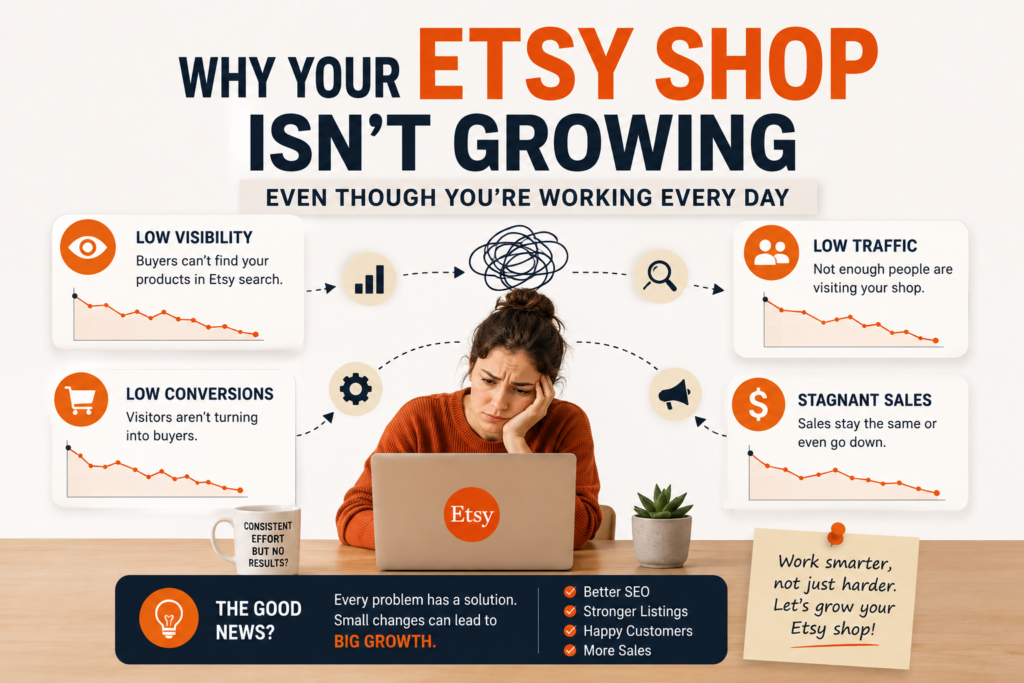
The Difference Between Slow Growth and a Stagnant Etsy Shop
One of the biggest misconceptions among new sellers is believing that every week without sales means something is broken. In reality, Etsy shops grow at different speeds depending on factors like competition, product demand, pricing, and listing quality.
A slow-growing shop still shows signs of progress. You might notice:
- More impressions over time
- Gradually increasing visits
- A few new favorites each week
- Occasional sales from different listings
- Improving keyword rankings
Growth may feel slow, but the trend is moving in the right direction.
A stagnant shop, on the other hand, shows little or no meaningful improvement. Common warning signs include:
| Slow Growth | Stagnant Shop |
| Traffic gradually increases | Traffic stays flat for months |
| New keywords begin ranking | Listings rarely appear in search |
| Favorites continue growing | Very few favorites or carts |
| Conversion rate improves over time | Visitors leave without buying |
| Sales become more consistent | Sales depend on luck or one listing |
Understanding this difference answers an important question many sellers ask: “Why is my Etsy shop stagnant?” The answer usually isn’t a lack of effort—it’s that one or more growth factors have stopped improving.
For example, imagine two shops selling printable planners. Both publish two new listings every week.
- Shop A studies customer search behavior, improves product photos, and updates titles based on performance data.
- Shop B simply uploads more products using the same optimization process every time.
After several months, Shop A gains momentum while Shop B remains almost unchanged. The amount of work was similar, but the quality and direction of that work were completely different.
Why Hard Work Doesn’t Always Translate Into More Sales
Many Etsy sellers believe consistency alone guarantees success. While consistency matters, productive work matters far more than busy work.
It’s easy to spend several hours every day on tasks that don’t directly improve visibility or conversions. Examples include:
- Constantly rewriting product descriptions
- Refreshing listings every few days
- Watching competitors instead of customers
- Frequently changing prices without data
- Checking analytics multiple times a day
These activities create the feeling of progress, but they often produce little measurable impact.
Instead, ask yourself a different question:
“Is the work I’m doing helping more qualified buyers find and trust my products?”
That’s the question Etsy’s search algorithm ultimately rewards.
If you’re wondering why my Etsy shop isn’t getting sales, remember that traffic and sales are influenced by multiple connected factors:
- Buyers must first discover your listings.
- Your photos and titles must earn the click.
- Your listing must answer the buyer’s questions.
- Pricing and reviews must build confidence.
- The product must match the shopper’s expectations.
A weakness at any stage can reduce overall growth.
This is why successful Etsy sellers don’t obsess over working longer hours—they focus on improving the parts of their shop that have the greatest impact.
If your shop has experienced declining performance after previous success, our guide on Etsy Sales Down? You’re Doing Everything “Right”—So Why Are Sales Getting Worse? explores additional causes that affect established shops and how to recover from them.
Which Etsy Metrics Actually Measure Shop Growth?
Many beginners judge success using only one metric: sales.
Sales matter, but they’re the result of several earlier performance indicators. Looking only at revenue makes it difficult to identify where the problem begins.
Instead, monitor these key metrics together:
| Metric | Why It Matters |
| Impressions | Shows how often Etsy displays your listings in search. |
| Visits | Indicates whether buyers are clicking your listings. |
| Click-Through Rate (CTR) | Measures how effective your thumbnails and titles are. |
| Favorites | Signals buyer interest even before a purchase. |
| Conversion Rate | Reveals how many visitors become customers. |
| Revenue Per Listing | Helps identify your strongest-performing products. |
Here’s a simple way to interpret your numbers:
- Low impressions usually point to keyword or SEO issues.
- High impressions but few clicks suggest your photos or titles aren’t compelling enough.
- Plenty of visits but no purchases often indicate pricing, trust, or listing quality problems.
- Strong conversion on a few listings means you have a repeatable strategy worth expanding.
Rather than asking, “How long does it take an Etsy shop to grow?” consider asking:
“Which metric improved this month compared to last month?”
Even small improvements in impressions, CTR, or conversion rate can compound into meaningful sales growth over time.
For additional guidance on understanding traffic and search performance, the Etsy Seller Handbook offers detailed explanations of Etsy search and shop analytics, while Google Search Central provides helpful principles for creating useful, user-focused content that aligns with modern search expectations.
AI Prompt: Diagnose Why Your Etsy Shop Isn’t Growing
Use the following prompt with ChatGPT, Gemini, Claude, or another AI assistant to perform a structured review of your shop.
Prompt:
Act as an experienced Etsy SEO consultant. Analyze my Etsy shop based on the following information: niche, number of listings, average monthly views, visits, conversion rate, favorites, top-performing products, pricing, product photos, titles, tags, descriptions, and recent sales trends. Identify the top five reasons my Etsy shop is not growing, prioritize them by impact, explain why each issue matters, and provide a practical action plan with quick wins and long-term improvements. Present the results as a prioritized checklist with clear next steps.
Why Your Etsy Shop Isn’t Getting Sales Even When You’re Doing Everything Right
Putting in consistent effort should lead to progress—but on Etsy, effort alone isn’t enough. Many sellers spend hours researching products, creating listings, updating keywords, and promoting their shops, only to wonder, “Why is my Etsy shop stagnant?” The answer is usually not a lack of hard work. Instead, it’s a series of small optimization gaps that quietly reduce your visibility, lower buyer engagement, and hurt conversions.
If your Etsy shop is not growing despite regular activity, start by looking at the three stages every successful listing must pass: getting discovered, earning the click, and converting visitors into buyers. A weakness at any stage can dramatically limit your sales.
Weak Keyword Targeting That Keeps Buyers From Finding You
One of the biggest reasons Etsy listings struggle is that they target the wrong keywords—or they target the right keywords in the wrong way.
Many beginners choose keywords based on what they would search instead of what real buyers type into Etsy. Others focus only on high-volume phrases that are so competitive their listings never gain visibility.
For example, a seller offering printable meal planners might target:
- Printable planner
- Planner PDF
- Digital planner
These keywords are broad and highly competitive.
A better strategy is to match specific buyer intent with phrases such as:
- Printable meal planner for busy moms
- Weekly meal planner PDF
- Undated digital meal planner
- Printable grocery and meal planner bundle
Specific keywords often attract shoppers who are much closer to making a purchase.
A healthy keyword strategy should include:
- Primary keyword in the listing title
- Related keywords throughout the description
- Natural keyword variations in tags
- Search terms that match how buyers actually shop
Before choosing keywords, spend time studying Etsy search suggestions, competitor listings, and buyer language. Combining those insights with keyword research tools creates a much stronger foundation than relying on guesses.
Low Click-Through Rates Caused by Photos, Titles, and Pricing
Getting impressions is only half the battle. Buyers still need a reason to click.
Even listings that rank well can underperform when their click-through rate (CTR) is low. Etsy’s search system pays attention to shopper behavior, so listings that consistently earn more clicks often gain additional visibility over time.
Ask yourself:
- Does your main photo stand out against competing listings?
- Does your title clearly communicate value instead of stuffing keywords?
- Is your pricing competitive for your niche?
- Do buyers immediately understand what they’re purchasing?
Imagine two nearly identical listings appearing side by side.
| Listing A | Listing B |
| Bright, professional hero image | Dark, cluttered thumbnail |
| Benefit-focused title | Keyword-heavy title |
| Clear pricing strategy | Price far above competitors |
| Strong first impression | Confusing presentation |
Most shoppers will choose Listing A within seconds.
Remember that buyers don’t compare every listing equally. They scan quickly and make snap judgments based on visual trust, clarity, and perceived value.
If your listings receive views but few purchases, the issue may extend beyond traffic. In that case, our guide on Etsy Views But No Sales? 17 Reasons Visitors Aren’t Buying (And How to Turn Clicks Into Customers) explains what happens after shoppers land on your listing and why many leave without buying.
Conversion Problems That Turn Visitors Into Lost Opportunities
Sometimes visibility isn’t the problem at all.
Your listings may attract visitors, but they fail to build enough confidence for someone to complete a purchase. This is where conversion optimization becomes essential.
Common conversion barriers include:
- Low-quality or inconsistent product photos
- Vague descriptions that leave important questions unanswered
- Missing size, material, or download details
- Weak shop branding
- Limited reviews or social proof
- Unclear processing or delivery expectations
Every unanswered question creates friction.
For example, a buyer purchasing a personalized gift wants reassurance before spending money. If your listing doesn’t clearly explain customization options, turnaround time, or what’s included, many shoppers will simply return to search results and choose another seller.
A simple conversion checklist can reveal hidden issues:
- Is the product benefit immediately obvious?
- Are the first few photos informative and professional?
- Does the description answer common buyer questions?
- Is pricing consistent with the value you provide?
- Does your shop inspire trust through branding and customer experience?
Small improvements across several areas often produce better results than making one major change.
Research from the Nielsen Norman Group has consistently shown that users make rapid judgments based on visual design, clarity, and ease of understanding. Those same principles apply to Etsy listings, where first impressions influence whether shoppers stay or leave.
By thinking like a buyer instead of a seller, you’ll uncover issues that analytics alone can’t reveal.
AI Prompt: Audit Your Etsy Listings for Hidden Growth Bottlenecks
Instead of manually reviewing every listing, use AI to perform a structured audit that highlights weaknesses affecting visibility, clicks, and conversions.
Prompt:
Act as an Etsy SEO consultant with expertise in marketplace optimization. Review my Etsy listing using current Etsy SEO best practices. Analyze keyword targeting, title quality, tags, product description, featured image, pricing, buyer trust signals, conversion potential, and overall listing quality. Identify every issue that could prevent my listing from ranking or converting. Then prioritize the problems from highest to lowest impact and provide clear, actionable recommendations with examples for improvement. Finally, create a 30-day optimization plan designed to increase search visibility, click-through rate, and sales.
How to Grow an Etsy Shop in 2026 With a Smarter SEO Strategy
Growing an Etsy shop today isn’t about finding a secret algorithm hack. It’s about creating listings and a shopping experience that align with how real buyers search, compare, and purchase products. If your etsy shop is not growing despite consistent effort, the solution is usually a smarter strategy—not simply working longer hours.
Many sellers focus almost exclusively on adding keywords to titles and tags. While keywords matter, Etsy’s search system has become much better at understanding buyer intent and rewarding listings that earn clicks, favorites, and purchases. That means your SEO strategy should help shoppers find your products and convince them to buy once they do.
Build Listings Around Buyer Search Intent, Not Just Keywords
One of the biggest reasons sellers struggle with visibility is that they optimize for words instead of people.
Imagine someone searching for “minimalist wedding invitation template.” They aren’t just looking for those exact words—they want a clean design, instant download, editable files, and confidence that the template will look professional.
A listing built around search intent answers those expectations before the shopper even asks.
Instead of creating listings based only on keyword volume, ask yourself:
- What problem is the buyer trying to solve?
- What questions will they have before purchasing?
- What information helps them feel confident?
- Which product features matter most to this audience?
When your listing matches buyer intent, Etsy is more likely to reward it with stronger engagement signals.
A well-optimized listing should include:
| Listing Element | Focus on Search Intent |
| Title | Describe exactly what the buyer wants |
| Photos | Show benefits, not just the product |
| Description | Answer common purchase questions |
| Tags | Match real customer search phrases |
| Attributes | Improve discoverability through accurate categorization |
This approach also helps answer the common question, “Why is my Etsy shop not getting sales?” Often, the issue isn’t that buyers can’t find your products—they simply don’t see enough value once they arrive.
If you want additional ideas for researching better keywords and writing stronger listings, our guide on Chat GPT Prompts for Etsy SEO offers practical AI-assisted workflows that complement this strategy.
Create a Shop That Etsy’s Algorithm Trusts
Many beginners assume Etsy ranks listings individually. In reality, Etsy also evaluates your shop’s overall performance.
Think of your shop as a brand rather than a collection of unrelated products.
Several factors work together to build trust over time:
- Consistent listing quality
- High-quality product photography
- Competitive pricing
- Positive customer reviews
- Fast response times
- Complete shop policies
- Accurate product information
- Reliable fulfillment
These elements influence shopper confidence, which directly affects engagement metrics like click-through rate and conversion rate.
For example:
Two sellers offer nearly identical digital planners.
Seller A has professional branding, detailed descriptions, FAQ sections, and hundreds of positive reviews.
Seller B has inconsistent photos, vague descriptions, and incomplete policies.
Even with similar keywords, Seller A is far more likely to earn clicks, favorites, and purchases—signals that reinforce Etsy’s confidence in the shop.
Another important factor is listing consistency.
Instead of uploading twenty products in one weekend and disappearing for two months, establish a predictable publishing schedule. Regular updates signal that your shop remains active and give Etsy more opportunities to evaluate new listings.
It’s also worth reviewing guidance from the Etsy Seller Handbook, which shares best practices directly from Etsy on improving shop quality and customer experience.
Improve Every Stage of the Customer Journey for Higher Conversions
Getting traffic is only half the challenge.
The real growth happens when more visitors become buyers.
Many sellers asking “why is my Etsy shop stagnant” focus entirely on SEO while overlooking conversion optimization.
Think about the complete buying journey.
Discovery
Can shoppers easily find your listing?
First Impression
Does your thumbnail immediately stand out among competing products?
Evaluation
Can buyers quickly understand what makes your product different?
Trust
Do reviews, policies, branding, and product images reduce purchase anxiety?
Purchase
Is the buying decision simple and friction-free?
Improving each stage creates compound results.
For example:
- Better thumbnails increase click-through rates.
- Stronger descriptions improve buyer confidence.
- Lifestyle images reduce uncertainty.
- Clear FAQs minimize hesitation.
- Fast customer support encourages positive reviews.
Small improvements across every step often outperform dramatic changes to a single listing element.
A useful weekly checklist includes:
- Review your lowest-performing listings.
- Update one product title based on buyer intent.
- Improve one featured image.
- Rewrite one product description for clarity.
- Add answers to common customer questions.
- Analyze which listings receive views but few purchases.
This continuous improvement process is one of the most practical Etsy shop growth tips because it compounds over time instead of relying on quick wins.
If you’re wondering how long it takes an Etsy shop to grow, there’s no universal timeline. Shops that consistently improve search visibility, conversion rates, and customer satisfaction typically build momentum much faster than those making random changes. Sustainable growth comes from measuring results, learning from buyer behavior, and refining your shop month after month.
AI Prompt: Generate an Etsy SEO Growth Plan for Any Product
Instead of guessing what to improve next, use AI to create a structured optimization roadmap tailored to your listing.
Prompt:
Act as an Etsy SEO expert specializing in the US marketplace. Analyze my product information and create a detailed Etsy SEO growth plan. Identify the ideal buyer persona, search intent, primary keyword, long-tail keywords, optimized title suggestions, tag recommendations, listing description improvements, photo ideas, pricing recommendations, trust-building elements, and conversion optimization opportunities. Then provide a prioritized 30-day action plan explaining which improvements will have the greatest impact on traffic, click-through rate, and sales. Base every recommendation on Etsy SEO best practices for 2026 and explain why each change matters.
Etsy Shop Growth Tips That Deliver Consistent Long-Term Results
Growing an Etsy shop isn’t about finding one magic trick or chasing the latest algorithm update. The shops that consistently gain traffic and sales usually improve dozens of small factors over time. If your Etsy shop not growing has become a recurring frustration, it’s worth shifting your focus from quick wins to sustainable habits that compound month after month.
Focus on Quality Listings Instead of Constant Publishing
Many new sellers believe that uploading more products automatically leads to more sales. While expanding your catalog can increase visibility, publishing low-quality listings simply to stay active often produces disappointing results.
Instead, treat every listing like an individual landing page designed to attract, persuade, and convert buyers.
A high-quality Etsy listing should include:
- A keyword-focused title written for both search engines and shoppers
- Clear, professional product photos that answer buyer questions
- A compelling description that highlights benefits before features
- Accurate tags covering primary and long-tail search terms
- Competitive pricing that reflects perceived value
- Complete attributes and categories
For example, imagine two shops selling printable wedding invitations.
- Shop A uploads 30 listings in one week with similar titles, average photos, and generic descriptions.
- Shop B publishes eight carefully optimized listings with unique keywords, polished images, and detailed descriptions that answer common buyer concerns.
Over time, Shop B often earns higher click-through rates, better conversion rates, and stronger customer engagement—all signals that help support long-term growth.
Another common mistake is making major edits every few days because sales haven’t appeared yet. Etsy’s search system needs time to gather performance data. Constantly changing titles, tags, and pricing makes it harder to understand what’s actually working.
A better workflow looks like this:
- Publish an optimized listing.
- Allow it to collect meaningful data.
- Review impressions, clicks, and conversions.
- Improve only the weakest elements.
- Repeat the process consistently.
If you’re struggling with keyword research or listing optimization, learning how to build better prompts can dramatically speed up your workflow. Our guide on ChatGPT Prompts for Etsy SEO explains how to generate keyword ideas, improve titles, and refine product listings with AI while keeping your content natural and buyer-focused.
Build Trust Through Branding, Reviews, and Customer Experience
Many sellers ask, “Why my Etsy shop isn’t getting sales?” even after improving their SEO. The answer often has little to do with keywords.
Buyers rarely purchase from the listing with the lowest price. They buy from the shop that feels trustworthy.
Think about your own online shopping habits. When two products appear similar, what influences your decision?
Usually it’s factors like:
- Professional branding
- Consistent photography
- Positive reviews
- Fast responses
- Clear policies
- Helpful product descriptions
These trust signals reduce purchase anxiety.
Strong branding also creates familiarity. Instead of making every listing look different, maintain consistency across:
- Product photography style
- Color palette
- Logo
- Banner
- Product mockups
- Writing style
When shoppers browse several of your listings, they should immediately recognize they’re in the same store.
Customer experience matters just as much after the sale.
Simple habits can increase repeat purchases and positive reviews:
- Ship orders on time.
- Respond politely within 24 hours whenever possible.
- Set realistic processing times.
- Include helpful instructions for digital products.
- Resolve issues professionally instead of defensively.
According to the Etsy Seller Handbook, providing accurate product information and excellent customer service helps build long-term buyer confidence and supports stronger shop performance over time.
Use Etsy Analytics to Make Better Business Decisions
One of the biggest reasons sellers wonder why is my Etsy shop stagnant is that they’re making decisions based on assumptions instead of data.
Etsy Analytics tells a much more accurate story than your emotions.
Rather than asking, “Why aren’t people buying?” ask questions like:
- Are buyers finding my listings?
- Are they clicking?
- Are they adding items to favorites?
- Where do visitors leave the buying process?
Each metric points toward a different problem.
| Metric | What It May Indicate |
| Low impressions | Weak keyword targeting or limited search visibility |
| High impressions, low clicks | Photos or titles aren’t attracting attention |
| High clicks, low sales | Listing quality or pricing needs improvement |
| High favorites, few purchases | Buyers are interested but not convinced to purchase |
| Returning customers | Strong customer experience and product satisfaction |
Instead of checking your dashboard every few hours, establish a weekly review routine.
Focus on identifying trends rather than reacting to daily fluctuations.
A simple weekly review checklist includes:
- Review your highest-performing listings.
- Identify listings with declining traffic.
- Compare click-through rates.
- Look for seasonal demand changes.
- Test one improvement at a time.
- Document the results before making additional edits.
This disciplined approach makes it much easier to understand how to grow an Etsy shop in 2026 because every change is supported by real customer behavior rather than guesswork.
For deeper guidance on interpreting shop performance metrics, the Etsy Seller Handbook offers practical documentation on analytics, search visibility, and listing optimization that complements your own testing.
AI Prompt: Analyze Etsy Analytics and Recommend Growth Opportunities
Use the following prompt with ChatGPT, Gemini, or Claude after exporting or reviewing your Etsy Analytics.
Prompt:
Act as an experienced Etsy SEO consultant and data analyst. Analyze my Etsy Analytics and identify the biggest opportunities for growth. Based on impressions, clicks, click-through rate, favorites, conversion rate, traffic sources, and sales trends, explain what’s performing well, what’s limiting growth, and recommend prioritized actions. Highlight listings that need better keywords, stronger photos, improved pricing, or higher-converting descriptions. Create a step-by-step 30-day improvement plan with measurable goals and explain why each recommendation should increase visibility, clicks, and conversions.
Common Mistakes That Keep an Etsy Shop Stagnant
Chasing Trends Instead of Building Evergreen Products
It can be tempting to jump on every trending product or seasonal craze, especially when you see other Etsy sellers making quick sales. But constantly chasing trends often creates a cycle of short-lived wins followed by long periods of slow traffic. If you’re wondering why your Etsy shop not growing, this is one of the first habits worth examining.
Trending products have one major drawback: demand disappears as quickly as it arrives. By the time you’ve researched the trend, created the product, optimized the listing, and started gaining visibility, buyer interest may already be fading.
Evergreen products work differently. They solve ongoing problems or meet year-round demand. Instead of relying on temporary spikes, they continue attracting shoppers month after month.
For example:
| Trend-Focused Shop | Evergreen-Focused Shop |
| Holiday-specific printable | Budget planner used year-round |
| Viral meme T-shirt | Personalized family gift |
| Seasonal party decoration | Wedding invitation template |
| One-time trend | Long-term search demand |
This doesn’t mean you should ignore trends entirely. A healthier strategy is to build your shop around a strong evergreen foundation while using trending products as occasional traffic boosters.
Ask yourself:
- Would someone search for this product six months from now?
- Does this solve a recurring problem?
- Can I update or expand this listing over time?
If the answer is yes, you’re building an asset rather than chasing temporary attention.
Making Changes Too Quickly to Measure Real Results
Many new sellers assume that if a listing doesn’t produce sales within a few days, something must be wrong. They rewrite titles, replace photos, change tags, adjust prices, and even redesign the entire listing—all before Etsy has enough data to evaluate it.
Ironically, this constant tweaking can slow growth even further.
Etsy’s search system needs time to collect performance signals such as clicks, favorites, purchases, and shopper engagement. When you make major edits every few days, you’re constantly changing the variables, making it difficult to understand what actually improved performance.
If you’ve ever asked yourself, “Why is my Etsy shop stagnant?”, consider whether you’re measuring results too quickly.
Instead of reacting emotionally, create a simple testing process:
- Make one meaningful optimization at a time.
- Record the date of the change.
- Track impressions, clicks, favorites, and conversions.
- Wait at least two to four weeks before judging the results, unless there’s a clear issue that requires immediate attention.
This disciplined approach helps you identify patterns instead of relying on guesswork.
Remember, Etsy growth is rarely linear. One listing may gain traction slowly before becoming a consistent seller. Patience combined with measurable improvements almost always beats constant experimentation.
Ignoring Conversion Rate While Obsessing Over Traffic
One of the biggest misconceptions among Etsy beginners is believing that more visitors automatically mean more sales.
Traffic matters—but conversion rate determines whether that traffic becomes revenue.
Imagine these two shops:
| Shop | Monthly Visitors | Conversion Rate | Monthly Orders |
| Shop A | 5,000 | 0.8% | 40 |
| Shop B | 2,000 | 3.5% | 70 |
Even with less traffic, Shop B generates significantly more sales because it converts visitors into buyers more effectively.
This is why sellers searching for why my Etsy shop isn’t getting sales often focus on the wrong metric.
Common conversion issues include:
- Weak product photos
- Generic or keyword-stuffed titles
- Unclear descriptions
- Inconsistent branding
- Uncompetitive pricing
- Few reviews or weak trust signals
- Confusing product options
Instead of asking, “How can I get more traffic?” ask, “Why aren’t current visitors buying?”
A quick conversion checklist:
- Is the first product photo immediately clear and professional?
- Does the title explain exactly what the buyer is getting?
- Are the benefits obvious within the first few lines of the description?
- Does pricing match the perceived value?
- Are shipping, personalization, and policies easy to understand?
Improving conversion often produces faster results than chasing additional traffic.
If you’re working on improving your keyword strategy alongside conversion optimization, our guide on ChatGPT Prompts for Etsy SEO can help you generate stronger titles, tags, and listing ideas that better match buyer search intent.
For additional guidance on improving listing quality and customer experience, the Etsy Seller Handbook provides official recommendations directly from Etsy’s marketplace experts.
AI Prompt: Review Your Etsy Shop and Identify Costly Mistakes
Instead of trying to diagnose every issue manually, use AI as a second set of experienced eyes. A well-written prompt can reveal optimization opportunities you may have overlooked.
Use this prompt with ChatGPT, Gemini, Claude, or another advanced AI assistant:
“Act as an experienced Etsy SEO consultant and marketplace growth strategist. Review my Etsy shop based on the following information: shop niche, listing titles, tags, product descriptions, pricing, photos, reviews, shop branding, conversion rate, and Etsy analytics. Identify the top 10 mistakes limiting my shop’s growth. Rank them by impact, explain why each issue matters, and provide prioritized, step-by-step recommendations to improve visibility, click-through rate, conversion rate, and long-term sales. Include quick wins I can complete this week and long-term improvements for sustainable Etsy growth.”
After reviewing the AI’s recommendations, compare them with your shop’s actual performance data instead of implementing every suggestion immediately. The most effective sellers combine AI insights with real customer behavior and Etsy analytics to make informed decisions.
Etsy Shop Not Growing? Create a 30-Day Action Plan That Builds Momentum
Feeling stuck can make it seem like your Etsy shop not growing is an unsolvable problem. In reality, most successful Etsy shops improve through small, consistent changes—not overnight breakthroughs. Instead of trying to fix everything at once, spend the next 30 days focusing on one priority each week. This approach makes it easier to identify what actually moves the needle and prevents you from making too many changes at the same time.
Week 1: Fix Visibility and Search Ranking Issues
Your first goal is simple: help more shoppers find your products.
Many sellers jump straight to redesigning photos or lowering prices, but none of that matters if your listings aren’t appearing in search results. If you’ve been wondering why my Etsy shop isn’t getting sales, poor visibility is often the first place to investigate.
During this week, complete the following tasks:
- Audit every listing title to ensure it matches what buyers actually search for.
- Replace vague tags with specific, long-tail keywords.
- Rewrite the first few lines of product descriptions so they clearly explain the product.
- Refresh your most important listings instead of making random edits across your entire shop.
- Remove duplicate keywords that don’t add search value.
A quick listing audit often reveals missed opportunities. For example, a title like Minimalist Wall Art competes with thousands of similar listings. A more descriptive title such as Minimalist Botanical Wall Art Print for Modern Living Room Decor gives Etsy and buyers far more context.
If keyword research feels overwhelming, our guide on ChatGPT Prompts for Etsy SEO can help you generate search-focused titles, tags, and listing ideas much faster while keeping the final content natural and shopper-friendly.
Mini Checklist
✔ Audit your top 10 listings
✔ Update titles and tags
✔ Improve description openings
✔ Check spelling and category accuracy
✔ Monitor impressions after each update
Avoid editing every listing in a single day. Give Etsy time to process changes before measuring results.
Week 2: Improve Clicks and Increase Buyer Confidence
Once your listings become more visible, the next challenge is convincing shoppers to click.
A low click-through rate usually signals that buyers aren’t finding your listing more appealing than competing options. This has less to do with keywords and more to do with presentation.
Focus on improving:
- Your primary listing photo
- Product thumbnails
- Pricing strategy
- Shipping expectations
- Shop branding
- Review visibility
Ask yourself one question:
Would I click this listing if I had never seen my shop before?
Compare your listings with those appearing on the first page for your target keyword. Notice how they use lighting, backgrounds, product angles, and image composition.
This week, aim to:
- Replace your weakest hero images.
- Add lifestyle photos whenever possible.
- Simplify thumbnails so products stand out.
- Rewrite product titles for readability—not just keywords.
- Make pricing easier to understand by avoiding confusing variations.
Trust also influences clicks. Complete your shop policies, update your About section, and respond to customer messages promptly. Buyers are more likely to purchase from shops that appear established and reliable.
Week 3: Optimize Conversions and Customer Experience
More traffic doesn’t automatically lead to more sales.
Many sellers discover that their biggest challenge isn’t visibility—it’s converting visitors into customers. This is often the answer to the question, why is my Etsy shop stagnant, even though impressions continue to increase.
Review your listings from a buyer’s perspective.
Can someone quickly understand:
- What they’re buying?
- Who it’s for?
- What size, color, or format they’ll receive?
- Why your product is different?
Reduce friction by making every listing easier to scan.
Consider improving:
| Area | Ask Yourself |
| Product Description | Does it answer common buyer questions? |
| Photos | Do they demonstrate scale, use, or quality? |
| Reviews | Are positive customer experiences easy to find? |
| FAQs | Have you addressed shipping, returns, and customization? |
| Variations | Are the options simple and clearly labeled? |
Small improvements often have a compounding effect. Even a modest increase in conversion rate means more sales without needing additional traffic.
For example, if your shop receives 1,000 monthly visitors, increasing your conversion rate from 1.5% to 2.5% results in significantly more orders using the same amount of traffic.
To better understand what influences online purchasing decisions, review the user experience research published by the Nielsen Norman Group. Their findings on trust, clarity, and usability apply directly to eCommerce listings and can help you make smarter design decisions.
Week 4: Track Progress and Scale What Works
By the fourth week, resist the temptation to keep changing everything.
Instead, evaluate your results.
Open Etsy Shop Stats and compare your performance against the previous month.
Look for improvements in:
- Impressions
- Click-through rate
- Visits
- Conversion rate
- Revenue
- Favorites
- Repeat customers
Don’t panic if every metric hasn’t improved immediately. One of the most common questions sellers ask is how long does it take an Etsy shop to grow. The answer depends on factors such as competition, listing quality, demand, and consistency. In many cases, meaningful SEO improvements take several weeks—or even a few months—to gain momentum.
Identify the listings that performed best during the month.
Ask:
- Which keyword updates increased impressions?
- Which new photos improved click-through rates?
- Which listings generated the highest conversion rates?
- What patterns can I repeat across the rest of my shop?
Growth becomes much easier when you double down on proven strategies instead of constantly experimenting with new ones.
Remember, successful Etsy sellers don’t chase every trend. They build repeatable systems that produce steady improvements over time.
AI Prompt: Build a Personalized 30-Day Etsy Growth Roadmap
Use the following prompt with ChatGPT, Gemini, or Claude to create a customized action plan for your shop:
Prompt:
Act as an Etsy SEO consultant and growth strategist. Analyze my Etsy shop based on the following information: shop niche, number of listings, average monthly visits, conversion rate, best-selling products, current tags, titles, pricing, and recent performance. Identify the biggest reasons my shop isn’t growing and create a personalized 30-day action plan. Break the roadmap into weekly tasks focused on visibility, keyword optimization, click-through rate, conversions, customer trust, and analytics. Prioritize high-impact improvements, explain why each task matters, and include measurable success metrics so I can track progress throughout the month.
Conclusion
Growing an Etsy business rarely comes down to working harder—it comes down to working on the right things. If your Etsy shop not growing has left you feeling frustrated, remember that slow progress doesn’t automatically mean you’re failing. More often, it means there’s a gap between what buyers are looking for and what your shop is communicating. The encouraging part is that those gaps can be identified, tested, and improved over time.
Instead of changing everything at once, focus on one improvement at a time. Refine your keyword strategy, strengthen your product presentation, monitor your analytics, and give each optimization enough time to produce meaningful results. Whether you’re trying to understand why my Etsy shop isn’t getting sales or searching for practical Etsy shop growth tips, consistent, data-driven improvements will always outperform random changes made out of frustration.
Every successful Etsy shop started with the same challenge: turning effort into momentum. Stay patient, keep learning from your results, and treat every listing as an opportunity to improve your visibility and connect with the right customers. Small, intentional changes made consistently often lead to the biggest breakthroughs.
If you’re ready to accelerate that process, explore our related Etsy SEO guides and AI-powered resources for listing optimization, keyword research, and shop growth. They’re designed to help you spend less time guessing and more time building a shop that attracts the right buyers and grows with confidence.