
You open your Etsy Shop Manager, see the view count climbing, and feel a quick rush of excitement. Shoppers are finding your products. They’re clicking your listings. But then you check your orders—and nothing. Etsy views but no sales is one of the most frustrating problems a seller can face because the traffic makes it feel like you’re this close to making money.
If you’ve caught yourself asking, “Why am I getting views but no sales on Etsy?”, here’s the uncomfortable truth: getting the click is only half the job. Once a shopper lands on your listing, your photos, price, product details, shipping terms, reviews, and overall trust signals have seconds to convince them to stay and buy.
When Etsy listings are getting views but no sales, the problem may not be your keywords or search visibility anymore. Hidden Etsy conversion rate problems can quietly push interested shoppers toward the back button—or straight to a competitor’s listing.
The good news? Many of these sales-killing issues are fixable.
In this guide, we’ll break down 11 common mistakes that explain why Etsy shoppers aren’t buying, even when they’re clearly interested enough to click. More importantly, you’ll see practical ways to remove buyer hesitation, strengthen your listings, and understand how to turn Etsy views into sales.
If shoppers are already clicking, you have their attention. Now it’s time to stop losing them before checkout.
Etsy Views but No Sales? Why Clicks Don’t Automatically Become Orders
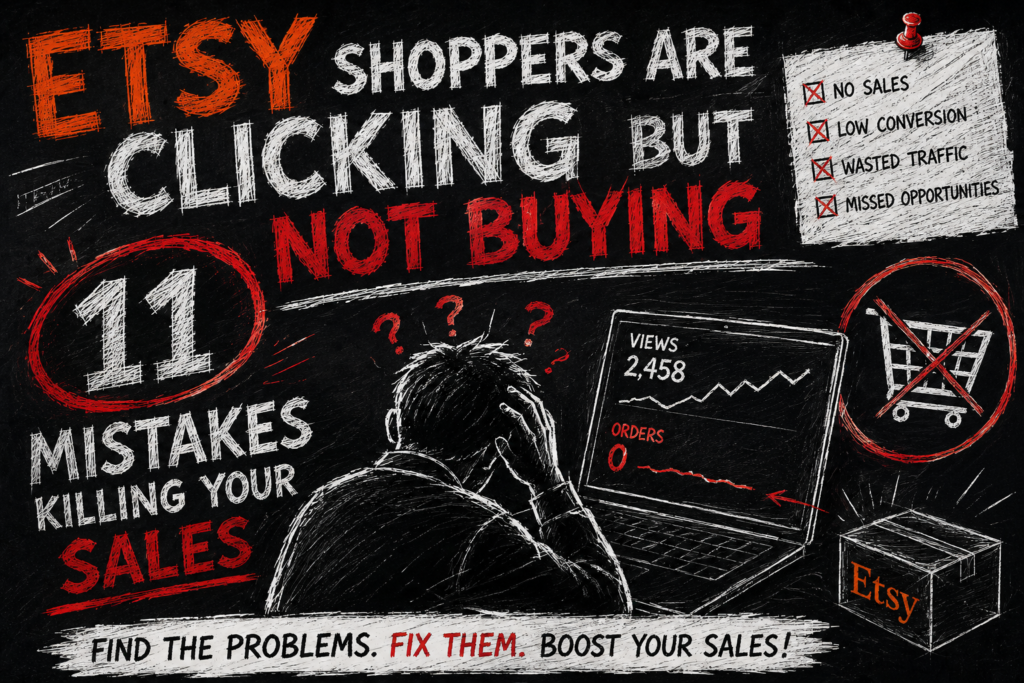
Seeing your Etsy views climb can feel like progress. More shoppers are landing on your products, your thumbnails are getting attention, and your listings appear to be doing something right.
But views don’t pay the bills. Orders do.
If you’re dealing with Etsy views but no sales, the problem may not be a lack of traffic at all. The real issue often begins after a shopper clicks—when they start evaluating your product, comparing options, and deciding whether your listing deserves their money.
Understanding that difference is critical before you change your keywords, lower your prices, or spend more on Etsy Ads.
What a Listing View Actually Tells You About Shopper Interest
A listing view tells you one simple thing: something convinced a shopper to look closer.
Maybe your main image caught their eye. Perhaps your title matched what they searched for, or your product appeared relevant enough to earn a click.
That’s a positive signal—but it’s not proof that the shopper wants to buy.
Think about how you shop online. You probably open several products, compare photos, check prices, read reviews, look at delivery estimates, and close most of the tabs without purchasing.
Etsy shoppers behave the same way.
A click can represent curiosity, comparison shopping, gift research, or genuine purchase intent. Your listing’s job is to move that shopper from “This looks interesting” to “This is exactly what I want.”
When Etsy listings are getting views but no sales, pay attention to what the click has already proven. Your listing may be attractive enough to earn attention but not convincing enough to close the sale.
That distinction changes what you need to fix.
The Difference Between an Etsy Traffic Problem and a Conversion Problem
Many sellers see zero orders and immediately assume they need more traffic.
So they rewrite tags. Chase new keywords. Increase ad budgets. Publish more listings.
But more visitors won’t automatically fix a listing that fails to convert.
A traffic problem means too few relevant shoppers are finding your products. You may need to review your Etsy SEO, keyword targeting, product demand, or search visibility.
A conversion problem means shoppers are already arriving—but they’re leaving without buying.
Here’s a simple way to think about it:
- Low views + low sales: You may have a visibility or traffic problem.
- High views + low sales: You may have a conversion or buyer-intent problem.
- Relevant traffic + repeated favorites but few orders: Pricing, shipping, trust, or purchase hesitation may be creating friction.
- Clicks from the wrong searches: Your keywords may be attracting shoppers with mismatched intent.
If you’re unsure whether your SEO is bringing the right shoppers, reviewing ChatGPT Prompts for Etsy SEO: 21 Powerful Prompts to Find and Fix Hidden Problems can help identify keyword and listing issues that may be hidden beneath surface-level view counts.
The goal isn’t simply to attract more people. It’s to attract the right shoppers and give them enough confidence to complete the purchase.
Why Etsy Shoppers Aren’t Buying Even After They Click
So, why Etsy shoppers aren’t buying when your products are clearly earning clicks?
Usually, there’s a moment of hesitation.
The shopper likes your thumbnail, opens the listing, and then notices something that makes them pause. Maybe they can’t understand the product’s actual size. The price feels higher than competing options. Shipping takes longer than expected.
Or perhaps the listing simply doesn’t answer one important question.
That hesitation creates an opportunity for the shopper to leave.
Common purchase blockers include:
- Product photos that look attractive but don’t provide enough detail
- Unclear sizing, materials, dimensions, or customization options
- A price that isn’t supported by obvious value
- Unexpected shipping costs or long delivery estimates
- Weak or limited reviews that create trust concerns
- Descriptions that fail to answer basic buyer questions
- Keywords that attract browsers instead of purchase-ready shoppers
These small issues can create major Etsy conversion rate problems.
The frustrating part is that shoppers rarely tell you why they left. They don’t send a message saying, “I almost bought this, but I couldn’t understand the size.”
They simply hit the back button and open another listing.
That’s why solving Etsy views but no sales requires you to evaluate your listing from the buyer’s perspective—not the seller’s.
How to Spot Etsy Conversion Rate Problems in Your Shop Stats
Your Etsy Shop Stats can help you identify where to investigate, but don’t look at total views alone.
Start with your most-viewed listings.
Which products consistently attract shoppers but generate few or no orders? These listings deserve your attention first because they’re already proving they can earn clicks.
Next, look for patterns.
Ask yourself:
- Are certain listings receiving significantly more views than sales?
- Are shoppers favoriting products but not completing purchases?
- Are your search terms closely aligned with the product you’re selling?
- Do high-traffic listings share similar pricing or shipping concerns?
- Did sales change after you updated photos, prices, titles, or descriptions?
Don’t panic over a small number of views. A listing with 15 visits and no sale doesn’t automatically have a conversion problem.
Instead, look for repeated patterns across a meaningful period of time.
If you’re asking, “Why am I getting views but no sales on Etsy?”, your shop data should be the starting point—not guesswork. Identify listings that repeatedly earn attention without producing orders, then examine the buyer experience one element at a time.
That’s how to turn Etsy views into sales without blindly changing everything in your shop.
The click tells you a shopper was interested enough to stop. What happens next determines whether that interest becomes an order—or another lost customer.
Mistakes 1–3: Your Listing Photos Are Getting Clicks but Losing Buyers
Your thumbnail did its job. A shopper noticed your product in Etsy search and clicked.
But the moment they land on the listing, your photos have a much bigger job: prove the product is exactly what the shopper expected. If that visual story falls apart, even highly interested buyers can leave without adding anything to their cart.
When you’re dealing with Etsy views but no sales, your product photos are one of the first places to investigate. A click shows curiosity. Strong listing images turn that curiosity into confidence.
Mistake 1: Your Main Photo Creates the Wrong Expectation
A beautiful main photo can still hurt sales if it attracts clicks for the wrong reason.
Imagine you’re selling a small handmade ceramic vase. Your main image shows it in a gorgeous living room setup surrounded by books, flowers, candles, and premium decor. The photo looks stunning—but the actual vase is much smaller than shoppers assumed.
They click. They scroll. Then they realize the product isn’t what they pictured.
That expectation gap can quickly explain why Etsy shoppers aren’t buying.
Your first photo should be attractive, but it also needs to be accurate. Don’t use angles, heavy cropping, oversized props, or AI-generated backgrounds that make your item appear larger, more premium, or materially different from the actual product.
Before publishing your main image, ask:
- Can shoppers immediately identify the product being sold?
- Does the product look similar in the first photo and supporting images?
- Could the background or props confuse buyers about what’s included?
- Does the image accurately represent the product’s color and finish?
- Would a first-time shopper misunderstand the item’s size or purpose?
Your thumbnail also plays a major role before shoppers ever reach the listing. If search traffic itself is weakening, common thumbnail and visibility issues are covered in [Etsy Click-Through Rate Dropping? 13 Problems Killing Your Listing Clicks – Internal Link].
The goal isn’t simply to win a click. It’s to earn the right click from a shopper whose expectations match the product you’re actually selling.
AI Prompt for Mistake 1: Check Whether Your Main Photo Creates the Wrong Expectation
Upload your Etsy listing’s main photo to ChatGPT or Gemini, then paste this prompt:
Act as an Etsy conversion optimization expert and a first-time US shopper. Analyze the main product photo I uploaded as if you found it while browsing Etsy search results.
Do not use assumptions or information that is not visually clear in the image.
Evaluate whether this photo creates the wrong expectation about my product’s size, color, material, quality, purpose, quantity, or what’s included in the purchase.
Specifically analyze:
- What product you believe is being sold at first glance
- What you expect to receive after seeing this image
- Whether props or background items could be mistaken as included
- Whether the camera angle or cropping makes the product look larger or smaller
- Whether lighting or editing may create unrealistic color expectations
- Whether the image attracts the right type of buyer
Identify every potential expectation gap that could cause a shopper to click my listing and leave without buying.
For each issue, explain why it may hurt conversions and give me an exact photo improvement recommendation.
End with a Main Photo Expectation Score from 1–10 and tell me the single most important change I should make first.
Mistake 2: Your Product Photos Don’t Answer Buyer Questions
Online shoppers can’t pick up your product.
They can’t touch the fabric, turn the item over, inspect the edges, test the clasp, or hold it under different lighting. Your photos have to do that work for them.
This is where many Etsy listings getting views but no sales run into trouble. Sellers upload one attractive hero image, add two similar angles, and assume the buyer has enough information.
Usually, they don’t.
A shopper may silently wonder:
- What does the back look like?
- Is the texture smooth or rough?
- How does the item close or attach?
- What exactly comes with my order?
- Is this color accurate in natural light?
- What does personalization look like up close?
- Are there small details or imperfections I should expect?
If your photos don’t answer those questions, shoppers have to guess. And when money is involved, uncertainty rarely helps a purchase decision.
Build your photo gallery like a visual FAQ.
Show the front, back, side, texture, important features, packaging, variations, and close-up details. If you’re selling a personalized item, include a clear example of the customization. If buyers receive only one item from a styled set, make that visually obvious.
Don’t upload ten nearly identical photos just because Etsy gives you space. Every image should remove a specific buyer question or objection.
AI Prompt for Mistake 2: Find Buyer Questions Your Product Photos Don’t Answer
Upload all of your Etsy listing photos to ChatGPT or Gemini before using this prompt:
Act as a skeptical first-time Etsy shopper who is seriously considering buying this product. Review every listing photo I uploaded and analyze what information is visually missing.
Assume you cannot touch, inspect, or test the product in person. Do not fill information gaps with assumptions.
After reviewing the photos, list every question you would still have before feeling confident enough to buy.
Check whether my images clearly show:
- Front, back, and relevant side views
- Materials and texture
- Important product features
- What’s included in the order
- Color and available variations
- Personalization or customization examples
- Closures, attachments, or functional parts
- Handmade details or natural variations
- Packaging, if relevant to the buying decision
Create a table with four columns:
Unanswered Buyer Question | Why It Creates Hesitation | Missing Photo Needed | Exact Photo Shot to Create
Rank each missing photo as High, Medium, or Low Priority based on how likely the information gap is to stop a shopper from purchasing.
Finally, create my ideal Etsy listing photo sequence from Photo #1 through the final image. Do not give generic advice. Base every recommendation on the uploaded product photos.
Mistake 3: Shoppers Can’t Understand Size, Scale, or Product Details
“8 inches wide” may be technically clear.
But many shoppers won’t instantly visualize eight inches while browsing on their phones.
This is a common source of Etsy conversion rate problems, especially for jewelry, wall art, stickers, furniture, bags, digital prints, home decor, and handmade accessories. The seller provides dimensions in the description, but the photos give buyers no visual sense of scale.
Then hesitation starts.
Is this necklace too small? Will this print look tiny above my couch? Can this pouch actually hold my phone?
Solve those questions visually.
Show the product:
- In a person’s hand
- Next to a familiar everyday object
- Being worn by a real person or model
- Placed in a realistic room or workspace
- Beside a ruler or measurement guide when appropriate
- In multiple size variations shown together
For example, if you sell earrings, include a photo showing them being worn. If you sell wall art, show the print above realistically sized furniture. If you sell storage products, show common items placed inside.
The same rule applies to small product details.
Zoom in on stitching, engraving, wood grain, hardware, texture, or handmade finishes that influence perceived value. Buyers shouldn’t have to imagine what makes your product special.
The easier your product is to understand, the easier it becomes to buy.
AI Prompt for Mistake 3: Audit Product Size, Scale, and Detail Confusion
Upload your Etsy listing photos to ChatGPT or Gemini, then use this prompt:
“Act as an Etsy product photography strategist and a first-time online buyer. Analyze my uploaded listing photos specifically for size, scale, and product detail confusion.
Review the images without relying on my written product description.
Determine whether a shopper can accurately understand the product’s real-world size within five seconds of viewing the photos.
Analyze:
- Whether the product appears larger or smaller than it may be in real life
- Whether there is a clear visual reference for scale
- Whether dimensions are easy to understand visually
- Whether an in-hand photo would improve clarity
- Whether the product should be shown on a person or model
- Whether a familiar everyday object should be used for comparison
- Whether a ruler or measurement graphic is needed
- Whether lifestyle photos accurately represent scale
- Which important textures, finishes, or small details need close-up images
Identify every point where a shopper may misunderstand the product’s size, scale, or physical details.
For each problem, recommend the exact photo I should create, including the suggested camera angle, product placement, scale reference, and detail to highlight.
Then create a prioritized Size and Scale Photo Fix Plan.
End with a Size and Scale Clarity Score from 1–10 and identify the one image most likely to reduce buyer hesitation.”
How Better Etsy Product Photos Build Buying Confidence
Great Etsy photography isn’t only about making your shop look professional. It’s about reducing the perceived risk of ordering a product the shopper has never seen in person.
Every useful photo answers a question.
Every accurate angle removes uncertainty.
Every close-up gives the buyer another reason to trust what will arrive at their door.
If you’re trying to figure out how to turn Etsy views into sales, review your most-viewed listings as if you’ve never seen the products before. Ignore what you already know as the seller and focus only on what the images actually communicate.
Ask yourself one simple question: Could a stranger confidently understand exactly what they’re buying without reading every word of the description?
If the answer is no, your photos may be earning clicks while quietly losing the sale.
Fix the expectation gap. Show the details. Make size and scale obvious. Give shoppers enough visual proof to feel comfortable moving from “I’m interested” to “Add to cart.”
Mistakes4 –6: Your Price, Shipping, and Offer Create Buyer Hesitation
If you’re dealing with Etsy views but no sales, don’t assume your pricing is the problem by itself. Buyers rarely compare price alone—they compare perceived value. A listing that looks trustworthy, answers questions, and removes uncertainty often outsells a cheaper alternative.
These three mistakes create hesitation at the exact moment shoppers are deciding whether to add your product to their cart or leave your listing.
Mistake #4: Your Price Feels Too High Without Showing Enough Value
Many Etsy sellers lower their prices when Etsy listings are getting views but no sales. In reality, shoppers often pay more for products that clearly communicate quality, craftsmanship, and value.
Ask yourself this question: Does your listing justify the price before the shopper even looks at the number?
Increase perceived value by:
- Showing close-up photos that highlight quality and craftsmanship.
- Explaining what makes your product different from similar listings.
- Including dimensions, materials, and production details.
- Demonstrating how the product is used or displayed.
- Highlighting personalization or handmade features when applicable.
➡️For example, a $45 handmade mug can feel like a bargain if buyers understand the craftsmanship behind it. The same mug may seem overpriced if the listing provides only one photo and a two-sentence description.
If you’re wondering why Etsy shoppers aren’t buying, remember that buyers don’t purchase products—they purchase confidence in the value they’re receiving.
AI Prompt: Increase the Perceived Value of My Etsy Product
Act as an expert Etsy conversion optimization consultant and consumer psychologist specializing in the US marketplace.
Analyze my Etsy listing and explain why shoppers may perceive my product as overpriced, even if the price is competitive.
Evaluate the following:
- Product title
- Product price
- Product description
- Product photos (I’ll describe or upload them)
- Materials and features
- Competitor positioning
- Customer objections
- Unique selling points
Then provide:
- The top reasons buyers may hesitate at my current price.
- Five ways to increase perceived value without lowering the price.
- Suggestions to rewrite my product description to justify the price.
- Ideas for new product photos that build trust.
- Recommendations for adding premium features or bonuses.
- A prioritized action plan from highest to lowest impact.
My Etsy listing:
(Paste your listing here)
Mistake 5: Unexpected Shipping Costs Make Shoppers Reconsider
One of the biggest reasons behind Etsy views but no sales is shipping friction.
A shopper may happily click your listing after seeing an attractive price, only to abandon the purchase when shipping costs appear at checkout. Even reasonable shipping fees can feel expensive if buyers weren’t expecting them.
Reduce shipping-related hesitation by:
- Displaying accurate shipping costs upfront.
- Offering free shipping whenever your margins allow.
- Building part of the shipping cost into the product price if appropriate.
- Clearly communicating processing and delivery times.
- Explaining why expedited or international shipping costs more.
Remember, shoppers evaluate the total purchase price, not just the item itself.
If you notice Etsy conversion rate problems, review your shipping strategy before assuming your SEO is failing. Traffic can be excellent while conversions suffer because buyers experience unexpected costs after clicking.
For additional strategies that improve listing visibility before optimizing conversions, see our guide on 11 Best Etsy SEO Tools to Boost Your Shop Traffic and Sales in 2026. This resource explains how stronger keyword research and listing optimization can attract shoppers who are more likely to purchase.
AI Prompt: Optimize My Etsy Shipping Strategy for More Sales
Act as an experienced Etsy ecommerce consultant specializing in buyer behavior and conversion optimization.
Review my product price, shipping costs, processing time, and delivery information.
Help me determine whether my shipping strategy is discouraging buyers.
Please provide:
- An analysis of potential shipping-related friction.
- Whether I should offer free shipping or keep separate shipping charges.
- Suggested pricing strategies that protect my profit margin.
- Recommended shipping wording that builds buyer confidence.
- Ways to reduce cart abandonment caused by shipping costs.
- Best practices used by successful Etsy sellers in my product category.
Product details:
(Paste your listing information here)
Mistake 6: Your Offer Gives Buyers No Reason to Purchase Now
Sometimes shoppers genuinely like your product—but they don’t feel any urgency to buy today.
Without a compelling reason to act, they bookmark the listing, continue browsing, or compare dozens of competitors before forgetting your shop entirely.
Create stronger purchase motivation by:
- Offering limited-time discounts during seasonal events.
- Creating bundle deals that increase perceived savings.
- Highlighting limited inventory only when it’s accurate.
- Providing personalization options that competitors don’t offer.
- Clearly explaining what makes your product unique.
This doesn’t mean using fake scarcity or misleading promotions. Etsy shoppers value authenticity, and exaggerated sales tactics can damage trust.
If you’re asking, “Why am I getting views but no sales on Etsy?”, your offer may simply lack enough buying motivation. The goal isn’t to pressure shoppers—it’s to make choosing your product feel like the smartest decision.
When pricing, shipping, and your overall offer work together, buyers spend less time second-guessing their purchase. That alone can dramatically improve how to turn Etsy views into sales, because removing hesitation is often more effective than attracting additional traffic.
AI Prompt: Create an Irresistible Etsy Offer That Converts More Visitors into Buyers
Act as a senior ecommerce conversion strategist with deep expertise in Etsy buyer psychology.
Analyze my Etsy product listing and identify why shoppers may delay or avoid purchasing.
Based on my product, generate:
- Five compelling offers that increase conversions without hurting profitability.
- Bundle ideas that increase average order value.
- Personalized upsell and cross-sell recommendations.
- Limited-time promotion ideas suitable for Etsy.
- Strong value propositions that differentiate my product from competitors.
- Trust-building elements that reduce buyer hesitation.
- A step-by-step conversion optimization plan ranked by expected impact.
Product listing:
(Paste your Etsy listing here)
Mistakes 7–9: Your Listing Is Confusing, Unconvincing, or Hard to Trust
Many sellers assume that once a shopper clicks, the sale is almost guaranteed. In reality, that’s where the real evaluation begins. If your Etsy listings are getting views but no sales, confusing information or missing trust signals can quickly push buyers toward a competing listing.
Mistake 7: Your Listing Title Attracts the Wrong Shopper
Your title shouldn’t just bring traffic—it should attract the right traffic. One reason for Etsy views but no sales is using broad or misleading keywords that generate clicks from shoppers who were never looking for your exact product.
A strong Etsy title should:
- Clearly describe the product
- Include accurate keywords without sounding spammy
- Set realistic expectations about style, size, and purpose
- Match what buyers see in the listing photos
For example, someone searching for a “minimalist gold necklace” will likely leave if your product is actually a chunky statement piece. The click counts, but the sale disappears because the listing didn’t match buyer intent.
Prompt:
Act as an Etsy SEO expert and conversion copywriter.
Analyze my Etsy listing title and rewrite it to attract qualified buyers instead of just generating clicks.
Requirements:
- Target US shoppers.
- Keep the title under Etsy’s character limit.
- Include the primary keyword naturally.
- Avoid keyword stuffing.
- Clearly describe the product.
- Match buyer search intent.
- Increase click-through rate without misleading shoppers.
- Suggest 5 optimized title variations ranked from best to worst.
- Explain why each title is likely to convert better.
Current Listing Title:
[Paste your Etsy title here]
Product Details:
[Paste product information here]
Mistake 8: Your Product Description Leaves Important Questions Unanswered
Even the best photos can’t answer every question. If shoppers have to guess important details, many won’t take the risk of buying.
Common gaps include:
- Exact dimensions and sizing
- Materials and product quality
- Processing and shipping times
- Care instructions
- Personalization options
- What’s included in the purchase
Many sellers asking, “Why am I getting views but no sales on Etsy?”, discover that buyers simply didn’t have enough information to feel confident.
Write descriptions that eliminate uncertainty rather than repeating marketing phrases. Every paragraph should answer a question a potential customer might ask before clicking “Add to Cart.”
Prompt:
Act as an Etsy conversion optimization specialist.
Rewrite my Etsy product description so it answers every important buyer question before they leave the listing.
Requirements:
- Write in natural American English.
- Focus on benefits before features.
- Reduce buyer hesitation.
- Include product dimensions, materials, shipping expectations, personalization details, care instructions, and what’s included.
- Use short paragraphs and bullet points for readability.
- Optimize for both Etsy SEO and conversions.
- End with a subtle purchase encouragement without sounding salesy.
Current Description:
[Paste description here]
Mistake 9: Weak Reviews and Trust Signals Increase Purchase Anxiety
Online shoppers naturally look for reassurance before spending money. When reviews are limited, outdated, or inconsistent, hesitation increases—even if your product is excellent.
Trust signals that influence purchasing decisions include:
- Positive customer reviews
- Clear shop policies
- High-quality product photography
- Accurate delivery estimates
- Complete seller profile
- Fast response times to customer questions
If why Etsy shoppers aren’t buying has become your biggest concern, don’t overlook credibility. Buyers often compare several similar listings, and the shop that appears most trustworthy usually wins the sale.
Prompt:
Act as an Etsy conversion rate optimization (CRO) consultant.
Review my Etsy listing and identify every reason shoppers may not trust my product enough to buy.
Analyze the following:
- Product photos
- Listing title
- Product description
- Price
- Shipping details
- Reviews
- Shop policies
- About section
- FAQs
- Overall buyer confidence
Then provide:
- A trust score out of 100.
- The top 10 trust issues reduce conversions.
- Specific recommendations to fix each issue.
- Quick wins that can be implemented in less than 30 minutes.
- A prioritized action plan to increase buyer confidence and sales.
Listing URL or Listing Details:
[Paste here]
Why Clear Listing Information Can Improve Buyer Confidence
Every successful Etsy listing answers a buyer’s questions before they’re asked. The easier it is to understand your product, the easier it is for shoppers to justify making a purchase.
If you’re dealing with Etsy views but no sales, review your listing as if you were seeing it for the first time. Is the title accurate? Does the description remove uncertainty? Do your reviews build confidence? Small improvements in clarity often solve hidden Etsy conversion rate problems and show you how to turn Etsy views into sales without increasing traffic.
Mistakes 10–11: You’re Ignoring Search Intent and Shopper Behavior
Mistake 10: Your Keywords Bring Traffic That Isn’t Ready to Buy
Ranking for popular keywords feels like a win, but high traffic doesn’t always lead to sales. If your keywords attract people who are browsing for inspiration instead of shopping, you’ll end up with Etsy views but no sales despite steady listing traffic.
Focus on buyer-intent keywords that match exactly what you’re selling. Instead of chasing broad search terms, optimize for phrases shoppers use when they’re ready to purchase. This simple shift can reduce Etsy conversion rate problems and bring more qualified visitors to your listings.
AI Prompt: Find High Buyer-Intent Etsy Keywords
Copy and paste this prompt into ChatGPT or Gemini:
Act as an Etsy SEO expert specializing in the US marketplace. Analyze my product and identify whether my current keywords attract buyers or casual browsers. Suggest 30 high buyer-intent Etsy keywords that indicate shoppers are ready to purchase, not just researching. Separate the keywords into High Intent, Medium Intent, and Low Intent categories. Explain why each keyword reflects purchase intent and recommend which ones should appear in my Etsy title, tags, and product description. Also identify any broad keywords that may be generating traffic but hurting my conversion rate.
Mistake 11: You’re Optimizing for Etsy SEO but Ignoring Conversions
Many sellers spend hours improving rankings but overlook what happens after the click. Strong SEO gets shoppers to your listing, but your photos, pricing, description, shipping details, and reviews determine whether they actually buy.
If your Etsy listings are getting views but no sales, the issue may no longer be SEO—it’s your ability to build confidence and remove buying friction. Every element of your listing should answer a shopper’s question before they think about leaving.
AI Prompt: Optimize My Etsy Listing for More Sales
Copy and paste this prompt into ChatGPT or Gemini:
Act as a senior Etsy conversion optimization consultant with expertise in buyer psychology. Review my Etsy listing and identify every reason shoppers might click but leave without buying. Analyze my title, product photos, description, pricing, shipping, personalization options, FAQs, reviews, and trust signals. Give each section a score out of 10, explain what’s reducing conversions, and provide rewritten, conversion-focused improvements. Finally, create a prioritized action plan listing the top 10 changes that will have the biggest impact on increasing my Etsy conversion rate and turning more listing views into sales.
Why Am I Getting Views but No Sales on Etsy? Check Buyer Intent
If you’re repeatedly asking, “Why am I getting views but no sales on Etsy?”, start by looking at who your listing is attracting. A mismatch between your keywords and your ideal customer often leads to clicks from people who were never likely to purchase.
Review your titles, tags, and product descriptions to ensure they match the expectations of buyers who are actively searching for your exact product. When your listing speaks directly to the right audience, it’s much easier to turn Etsy views into sales.
Stop Chasing More Traffic Before Fixing Your Existing Listings
More traffic won’t solve a weak conversion rate. Sending additional visitors to a listing that isn’t convincing buyers simply creates more Etsy views but no sales.
Before investing more time in SEO or advertising, improve the listings that already receive consistent traffic. Once those pages convert better, every future visitor becomes more valuable, helping you solve why Etsy shoppers aren’t buying while building sustainable sales growth.
How to Turn Etsy Views Into Sales With a Simple Listing Audit
If you’re dealing with Etsy views but no sales, don’t rush to rewrite your entire shop. The smartest approach is to audit your listings one by one and identify where shoppers lose confidence. Small, data-driven improvements often produce better results than making multiple changes all at once.
Audit Your Most-Viewed Listings First
Start with the listings that already receive the most traffic. These products have proven they can attract shoppers, which means your visibility isn’t the biggest problem—your conversion rate is.
Open your Etsy Shop Manager and review the following for each high-traffic listing:
- Total views versus total orders
- Favorites compared to purchases
- Traffic sources (Etsy Search, Offsite Ads, social media, etc.)
- Seasonal trends and recent performance
- Customer questions or recurring messages
If Etsy listings getting views but no sales sounds familiar, begin with the listings that receive the highest number of clicks but generate little or no revenue. These usually offer the fastest opportunity for improvement.
Review Photos, Pricing, Shipping, and Buyer Objections
Once you’ve identified your priority listings, evaluate them from a shopper’s perspective. Imagine you’ve never seen the product before.
Ask yourself:
- Does the first photo instantly explain what you’re selling?
- Are the images sharp, well-lit, and professionally presented?
- Is the price reasonable compared with similar Etsy products?
- Are shipping costs or delivery times discouraging buyers?
- Does the description answer common customer questions?
- Is there enough social proof through reviews and customer photos?
Many sellers experiencing Etsy views but no sales discover that shoppers aren’t rejecting the product—they’re simply hesitating because something feels unclear or risky.
Every unanswered question creates another reason for a customer to leave your listing.
Change One Conversion Element at a Time
Avoid making five or six changes simultaneously. If sales improve, you won’t know which update actually made the difference.
Instead, test one element, monitor the results, and then move to the next improvement.
A simple testing order looks like this:
- Replace the primary listing photo.
- Improve product descriptions and key details.
- Adjust pricing or perceived value.
- Review shipping options and delivery estimates.
- Add stronger images or videos if available.
This method helps isolate the true cause of your Etsy conversion rate problems instead of relying on guesswork.
Track Listing Performance Before and After Each Update
Optimization isn’t complete until you measure the results.
Before changing anything, record your baseline metrics:
- Listing views
- Orders
- Favorites
- Conversion rate
- Revenue generated
- Average order value
After each update, allow enough time for new shopper behavior to develop before drawing conclusions. Comparing performance over several weeks provides a much clearer picture than reacting to daily fluctuations.
If you’re wondering why am I getting views but no sales on Etsy, consistent tracking often reveals patterns that are impossible to notice otherwise.
When to Rewrite, Reposition, or Replace a Low-Converting Listing
Not every listing can be saved through minor adjustments. Some products attract curiosity but fail to meet buyer expectations, while others target the wrong audience entirely.
Consider a complete rewrite or repositioning when:
- The listing receives consistent traffic but almost no purchases.
- Multiple optimization tests fail to improve conversions.
- Customer questions reveal widespread confusion.
- Similar competitors consistently outperform your listing.
- Your keywords attract shoppers who aren’t actually looking for your product.
In some cases, replacing the listing with stronger photos, a clearer value proposition, a different pricing strategy, or better keyword targeting is the fastest way to turn Etsy views into sales.
Remember, successful Etsy sellers don’t obsess over getting more traffic first. They maximize the value of the traffic they already have. Fixing one weak, high-traffic listing can often generate more revenue than publishing several new listings that face the same conversion issues.
Final Takeaway: Fix the Reason Shoppers Leave Before Chasing More Views
Clicks Prove Shoppers Are Interested—But Interest Isn’t Enough
If you’re dealing with Etsy views but no sales, remember that every click is a sign of buyer interest. Your title, thumbnail, or search optimization has already done its job by bringing shoppers to your listing.
The real challenge begins after the click. If visitors leave without adding your product to their cart, they’re encountering something that creates doubt, confusion, or hesitation. Solving why Etsy shoppers aren’t buying is often far more valuable than chasing additional traffic.
Focus on Buyer Confidence, Clarity, and Perceived Value
Successful Etsy sellers don’t just optimize for search—they optimize for trust. Clear photos, transparent pricing, detailed descriptions, realistic shipping expectations, and strong customer reviews all work together to reduce buyer hesitation.
Many sellers experiencing Etsy listings getting views but no sales assume they need better SEO, when the real issue is weak conversion. Addressing these Etsy conversion rate problems can dramatically improve results without increasing your traffic.
Your Next Step: Audit One High-View, Low-Sales Listing Today
Instead of changing your entire shop, start with the listing that already receives consistent traffic but struggles to generate orders. Review every element from the buyer’s perspective and ask whether anything creates uncertainty or makes comparison shopping easier.
If you’ve been asking, “Why am I getting views but no sales on Etsy?”, treat each listing like an experiment. Make one meaningful improvement at a time, measure the results, and repeat the process. That’s the most reliable way to solve Etsy views but no sales and discover how to turn Etsy views into sales over the long term.