
Starting an online business in 2026 is easier than ever—but choosing the right platform can make or break your success. If you’re confused between Etsy vs Shopify for beginners, you’re not alone. Thousands of new sellers struggle with this decision because both platforms offer completely different ways to build an online store.
On one side, Etsy gives you instant access to millions of buyers who are already searching for products like yours. You can list your product in minutes and start selling without worrying about website design, traffic, or technical setup.
On the other side, Shopify allows you to build your own brand, create a fully customized store, and scale your business without limitations. But with that freedom comes responsibility—you need to handle marketing, traffic, and optimization yourself.
This is where most beginners get stuck.
Should you choose easy sales with Etsy?
Or long-term growth with Shopify?The truth is, the right choice depends on your goals, budget, and strategy. Understanding the difference between Etsy vs Shopify for beginners will help you avoid costly mistakes and start your journey the right way.
In this guide, we’ll break down everything you need to know—from costs and ease of use to scalability and profit potential—so you can confidently choose the best platform for your business in 2026.
📖 Introduction
When comparing Etsy vs Shopify for beginners, it’s important to understand that these platforms are fundamentally different.
Etsy is a marketplace, while Shopify is a store builder. This single difference changes everything—from how you get traffic to how much control you have over your business.
Etsy provides a ready-made marketplace where buyers are already searching for products. This means you don’t need to worry about marketing in the beginning. You simply create listings, optimize them for search, and start selling. That’s why many experts consider Etsy the best starting point for beginners.
Shopify, on the other hand, gives you a fully independent store. You own your website, control your branding, and manage your customer experience. However, you need to bring your own traffic through SEO, ads, or social media.
For beginners, this creates a key question:
👉 Do you want easy start (Etsy)
👉 Or long-term control (Shopify)
Another important factor is cost. Etsy has low upfront costs but charges transaction fees, while Shopify requires a monthly subscription but gives you more control over profits.
Understanding these differences is essential when deciding between Etsy vs Shopify for beginners.
💡 Want to increase traffic?
Read AI prompts for blog optimization
⚖️ Etsy vs Shopify: Key Differences
When comparing Etsy vs Shopify for beginners, the most important thing to understand is that these two platforms operate on completely different business models. This single difference affects everything—from how you get traffic to how much control you have over your store.
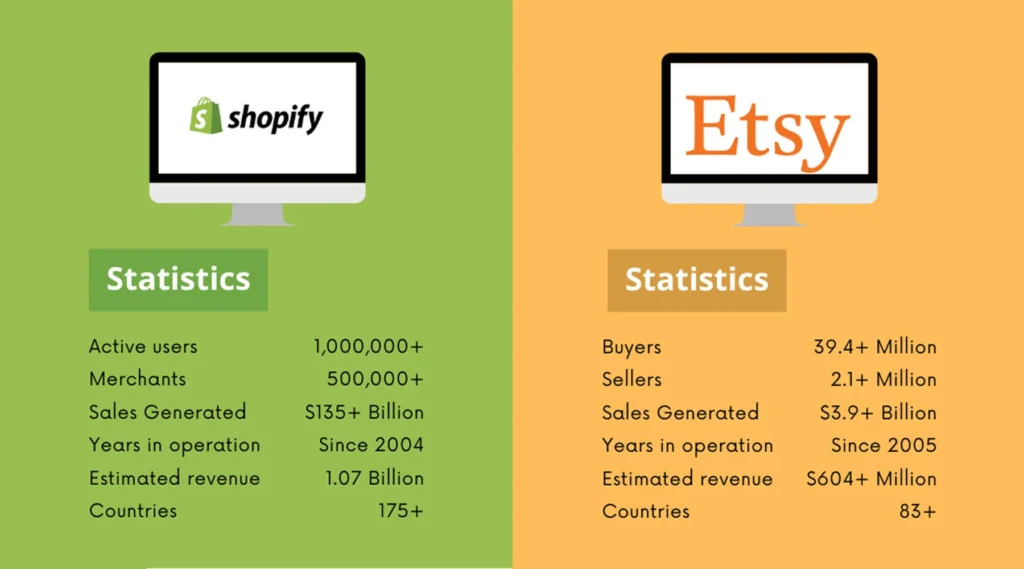
Etsy is a marketplace, meaning it already has millions of buyers actively searching for products. When you list your items on Etsy, you are placing them in front of an existing audience. This is a huge advantage for beginners who don’t have marketing experience. You don’t need to worry about building a website or driving traffic initially. Instead, your main focus is optimizing your listings with the right keywords and visuals.
Shopify, on the other hand, is a standalone store builder. You create your own website, design your brand, and control the entire customer experience. However, Shopify does not provide built-in traffic. You are responsible for bringing visitors through SEO, social media, or paid ads. This makes it more challenging for beginners but much more powerful for long-term growth.
Another major difference in Etsy vs Shopify for beginners is control. Etsy has strict rules, and your store operates within their ecosystem. You cannot fully customize your shop, and Etsy can even suspend listings if policies are violated. Shopify gives you complete freedom—you own your store, your branding, and your customer data.
Cost structure also differs. Etsy has low upfront costs but charges fees per transaction, while Shopify has a fixed monthly cost but lower transaction dependency. Understanding these key differences is essential before choosing the right platform.
🧠 Etsy vs Shopify for Beginners (Real Truth)
If we talk honestly about Etsy vs Shopify for beginners, the real answer is not about which platform is “better”—it’s about which platform fits your current stage.
For complete beginners, Etsy is almost always the better starting point. The biggest advantage is simplicity. You can create an account, upload products, and start selling within hours. You don’t need technical knowledge, website design skills, or marketing experience. Etsy handles traffic, payments, and basic infrastructure, allowing you to focus only on your product.
🚀 Learn full Etsy SEO strategy with Etsy SEO AI prompts step by step
Another important reason Etsy works for beginners is validation. Many new sellers don’t know whether their product will sell or not. Etsy allows you to test ideas quickly with minimal investment. If your product performs well, you gain confidence and data to scale further.
However, Shopify becomes powerful once you understand the basics. It is not beginner-friendly in the early stages because you need to bring your own traffic. Without marketing, a Shopify store will not generate sales. This is where many beginners fail—they choose Shopify too early and struggle with zero visitors.
The real truth about Etsy vs Shopify for beginners is this:
👉 Etsy = learning + validation platform
👉 Shopify = scaling + branding platform
Smart sellers don’t choose one permanently—they transition. They start with Etsy, learn what works, and then move to Shopify to build a brand and increase profits.
So instead of asking “which is better,” ask:
👉 Where am I in my journey?
👉 Also selling on Amazon? Check AI prompts for Amazon product listings
🚀 Pros & Cons
Understanding the pros and cons is critical when deciding between Etsy vs Shopify for beginners, because each platform solves different problems.
- 🟢 Etsy Pros (Deep Insight)
Etsy’s biggest advantage is built-in traffic. Millions of buyers are already searching for products, which means you don’t need to invest in marketing immediately. This reduces risk and makes it ideal for beginners.
Another benefit is ease of use. You don’t need technical skills to start selling. The platform is simple, and you can launch a store quickly. This is why many first-time sellers prefer Etsy.
Etsy also has a low startup cost, making it accessible for anyone with a limited budget. You can start with almost zero investment and scale gradually.
- 🔴 Etsy Cons (Reality)
The biggest downside is competition. Since it’s easy to start, many sellers enter the marketplace, making it harder to stand out.
You also have limited control. Your store operates under Etsy’s rules, and you cannot fully customize your brand.
Additionally, Etsy charges transaction fees, which can reduce your profit margins over time.
- 🟢 Shopify Pros (Deep Insight)
Shopify gives you full control over your business. You own your website, branding, and customer data. This allows you to build a long-term brand.
It is also highly scalable. You can expand your business without platform limitations, making it ideal for growth.
- 🔴 Shopify Cons (Reality)
The biggest challenge is traffic generation. Without marketing, your store will not get visitors.
There is also a learning curve, which can be difficult for beginners.
📊 FINAL VERDICT (IMPORTANT)
When analyzing Etsy vs Shopify for beginners, the final verdict depends entirely on your goals, experience level, and business vision.
If you are just starting out, Etsy is clearly the better option. It allows you to enter the market quickly, test your product ideas, and start generating sales without needing advanced skills. The built-in traffic removes one of the biggest barriers—getting customers. This makes Etsy ideal for beginners who want fast results with minimal risk.
However, Etsy is not perfect for long-term growth. As your business grows, you may face limitations such as high competition, fees, and lack of brand control. This is where Shopify becomes the better option.
Shopify is designed for scaling. It allows you to build your own brand, create a unique customer experience, and increase profit margins. But it requires effort—especially in marketing and traffic generation.
The smartest conclusion in the Etsy vs Shopify for beginners debate is this:
👉 Start with Etsy
👉 Scale with Shopify
This hybrid approach combines the strengths of both platforms. You use Etsy to gain initial traction and Shopify to build a long-term business.
Instead of choosing one over the other, think strategically. Use each platform at the right stage of your journey.
🔥 PRO STRATEGY (SMART SELLERS DO THIS)
The most successful sellers in 2026 don’t limit themselves to one platform. Instead, they combine the strengths of both in a strategic way. This is the real winning approach in the Etsy vs Shopify for beginners discussion.
The strategy is simple but powerful:
👉 Step 1: Start on Etsy
👉 Step 2: Validate your product
👉 Step 3: Move to Shopify
👉 Step 4: Scale your brand
Etsy acts as your testing ground. You launch products, optimize listings, and see what sells. Since Etsy already has traffic, you can gather data quickly. This helps you understand your audience, pricing, and demand.
Once you identify a winning product, you transition to Shopify. Here, you build your own brand, create a professional website, and improve your profit margins. Unlike Etsy, Shopify allows you to own your customer data, which is crucial for long-term growth.
Another important part of this strategy is multi-channel selling. You can continue using Etsy for traffic while directing customers to your Shopify store for repeat purchases. This creates a powerful ecosystem where Etsy brings customers, and Shopify builds loyalty.
AI tools can further enhance this strategy by helping you optimize listings, create content, and automate marketing. This combination of platforms + AI creates a scalable business model.
In conclusion, the smartest sellers don’t choose between Etsy vs Shopify for beginners—they use both strategically to maximize growth and income.
💰 Want more conversions? Read AI prompts for Shopify product descriptions
📌 Conclusion
Choosing between Etsy vs Shopify for beginners depends on your goals, not just features. If you want a simple, low-risk way to start selling online, Etsy is the best choice. It allows you to focus on product creation while leveraging an existing audience.
However, if your goal is to build a long-term brand and scale your business, Shopify is the better option. It gives you full control over your store, customers, and marketing strategy.
The smartest approach is to combine both platforms. Start with Etsy to generate traffic and validate your product, then move to Shopify to build your brand and increase profits.
By understanding the difference between Etsy vs Shopify for beginners, you can avoid common mistakes and create a strong foundation for your online business
Which is better: Etsy vs Shopify for beginners?
Etsy is better for beginners due to built-in traffic.