
You’ve done the math. Materials, labor, packaging, fees, and profit are all accounted for. Yet a customer still looks at your handmade product and says, “That’s expensive.” It’s frustrating—especially when your handmade product pricing is already fair and you’re not trying to overcharge anyone.
The problem may not be your price at all. Buyers don’t judge value by your costs; they judge what the product feels worth before they decide to purchase. A weak product photo, generic description, unclear craftsmanship, poor positioning, or a lack of differentiation can make a fairly priced product seem overpriced. That’s why simply lowering your price can sometimes make the situation worse: you sacrifice your margin without fixing the real reason customers hesitate.
The good news is that perceived value can be improved. Understanding handmade product pricing psychology can help you see why some products command premium prices while others struggle to convert at much lower prices. You’ll also learn how to price handmade products more strategically, communicate what makes your work valuable, and increase the perceived value of handmade products without racing to the bottom.
Before changing your price, it’s worth finding out whether the price is actually the problem—or whether your customers simply aren’t seeing the value behind it.
Why Your Handmade Products Feel Expensive Even When the Price Is Fair
A customer saying “That’s too expensive” does not automatically mean your price is wrong. In many cases, it means they don’t yet see enough value to justify the price.
This distinction is critical for beginner Etsy sellers. You may have carefully calculated materials, labor, packaging, Etsy fees, and profit, yet a buyer can still compare your $65 handmade item with a $25 mass-produced alternative and wonder why yours costs so much. That is where handmade product pricing becomes more than a simple math problem.
What “Too Expensive” Really Means to a Buyer
When shoppers say a handmade product is expensive, they are rarely looking at your production spreadsheet. They are making a quick judgment based on what they can see, understand, and compare.
A buyer may be thinking:
- “Does this look different enough from cheaper options?”
- “Why is this worth $65?”
- “What makes it better?”
- “Is it actually handmade?”
- “Will it last longer?”
- “Am I paying for quality or just the seller’s markup?”
Notice that none of these questions are really about your material cost. They are questions about value.
That is why a product can be fairly priced and still feel overpriced.
For example, imagine two Etsy listings selling handmade ceramic mugs for $42.
The first listing has a poorly lit photo, a basic title such as “Handmade Ceramic Mug,” and a short description that says the mug is made from clay and holds 12 ounces.
The second listing shows detailed photography, close-ups of the glaze and texture, explains the making process, highlights the handmade variations, and clearly describes who the mug is designed for.
The physical products could be similar. Yet the second listing may communicate significantly more value.
The lesson: buyers don’t experience your costs directly. They experience the value you communicate.
The Difference Between Price, Cost, and Perceived Value
These three concepts are closely connected, but they are not interchangeable.
Cost is what it takes to create and sell the product.
Price is what you ask the customer to pay.
Perceived value is what the customer believes the product is worth.
A simple example makes this easier:
| Factor | Example |
| Materials | $12 |
| Labor | $18 |
| Packaging and overhead | $8 |
| Selling fees | $7 |
| Profit | $15 |
| Selling price | $60 |
Your $60 price may be completely reasonable. But if the listing makes the product look generic, the buyer may perceive it as a $35 product.
That does not necessarily mean you should reduce the price to $35. You could instead have a value-communication problem.
Before changing your price, review:
- Product presentation — Does the photography make the product look as good as it actually is?
- Differentiation — Can a shopper immediately understand what makes it different?
- Craftsmanship — Have you shown the details that justify handmade quality?
- Description — Does the copy explain benefits rather than simply list features?
- Positioning — Are you presenting the product to the right customer?
- Social proof — Do reviews, customer photos, or testimonials reinforce quality?
This is the foundation of effective handmade product pricing psychology. Price communicates value, but your entire listing helps determine whether the buyer accepts that price.
Why Customers Compare Handmade Products to Mass-Produced Alternatives
Here is one of the biggest challenges handmade sellers face: customers compare prices more easily than they compare production methods.
A shopper might see your handmade wooden tray for $85 and another tray online for $29. From a distance, both may appear to perform the same basic function.
The cheaper product may be factory-produced at scale. Your product may involve hand selection of materials, hours of labor, individual finishing, customization, and small-batch production.
But unless those differences are obvious, the shopper may simply see:
Tray A: $29
Tray B: $85
That comparison makes your product feel expensive.
The solution is not to pretend the cheaper product does not exist. Instead, your listing needs to make the difference in value visible and understandable.
Show the craftsmanship. Explain the materials. Demonstrate customization. Photograph details that would be impossible to appreciate in a distant product shot. Tell the story behind the design when that story genuinely adds value.
Most importantly, don’t try to win every buyer by being cheaper.
A customer shopping primarily for the lowest possible price may never become your ideal customer. Your goal is to attract shoppers who care enough about uniqueness, craftsmanship, customization, quality, or the experience of owning something handmade to consider your price reasonable.
That is the real shift from pricing handmade products for profit to pricing them for the right market.
Before changing your price, ask one more question:
“If I showed this product to someone who has never seen it before, would they immediately understand why it costs what it costs?”
If the answer is no, your next step may not be a new price. It may be a stronger value proposition.
Handmade Product Pricing: How to Know If Your Price Is Actually Right
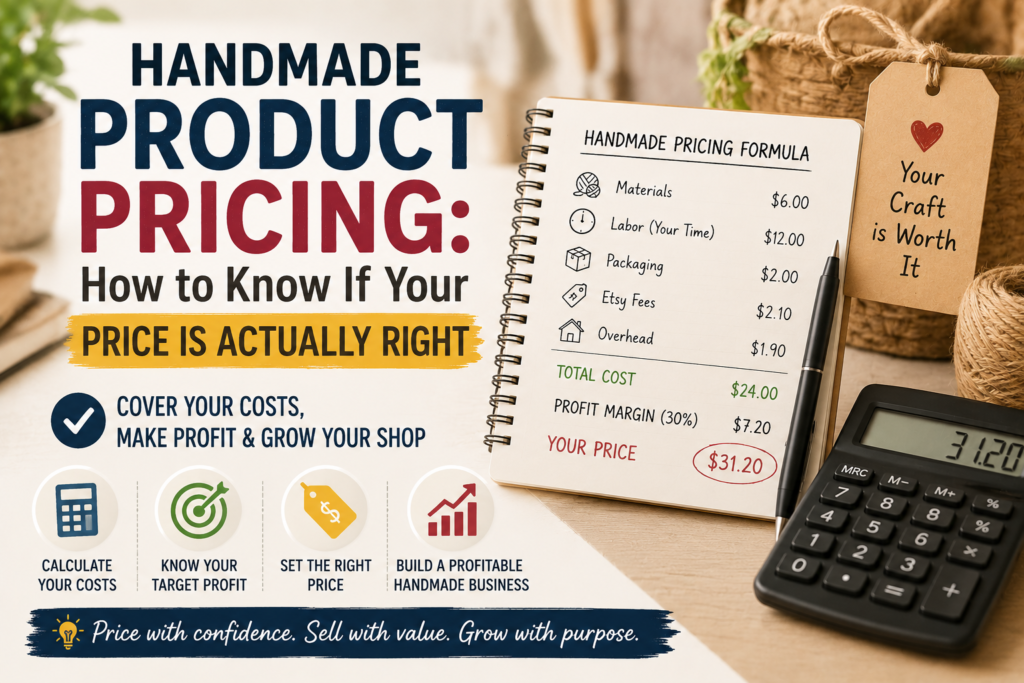
Before changing your price, make sure you know what “right” actually means. A handmade product is not priced correctly simply because it matches a competitor’s price or because customers say it feels expensive. Handmade product pricing needs to cover the real cost of creating and selling the product while leaving enough profit to make the business sustainable.
A useful starting point is to separate three numbers: your total cost, your selling price, and your profit. Once those numbers are clear, you can determine whether the problem is truly pricing—or whether customers simply aren’t seeing enough value.
Calculate Your True Product Cost Before Changing the Price
Many handmade sellers calculate materials and stop there. That can make a product look profitable on paper when it isn’t.
Your true product cost should account for:
- Materials and supplies
- Your labor
- Packaging
- Shipping-related costs you absorb
- Marketplace or payment-processing fees
- Equipment and production expenses
- A reasonable share of business overhead
For example, imagine you make a handmade wooden sign.
| Cost | Amount |
| Wood and materials | $12 |
| Paint, hardware, supplies | $4 |
| Packaging | $3 |
| Labor: 1.5 hours × $20 | $30 |
| Selling/payment fees | $6 |
| Overhead allocation | $5 |
| Total cost | $60 |
If you sell that sign for $65, you haven’t created a $65 product with a $5 profit in any meaningful long-term sense—you have created a product with very little room for mistakes, discounts, replacements, or unexpected expenses.
This is why pricing handmade products for profit requires you to value your own time. Your labor isn’t a bonus; it is part of the cost of producing the item.
How Labor, Materials, Overhead, Fees, and Profit Affect Pricing
A practical handmade pricing strategy starts with your cost floor, then works upward.
One simple framework is:
Selling Price = Total Product Cost + Desired Profit
Suppose your total cost is $60 and you want $30 in profit. Your target selling price would be $90 before considering any additional pricing adjustments.
But don’t assume that a formula automatically produces the perfect market price. A handmade pricing formula tells you what you need to charge. It doesn’t tell you what customers will perceive as valuable.
That’s where pricing psychology matters.
Two sellers could make similar products at similar costs but charge different prices because they target different customers and communicate different levels of value. A basic handmade candle presented as a generic commodity may struggle at $35, while a beautifully positioned, gift-ready candle with distinctive materials, personalization, strong photography, and a compelling brand story may support a higher price.
The goal isn’t to make your product artificially expensive. It’s to make sure the price reflects both business economics and customer-perceived value.
How to Price Handmade Products Without Undercutting Your Profit
If sales are slow, lowering the price is often the first reaction. It shouldn’t always be the first solution.
Before reducing your price, work through this sequence:
- Verify your costs. Make sure labor, fees, packaging, and overhead are included.
- Check your profit. Determine what you actually keep after every relevant expense.
- Review your positioning. Ask whether your listing communicates why the product is different.
- Compare the right competitors. Look at products serving a similar customer, quality level, and use case—not simply the cheapest listings.
- Test the value proposition before testing a discount. Improve photography, descriptions, customization options, or product presentation first.
- Measure the result. Track views, favorites, inquiries, conversion rate, average order value, and profit—not sales volume alone.
A useful question is: “If I lowered this price by 10%, would I actually solve the customer’s objection?”
If the answer is no, you may be treating a value-communication problem as a pricing problem.
For example, a $75 handmade product with poor photography and a vague description can feel expensive because the buyer has little evidence supporting the price. Improving the presentation may do more than dropping the price to $65.
The objective isn’t to find the cheapest price that gets an order. It’s to find a price that your target customer accepts while giving your business enough margin to continue producing quality work.
AI Prompt: Calculate a Profitable Handmade Product Price
You can use an AI assistant to turn your cost information into a pricing starting point. Give it your material costs, labor time, hourly rate, packaging expenses, platform fees, overhead, and desired profit.
Try this prompt:
Act as a small-business pricing analyst. Help me calculate a profitable price for my handmade product. Here are my costs: [list materials], labor time: [hours], hourly labor rate: [$], packaging: [$], platform/payment fees: [amount or percentage], shipping cost I absorb: [$], and estimated overhead per product: [$]. My desired profit is [$] or [%]. Calculate my total cost, minimum sustainable price, target selling price, and profit at each price. Then explain what could justify a higher perceived value without recommending an unnecessary discount.
Treat the result as a starting point, not an automatic answer. Your numbers tell you what the business needs; customer behavior and perceived value tell you whether the market will support the price.
The Psychology Behind Perceived Value of Handmade Products
Why Buyers Pay More for Products That Feel Unique and Valuable
A buyer rarely evaluates a handmade product by calculating your material costs, hours of labor, and profit margin. They are asking a simpler question: “Does this feel worth the price to me?”
That distinction is at the heart of handmade product pricing. Two products can cost almost the same to make, yet one can command a much higher price because it communicates more value. The difference may come from originality, craftsmanship, personalization, story, presentation, or the feeling that the product was made specifically for someone like the buyer.
Think about a handmade ceramic mug. If the listing simply says “12 oz ceramic coffee mug,” it sounds like a commodity. But if the seller explains that each mug is individually shaped, has a distinctive glaze, and is designed for buyers who appreciate small-batch craftsmanship, the same physical product becomes easier to value.
This doesn’t mean exaggerating what makes your product special. It means making existing value visible.
Before changing your price, ask:
- What makes this product different from a mass-produced alternative?
- What part of the product requires skill or specialized work?
- What can the buyer personalize?
- What experience or emotion does the product create?
- Is that value obvious from the listing alone?
If the answers aren’t obvious, the problem may be communication rather than price.
How Craftsmanship, Materials, Customization, and Scarcity Influence Value
Several factors can increase the perceived value of handmade products, but they work best when they are specific and believable.
Craftsmanship gives buyers a reason to recognize the work behind the price. Instead of simply saying “high quality,” explain what actually requires expertise. For example, a woodworker might mention hand-sanded edges, carefully selected hardwood, or a multi-step finishing process. A jewelry maker could explain the construction technique, stone selection, or finishing work.
Materials matter when they are meaningful to the buyer. “Made with premium materials” is vague. “Solid walnut with a hand-rubbed finish” gives the customer something concrete to understand and evaluate.
Customization can make a product feel more personally valuable. A monogrammed leather journal, personalized wedding sign, or custom birth-flower necklace isn’t competing on exactly the same terms as a generic factory-made product. The buyer is paying for relevance as well as the physical item.
Scarcity can also influence perceived value, but it should be genuine. Limited batches, seasonal materials, or genuinely time-intensive production can create legitimate scarcity. Artificial countdowns or fake “only 2 left” messages can damage trust.
A useful rule is:
Don’t manufacture value. Reveal the value that’s already there.
For Etsy sellers especially, this means your photos, title, description, materials, personalization options, and shop presentation should tell the same value story. If your product is carefully handcrafted but the listing looks generic, customers may never understand why it costs more.
How Product Positioning Changes What Customers Are Willing to Pay
Price doesn’t exist in isolation. Product positioning determines what buyers compare your product against and what they expect from it.
Suppose you sell a handmade leather wallet for $85. If your listing positions it as simply “a leather wallet,” buyers may compare it with inexpensive mass-market wallets. The price can immediately feel high.
Now imagine the same wallet is positioned around full-grain leather, hand finishing, personalization, durability, and gifting. The buyer may start comparing it with other premium handmade or personalized products instead.
The product hasn’t necessarily changed. The frame around the product has changed.
This is why a strong handmade product pricing strategy starts before you enter a number into a pricing formula or handmade pricing calculator. First determine who the product is for, what problem or desire it addresses, and why that buyer would choose it over the alternatives.
You can use this simple positioning test:
- Identify the ideal buyer. Who is most likely to value what you make?
- Identify the strongest differentiator. What can your product offer that cheaper alternatives cannot?
- Make the differentiator visible. Show it through photos, copy, materials, customization, and examples.
- Choose the right comparison. Don’t frame a handcrafted product as though it competes solely with mass-produced goods.
- Let the price support the position. A premium-looking product with a bargain-bin presentation creates confusion.
The same principle applies when selling digital products, too: the way an offer is positioned can change how easily customers understand its value. For a broader look at this concept, see Digital Product Positioning: Make Products Easier to Sell.
The goal isn’t to convince every shopper that your product is worth more. It’s to make the value clear enough that the right customer understands why your price makes sense.
AI Prompt: Analyze and Increase Your Product’s Perceived Value
AI can help you identify gaps between what your handmade product offers and what your listing communicates. Instead of asking an AI tool to simply “make my product sound expensive,” give it the actual product details and ask it to find missing value signals.
Use this prompt:
Act as a product positioning and customer psychology expert for handmade businesses. Analyze the following product and determine why a potential buyer might perceive it as expensive. Identify the strongest genuine value drivers, including craftsmanship, materials, customization, uniqueness, durability, scarcity, emotional value, and buyer outcome. Then identify what the current product presentation may be failing to communicate. Finally, recommend specific improvements to the product title, photos, description, value proposition, and positioning without using exaggerated claims or lowering the price.
Product: [Describe your product]
Current price: [$X]
Materials: [Materials]
Production process: [Process]
Customization options: [Options]
Target customer: [Customer]
Current product description: [Paste description]
Use the output as a diagnostic tool, not as a substitute for customer research. The strongest pricing decisions come from combining your actual costs, customer behavior, competitive context, and clear value communication.
Once buyers can see the value behind the product, the next question becomes much more practical: how do you communicate that value without relying on discounts or constantly changing your price?
How to Increase Perceived Value Without Lowering Your Price
When customers say a handmade product is “too expensive,” lowering the price is often the first reaction. But before cutting your margin, look at what the buyer actually sees. A product can have a fair price and still feel overpriced when its quality, craftsmanship, or uniqueness isn’t obvious.
The goal of handmade product pricing isn’t simply to find a number customers will accept. It’s to make sure the product experience communicates why that number makes sense.
Improve Product Photography to Make Quality Obvious
Your photos are often the first evidence a buyer uses to judge whether your product is worth the price. If the images look dark, cluttered, blurry, or generic, customers may unconsciously compare your handmade item with inexpensive mass-produced alternatives.
Strong product photography should make quality visible before the customer reads a single sentence.
Focus on:
- A clean primary image: Show the product clearly without distracting backgrounds.
- Close-up details: Capture stitching, texture, wood grain, finishes, engraving, or other craftsmanship.
- Scale: Give buyers a realistic sense of size.
- Multiple angles: Show details that justify the price but may not be visible from the front.
- Lifestyle images: Demonstrate how the product looks or works in its intended setting.
- Process images: When appropriate, show part of the making process to reinforce its handmade nature.
For example, a handmade wooden tray photographed against a cluttered kitchen counter may look like an ordinary tray. The same product photographed with a close-up of its hand-finished edges, visible wood grain, and a carefully styled kitchen setting can communicate craftsmanship and quality much more effectively.
Before changing your price, ask: Does the customer have enough visual evidence to understand what they’re paying for?
Rewrite Your Product Description Around Benefits, Craftsmanship, and Story
A product description should do more than list dimensions and materials. Those details matter, but they don’t necessarily explain why the product is worth the price.
Instead of writing:
“Handmade ceramic mug. 12 oz. Stoneware clay. Dishwasher safe.”
Explain what makes the item meaningful:
“Each 12-ounce mug is individually shaped and finished by hand, giving every piece subtle variations in texture and character. The durable stoneware design is made for everyday use while retaining the look and feel of a handcrafted piece.”
The second version gives the buyer a reason to value the product.
When improving your listing, connect features to buyer benefits:
Feature → Meaning → Benefit
- Hand-stitched → individually crafted → feels distinctive rather than mass-produced
- Solid hardwood → durable construction → designed for years of everyday use
- Custom engraving → personalized → makes the item more meaningful as a gift
- Small-batch production → limited availability → gives the product a sense of uniqueness
This is also where handmade product value and storytelling intersect. Buyers aren’t only purchasing materials. They may be purchasing craftsmanship, individuality, personalization, durability, or the experience of owning something that wasn’t produced by the thousands.
For a broader look at how small changes can improve perceived value, the same principle applies to digital products as well: digital product value strategies can help illustrate how presentation and positioning influence what customers believe an offer is worth.
Use Branding, Packaging, Personalization, and Social Proof to Strengthen Value
Perceived value doesn’t come from the product alone. It is shaped by everything surrounding the purchase.
A consistent brand identity can make a handmade business feel more established. Thoughtful packaging can make an ordinary delivery feel like an experience. Personalization can give customers a stronger reason to choose your product over a generic alternative.
Social proof matters too. Reviews, customer photos, testimonials, and examples of previous custom work can reduce uncertainty and help prospective buyers understand what others valued about the product.
Think of the complete customer experience as a chain:
Listing → Photos → Description → Brand → Packaging → Product → Customer Experience
If several links feel inexpensive or generic, the buyer may question the price even when the product itself is excellent.
The important distinction is that you are not trying to make an overpriced product look expensive. You’re making the genuine qualities of a fairly priced product easier to recognize.
AI Prompt: Rewrite Your Product Listing to Communicate Premium Value
You can use an AI assistant such as ChatGPT, Gemini, or Claude to identify weak value communication before changing your price.
Give it your current product title, description, materials, production process, customization options, target customer, and price. Then ask it to identify which valuable qualities are currently being overlooked and rewrite the listing around benefits, craftsmanship, differentiation, and buyer outcomes.
Use this prompt:
Act as an ecommerce copywriter and handmade-product positioning expert. Analyze the product information below and identify why the product might feel expensive to a potential buyer even if the price is justified. Do not recommend lowering the price automatically. Instead, identify missing value signals, weak positioning, unclear benefits, and opportunities to communicate craftsmanship, quality, personalization, durability, or uniqueness more effectively. Then rewrite the product description in natural American English without making unsupported claims or using exaggerated marketing language. Keep the copy specific, trustworthy, and customer-focused.
Product information: [Paste details]
Current price: [Price]
Target customer: [Customer]
Current listing: [Paste listing]
The result should be treated as a starting point, not a finished listing. Verify every claim against the actual product. Better positioning works best when it reveals real value rather than inventing value that isn’t there.
Handmade Product Pricing Mistakes That Make Customers Hesitate
A fair price can still create hesitation when the buyer doesn’t immediately understand what they’re paying for. That is where handmade product pricing gets tricky. Sellers often assume a slow sales period means the price must be too high, then make changes that reduce profit without addressing the real problem.
The better approach is to identify whether the issue is actually price—or whether the listing, positioning, or value communication is making the price feel harder to justify.
Cutting Prices Too Quickly When Sales Are Slow
One of the most common mistakes handmade sellers make is lowering their price the moment sales slow down.
Imagine you sell a handmade leather wallet for $68. You know the leather costs $18, your labor is worth $20, packaging and selling expenses add another $10, and you need the remaining amount to cover overhead and profit. But after two weeks without a sale, you reduce the price to $49.
The price may look more attractive, but you have not necessarily fixed the reason customers aren’t buying.
Before changing your price, check these areas:
- Traffic: Are enough qualified shoppers seeing the listing?
- Photos: Does the first image immediately communicate quality?
- Positioning: Is it clear who the product is designed for?
- Description: Can shoppers understand what makes it different?
- Trust: Are reviews, policies, and product details reassuring?
- Value: Does the listing explain why the product deserves its price?
A useful rule is: don’t solve a traffic or value-communication problem with a discount.
If shoppers aren’t clicking, improve your presentation and search visibility. If they click but leave without buying, investigate the listing experience. If people repeatedly add the product to their cart but don’t complete the purchase, then pricing may deserve closer attention.
This is also where pricing handmade products for profit requires discipline. Your price needs to support the business, not simply remove every possible objection from a price-sensitive shopper.
Copying Competitors Without Understanding Their Costs or Positioning
Another mistake is looking at similar products on Etsy and deciding, “Everyone else charges $35, so I should charge $35 too.”
That sounds logical until you examine what you’re actually comparing.
Two sellers can offer products that look similar while having completely different:
- Material costs
- Labor time
- Production methods
- Business overhead
- Packaging costs
- Platform and payment fees
- Brand positioning
- Customer expectations
- Profit requirements
A seller producing 20 items in a batch may have a very different cost structure from someone creating every piece individually. A new seller trying to build a premium brand also shouldn’t automatically copy the pricing of a discount-focused competitor.
Instead, use competitors as market signals, not as instructions.
Create a simple comparison:
| Factor | Your Product | Competitor A | Competitor B |
| Base price | $ | $ | $ |
| Materials | |||
| Customization | |||
| Handmade details | |||
| Product presentation | |||
| Reviews/social proof | |||
| Target customer |
Then ask a more useful question:
What makes my product worth choosing at its current price?
That question moves you from competitor copying toward product positioning—a much stronger foundation for a sustainable handmade product pricing strategy.
Focusing on Features Instead of Explaining Why the Product Is Worth Buying
Listing features is easy. Communicating value takes more thought.
For example, a seller might write:
“Handmade walnut cutting board. 18 x 12 inches. Food-safe finish. 1.25 inches thick.”
Those details are useful, but they don’t necessarily answer the buyer’s most important question:
“Why should I pay $95 for this instead of buying a $30 cutting board?”
A stronger listing connects the features to meaningful benefits:
“Crafted from solid walnut and finished by hand, this thick, durable cutting board is designed for home cooks who want a functional kitchen piece that can also stay on display.”
Now the shopper has more context. The product is not being positioned as merely another cutting board. It is being presented as a durable, handcrafted piece with a specific use and customer in mind.
This is the core of handmade product pricing psychology: buyers don’t evaluate price in isolation. They evaluate the relationship between price and the value they believe they will receive.
Look at your listing and separate the information into three layers:
- Feature: What does the product have?
- Benefit: What does that feature do for the buyer?
- Value: Why does that benefit make the product worth choosing?
For example:
Feature: Hand-stitched leather construction
Benefit: Designed for durability and everyday use
Value: A long-lasting handmade alternative for someone who values craftsmanship over disposable, mass-produced goods
The goal isn’t to exaggerate the product or manufacture artificial scarcity. It’s to make the value that already exists easier to recognize.
The same principle applies to digital products, where perceived value can also determine whether a customer sees a product as worth the asking price. For a broader look at value perception, see Digital Product Value: 21 Small Changes That Make Your Digital Products Feel Instantly More Valuable.
Before changing your price, therefore, audit the message surrounding it. If the listing communicates the product’s quality, craftsmanship, intended customer, and meaningful benefits clearly, you’ll have much better evidence for deciding whether the handmade product pricing itself needs to change.
AI Prompt: Audit Your Listing for Pricing and Value-Communication Mistakes
Use this prompt with ChatGPT, Gemini, Claude, or another AI assistant to get a structured second opinion on your listing:
Act as an ecommerce conversion strategist specializing in handmade products. Analyze the following product listing and determine whether the price feels difficult to justify because of the price itself, weak value communication, poor positioning, unclear benefits, weak product presentation, or insufficient trust signals.
Product price: [Insert price]
Product cost: [Insert approximate total cost]
Product title: [Paste title]
Product description: [Paste description]
Target customer: [Describe customer]
Evaluate the listing across:
- Price justification
- Perceived value
- Product positioning
- Feature-to-benefit messaging
- Differentiation
- Customer objections
- Trust signals
- Missing information
Then identify the three biggest reasons a buyer might hesitate at this price. For each reason, recommend one specific improvement that does not involve lowering the price. Finally, rewrite the weakest section of the listing so the product’s existing value is clearer without making exaggerated claims.
The objective is not to make every product appear expensive. It is to make sure the price, product, and value communicated to the buyer are telling the same story.
A Practical Handmade Product Pricing Strategy for Etsy Sellers
A profitable handmade product pricing strategy is not about finding one “perfect” number and leaving it there forever. Your price needs to fit three things at the same time: your costs, your target customer, and the position you want your product to occupy in the market.
For beginner Etsy sellers, this is especially important. A common mistake is looking at similar listings, finding the cheapest comparable product, and pricing just below it. That may generate a competitive-looking price, but it can also leave you working for very little profit.
Match Your Price to the Right Customer and Market Position
Before changing your price, decide who you want to attract.
A handmade product can be positioned as budget-friendly, mid-market, premium, personalized, or highly specialized. Each position attracts a different buyer, and competing solely on price can make it difficult to build a sustainable business.
For example, imagine two sellers offering handmade wooden serving boards:
| Seller | Positioning | Example Price |
| A | Basic, simple design | $28 |
| B | Premium hardwood, personalized engraving, gift-ready packaging | $55 |
The second seller is not necessarily “too expensive.” The buyer is being offered a different combination of materials, craftsmanship, customization, presentation, and experience.
This is where product positioning becomes part of your pricing strategy.
Ask yourself:
- Who is most likely to value this product?
- What problem, occasion, or desire does it address?
- What makes it meaningfully different from cheaper alternatives?
- Is the product designed for everyday use, gifting, collecting, or a special occasion?
- Does the listing communicate those differences clearly?
If your ideal customer cares about personalization and craftsmanship, comparing your price with a mass-produced product may lead you to make the wrong decision.
Your goal is not to convince every Etsy shopper that your product is worth the price. Your goal is to make the value obvious to the right shopper.
Test Your Price Without Destroying Your Profit Margin
Price testing does not mean randomly raising or lowering your price every few days.
Start by establishing a minimum profitable price using your materials, labor, packaging, selling fees, overhead, and desired profit. Your handmade pricing formula should give you a floor below which you should not routinely sell.
Then the test changes above that floor.
A simple process looks like this:
- Calculate your current profit per sale.
- Record your current price and conversion performance.
- Make one meaningful pricing change.
- Keep other major listing variables relatively stable.
- Allow enough time and traffic to collect useful observations.
- Compare sales, revenue, and profit—not just orders.
Suppose you sell a product for $35 and make $10 in contribution after relevant costs. You raise the price to $40, and sales volume falls slightly. That does not automatically mean the test failed.
If you previously sold 20 units at $35, your revenue was $700. If you now sell 18 units at $40, revenue becomes $720. More importantly, your profit may have improved substantially.
That is why pricing handmade products for profit requires looking beyond the number of orders.
Avoid making dramatic price changes simply because one customer says your product is expensive. A single objection is feedback, not definitive market evidence.
Use Customer Behavior and Sales Data to Decide What to Change
Your Etsy data can help you determine whether the problem is actually your price.
If shoppers are seeing your listing but very few are clicking, the first issue may be your listing presentation, not your price. Your main image, title, product positioning, and search relevance deserve attention before you assume the product is overpriced.
If shoppers are clicking but rarely purchasing, investigate what happens after the click.
Look at:
- Listing views
- Favorites
- Add-to-cart behavior
- Purchases
- Conversion rate
- Traffic sources
- Best-performing products
- Customer questions and objections
- Performance before and after pricing changes
The pattern matters.
High traffic + low clicks: improve the listing’s search presentation and primary image.
Good clicks + low purchases: examine perceived value, description, photos, shipping costs, reviews, and price.
Strong conversion + healthy profit: your price may already be working.
Strong demand + limited profit: you may have room to test a higher price.
This is where handmade product pricing psychology becomes practical. Buyers do not evaluate price in isolation. They compare it with the value they believe they are receiving.
Before reaching for a discount, ask one better question:
“What information does the buyer still need before this price feels justified?”
Sometimes the answer is a better photo. Sometimes it is clearer craftsmanship details, stronger personalization, better packaging, more convincing social proof, or a sharper explanation of who the product is designed for.
AI Prompt: Build a Data-Driven Pricing and Listing Optimization Plan
If you have enough information from your Etsy shop, an AI assistant can help organize your observations into a practical testing plan. Give it your product price, estimated costs, sales volume, conversion data, customer objections, and competing price ranges.
Use a prompt like this:
Act as an Etsy pricing and conversion optimization specialist. Analyze the following product data: current price, material cost, labor cost, packaging cost, Etsy fees, estimated profit per sale, monthly views, conversion rate, favorites, sales, customer objections, and comparable product prices. Identify whether the primary issue is price, perceived value, positioning, listing presentation, or traffic. Recommend one pricing test and three non-price improvements. Protect my minimum profit target and explain what metrics I should monitor before making another change. Do not recommend copying competitors solely because their prices are lower.
The important part is to use AI as an analysis assistant, not as the final decision-maker. Your actual customer behavior and profit numbers should determine what happens next.
A strong pricing strategy is ultimately a feedback loop: set a profitable price → communicate the value → measure buyer behavior → test carefully → improve based on evidence. That approach gives you far more control than constantly changing your price whenever sales slow down.
Conclusion
The right handmade product pricing strategy is not about being the cheapest seller on Etsy. It is about making sure your price reflects your costs, your craftsmanship, your positioning, and the value your ideal customer expects to receive.
If customers say your product feels expensive, resist the urge to immediately offer a discount. First, look at the bigger picture. Is your product clearly different from cheaper alternatives? Do your photos communicate quality? Does your description explain the craftsmanship, materials, customization, or story behind the product? Are you targeting buyers who actually value those qualities?
Then use your Etsy data to make decisions instead of relying on guesswork. Track traffic, clicks, favorites, conversions, customer questions, and profit. If the numbers suggest that your pricing is healthy, focus on improving perceived value before reducing your price.
Remember, how to price handmade products is only one part of the equation. The other part is helping customers understand why your product deserves that price.
Start with one listing. Calculate your true costs, review its positioning, identify one weakness in its value communication, and make one measurable improvement. Then watch what happens.
You do not need every shopper to think your product is inexpensive. You need the right shopper to look at the price and think, “This is worth it.” That is where sustainable pricing—and a more profitable handmade business—begins.