
Your Etsy product may be genuinely useful, well-designed, and worth every dollar you’re asking for—and buyers still might not see the value. That’s the frustrating part. You can spend hours creating a template, ebook, printable, or AI prompt bundle, get people to click your Etsy listing, and still watch them leave without buying.
Often, the problem isn’t the product itself. It’s the gap between what your Etsy product is and what the buyer believes it can do for them. An Etsy listing description that simply lists features, file types, or what’s included may give shoppers information without giving them a compelling reason to care. And when buyers have to figure out the benefits for themselves, hesitation becomes much easier than purchasing.
This is where Etsy listing optimization becomes more than adding keywords. Your product needs to communicate the problem it solves, the outcome it helps create, who it is designed for, and why it is worth choosing over another option. For digital products especially, that clarity can make a major difference in how shoppers understand the offer.
The good news is that you may not need to completely reinvent your product. You may need to uncover the value that is already there—and communicate it in a way buyers immediately understand. The first step is recognizing what your Etsy product description is currently missing.
The Real Reason Buyers May Not See the Value in Your Etsy Product
A strong Etsy product can still look ordinary when its value is not communicated clearly. This is especially common with digital products. You may have spent days creating a polished template, detailed ebook, useful planner, or carefully organized AI prompt bundle, yet a shopper may see only a file, a few features, and a price.
That creates a critical gap: you know what went into the product, but the buyer only sees what you managed to communicate.
Etsy itself describes the listing as more than a description. Its current guidance says the platform considers multiple elements—including the title, tags, attributes, description, first photo, and reviews—to help connect shoppers with relevant products and give them confidence in purchasing.
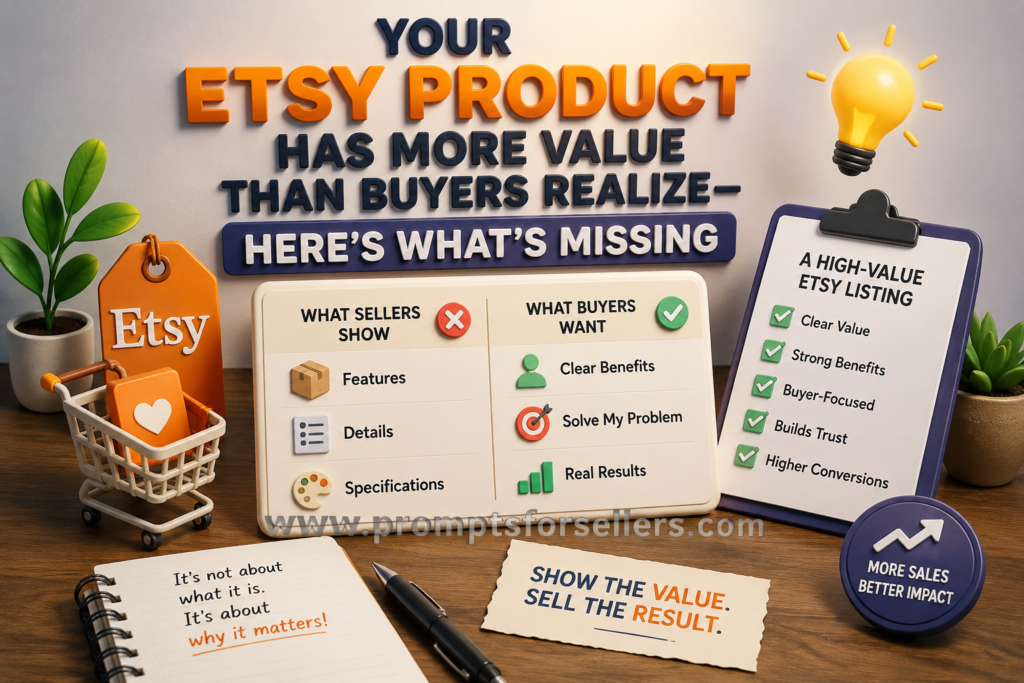
Your Product Can Be Useful Without Feeling Valuable
Use this distinction:
Useful product:
“This bundle includes 100 Canva social media templates.”
Clearly communicated value:
“This bundle gives small business owners 100 ready-to-customize Canva templates so they can create consistent social content without designing every post from scratch.”
The underlying product has not changed. The meaning of the product has.
The first statement tells shoppers what they receive. The second helps them understand why receiving it matters.
This distinction is particularly important for digital products because buyers cannot physically examine them before purchasing. They need enough information to mentally picture the product, understand how they will use it, and decide whether it solves a problem they actually have.
A useful way to evaluate your Etsy product is to separate four layers:
| Layer | Question the buyer needs answered |
| Feature | What is included? |
| Benefit | What does it help me do? |
| Use case | How would I actually use it? |
| Outcome | What becomes easier, faster, clearer, or better? |
For example, an ebook with 75 pages is a feature. A structured system for helping a new seller plan their first digital product is a benefit and use case. Helping that seller move from “I don’t know what to create” to having a practical product plan is the outcome.
The more clearly your listing communicates these layers, the less work the shopper has to do to understand the offer.
Ready to Choose Your First Etsy Product?
You don’t need hundreds of product ideas—you need one idea worth testing.
The Not Sure What to Sell on Etsy? guide helps you use AI to brainstorm product opportunities, evaluate them, and narrow your options so you can make a more informed decision about what to sell.
If you’re still stuck at “What should I sell on Etsy?”, this guide is your next step.
👉 Get the guide for just $9
Get the Etsy Product Idea Guide →Instant digital download • Beginner-friendly • AI-powered
That does not mean promising unrealistic results. Your product should never claim that an ebook will guarantee income or that a template will automatically generate sales. Instead, communicate the specific problem, task, or decision the product is designed to help with.
Etsy’s own seller guidance recommends using the description to explain what the product is, how shoppers might use it, and what makes it unique.
The Gap Between What You Created and What Buyers Understand
Creators naturally think about their products from the inside out.
You remember:
- How many hours you spent creating it
- The research behind it
- The features you carefully added
- The revisions you made
- The tools you used
- The expertise required to produce it
The buyer does not automatically see any of that.
They are approaching your Etsy product from the outside in.
Their thought process may be closer to:
“Is this actually for me?”
“What exactly will I get?”
“Will this solve my problem?”
“How would I use it?”
“Why should I choose this instead of another product?”
“Is it worth the price?”
That is why an Etsy listing description cannot simply function as an inventory sheet.
Consider a hypothetical digital budget planner.
A creator might describe it like this:
“Printable budget planner with 25 pages, monthly budget sheets, expense trackers, savings trackers, and debt payoff worksheets.”
Everything there may be accurate. But the shopper still has to connect those features to a personal need.
A buyer-focused version could explain:
“Plan your monthly spending, track where your money is going, and organize savings and debt goals in one simple printable system.”
The second version gives the features context. It helps the shopper understand the job the product is designed to do.
This is also where your product positioning matters. If your listing tries to appeal to everyone, the value can become vague. A product designed specifically for “first-time Etsy sellers who need a simple listing workflow” is easier to position than one described as “a complete business toolkit for everyone.”
The goal is not to make your product sound bigger than it is.
The goal is to make its actual usefulness easier to recognize.
How Buyer Perception Influences Purchase Decisions
Buyers do not evaluate an Etsy product based only on its objective features. They evaluate the information available to them and form a perception of whether the product is relevant, useful, trustworthy, and worth the asking price.
That is why two products with similar features can be perceived very differently.
Imagine two AI prompt bundles:
Product A:
“500 AI prompts for entrepreneurs.”
Product B:
“500 ready-to-use AI prompts for freelancers who want help with client proposals, marketing ideas, content planning, and repetitive business tasks.”
The second product immediately provides more context:
- Who it is for
- What types of problems it addresses
- Where the prompts can be used
- Why the buyer might need them
The number of prompts did not change. The perceived relevance did.
This matters for Etsy listing conversion because getting someone to click your product is only part of the journey. Etsy says its search system considers listing engagement and how well listings convert after shoppers interact with them, alongside relevance and other listing and shop factors.
That makes buyer understanding an important part of the larger Etsy product listing—not a separate copywriting exercise.
Your listing needs to bridge three things:
What you created → What the buyer needs → Why your product is a sensible solution
When that bridge is weak, shoppers may have to work too hard to understand the offer. They may compare your product primarily on price because the difference in value has not been made obvious.
When the bridge is clear, the buyer can evaluate the product on more meaningful factors: relevance, usefulness, fit, convenience, and the specific outcome the product is designed to support.
And this leads to the most important question for your listing: What value is already inside your product that your current messaging has failed to make obvious?
Find the Value Your Etsy Product Already Has
A common mistake in digital product selling is assuming that the value of a product is obvious because you created it. You know how much research went into the ebook, how many hours went into building the template, or how carefully you organized an AI prompt bundle. The buyer does not.
They see the finished offer through a much smaller window: your images, title, price, and Etsy listing description. If those elements don’t make the usefulness of the product clear, shoppers may judge it based on what they can understand in a few seconds—not on the amount of work behind it.
Etsy’s own seller guidance emphasizes that descriptions should help buyers understand what they’re purchasing and answer their questions before they need to contact the seller.
That means the first job isn’t necessarily to rewrite your copy. It’s to discover the value your product already contains.
Identify the Problem Your Product Solves
Start with the problem, not the product.
This sounds simple, but it changes the way you describe almost everything. Sellers often begin with:
“This is a 25-page budgeting workbook with editable worksheets.”
That’s accurate, but it leaves the buyer with an important unanswered question:
“So what does this do for me?”
A stronger value-oriented explanation might be:
“A printable budgeting workbook designed to help you organize monthly expenses, identify where your money is going, and create a realistic spending plan.”
The difference isn’t necessarily the product. The difference is context.
The first version describes the object. The second connects the object to a problem and a desired result.
This distinction matters particularly for digital products because buyers can’t physically inspect the product before purchasing. Etsy allows sellers to offer digital downloads such as templates, printables, patterns, and other downloadable products, so the listing has to do more of the explanatory work.
To uncover the core problem your product solves, ask:
- What situation causes someone to look for this product?
- What are they struggling with before they find it?
- What are they trying to accomplish?
- What would become easier, faster, clearer, or more organized after using it?
- What would happen if they didn’t have a solution?
For example:
| Product | Weak Positioning | Stronger Problem-Based Positioning |
| Social media template bundle | 100 Canva templates | Helps small businesses create consistent social content faster |
| Resume template | Editable resume template | Helps job seekers present their experience in a clean, professional format |
| Wedding planner | 80-page wedding planner | Helps couples organize vendors, deadlines, budgets, and wedding-day details |
| AI prompt bundle | 200 ChatGPT prompts | Helps creators generate marketing ideas without starting every task from scratch |
| Ebook | 75-page guide | Gives beginners a structured path to solve a specific problem |
The key is to avoid inventing a problem simply because it sounds marketable. The problem should be genuinely connected to what the product helps the buyer accomplish.
This also gives you a better foundation for your Etsy product listing because you’re no longer asking, “What can I say about my product?”
You’re asking:
“What does my buyer need this product to help them do?”
That question leads directly to the next layer of value.
Uncover the Benefits Hidden Inside Your Features
Features tell buyers what they receive. Benefits explain why those features matter.
This is one of the most important distinctions in product positioning.
Consider a digital planner with:
- 60 pages
- Monthly planning pages
- Weekly spreads
- Goal-setting worksheets
- Budget pages
- PDF format
Those details are useful. But they’re not automatically persuasive.
The features become more meaningful when you connect them to buyer benefits:
| Feature | Buyer Benefit |
| 60 planning pages | Gives buyers multiple tools for organizing different areas of their lives |
| Weekly spreads | Makes it easier to see upcoming tasks and priorities |
| Goal-setting worksheets | Helps turn broad goals into actionable plans |
| Budget pages | Provides a dedicated place to track spending and plan expenses |
| PDF format | Makes the product easy to download and use digitally or print |
The important principle is feature → benefit → relevance.
For example:
Feature: 30 editable Canva templates
Benefit: Buyers can customize the designs to match their brand
Relevance: They can create consistent social content without designing every post from scratch
That final step is where perceived value becomes much clearer.
Etsy’s current guidance similarly emphasizes using listing information to help shoppers understand the product, while its broader listing guidance recommends clear, buyer-friendly information across titles, descriptions, tags, attributes, photos, and other listing elements.
A useful exercise is to take every major feature of your product and complete this sentence:
“This matters to the buyer because…”
If you can’t finish the sentence with a meaningful benefit, that feature probably shouldn’t receive prominent space in your marketing.
For digital products, go one step further. Ask:
“What does this feature save the buyer?”
It might save:
- Time
- Research
- Effort
- Decision-making
- Organization
- Design work
- Repetitive tasks
- Trial and error
You shouldn’t automatically assign a dollar value to those savings. Instead, explain the practical advantage honestly.
For a creator selling through Etsy, Gumroad, or another digital storefront, this distinction can become part of a reusable product-positioning system. Once you understand the real benefits behind the features, the same messaging can support your product page, email campaigns, social content, launch materials, and other marketing assets.
Define the Transformation or Outcome Buyers Want
Benefits answer “Why does this matter?”
Outcomes answer a deeper question:
“What will be different for me after I use it?”
That’s where many Etsy listings stop too early.
Imagine you’re selling an AI prompt bundle for freelance designers.
A feature-focused description might say:
“Includes 150 AI prompts for client communication, content creation, research, and business planning.”
A benefit-focused description might say:
“Use the prompts to speed up common business and marketing tasks.”
An outcome-focused version goes further:
“Spend less time staring at a blank screen when you need to write client messages, brainstorm content, or organize your next marketing task.”
The product hasn’t changed. The mental picture of using it has.
This is especially important when your product is intangible. A buyer can’t hold an ebook, open a template package in their hands, or physically examine a collection of AI prompts before purchasing. They need enough information to imagine how the product fits into their own situation.
Ask yourself:
- What can the buyer accomplish with this?
- What task becomes easier?
- What decision becomes simpler?
- What frustration can be reduced?
- What process becomes more organized?
- What can the buyer create, plan, learn, or complete?
- Who benefits most from that outcome?
Be careful with the word “transformation,” though. It doesn’t have to mean a dramatic life-changing result.
For a digital product, the transformation could be modest and practical:
Before: “I don’t know how to organize my content.”
After: “I have a structured content calendar I can actually follow.”
Before: “I don’t know what to include in my resume.”
After: “I have a clear structure for presenting my experience.”
Before: “I keep starting my product descriptions from scratch.”
After: “I have a repeatable framework for communicating my product’s value.”
Those are believable outcomes. They don’t promise guaranteed sales or unrealistic results.
And that distinction matters. A strong value proposition isn’t about making your product sound bigger than it is. It’s about making its real usefulness easier to recognize.
AI Prompt: Extract the Hidden Value From Your Etsy Product
Purpose
Use AI to analyze your product from a buyer’s perspective and uncover the problems, benefits, use cases, and realistic outcomes that may not be obvious from the product’s features alone.
Prompt:
Act as a senior product-positioning strategist and conversion copywriter specializing in Etsy and digital products.
Analyze the product information below and identify the value that a potential buyer may not immediately recognize.
Product name: [PRODUCT NAME]
Product type: [TEMPLATE / EBOOK / PRINTABLE / PLANNER / AI PROMPT BUNDLE / COURSE / OTHER]
What the product includes: [LIST FEATURES, FILES, PAGES, MODULES, TOOLS, OR COMPONENTS]
Target buyer:[DESCRIBE THE IDEAL CUSTOMER]
Current Etsy product description: [PASTE DESCRIPTION]
Current price: [PRICE]
Analyze the product without inventing features, benefits, guarantees, or customer results.
Provide:
- The primary problem this product appears to solve.
- Three additional problems it may help address.
- The target buyer’s likely goals and motivations.
- The most important features.
- The practical buyer benefits behind each important feature.
- The realistic outcome or use case associated with each benefit.
- The strongest unique value proposition supported by the information provided.
- Five reasons a buyer might still fail to recognize the product’s value.
- Five buyer questions or objections the Etsy listing should answer.
- Five specific value statements that could be tested in the product description.
Separate confirmed product facts from reasonable positioning opportunities. Do not make unsupported claims.
Finally, create a simple:
Feature → Benefit → Buyer Outcome
table that I can use as the foundation for rewriting my Etsy listing.
How to use it:
Paste the information you already have about the product, even if the current listing is poorly written. The goal isn’t to have AI magically invent better copy. It’s to make the underlying value easier to see before you rewrite the listing.
Customize:
- Product type
- Target buyer
- Product features
- Included files or content
- Current description
- Price
- Primary use case
- Known buyer questions or objections
Once you’ve completed this exercise, you should have something much more valuable than a list of features: a clear map of why the product matters to the person considering buying it. That map becomes the foundation for turning those features into persuasive, buyer-centered messaging.
Turn Product Features Into a Reason to Buy
A common mistake in an Etsy product listing is assuming that more information automatically creates more value. It doesn’t. A buyer can understand exactly what your product includes and still feel no strong reason to purchase it.
Think about a digital product such as a 50-page business planner. Saying it includes “50 pages, 10 worksheets, goal-setting templates, and budget trackers” tells the shopper what exists inside the file. But it does not necessarily explain why those pages matter to them.
The stronger message is closer to: “Plan your week, organize your priorities, and keep your business tasks in one place without building a planning system from scratch.”
The product did not change. The meaning changed.
That distinction matters because Etsy itself recommends using listing descriptions to give shoppers the information they need to understand what they are buying and answer their questions before they have to ask. Etsy also says its search system considers multiple parts of a listing, including the title, tags, attributes, description, first photo, and reviews.
Stop Listing Features Without Context
Features are facts about your product.
Benefits explain why those facts matter.
That sounds like a small difference, but it can completely change how an Etsy product is perceived.
Consider a seller offering an editable social media template bundle.
A feature-focused description might say:
“Includes 75 Canva templates in 15 different layouts.”
That information is useful, but the buyer still has to answer several questions:
- Why do I need 75 templates?
- What will they help me do?
- Who are these templates designed for?
- How will they save me time?
- What makes them better than another template bundle?
A benefit-focused version could say:
“Create consistent social media content faster with 75 editable Canva templates designed to help small businesses plan and publish professional-looking posts without starting every design from scratch.”
Now the same feature supports a clear outcome: less repetitive work and a simpler content-creation process.
This is especially important for digital products because buyers cannot physically examine the product before purchasing. They often have to understand its value through your images, title, description, previews, reviews, and other listing information.
Etsy’s own guidance recommends making descriptions informative and engaging while clearly explaining what makes the product unique.
A useful rule is:
Don’t stop at “What is included?” Ask “Why should the buyer care?”
You can use this simple transformation:
Feature → Benefit → Outcome
For example:
| Feature | Buyer Benefit | Desired Outcome |
| 100 editable Canva templates | Gives the buyer ready-to-customize designs | Create content without designing every post from scratch |
| 30-page budgeting workbook | Provides a structured way to organize finances | Build a clearer personal budgeting routine |
| 200 AI prompts | Gives creators ready-made starting points | Spend less time figuring out what to ask AI |
| 12 ebook chapters | Provides a structured learning path | Learn the topic without piecing information together |
| Printable weekly planner | Creates a simple planning system | Organize priorities and tasks more consistently |
The feature is still important. It simply isn’t doing all the selling.
Connect Each Feature to a Specific Buyer Benefit
The next step is to connect your product’s features to the specific reason your target customer would use them.
This requires knowing what the buyer is trying to accomplish.
A template seller might think:
“My product has 100 templates.”
The buyer might be thinking:
“I need to create content this week, but I don’t have time to design everything.”
Those are two completely different perspectives.
Your listing becomes stronger when it bridges them.
Start by taking your main product features and asking three questions:
- What does this feature give the buyer?
- What problem does it reduce or solve?
- What can the buyer do more easily because of it?
For example:
Feature: 100 editable templates
Benefit: Gives buyers ready-to-customize designs
Problem reduced: Starting every design from a blank page
Practical outcome: Faster content creation
Or:
Feature: 150 AI prompts for Etsy sellers
Benefit: Gives sellers structured starting points for common tasks
Problem reduced: Spending time figuring out what to ask an AI tool
Practical outcome: Faster listing, marketing, and content workflows
Notice that the strongest benefit is not necessarily “saves time” every time. Sometimes the real value is clarity, convenience, confidence, organization, consistency, customization, or reduced effort.
That’s why generic claims such as “high quality,” “easy to use,” and “must-have” are usually weaker than specific explanations. They ask the buyer to trust your judgment instead of showing them what the product actually enables them to do.
For an Etsy digital product description, specificity is particularly useful. Etsy recommends including important information that helps shoppers understand exactly what they’re purchasing, including what is and isn’t included.
A practical way to write each major feature is:
[Feature] helps [specific buyer] [specific benefit] so they can [desired outcome].
For example:
“The included weekly content planner helps busy Etsy sellers organize upcoming posts in one place so they can maintain a consistent publishing routine without constantly deciding what to post next.”
That’s much more useful than:
“Includes a weekly content planner.”
The second statement tells. The first connects.
And that connection is what turns product information into perceived value.
Use Real-World Use Cases to Make Value Concrete
Buyers don’t always purchase a product because of its specifications. They purchase because they can picture using it in their own situation.
That’s why use cases are powerful.
Instead of only explaining what your Etsy product contains, show the reader where it fits into their life, business, or workflow.
For example, imagine you’re selling an Etsy SEO prompt bundle.
A feature-based listing might say:
“Includes 75 prompts for Etsy SEO.”
A use-case-focused explanation could say:
“Use the prompts when you’re researching listing keywords, improving product descriptions, brainstorming title ideas, or looking for new ways to explain your product benefits.”
The second version helps the buyer visualize the product in action.
For digital products, useful use cases might include:
- Templates: creating social posts, presentations, lead magnets, or business documents
- Ebooks: learning a skill, following a process, or solving a specific problem
- Planners: organizing work, finances, projects, or personal routines
- AI prompt packs: generating ideas, improving workflows, researching topics, or creating marketing assets
- Courses: learning a defined skill or completing a specific transformation
- Spreadsheets: tracking expenses, inventory, leads, projects, or business performance
The key is to avoid inventing outcomes the product cannot realistically deliver.
If your planner helps someone organize their tasks, say that. Don’t turn it into a promise that the planner will “transform their business” unless you can genuinely support that claim.
You can also use buyer scenarios to make a product easier to understand.
For example:
For the Etsy seller who has plenty of product ideas but struggles to organize them: use the included planning worksheets to map products, content, and promotional tasks in one place.
Or:
For the creator who spends too much time staring at a blank AI chat window: use the prompt collection as a starting point for common digital-product marketing tasks.
These statements are stronger because they connect the product to a recognizable situation.
This approach also works beyond Etsy. If you later sell the same digital product through Gumroad, the underlying value proposition can remain consistent while the messaging is adapted to the audience and buying context.
A useful test is to imagine your ideal customer reading one feature from your listing and asking:
“So what does that actually help me do?”
Your next sentence should answer that question.
If the buyer has to figure out the answer alone, there’s probably a missing layer of value communication.
AI Prompt: Turn Etsy Product Features Into Buyer Benefits
Purpose
Use this prompt to transform a feature-heavy Etsy product description into buyer-focused messaging that explains why each feature matters, without inventing benefits or making unrealistic claims.
Prompt:
Act as an expert Etsy product positioning strategist and conversion copywriter.
I sell the following Etsy product:
Product name: [PRODUCT NAME]
Product type: [TEMPLATE / EBOOK / PLANNER / PRINTABLE / AI PROMPT BUNDLE / COURSE / OTHER]
Target buyer: [DESCRIBE YOUR IDEAL CUSTOMER]
Buyer problem: [PROBLEM THE PRODUCT IS DESIGNED TO HELP WITH]
Desired outcome: [WHAT THE BUYER WANTS TO ACCOMPLISH]
Product features:
- [FEATURE 1]
- [FEATURE 2]
- [FEATURE 3]
- [FEATURE 4]
- [FEATURE 5]
For each feature:
- Explain what the feature actually provides.
- Identify the practical buyer benefit.
- Identify the problem or friction it can reduce.
- Explain the realistic outcome it can help the buyer achieve.
- Give one specific real-world use case.
- Write one natural, buyer-focused sentence that could be used in an Etsy listing description.
Use specific language instead of vague claims such as “amazing,” “perfect,” “must-have,” or “high quality.”
Do not invent features, customer results, statistics, testimonials, or guarantees.
Keep the benefits realistic and directly connected to the features provided.
Finally, identify the 3 strongest value propositions from the product and rank them from strongest to weakest based on relevance to the target buyer.
Format the response as:
Feature
- What it provides:
- Buyer benefit:
- Problem reduced:
- Realistic outcome:
- Use case:
- Etsy-ready benefit statement:
Then provide:
Top 3 Value Propositions
- [Value proposition]
- [Value proposition]
- [Value proposition]
How to use it:
Give the AI the actual features of your product rather than a vague product description. The more accurately you describe what the buyer receives, the less likely the output is to drift into generic marketing language.
After generating the results, verify every benefit against the actual product. Keep only claims you can honestly support.
Customize:
- Product type
- Target buyer
- Buyer problem
- Desired outcome
- Product features
- Included files or resources
- Main use cases
- Any meaningful limitations or requirements
The goal isn’t to make every feature sound impressive. It’s to make every important feature understandable in terms of buyer value. Once a shopper can see what a feature helps them accomplish, the product stops looking like a collection of files or specifications and starts looking like a useful solution.
Make Your Etsy Listing Description Answer the Buyer’s Real Questions
A strong Etsy listing description should do more than describe what you created. It should remove the uncertainty that naturally appears when someone is deciding whether a product is worth their money.
Think about the questions a shopper is silently asking while looking at your listing:
- What exactly am I buying?
- Is this actually for someone like me?
- What will I be able to do with it?
- What files or materials are included?
- How does it work?
- Is there anything I need before I can use it?
- Why would I choose this product instead of another one?
Etsy itself recommends making descriptions complete enough to answer shoppers’ questions before they need to contact the seller. Its current listing guidance also says descriptions should explain the details of the item so buyers know what they’re getting.
For digital products, this becomes even more important because buyers cannot physically examine the product before purchasing. Your Etsy digital product description has to replace some of the information a shopper would normally gather by handling or inspecting a physical item.
What Exactly Am I Getting?
One of the easiest ways to create buyer hesitation is to leave the contents of the purchase unclear.
A buyer shouldn’t have to decode your listing to determine what comes with the purchase.
Instead of writing:
“Complete social media content bundle for small businesses.”
Give the buyer a concrete picture of the offer:
What’s included:
• 50 editable Canva templates
• 25 Instagram post designs
• 15 story templates
• PDF quick-start guide
• Instant digital download
• Canva account required for editing
The second version doesn’t necessarily make the product better. It makes the offer easier to understand.
For an Etsy digital product, clarity should cover practical details such as:
- Number of files
- File formats
- Number of pages, templates, or designs
- Software or apps required
- Editable vs. non-editable files
- Instant download vs. made-to-order delivery
- Included bonuses
- Usage instructions
- Any important limitations
Etsy currently allows sellers of instant digital listings to upload up to five files, with a maximum size of 20 MB per file. Being precise about what those files contain helps buyers understand what they’re actually purchasing.
This distinction matters because value is difficult to perceive when the offer itself is vague.
Consider two ebook listings:
Listing A:
“A complete guide to starting an online business.”
Listing B:
“A 72-page beginner guide covering product selection, pricing, simple marketing strategies, and a step-by-step launch checklist for your first digital product.”
Listing B gives the shopper something to evaluate.
The goal isn’t to make the description longer for the sake of length. The goal is to eliminate unnecessary uncertainty.
A useful test is:
Could a buyer describe exactly what they will receive after reading the first part of your description?
If the answer is no, your listing still has a clarity gap.
Who Is This Product Designed For?
The second question buyers need answered is more subtle:
“Is this actually for me?”
A product can be useful to many people, but trying to speak to everyone often makes the listing feel relevant to no one.
For example, imagine you’re selling a Canva business-planning template.
This:
“Business planner for entrepreneurs.”
is broad.
This:
“A simple weekly business planner for solo service providers who need a clearer way to organize client work, marketing tasks, and weekly priorities.”
creates a much more specific mental picture.
The buyer can recognize themselves in the description.
This is particularly important for digital products because the same basic format can serve completely different audiences. A spreadsheet could be:
- A budget tracker for college students
- A cash-flow tracker for freelancers
- An expense tracker for Etsy sellers
- A financial planning worksheet for families
The file itself may be structurally similar, but the positioning changes its perceived usefulness.
That’s why your Etsy product listing should identify the intended buyer through specific situations, goals, or problems—not vague labels such as “anyone,” “everyone,” or “all business owners.”
A practical way to define your audience is to complete this sentence:
This product is designed for [specific person] who wants to [specific outcome] but struggles with [specific problem].
For example:
This template is designed for freelance designers who want to organize client projects in one place but struggle to keep deadlines, revisions, and deliverables organized.
Now the product has context.
And context creates relevance.
This doesn’t mean you should exclude every other possible customer. It simply gives your primary buyer a clear reason to think, “This was made for someone like me.”
That principle also connects to your broader product positioning. If you sell the same digital product through another channel such as Gumroad, the underlying value proposition can remain consistent while the messaging is adapted to that platform and audience.
If you’re struggling to identify why a product isn’t connecting with shoppers, examining whether the listing communicates the product’s value clearly can also reveal problems that look like a product-quality issue but are actually positioning issues. This is closely related to the broader challenge of why digital products are not selling and how creators can diagnose the underlying problem. digital products are not selling and how Gumroad creators can diagnose and fix the underlying problems
What Can I Actually Do With It?
Knowing what you’re buying isn’t always enough.
The buyer also wants to understand:
“What will this help me do?”
This is where many product descriptions stop too early.
A seller might write:
“Includes 100 AI prompts for content creation.”
That’s clear about the quantity, but it doesn’t fully communicate the practical value.
A stronger explanation might be:
“Use the 100 AI prompts to generate social media ideas, rewrite product messaging, create promotional angles, and build a consistent content workflow without starting from a blank page every time.”
Now the buyer can visualize using the product.
The difference is feature versus outcome.
| Feature | Buyer-focused explanation |
| 100 AI prompts | Generate content ideas without starting from scratch |
| 30 Canva templates | Create consistent branded posts faster |
| 50-page ebook | Follow a structured process instead of piecing information together |
| Budget spreadsheet | Track expenses and see where money is going |
| Editable planner | Adapt the workflow to your own routine |
Still Not Sure What to Sell on Etsy?
Finding an Etsy product idea can be harder than it looks. You need to think about buyer demand, competition, profitability, and whether people are actually searching for the product.
Instead of guessing, use a structured process to find and validate your ideas before investing your time in creating a product.
Not Sure What to Sell on Etsy? is a practical AI-powered guide that helps you find, validate, and choose your first Etsy product idea.
Inside the guide, you’ll learn how to:
- Find potential Etsy product ideas
- Use AI to generate and evaluate ideas
- Validate an idea before creating it
- Think about competition and buyer demand
- Narrow multiple ideas down to one stronger option
👉 Ready to find your first Etsy product idea?
Get the Etsy Product Idea Guide →Instant digital download • Beginner-friendly • AI-powered
The feature tells the buyer what exists.
The benefit explains why it matters.
The outcome shows what the buyer can accomplish with it.
For digital products, this progression is especially useful because the product may have no physical presence. A buyer can’t hold an ebook, flip through every page of a template bundle, or test an AI prompt library before purchasing.
Your listing therefore needs to help them mentally experience the product.
Try describing practical use cases such as:
- “Use this when…”
- “You can use these templates to…”
- “This is especially useful if…”
- “By the end, you’ll have…”
- “Instead of spending time…, you can…”
Etsy also recommends making descriptions easy to scan and putting important information where buyers can find it quickly.
That means you don’t need to bury every detail inside large paragraphs. Short sections, bullets, and clear labels can make the information easier to process.
There’s another important benefit to this approach: it helps you avoid making unsupported promises.
Instead of saying:
“This template will transform your business.”
say:
“Use the template to organize your weekly marketing tasks, track priorities, and keep recurring work in one place.”
The second statement is specific and believable.
Your goal isn’t to convince every visitor that your Etsy product is extraordinary.
Your goal is to give the right buyer enough clear information to understand its usefulness.
AI Prompt: Find the Questions Missing From an Etsy Listing Description
Purpose
Use AI as a buyer-perspective audit. Instead of asking AI to simply rewrite your description, have it identify the questions, uncertainties, and missing information that could prevent a shopper from understanding your offer.
Prompt:
Act as an Etsy conversion copywriter and skeptical online shopper.
I sell the following Etsy product:
Product name: [PRODUCT NAME]
Product type: [EBOOK / TEMPLATE / PRINTABLE / AI PROMPT BUNDLE / COURSE / OTHER]
Target buyer: [IDEAL CUSTOMER]
Main problem it helps solve: [PROBLEM]
Desired buyer outcome: [OUTCOME]
What is included: [LIST EVERYTHING INCLUDED]
File formats: [FILE TYPES]
How the buyer uses it: [EXPLAIN THE BASIC USE CASE]
Price: [PRICE]
Current Etsy listing description: [PASTE YOUR FULL DESCRIPTION]
Analyze this listing from the perspective of a first-time buyer who has never seen my product before.
Identify:
1. The most important questions a buyer may still have after reading the description.
2. Any information about the product contents that is unclear or missing.
3. Any unclear information about who the product is designed for.
4. Any uncertainty about how the buyer would actually use the product.
5. Any potential objections that could prevent a purchase.
6. Any phrases that describe features without explaining their practical benefit.
7. Any claims that sound vague, exaggerated, or unsupported.
8. Any places where the buyer may misunderstand what they will receive.
9. The three most important pieces of information that should be moved higher in the description.
10. A prioritized checklist of changes, ranked from highest to lowest impact on buyer clarity.
Do not rewrite the entire listing.
Focus only on diagnosing information gaps and buyer questions.
Do not invent product features, benefits, files, guarantees, results, or customer experiences that I did not provide.
How to use it:
Paste your actual listing into the prompt and review the questions AI identifies. Don’t automatically add every suggested detail. First verify whether each question is genuinely relevant to your product.
The highest-priority questions are usually the ones that clarify what the buyer receives, who it’s for, how it works, and what they can realistically accomplish with it.
Customize:
- [PRODUCT NAME]
- [PRODUCT TYPE]
- [IDEAL CUSTOMER]
- [PROBLEM]
- [OUTCOME]
- [LIST EVERYTHING INCLUDED]
- [FILE TYPES]
- [BASIC USE CASE]
- [PRICE]
- [CURRENT LISTING DESCRIPTION]
The best Etsy listing description doesn’t force a buyer to work out the value on their own. It makes the product, its intended user, and its practical use clear enough that the right shopper can quickly decide whether the offer fits their needs. That clarity becomes the foundation for communicating why the product deserves consideration in the first place.
Build a Stronger Value Proposition Around Your Etsy Product
A strong value proposition answers a simple question from the buyer’s perspective: “Why should I choose this product instead of another one?” Your Etsy product does not need to be completely unique to have a compelling answer. It needs to be positioned around a meaningful problem, a specific audience, or a useful outcome that buyers can recognize quickly.
This matters because shoppers rarely evaluate a product based on features alone. They are trying to determine whether the product fits their situation and whether the expected benefit justifies the price. Etsy itself recommends identifying your target customer, understanding the problems you solve, and defining the qualities that differentiate your products when developing your unique selling proposition.
Clarify What Makes Your Product Different
“Different” does not necessarily mean you invented something nobody else sells.
For most Etsy sellers, especially digital-product creators, differentiation is more specific than that. Your product might be:
- Easier for beginners to use
- Designed for a particular profession or audience
- More comprehensive
- More customizable
- Faster to implement
- Organized in a more useful way
- Built around a specific problem
- More focused than competing products
- Designed to produce a particular outcome
Consider a seller offering a social media template bundle.
A weak positioning statement might be:
“100 editable Canva templates for social media.”
That tells the shopper what the product contains. It does not tell them why this particular bundle deserves their attention.
A stronger position could be:
“100 ready-to-customize Canva templates designed for busy real estate agents who need professional social posts without creating every design from scratch.”
Now the product has a clearer identity.
The difference is not necessarily the number of templates. It is the specific buyer, problem, and use case.
This is also why you should avoid trying to compete by simply adding more files. A 500-page bundle is not automatically more valuable than a 50-page resource if the smaller product solves the buyer’s problem more directly.
Your Etsy product should make its strongest distinction obvious:
Who is it for? → What problem does it address? → What makes your solution useful?
That positioning can then influence your title, images, listing description, product previews, and promotional content. Etsy’s current listing guidance similarly emphasizes buyer-friendly clarity and understanding what helps shoppers feel confident about a purchase.
If you’re struggling to determine whether your offer actually feels different, step back from the product itself and look at the buyer’s decision. Ask:
“What would make the right customer say, ‘This is exactly what I need’?”
That answer is usually more valuable than another list of features.
Position the Product Around a Specific Buyer Need
One of the easiest ways to strengthen an Etsy product is to stop positioning it for everyone.
A product becomes easier to understand when the buyer can immediately recognize themselves in the offer.
Compare these two descriptions:
Broad positioning:
“Digital budget planner for managing your finances.”
Specific positioning:
“A simple digital budget planner for busy professionals who want to organize monthly spending, savings goals, and recurring bills in one place.”
The second version creates context. A potential buyer can quickly decide whether the product is relevant to them.
This is particularly important for digital products because shoppers cannot physically inspect the finished product. They need enough information to understand what they are buying, how it fits their situation, and what they can actually do with it.
The same principle applies to an ebook.
Instead of:
“An ebook about starting an online business.”
You could position it around a more specific need:
“A practical beginner guide for freelancers who want to turn their existing skills into a simple digital-product business.”
The product has not changed. The perceived relevance has.
This is where your Etsy listing description should work together with your positioning. Rather than beginning with everything included in the product, establish the buyer’s situation first.
A useful positioning formula is:
For [specific buyer] who wants [desired outcome], this [product type] helps them [solve problem] by [key mechanism or advantage].
For example:
For Etsy sellers who struggle to create consistent promotional content, this Canva template bundle provides ready-to-customize designs that make weekly content creation faster and easier.
You do not have to use this sentence word-for-word in your listing. Use it as a strategic filter.
If you cannot clearly identify the buyer or need, your product positioning may still be too broad.
And remember: specificity does not mean excluding everyone who falls outside your ideal customer profile. It means giving the right buyer a clear reason to recognize the product as relevant.
Make the Price Feel Easier to Understand Through Value
Price and value are related, but they are not the same thing.
A $19 digital product can feel expensive when the listing makes it look like a collection of files. The same $19 product can feel reasonable when the buyer understands exactly what those files help them accomplish.
That does not mean you should manipulate buyers into believing an overpriced product is cheap. Strong positioning should make the actual value easier to understand—not disguise the price.
Etsy gives sellers control over their pricing and recommends considering expenses and business costs when setting prices. Its pricing guidance also emphasizes that sellers are responsible for their own pricing decisions.
For a digital product, think beyond the number of files.
Suppose you sell a $17 content-planning template.
If your listing emphasizes:
- 30 pages
- 12 worksheets
- 50 prompts
- Editable Canva file
- PDF download
the shopper may start counting pages instead of considering usefulness.
Instead, connect those components to the job they perform:
- Plan content without starting from a blank page
- Organize ideas into a repeatable workflow
- Reduce the time spent deciding what to publish
- Customize the system around a specific business
- Start using the resource immediately
Now the buyer has context for the price.
A useful way to evaluate your own listing is to separate product cost from buyer value:
| Product Information | Buyer-Focused Value |
| 100 templates | Helps create consistent content faster |
| 50 AI prompts | Reduces time spent figuring out what to ask AI |
| 80-page ebook | Provides a structured process for solving a specific problem |
| Editable planner | Lets buyers adapt the system to their own workflow |
| Spreadsheet calculator | Simplifies a task that would otherwise require manual work |
The goal is not to hide the specifications. Buyers still need to know exactly what they receive. The goal is to translate specifications into relevance.
This becomes especially important when competing against lower-priced products. You should not automatically respond by lowering your price. First ask whether your listing clearly communicates why your product is useful, who it is designed for, and what makes the offer different.
Etsy’s own conversion guidance notes that shoppers compare prices and that price can influence whether they click a listing, while also emphasizing other factors such as titles, reviews, images, and the overall listing experience.
That gives you a more sustainable approach to Etsy listing conversion:
Don’t simply make the product cheaper. Make the value easier to understand.
AI Prompt: Create a Clear Etsy Product Value Proposition
Purpose
Use this prompt when you have a good Etsy product but are struggling to explain what makes it valuable, different, or relevant to the right buyer.
Prompt:
Act as a product-positioning strategist and conversion copywriter specializing in Etsy digital products.
I want you to help me create a clear, buyer-focused value proposition for my Etsy product.
PRODUCT INFORMATION
Product name: [PRODUCT NAME]
Product type: [TEMPLATE / EBOOK / PLANNER / PRINTABLE / AI PROMPT BUNDLE / COURSE / OTHER]
Current price: [$PRICE]
Target buyer: [IDEAL CUSTOMER]
Primary problem the product addresses: [PROBLEM]
Desired buyer outcome: [OUTCOME]
What is included: [LIST OF FEATURES / FILES / COMPONENTS]
How the buyer uses it: [USE CASE]
What makes my product different: [DIFFERENTIATOR, IF KNOWN]
Main competing alternatives: [ALTERNATIVES OR COMPETING PRODUCTS]
Buyer objections I expect: [OBJECTIONS]
Brand voice: [VOICE]
Analyze the information above and produce:
1. The core problem this product solves.
2. The strongest buyer benefits.
3. The most important desired outcome.
4. Three meaningful ways to differentiate the product without making unsupported claims.
5. A clear one-sentence value proposition using this framework:
“For [specific buyer] who wants [desired outcome], this [product] helps them [solve problem] by [key advantage].”
6. Three alternative value propositions with different positioning angles.
7. A short “Why this is different” statement.
8. Five buyer-focused benefits derived from the actual features.
9. Five likely buyer objections and a concise, honest response to each.
10. Three ways the value proposition could be adapted for:
– Etsy listing description
– Product image text
– Gumroad product page
Important rules:
– Do not invent features, guarantees, testimonials, statistics, or results.
– Do not claim the product is better than competitors unless the supplied information supports that claim.
– Separate product features from buyer benefits.
– Prioritize specificity over generic marketing language.
– Focus on why the right buyer would find this product useful.
– Keep the positioning credible and suitable for a US audience.
How to use it:
Fill in the brackets with the actual details of your product. The more specific your information is about the buyer, problem, and desired outcome, the more useful the resulting positioning will be.
Customize:
- [PRODUCT NAME] — the exact product you’re selling
- [TARGET CUSTOMER] — the person most likely to benefit
- [PROBLEM] — the specific problem they are trying to solve
- [OUTCOME] — what they want to accomplish
- [FEATURES] — everything actually included
- [DIFFERENTIATOR] — what genuinely makes your offer distinct
- [OBJECTIONS] — reasons someone might hesitate before purchasing
The strongest value proposition should eventually become the thread connecting your Etsy product title, images, listing description, and promotional messaging. When those elements all communicate the same buyer benefit from different angles, shoppers have less work to do to understand what your product is worth.
Fix the Conversion Leaks That Make Buyers Hesitate
Getting a shopper to click an Etsy product listing is only part of the job. Once they arrive, the listing has to answer a different question: “Is this actually worth buying for me?”
That question is where many otherwise strong products lose momentum. A shopper may understand what the product is, but still hesitate because something feels unclear. Maybe they cannot tell exactly what they will receive, whether it fits their situation, how they will use it, or why it is worth the price.
For digital products, this uncertainty can be even more important because buyers cannot physically inspect the product before purchasing. Etsy itself recommends that listing descriptions answer shoppers’ questions and provide the information they need to understand an item. Its current guidance also emphasizes that titles, descriptions, photos, tags, attributes, and reviews work together to help shoppers make confident purchasing decisions.
The goal, then, is not to pressure someone into buying. It is to remove unnecessary uncertainty so the right buyer can make an informed decision.
Identify Confusing or Missing Information
A conversion problem often starts with something surprisingly simple: the buyer still has unanswered questions.
Imagine you sell a $19 digital business planner. Your listing says:
“Complete business planner with 75 pages, editable templates, goal-setting worksheets, and financial trackers.”
That sounds informative, but a buyer could still wonder:
- Is this for beginners or experienced business owners?
- Is it a PDF, Canva template, or another file type?
- Can I edit everything?
- What exactly is included?
- How would I use it?
- Is it designed for freelancers, small businesses, or creators?
- Do I need special software?
- Is this a download or something physical?
- What problem does it actually help me solve?
The listing has information, but it may not have enough decision-making information.
That distinction matters.
Etsy recommends putting important information where shoppers can find it easily and using descriptions to answer questions before buyers have to ask.
A useful way to audit your Etsy listing description is to imagine that the buyer has never seen your product before. Then check whether the listing clearly answers five categories:
| Buyer question | What your listing should clarify |
| What is it? | Product type, format, size, quantity, or contents |
| Who is it for? | Ideal customer, experience level, situation, or use case |
| Why do I need it? | Problem, frustration, goal, or desired outcome |
| What do I get? | Exact files, pages, templates, features, or components |
| What should I expect? | How it works, how to access it, limitations, and requirements |
For a digital product, clarity around the actual deliverable is particularly important. “100-page business guide” is less useful than explaining what those 100 pages contain, how the buyer receives them, and what they can realistically do with them.
You should also look for hidden assumptions.
Creators often know their products so well that they unconsciously skip information that feels obvious to them. A buyer does not have that background.
For example:
Creator thinks:
“Of course they know this is a Canva template.”
Buyer thinks:
“Wait—what program do I need to edit this?”
That small gap can become a conversion leak.
This is also why accurate product representation matters. Etsy advises sellers to represent their products accurately through listing images and descriptions so shoppers have a clear understanding of what they will receive.
Before changing your copy, read your listing like a first-time customer. Mark every sentence that describes the product and ask:
“Does this help the buyer make a decision, or does it simply describe what I created?”
That question leads directly to the next conversion issue: objections.
Address Common Objections Before They Stop the Purchase
An objection is not necessarily a complaint. Often, it is simply an unanswered concern that causes the buyer to pause.
For an Etsy digital product, common objections might sound like:
- “Will this work for me?”
- “Is this really worth the price?”
- “What exactly am I getting?”
- “Will I know how to use it?”
- “Is this editable?”
- “Is this compatible with the software I use?”
- “Is this beginner-friendly?”
- “How is this different from the cheaper option?”
- “What happens after I purchase?”
You do not need to create a giant block of defensive copy to address these concerns. The better approach is to anticipate the most important objections and answer them at the point where they naturally arise.
For example, instead of:
“Editable social media template pack.”
Try:
“A set of 50 Canva templates you can customize with your own colors, fonts, photos, and text. Designed for small-business owners who want to create consistent social posts without designing every graphic from scratch.”
The second version answers several questions at once:
- What is it?
- What can I edit?
- Who is it for?
- How can I use it?
- What problem does it address?
Notice that it does not rely on exaggerated claims such as “This will transform your business.” It makes the value easier to understand by making the product’s practical use obvious.
That distinction is especially important when selling digital products on Etsy, Gumroad, or another creator platform. Good conversion copy reduces uncertainty; it does not manufacture urgency.
Reviews can also help address objections because they provide evidence from other buyers. Etsy notes that reviews can help shoppers feel more comfortable purchasing, while clear photos, descriptions, and shop information contribute to buyer confidence as well.
If your product already has reviews, look for recurring questions or benefits mentioned by customers. Those comments can reveal what buyers actually value—not just what you assumed they valued.
For example, you may describe an ebook as:
“A 120-page Etsy SEO guide.”
But customers might repeatedly mention:
“I finally understood why my listings weren’t getting clicks.”
That tells you something important about perceived value. The product may technically be an ebook, but the buyer may value the clarity and problem-solving outcome more than the page count.
That insight can improve your product positioning across your Etsy listing, email marketing, Gumroad product page, social content, and other promotional channels.
Remove Unnecessary Friction From the Buying Decision
Not every conversion problem is caused by weak persuasion.
Sometimes the product is simply harder to understand or evaluate than it needs to be.
Think of friction as anything that makes a buyer stop and work too hard to answer a basic purchasing question.
For a digital product, friction can come from:
- A vague product title
- Unclear file formats
- Missing previews
- Confusing instructions
- Poorly organized descriptions
- Unclear licensing information
- Unexplained software requirements
- Ambiguous quantities
- Weak product images
- Missing examples
- Unclear delivery or access information
- A mismatch between the images and the written description
Etsy’s own listing guidance recommends using clear descriptions, photos, tags, and other listing elements to provide shoppers with the information they need. Its current listing guidance also emphasizes clarity and scannability rather than making one listing element carry the entire burden of persuasion.
For example, compare these two digital-product descriptions:
Higher friction:
“Ultimate Content Planner — 80 pages of useful resources for content creators.”
Lower friction:
“An 80-page printable content planner for creators who need a simpler way to plan, organize, and track their weekly content. Includes monthly planning pages, weekly content calendars, idea worksheets, and performance tracking pages. Digital PDF download—no physical product will be shipped.”
The second version does not necessarily sound more persuasive because it uses stronger adjectives. It works better because it removes questions.
A buyer can quickly understand:
Who: creators
Problem: disorganized content planning
What: 80-page planner
Included: specific planning resources
Format: digital PDF
Expectation: no physical product
That is conversion-focused clarity.
Your product images can perform the same job. Etsy notes that additional listing images can give shoppers more information about the product, how it is used, and what they can expect.
For a template, for instance, don’t show only a polished mockup. Consider showing:
- What the template looks like before customization.
- What it looks like after customization.
- The different pages or components included.
- A realistic example of how it can be used.
- Important technical information such as format or compatibility.
The objective is simple: make the buyer’s mental picture of the product as complete as possible before they purchase.
This is also where your broader digital-product strategy matters. If you eventually sell the same product through Gumroad, the value proposition you develop on Etsy can become a reusable marketing asset. The same buyer problem, desired outcome, objections, benefits, and proof can inform your Gumroad product page and promotional content.
And if you’re trying to diagnose why an Etsy listing gets attention but struggles to convert, don’t immediately rewrite everything. First separate the possible problems:
Visibility problem: Not enough relevant shoppers are finding the listing.
Click problem: Shoppers see it but don’t feel compelled to open it.
Value problem: They open it but don’t understand why they should want it.
Trust problem: They understand the offer but don’t feel confident purchasing.
Friction problem: They want it but still have unanswered questions.
Offer problem:
The product, positioning, or price does not match what the buyer wants.
That distinction prevents you from treating every weak result as an SEO problem.
AI Prompt: Diagnose Why an Etsy Listing May Not Be Converting
Purpose
Use AI as a structured second set of eyes to identify unanswered questions, buyer objections, unclear value, and unnecessary friction in an Etsy product listing.
Prompt:
Act as a conversion-focused Etsy listing strategist specializing in digital products and buyer psychology.
Audit the Etsy listing below as if you are a first-time buyer who has never seen this product before.
Product: [PRODUCT NAME]
Target Buyer: [IDEAL CUSTOMER]
Price: [$PRICE]
Listing Title: [TITLE]
Listing Description: [PASTE DESCRIPTION]
What the Buyer Receives: [FILES / PAGES / TEMPLATES / CONTENT]
Product Images or Image Descriptions: [DESCRIBE OR PASTE RELEVANT DETAILS]
Reviews or Customer Feedback: [PASTE RELEVANT REVIEWS, IF AVAILABLE]
Analyze the listing without assuming that anything is obvious to the buyer.
Identify:
- The three strongest reasons the target buyer might want this product.
- The five most important questions a buyer may still have after reading the listing.
- The five most likely purchase objections.
- Any unclear, vague, exaggerated, or unsupported claims.
- Features that are listed without explaining their practical benefit.
- Benefits that are missing or underdeveloped.
- Information that should be moved higher in the description.
- Any unnecessary friction that could make the buying decision harder.
- Any mismatch between the product title, images, description, and actual offer.
- Three specific changes that could make the listing easier to understand and evaluate.
Then create a Conversion Gap Report with these columns:
Problem | Why It May Create Hesitation | Recommended Fix | Example Revision
Do not invent customer results, reviews, statistics, or product features that I did not provide. If information is missing, clearly identify it as missing rather than making an assumption.
Keep the recommendations specific to the target buyer and product.
How to use it:
Paste your actual listing information into the prompt and let the AI identify gaps before rewriting the copy. That order matters. If you rewrite first, you may produce smoother wording without fixing the underlying conversion problem.
Customize:
- [PRODUCT NAME]
- [IDEAL CUSTOMER]
- [$PRICE]
- [TITLE]
- [LISTING DESCRIPTION]
- [FILES / PAGES / TEMPLATES / CONTENT]
- [IMAGE DETAILS]
- [CUSTOMER REVIEWS]
The strongest Etsy listing is not necessarily the one with the most persuasive language. It is the one that makes the right buyer think, “I understand exactly what this is, why I need it, what I’m getting, and what to expect.”
Once those conversion leaks are removed, the next challenge is making the value proposition strong enough to differentiate the product from everything else competing for the same buyer’s attention.
Turn Etsy Product Value Into a Repeatable Marketing Asset
The value proposition you develop for an Etsy product should not disappear after the shopper leaves your listing. If you have clearly identified who the product helps, what problem it solves, what makes it different, and what outcome it supports, you have already created the foundation for much more than an Etsy product listing.
That same messaging can become the raw material for your product page, emails, social content, launch campaigns, and even another storefront such as Gumroad. The goal is not to copy and paste the same description everywhere. It is to preserve the core positioning while adapting the message to the context in which a buyer encounters it.
This is particularly useful for digital-product creators. A template, ebook, course, or AI prompt bundle may be sold through multiple channels, but the underlying buyer need remains the same.
Reuse Your Value Proposition Across Gumroad and Other Sales Channels
Suppose you sell an Etsy template bundle designed to help freelancers create professional client proposals faster.
Your Etsy positioning might focus on:
“Editable client proposal templates for freelancers who want to present their services professionally without designing every proposal from scratch.”
That statement contains several reusable components:
- Audience: freelancers
- Problem: creating professional proposals takes time
- Product: editable proposal templates
- Benefit: faster proposal creation
- Outcome: a more professional client presentation
You can then adapt those components for other channels.
On Etsy, the emphasis may be on helping the shopper understand the product and what they receive.
On Gumroad, the product page can go deeper into the transformation, explain the workflow, show previews, answer objections, and present related products. Gumroad allows creators to sell through their profile or website, interact with their audience through email, and use features such as product updates, discounts, and affiliates.
The important distinction is reuse the strategy, not the exact copy.
A useful way to think about it is:
| Core Value | Etsy | Gumroad | Marketing Content |
| Saves freelancers time | Short benefit statement | Detailed product-page explanation | “Stop rebuilding proposals from scratch” |
| Improves presentation | Listing benefit | Preview + explanation | Before/after content |
| Easy to customize | Feature + use case | Product details | Tutorial or demo |
| Built for freelancers | Audience positioning | Product positioning | Social post or email |
This approach also helps prevent a common creator mistake: building every marketing asset from scratch.
If your product’s positioning is already clear, each new channel becomes an adaptation exercise rather than a completely new copywriting project.
For creators using Gumroad, this can extend into audience building as well. Gumroad provides subscriber and customer communication tools, including targeted emails and automated workflows, so your product’s core benefits can become part of an ongoing relationship rather than a one-time sales message.
And if you are unsure whether a particular channel is actually producing results, connect the message to measurable behavior. Gumroad’s analytics can show product views, purchases, conversion rates, referrers, and UTM-tracked campaigns, giving creators a way to evaluate which promotional sources are contributing to sales.
The principle is simple:
One strong value proposition can power multiple customer touchpoints.
Transform Product Benefits Into Content and Promotional Angles
Once you have identified the benefits of your Etsy product, don’t treat them as copies that belong only on the product page.
Each meaningful benefit can become a content angle.
For example, imagine you sell an AI prompt bundle for small-business owners.
The product feature might be:
“100 AI prompts for marketing.”
That is accurate, but it is not particularly compelling as a content strategy.
Instead, identify the underlying benefits:
- Save time creating marketing ideas
- Overcome writer’s block
- Generate social media concepts
- Create promotional variations
- Organize recurring marketing tasks
Now each benefit can become a different piece of content.
Benefit: Save time
Content angle: “5 marketing tasks you can speed up with AI”
Benefit: Overcome writer’s block
Content angle: “What to do when you have nothing to post about”
Benefit: Generate more ideas
Content angle: “10 content angles hiding inside one product idea”
Benefit: Create promotional variations
Content angle: “How to turn one product benefit into five marketing messages”
This gives you a much stronger content engine than repeatedly saying, “Buy my 100 AI prompts.”
The content demonstrates the problem and the possibility, while the product provides a deeper solution.
You can apply the same method to almost any digital product:
- List the product’s important features.
- Convert each feature into a practical benefit.
- Convert each benefit into a buyer outcome.
- Identify a question, frustration, mistake, or goal related to that outcome.
- Turn that idea into a content topic.
- Connect the content naturally back to the product.
For example:
Feature: 50 editable Canva templates
→ Benefit: Create branded graphics faster
→ Outcome: Maintain a more consistent visual presence
→ Content: “Why your social media graphics look inconsistent—and how to fix them”
This is where product positioning and content marketing start working together.
The product isn’t merely being promoted. The problem the product solves becomes the subject of the content.
That makes your marketing more useful and gives potential buyers a reason to engage before they are ready to purchase.
It also creates a natural bridge between Etsy and Gumroad. You might discover a buyer problem through your Etsy audience, create educational content around that problem, and then use your broader digital-product storefront to offer a deeper solution.
Use AI to Generate New Messaging Without Losing Your Core Positioning
AI can make this repurposing process much faster, but there is an important distinction between generating more content and maintaining consistent positioning.
If you simply tell an AI tool, “Write 20 posts promoting my product,” you may get a collection of generic marketing messages that all sound different—and none clearly communicate why the product matters.
A better workflow is to establish your positioning first.
Give the AI:
- Who the product is for
- The buyer’s main problem
- The product’s core features
- The most important benefits
- Desired buyer outcomes
- Differentiators
- Common objections
- Brand voice
- Promotional restrictions
Then instruct it to create variations without changing the underlying promise.
For example, your core positioning might be:
“A beginner-friendly Etsy SEO workbook that helps new sellers organize their keyword research and turn it into clearer, more focused listings.”
An AI assistant could adapt that positioning into:
- A Pinterest headline
- An Instagram caption
- A short email
- A Gumroad product-page section
- A blog topic
- A product launch announcement
- A customer education post
The wording changes, but the strategic foundation stays intact.
This is especially valuable when you sell through multiple channels. Gumroad’s current tools support product pages, audience communication, custom pages, and product-related marketing workflows, giving creators several places where consistent positioning can be applied.
The rule to remember is:
Use AI to multiply your message—not to reinvent your product’s promise every time.
That distinction protects your brand from becoming inconsistent while still giving you the speed advantage of AI-assisted content creation.
AI Prompt: Repurpose an Etsy Product’s Value Proposition for Marketing
Purpose
Use this prompt to turn one well-defined Etsy product value proposition into multiple marketing assets for Etsy, Gumroad, email, social media, and content marketing—while keeping the product’s core positioning consistent.
Prompt:
Act as a senior digital product marketing strategist and conversion copywriter.
I sell a digital product and want to repurpose its core value proposition across multiple marketing channels without changing what the product fundamentally promises.
PRODUCT INFORMATION
Product name: [PRODUCT NAME]
Product type: [TEMPLATE / EBOOK / COURSE / AI PROMPT BUNDLE / PRINTABLE / OTHER]
Primary audience: [IDEAL BUYER]
Primary problem: [MAIN PROBLEM THE BUYER IS TRYING TO SOLVE]
Product features: [LIST THE MOST IMPORTANT FEATURES]
Key benefits: [LIST THE MAIN BENEFITS]
Desired buyer outcome: [WHAT THE BUYER WANTS TO ACHIEVE]
Main differentiator: [WHAT MAKES THIS PRODUCT DIFFERENT]
Common buyer objections: [LIST 3–5 OBJECTIONS]
Current Etsy value proposition: [PASTE YOUR CURRENT VALUE PROPOSITION]
Brand voice: [PROFESSIONAL / FRIENDLY / DIRECT / EDUCATIONAL / ETC.]
Create a messaging matrix that preserves the same core positioning but adapts the message for different customer touchpoints.
Create:
1. Etsy listing benefit statement
2. Gumroad product-page value proposition
3. Gumroad product-page supporting section
4. 3 social media content angles
5. 3 educational content ideas
6. 3 email marketing angles
7. 3 promotional hooks
8. 3 buyer-objection responses
9. 3 short calls to action
For every message:
– Focus on the buyer’s problem and desired outcome.
– Do not exaggerate the product’s capabilities.
– Do not invent features, testimonials, statistics, or results.
– Do not make guaranteed income or sales claims.
– Avoid generic phrases such as “take your business to the next level.”
– Keep the core positioning consistent across all channels.
– Change the angle and format according to the platform instead of copying the same sentence everywhere.
– Make each message specific enough that a real buyer can understand why the product is useful.
After creating the messaging matrix, identify:
A. The strongest core promise
B. The strongest practical benefit
C. The strongest emotional benefit
D. The strongest content angle
E. The most important buyer objection to address
F. One positioning statement that should remain consistent across all channels
Finally, identify any part of my current value proposition that sounds vague, unsupported, or overly broad and explain how to make it more specific.
How to use it:
Start with the value proposition you developed for your Etsy product rather than asking AI to invent one from scratch. Then review the outputs against the actual product. Remove anything that implies a feature, result, or capability the product does not genuinely provide.
Customize:
- [PRODUCT NAME]
- [PRODUCT TYPE]
- [IDEAL BUYER]
- [MAIN PROBLEM]
- [FEATURES]
- [BENEFITS]
- [DESIRED OUTCOME]
- [DIFFERENTIATOR]
- [BUYER OBJECTIONS]
- [CURRENT VALUE PROPOSITION]
- [BRAND VOICE]
The result should be a repeatable messaging system, not just a collection of promotional posts. Once the core value is clear, you can adapt it across Etsy, Gumroad, email, social content, and other channels while keeping the buyer’s reason for choosing your product consistent.
Conclusion
Your Etsy product may not need more features, a lower price, or a complete redesign. It may simply need better communication.
When buyers only see what your product is, they have to do the work of figuring out why it matters. But when your listing clearly connects features to benefits, benefits to outcomes, and outcomes to a specific buyer problem, the product becomes much easier to understand—and easier to evaluate.
Start by looking at your Etsy product from the buyer’s perspective. Can they quickly tell who it is for, what problem it solves, what they will receive, how they can use it, and why it is different from other options? If any of those answers are unclear, you have found a value gap worth fixing.
Your Etsy listing description should support that same message instead of simply repeating a feature list. Your images, title, attributes, reviews, and other listing elements should reinforce the buyer’s understanding rather than create conflicting signals.
And once you have a clear value proposition, don’t let it stay inside one Etsy listing. Turn those same benefits and buyer insights into emails, social content, product-page copy, and marketing campaigns. If you also sell through Gumroad, that positioning can become the foundation for a consistent digital-product marketing system across multiple channels.
The goal isn’t to convince someone that your product is valuable. It’s to make the value that’s already there impossible to overlook.
2 thoughts on “Your Etsy Product Has More Value Than Buyers Realize—Here’s What’s Missing”