
You check your Etsy dashboard, hoping today will finally be different. Instead, the same thing stares back at you: views, maybe a few favorites, but no orders. You’ve spent time choosing keywords, rewriting titles, adding Etsy tags, and improving your photos—yet your Etsy shop is not making sales. At some point, you start wondering whether you’re doing something completely wrong.
That frustration is especially tough when you know people are seeing your products. Maybe shoppers are clicking but leaving without buying. Maybe your listings barely appear in Etsy search. Or perhaps your Etsy shop sales have simply stalled, and you can’t tell whether the problem is your SEO, your listing, your pricing, or something else entirely.
The worst part isn’t just the missing sales. It’s the uncertainty. Every change feels like another guess, and changing five things at once makes it almost impossible to know what actually helped.
The good news is that an Etsy shop not making sales doesn’t automatically mean you need more products, more traffic, or a complete shop overhaul. Sometimes one weak point in the path from search to purchase is quietly costing you buyers.
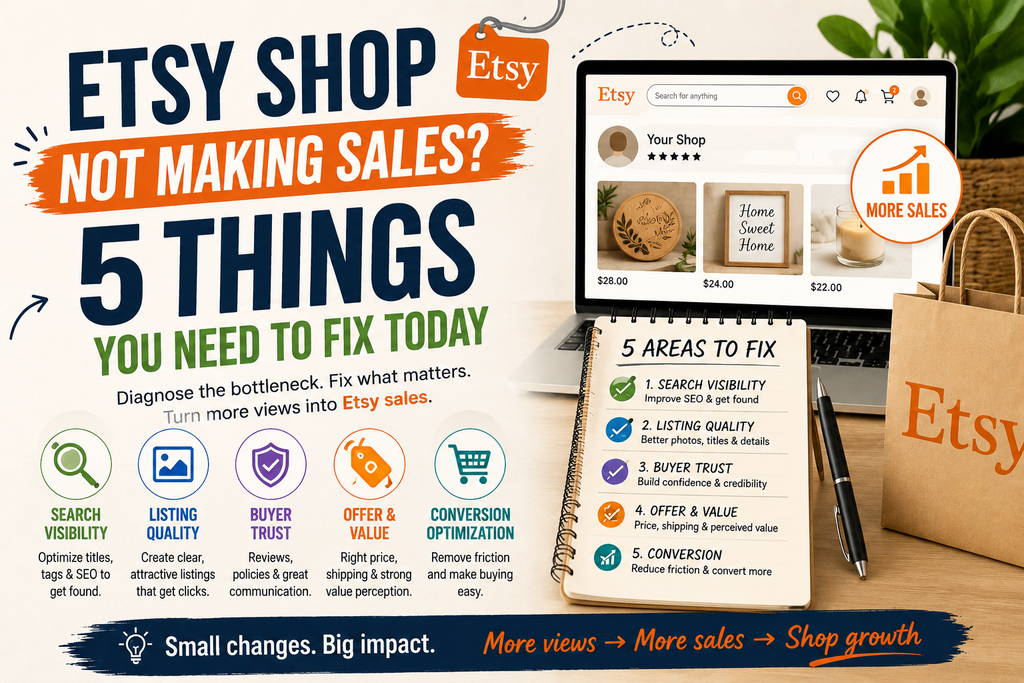
Before you change another title or tag, you need to find that weak point. These seven areas will help you identify where your shop may be losing potential buyers—and what to fix first.
Why Your Etsy Shop Is Not Making Sales: Find the Bottleneck First
If your Etsy shop is not making sales, the first mistake is assuming you need to change your SEO. Sometimes the problem is visibility. Sometimes shoppers are finding your products but not clicking. And sometimes your listings are getting attention but losing the buyer somewhere between the product page and checkout.
Those are three very different problems—and they require different fixes.
Before changing your titles, rewriting every description, or adding a dozen new products, figure out where the sales process is breaking down. Etsy itself distinguishes between visits and views in Shop Stats, while its search system considers signals such as relevance and how shoppers engage with listings.
Check Whether You Have a Traffic or Conversion Problem
Start by asking a simple question: Are enough of the right shoppers reaching your listings?
If your listings receive very few impressions or visits, focus first on Etsy search visibility and relevance. Your keywords, titles, tags, attributes, categories, or product positioning may not be connecting your products with the searches that matter.
But if shoppers are reaching your listings and you still have few orders, the problem may be further down the funnel.
For example:
| What you’re seeing | What it may indicate |
| Very little search traffic | Visibility or relevance problem |
| Impressions but few clicks | Search-result presentation problem |
| Views but no purchases | Conversion problem |
| Favorites but few purchases | Value, trust, price, or purchase-friction problem |
| Traffic and sales suddenly declining | Broader listing, market, or demand issue |
This is why the answer to “why is my Etsy shop not making sales?” isn’t automatically “use better keywords.” More relevant traffic is useful only when the listing gives shoppers a reason to click and buy.
Compare Impressions, Clicks, Views, and Orders
Don’t judge your shop based on one number.
Etsy’s Shop Stats distinguishes visits from views: a visit represents a shopper coming to your shop or listings, while views count the times listings are viewed. Etsy also lets sellers see the search terms shoppers used to find their shop.
That gives you a more useful diagnostic sequence:
Search visibility → Clicks → Listing views → Buyer action → Order
Suppose one listing is getting plenty of visibility but very few clicks. Improving the product description probably isn’t your first priority because most shoppers aren’t reaching it yet. Your first listing photo, title, product positioning, or search relevance deserves closer attention.
Now consider the opposite situation: shoppers are clicking, viewing multiple images, and spending time on the listing—but purchases remain low. In that case, endlessly researching keywords may not solve the real problem.
Etsy says listing engagement can include shopper actions such as clicks, favorites, and purchases, and that conversion-focused listing improvements can potentially improve search placement.
If you’re unsure whether your listings are actually struggling with search visibility, don’t rely solely on searching for your own products manually. Etsy notes that search results are personalized, and your Shop Stats are the more accurate place to evaluate how your listings are performing in search.
For a deeper look at the specific reasons a listing may fail to appear prominently in search, you can also examine the common visibility issues covered in Etsy listings not ranking and how to fix them.
Identify What Is Stopping Buyers From Moving Forward
Once you know that shoppers are reaching a listing, shift your attention from “How do I get more traffic?” to “Why isn’t this shopper buying?”
Look at the listing from the buyer’s perspective.
Can they immediately understand what the product is? Is the first image clear enough to make them want to click? Do the additional photos answer important questions? Is the price easy to understand? Are variations, sizing, materials, personalization, processing time, and shipping details clear?
Etsy’s own conversion guidance emphasizes that the first image helps earn the click, while additional listing images and useful product information help shoppers make a purchase decision.
You can also look for less obvious friction:
- The product looks different from what the shopper expected.
- The value isn’t obvious at the listed price.
- Important details are buried in the description.
- The photos don’t show scale, size, or real-world use.
- The listing doesn’t answer the questions a buyer is likely to have.
- The offer feels less compelling than competing options.
The goal isn’t to make your listing sound more salesy. It’s to remove uncertainty.
If you can identify the exact point where shoppers stop moving toward a purchase, you have a much better starting point for improving Etsy sales.
AI Prompt: Diagnose Your Etsy Shop Sales Bottleneck
Purpose:
Use AI to analyze your Etsy performance data and identify whether your biggest problem is visibility, clicks, listing engagement, or conversion.
Act as an Etsy SEO and conversion optimization specialist.
I want you to diagnose why my Etsy shop may not be generating enough sales. Do not assume the problem is SEO.
Analyze the following Etsy performance information:
Shop/product: [Describe the product or listing]
Time period: [Enter date range]
Search impressions or visibility data: [Enter data]
Visits: [Enter number]
Listing views: [Enter number]
Clicks, if available: [Enter number]
Favorites: [Enter number]
Orders: [Enter number]
Sales: [Enter amount]
Top Etsy search terms: [Enter search terms]
Current listing title: [Paste title]
Current tags: [Paste tags]
Product description: [Paste description]
First listing photo description: [Describe the image]
Price: [Enter price]
Shipping cost: [Enter shipping cost]
Your task:
1. Determine whether the primary bottleneck appears to be:
– search visibility
– search relevance
– getting clicks
– listing engagement
– buyer trust
– perceived value
– conversion
– or insufficient data
2. Explain the reasoning behind your diagnosis.
3. Separate problems that are supported by the data from problems that are only possible hypotheses.
4. Identify the three highest-priority issues I should investigate first.
5. For each issue, recommend one specific action rather than a long list of changes.
6. Tell me what I should NOT change yet so I don’t create unnecessary variables.
7. Create a simple diagnostic table with: Metric | What it suggests | Possible problem | Recommended next action
Do not invent missing data, Etsy ranking factors, statistics, or guaranteed outcomes.
Focus on practical Etsy seller decisions and distinguish clearly between visibility problems and conversion problems.
Fix Your Etsy SEO and Search Visibility
If your Etsy shop is not making sales, your first instinct may be to rewrite every title, add more tags, or chase whatever keyword seems popular. But Etsy SEO works better when you start with a simpler question: Are your listings matching the searches your ideal buyers are actually making?
Etsy search begins by matching a shopper’s query with relevant listings, then ranking those listings based on multiple factors. Etsy explains that its search system considers information such as titles, tags, attributes, descriptions, photos, reviews, and other listing and shop signals rather than relying on a single keyword field. Etsy’s guide to how search works
That means good Etsy search visibility isn’t about stuffing every possible phrase into a title. It’s about making the relationship between your product and your buyer’s search clear.
Match Your Keywords to Real Buyer Intent
Start with the words a buyer would actually use when looking for your product—not necessarily the words you use internally to describe your business.
For example, suppose you sell a printable wedding seating chart. A phrase like “editable wedding seating chart template” communicates a specific product and a specific shopping need. A broad term such as “wedding decor” may describe the general category, but it doesn’t tell Etsy—or the shopper—exactly what you’re offering.
Think about keyword intent in three layers:
- What is the product?
- What makes it different?
- What would someone type when they’re ready to find or buy it?
Etsy recommends considering the words and phrases your target buyer might search when optimizing a listing. Etsy’s Seller Handbook guidance on using tags and keywords
The goal isn’t to find one magical keyword. You want a group of closely related phrases that describe the same product from the buyer’s perspective.
If you’re still unsure whether your listings are appearing for relevant searches, it’s also useful to distinguish a keyword problem from a broader visibility problem. For example, Etsy listings not ranking and how to fix them can help you think through other reasons a listing may fail to gain search exposure.
Improve Etsy Listing Titles, Tags, and Attributes
Your title, tags, categories, and attributes should work together rather than competing with each other.
Etsy currently provides 13 tag opportunities per listing and recommends using relevant, diverse phrases rather than repeating essentially the same term. Etsy’s official guide to using tags
For example, if you sell a handmade ceramic coffee mug, your keyword ecosystem might include:
- ceramic coffee mug
- handmade coffee cup
- stoneware mug
- minimalist mug
- pottery coffee mug
- gift for coffee lover
You don’t need to force every variation into the title. Etsy’s search guidance emphasizes the listing as a whole, with titles, tags, descriptions, categories, and attributes contributing to relevance. Etsy’s search optimization guidance
Attributes deserve particular attention because they provide structured information about the product. Etsy recommends selecting accurate attributes that apply to the listing. Etsy’s guide to listing attributes
Titles also deserve a readability check. Etsy’s current title guidance recommends clear, buyer-friendly titles that identify the item and put important traits upfront instead of creating long, repetitive keyword strings. Etsy’s updated title guidance
So instead of:
“Coffee Mug Handmade Mug Ceramic Mug Gift Mug Coffee Lover Mug…”
Aim for something a shopper can understand immediately:
“Handmade Ceramic Coffee Mug, Speckled Stoneware Cup”
The second title still communicates relevant information, but it is easier to scan and understand.
Stop Using Keywords That Attract the Wrong Shoppers
More impressions aren’t automatically better.
Imagine you sell a personalized wooden wedding guest book, but you optimize heavily around the broad phrase “wedding decorations.” You may attract people looking for centerpieces, signs, flowers, or other decor. Those shoppers aren’t necessarily looking for a guest book.
You can end up with plenty of exposure but very few Etsy sales because the traffic isn’t qualified.
This is one reason an Etsy shop not making sales may actually have a keyword-targeting problem rather than a simple traffic problem.
Look at the search terms bringing visitors to your listings and ask:
- Does this phrase describe my actual product?
- Would someone searching this phrase reasonably expect to see my listing?
- Does the product satisfy the intent behind the search?
- Are these shoppers likely to be interested in buying what I sell?
Etsy recommends using your shop’s stats to understand which search terms are bringing traffic and to use that information when refining listings. Etsy’s Seller Handbook search guidance
If a keyword brings visitors who consistently don’t engage or purchase, don’t automatically celebrate the traffic. Relevant traffic is more valuable than empty visibility.
And remember that search relevance is only part of the buying decision. If your product has a strong value proposition but the listing doesn’t communicate it clearly, the problem may extend beyond keywords. For example, what buyers may be missing about your Etsy product’s value can help frame the connection between product positioning and buyer response.
AI Prompt: Find Better Etsy Keywords for Your Product
Purpose:
Use AI to organize your product information around real buyer intent and identify relevant keyword opportunities without turning your listing into a collection of stuffed search phrases.
Copy-and-Paste Prompt:
Act as an Etsy SEO strategist specializing in US Etsy buyers.
Analyze the product information below and help me identify keyword opportunities based on real buyer intent.
PRODUCT INFORMATION
Product name: [PRODUCT NAME]
What it is: [PRODUCT DESCRIPTION]
Materials: [MATERIALS]
Size/dimensions: [SIZE]
Main features: [FEATURES]
Customization options: [CUSTOMIZATION]
Primary buyer: [IDEAL BUYER]
Main use or occasion: [USE/OCCASION]
Price: [PRICE]
Current Etsy title: [CURRENT TITLE]
Current Etsy tags: [CURRENT TAGS]
TASK
1. Identify the primary product concept a buyer is most likely searching for.
2. Identify 10-15 relevant long-tail keyword phrases that accurately describe this product.
3. Identify 5-10 buyer-intent phrases that suggest stronger purchase intent.
4. Identify 5-10 broader phrases that may attract less-qualified traffic and explain why they may be weaker targets.
5. Group the strongest keywords by search intent:
– Product-focused
– Feature-focused
– Buyer/recipient-focused
– Occasion-focused
– Use-case-focused
6. Identify keyword overlaps where one phrase is essentially a duplicate of another.
7. Recommend the strongest keyword concepts for my Etsy title.
8. Recommend the strongest keyword concepts for my 13 Etsy tags.
9. Identify relevant Etsy attributes or product characteristics I should consider adding.
10. Do not invent product characteristics, materials, uses, or buyer needs that I did not provide.
IMPORTANT CONSTRAINTS
– Prioritize relevance and buyer intent over keyword volume.
– Do not recommend keyword stuffing.
– Do not recommend unrelated broad keywords simply because they may have higher traffic.
– Do not claim specific search volume, competition, CPC, or ranking potential unless I provide verified data.
– Use natural American English.
– Keep recommendations specific to Etsy buyers in the United States.
– Explain briefly why each recommended keyword fits the product.
Return the results in a clear table with:
Keyword | Intent | Relevance | Where to Use It | Reason
Improve Your Listings to Earn More Clicks
Getting your Etsy listing into search results is only the first step. The next challenge is getting a shopper to stop scrolling, understand what you’re selling, and decide that your listing is worth a closer look.
This matters because an Etsy shop not making sales can sometimes have a visibility problem—but it can also have a click problem. If shoppers see your listing and keep scrolling, more impressions alone won’t solve the issue. Etsy specifically points to the first listing photo, title, and price as factors that can influence whether shoppers click, while its broader listing guidance emphasizes creating a listing that helps buyers make confident decisions.
Make Your First Etsy Listing Photo Do More Work
Your first photo has a difficult job: it has to communicate the product quickly enough for someone scrolling through a crowded Etsy search page to understand what they’re looking at.
A beautiful photo isn’t automatically a good thumbnail. If the product is too small, the background is distracting, the lighting is poor, or the image contains several products competing for attention, a shopper may simply move on.
Etsy recommends that the first image clearly show the item being sold and be high-resolution, clear, and well lit. Etsy also cautions against using collages as the first image because they can make it harder to understand what is actually for sale—especially at smaller thumbnail sizes.
Before replacing a photo, ask yourself:
- Can I immediately tell what the product is?
- Is the product large enough to recognize on a phone?
- Does the image show the actual item rather than creating confusion?
- Does the background help the product stand out?
- Would this image make me pause while browsing similar products?
For handmade products in particular, presentation can change how shoppers perceive quality. If your product is genuinely well made but the photography makes it look unfinished or inexpensive, the listing may be communicating the wrong value. This is closely related to how buyers perceive product presentation and perceived quality, not just photography technique.
how product presentation can affect perceived value
And don’t treat the first image as the entire photography strategy. Etsy says the first photo helps earn the click, while the additional photos help provide the information shoppers need to make the purchase decision.
Create Clearer, More Buyer-Focused Product Titles
Your title has two audiences: Etsy search and the human being scanning the results.
The mistake is assuming that adding more keywords automatically makes a title stronger. A title packed with repetitive phrases can become difficult to understand, especially when a shopper is quickly comparing several listings.
Etsy’s April 2026 guidance emphasizes clear, buyer-friendly titles and recommends making it easy for shoppers to understand what the item is. Etsy also notes that its search system now takes a more holistic view of listing information, including the title, tags, attributes, description, first photo, and reviews.
Instead of writing something like:
“Personalized Mug Coffee Mug Custom Mug Gift Mug Ceramic Mug Coffee Cup”
aim for a title that quickly identifies the product and its most useful distinguishing details:
“Personalized Ceramic Coffee Mug, Custom Name Gift for Coffee Lovers”
The second version still communicates important search concepts, but it sounds like something a person can actually read.
A useful test is to look at your title without thinking about SEO. If someone saw only the first part of it in search results, would they immediately know:
- What the product is?
- Who or what it is for?
- What makes it different or relevant?
If not, your Etsy listing optimization may need a clarity upgrade rather than another round of keyword stuffing.
If your listings also struggle to appear for relevant searches, treat that as a separate issue from clickability. Etsy search visibility depends on more than the title alone, so changing titles without understanding the broader listing can lead you in the wrong direction.
Etsy listings not ranking and what to fix
Use Your Listing Images to Answer Buyer Questions
Once someone clicks, your photos need to do more than show that the product exists. They should help the shopper answer the questions that stand between interest and purchase.
For example, someone considering a handmade tote bag may want to know:
- How large is it?
- What does it look like when carried?
- What material is it made from?
- How much can it hold?
- What do the details look like up close?
- How does the color look in real life?
Your listing images can answer many of those questions before the buyer ever reads a paragraph of description.
Think of the photo sequence as a visual conversation. The first image earns attention. The next images build understanding. Later images can demonstrate size, scale, materials, details, variations, packaging, or the product in use.
Etsy currently allows up to 10 photos per listing and recommends using multiple high-quality images because each additional image can give shoppers more information about the product.
This is particularly important when your Etsy shop is not making sales but shoppers are already viewing your listings. In that situation, don’t automatically assume you need more traffic. First ask whether the listing gives buyers enough information and confidence to continue toward checkout.
AI Prompt: Audit Your Etsy Listing for Clickability
Purpose:
Use AI as a second set of eyes to identify problems in your listing’s first impression, title clarity, and visual presentation. The goal isn’t to let AI invent claims about your product; it’s to uncover potential reasons a shopper might scroll past or hesitate to click.
Copy-and-Paste Prompt:
Act as an Etsy listing optimization specialist and US online-shopping behavior analyst.
Audit the Etsy listing below specifically for CLICKABILITY and first-impression quality.
Do not assume that more keywords are better. Evaluate the listing from the perspective of a real Etsy shopper who is comparing several similar products in search results.
PRODUCT INFORMATION:
Product name: [PRODUCT NAME]
Product type: [PRODUCT TYPE]
Target buyer: [TARGET BUYER]
Price: [PRICE]
Main product benefit: [MAIN BENEFIT]
Key differentiator: [WHAT MAKES IT DIFFERENT]
Current Etsy title: [PASTE TITLE]
Current tags: [PASTE TAGS]
Current description: [PASTE DESCRIPTION]
First listing photo: [DESCRIBE THE PHOTO OR ATTACH IT]
Other listing photos: [DESCRIBE OR ATTACH THEM]
Analyze:
1. Whether the first photo communicates the product clearly at thumbnail size.
2. Whether the first photo creates a reason to click.
3. Whether the product is visually easy to identify.
4. Whether the title is clear and easy to scan.
5. Whether the beginning of the title communicates the most important product information.
6. Whether the title sounds natural to a US Etsy buyer.
7. Whether the title appears unnecessarily repetitive or keyword-stuffed.
8. Whether the image sequence answers important buyer questions.
9. Whether the listing gives enough visual information to understand the product, size, material, use, or important details.
10. Any obvious mismatch between the product promise and the visual presentation.
Then provide the output in this format:
A. Biggest Clickability Problem
B. First Photo Assessment
C. Title Assessment
D. Image Sequence Assessment
E. Top 5 Changes to Test
F. One Example of a Stronger Title
G. Suggested Photo Sequence
Do not invent product features, materials, sizes, guarantees, reviews, or other facts that I did not provide.
Keep recommendations practical and specific to this listing.
Turn Etsy Listing Views Into More Purchases
Getting a shopper to your Etsy listing is only half the job. The harder part is giving that shopper enough clarity and confidence to actually buy. If your Etsy shop is not making sales despite getting views, the problem may not be visibility at all. It may be what happens after someone lands on the product page.
Rewrite Product Descriptions Around Buyer Benefits
A product description should answer the buyer’s most important questions quickly: What is this? Who is it for? What do I get? Why does it matter?
Avoid opening with a long story about how you created the product. Lead with the information that helps someone decide whether the item fits their needs. Etsy recommends keeping descriptions informative and engaging, putting essential details near the top, and using relevant keywords naturally in the opening sentences.
For example, instead of:
“I started making these candles in my home studio because I’ve always loved creating beautiful things…”
Try something more buyer-focused:
“This hand-poured lavender soy candle is designed for relaxing evenings, bedrooms, and thoughtful self-care gifts. It comes in a reusable 8-oz glass jar and burns for approximately 40 hours.”
The second version immediately communicates the product, benefit, use case, and key details.
A useful description structure is:
- What the product is
- Who it’s designed for
- Main benefits or use cases
- Size, materials, quantity, or dimensions
- Customization details
- Processing or delivery information
- Care or usage instructions
- What makes the product different
This approach also supports Etsy listing optimization because you’re helping both the shopper and Etsy understand what the product actually offers.
For more on why product presentation can affect perceived value, the principles discussed in why handmade products can look cheaper than they actually are can help you evaluate your own listing from a buyer’s perspective.
Remove Common Purchase Objections and Uncertainty
A shopper can like your product and still leave because something feels unclear.
Maybe they don’t know the exact size. Maybe they aren’t sure what comes with the purchase. Maybe shipping takes longer than expected. Maybe the product photo looks different from what they expected. Or they simply can’t tell whether the item will solve their particular problem.
These small uncertainties create friction.
When reviewing a listing, ask yourself:
- Is the exact product included clearly stated?
- Are dimensions easy to find?
- Are materials or ingredients clearly explained?
- Does the buyer know how many items they receive?
- Are customization options explained?
- Is the processing time clear?
- Are shipping expectations easy to understand?
- Does the description answer the questions a first-time buyer would ask?
Etsy specifically recommends using descriptions to answer buyer questions and making important details easy to find.
Your shop policies matter here, too. Etsy says shoppers consider information such as shipping, returns, and exchanges when deciding whether to buy, and recommends providing detailed shop policies.
Think of every unanswered question as a small reason to postpone the purchase. Your goal isn’t to pressure the buyer. It’s to remove unnecessary uncertainty.
Strengthen Buyer Trust With Clear Product and Shop Information
When someone discovers an unfamiliar Etsy seller, they are taking a small risk. They want to know that the product is accurately represented, the seller is reliable, and the buying process won’t become a headache.
That makes buyer trust on Etsy part of conversion optimization—not an optional extra.
Start with the basics. Make sure your photos accurately represent the item. Keep your description consistent with what the buyer will receive. Explain variations, materials, dimensions, personalization, and limitations instead of assuming shoppers will figure them out.
Your shop itself should also feel complete and credible. Etsy’s guidance recommends using shop information, policies, and other details to help shoppers understand who they’re buying from and what to expect.
Reviews can reinforce that confidence over time. But if you’re a newer seller without many reviews, don’t try to compensate with exaggerated claims. Instead, make the rest of the buying experience exceptionally clear.
And if a buyer contacts you with a question, treat the interaction as part of the sales experience. Etsy recommends prompt, clear, empathetic communication because it can improve buyer trust and help prevent issues from escalating.
If your Etsy shop is not making sales, look at the listing through the eyes of someone who has never heard of your shop before. Would they understand the product within a few seconds? Would they know exactly what they’re getting? Would they feel comfortable spending their money?
Those questions often reveal conversion problems that another round of keyword changes won’t solve.
AI Prompt: Identify Buyer Objections Before They Cost a Sale
Purpose:
Use AI to review an Etsy listing from a skeptical buyer’s perspective and identify unclear information, missing details, trust concerns, and purchase objections before rewriting the listing.
Copy-and-Paste Prompt:
Act as an experienced Etsy conversion optimization specialist and skeptical US Etsy buyer.
Analyze the Etsy listing below and identify anything that could make a qualified shopper hesitate, leave the page, or delay purchasing.
LISTING INFORMATION:
Product name: [PRODUCT NAME]
Current title: [ETSY TITLE]
Current description: [PASTE DESCRIPTION]
Price: [PRICE]
Shipping cost: [SHIPPING COST]
Processing time: [PROCESSING TIME]
Materials: [MATERIALS]
Size/dimensions: [SIZE]
Customization options: [CUSTOMIZATION DETAILS]
What the buyer receives: [PRODUCT CONTENTS]
Return/exchange policy: [POLICY]
Reviews or common customer questions: [PASTE IF AVAILABLE]
Target buyer: [IDEAL BUYER]
Evaluate the listing for:
1. Product clarity
2. Missing or confusing information
3. Buyer objections
4. Perceived value
5. Price-related hesitation
6. Shipping or delivery concerns
7. Trust issues
8. Unanswered buyer questions
9. Description weaknesses
10. Mismatch between buyer intent and the current messaging
Separate your findings into:
– Critical purchase barriers
– Moderate friction points
– Minor improvements
For every issue, explain:
– What the shopper may be thinking
– Why the issue could reduce purchase confidence
– What specific information or wording should be improved
Then create a prioritized “Fix First” checklist with the 5 highest-impact improvements.
Do not invent product facts, reviews, guarantees, statistics, or customer experiences. If information is missing, clearly identify it as missing instead of guessing.
Keep the recommendations practical for a real Etsy seller and use natural American English.
Improve Your Offer, Value, and Conversion Strategy
Evaluate Whether Your Price Matches the Perceived Value
A price can be technically reasonable and still feel too expensive to a buyer.
That distinction matters. When an Etsy buyer sees your listing, they are not judging your price in isolation. They are comparing the perceived value of your product with other options, your photos, materials, craftsmanship, personalization, reviews, shipping cost, and the experience they expect after placing the order.
For example, imagine two handmade candles are both priced at $28. One listing clearly shows the size, wax type, scent profile, packaging, and how the candle looks in a real home. The other simply says “handmade soy candle” with a few basic photos. The products might be similar, but the first listing gives the buyer more reasons to understand the price.
Etsy recommends researching comparable products and considering materials, labor, overhead, shipping, and the target customer when developing a pricing strategy. It also notes that being the cheapest option is not necessarily the goal; higher pricing can make sense when the listing communicates meaningful differences in quality or value.
If your Etsy shop is not making sales, don’t immediately assume your price needs to come down. Instead, ask:
- Does the buyer understand exactly what they are getting?
- Is the quality obvious from the photos?
- Are important features or materials clearly explained?
- Does the product have a recognizable reason to cost what it does?
- Are you comparing your price with genuinely similar products?
- Does shipping make the total cost feel unexpectedly high?
Your goal is not simply to be cheaper. It is to make the value understandable.
Reduce Friction Around Shipping, Policies, and Purchase Details
Sometimes a buyer has already decided they like your product—and then something creates hesitation.
Shipping is one common example. A shopper may click because the product looks perfect, but a surprisingly high shipping charge can change the perceived value of the entire purchase. Etsy specifically identifies shipping cost as a factor buyers consider when deciding whether to purchase.
The same applies to uncertainty around delivery timing.
If a buyer needs a personalized gift for a birthday next week and your listing doesn’t make the processing timeline clear, they may simply move on to another seller. Etsy’s processing-time guidance explains that accurate processing times help set buyer expectations and provide more accurate delivery information.
Review your listing from the buyer’s perspective:
Before purchase, can they quickly understand:
- What exactly is included?
- What size or quantity will they receive?
- When will it ship?
- How much will shipping cost?
- Are personalization instructions clear?
- What happens if they need help?
- What are the relevant shop policies?
Don’t hide important purchase information deep inside a long description. Make the decision easy.
For US sellers, Etsy also provides options for offering free shipping and adjusting pricing to account for shipping costs. Whether free shipping makes financial sense depends on your product, margins, and customers—it should be treated as a pricing strategy, not an automatic requirement.
If your product’s value needs more explanation, look at how you communicate that value rather than immediately discounting it. A useful way to approach this is to examine the gap between what you know about your product and what a first-time buyer can actually understand from the listing. how to communicate the value of your Etsy product more clearly
Test One Meaningful Change Instead of Changing Everything
When Etsy shop sales are low, it’s tempting to rewrite every title, replace every photo, change your prices, update all your tags, and launch a sale at the same time.
That creates a problem: you won’t know what actually made a difference.
A better approach is to treat your listing like something you can improve through controlled experimentation.
Start with one listing that already receives some traffic but isn’t converting well. Choose one meaningful variable based on the problem you’ve identified.
For example:
| Problem you notice | First change to consider |
| Shoppers see the listing but don’t click | Improve the first photo |
| Buyers click but seem uncertain | Clarify product information |
| Price appears uncompetitive | Reevaluate total value and pricing |
| Shipping creates hesitation | Review shipping cost and delivery expectations |
| Product value isn’t obvious | Strengthen benefit-focused messaging |
Give the change enough time to collect useful observations before making another major change. Etsy itself describes pricing as something sellers can refine through experimentation and market research, including testing different prices for similar items.
This mindset is especially useful when figuring out why are my Etsy listings not selling. You aren’t trying to guess your way to more orders. You’re trying to identify the weakest part of the buyer journey and improve it deliberately.
AI Prompt: Create a Conversion-Focused Etsy Listing Improvement Plan
Purpose:
Use AI to turn your listing information and performance observations into a prioritized improvement plan instead of making random changes.
Copy-and-Paste Prompt:
Act as an Etsy conversion optimization specialist for US Etsy sellers.
I want you to diagnose one Etsy listing and create a practical improvement plan focused on increasing buyer confidence and conversion.
Here is my listing information:
Product name: [PRODUCT NAME]
Product type: [PRODUCT TYPE]
Current price: [PRICE]
Shipping cost: [SHIPPING COST]
Processing time: [PROCESSING TIME]
Target buyer: [TARGET BUYER]
Main use case or buying occasion: [USE CASE / OCCASION]
Current title: [PASTE TITLE]
Current description: [PASTE DESCRIPTION]
Current tags: [PASTE TAGS]
What the listing photos show: [DESCRIBE PHOTOS]
Current reviews or common buyer feedback: [PASTE RELEVANT FEEDBACK]
Performance information, if available:
Impressions: [NUMBER]
Views: [NUMBER]
Favorites: [NUMBER]
Orders: [NUMBER]
Analyze the listing without assuming that lowering the price is the answer.
Identify:
1. The most likely conversion bottleneck.
2. Any gap between the product’s actual value and its perceived value.
3. Pricing or shipping concerns a buyer may have.
4. Missing information that could create purchase hesitation.
5. Trust or credibility gaps.
6. Any unclear product benefits.
7. The single highest-priority change I should make first.
8. Two secondary changes I should test afterward.
Then create a prioritized action plan using:
– Fix now
– Test next
– Leave unchanged for now
Do not invent product features, customer feedback, statistics, or Etsy policies.
Do not recommend keyword stuffing.
Do not automatically recommend lowering the price.
Base your recommendations only on the information I provide and clearly label anything that cannot be determined from the available data.