
What if you could create stunning, studio-quality product images without hiring a photographer, renting expensive equipment, or spending hours editing photos? In 2026, that’s no longer a dream—it’s the new reality for online sellers.
AI Ecommerce Product Photos are transforming the way businesses showcase products online. From small startups to established brands, sellers are using advanced AI tools for ecommerce product photography to produce professional-grade visuals in minutes instead of days. Whether you’re selling on Amazon, Etsy, or Shopify, high-quality product images can make the difference between a visitor who scrolls past and a customer who clicks “Buy Now.”
The best part? You no longer need professional photography skills. Today’s AI product image generator for online stores can remove backgrounds, create realistic lifestyle scenes, enhance lighting, and even generate entirely new product shots with incredible accuracy. Many of the best AI product photo editing tools are designed specifically for ecommerce sellers looking to scale faster and reduce costs.
If you’re serious about increasing conversions, don’t miss our companion guide: 15 Powerful AI Prompts for Product Launch Campaigns That Generate Instant Sales (2026 Guide
In this guide, we’ll reveal the 11 best tools to create professional product photos with AI and help you choose the right solution for your store.
What Are AI Ecommerce Product Photos and Why Are They Dominating Online Retail?
The ecommerce landscape has changed dramatically over the past few years. Today, shoppers make buying decisions in seconds, and product images often determine whether a visitor becomes a customer. That’s why AI Ecommerce Product Photos have become one of the most powerful tools for online sellers looking to increase conversions, reduce costs, and scale faster.
Instead of relying solely on traditional photography studios, businesses can now use advanced AI tools to create, edit, and enhance product images in minutes. From background removal and lighting adjustments to realistic lifestyle scenes, AI is making professional-quality product photography accessible to businesses of all sizes.
How AI Ecommerce Product Photos Differ From Traditional Product Photography
Traditional product photography can be expensive, time-consuming, and difficult to scale. A single photoshoot may require photographers, lighting equipment, studio rentals, models, and extensive post-production editing.
AI-powered solutions simplify the entire process.
Here’s how they compare:
| Traditional Photography | AI Ecommerce Product Photos |
| Requires physical photoshoots | Generates or enhances images digitally |
| Higher production costs | Lower operating costs |
| Days or weeks to complete | Minutes or hours to complete |
| Limited creative variations | Unlimited background and scene generation |
| Manual editing workflows | Automated AI enhancements |
Using modern AI tools for ecommerce product photography, sellers can quickly test different product styles, backgrounds, and marketing concepts without scheduling additional shoots.
For example, a skincare brand can instantly place a product into a luxury bathroom setting, while a fashion retailer can generate multiple seasonal lifestyle images from a single product photo.
This flexibility helps businesses create professional product photos with AI while dramatically reducing production expenses.
Why US Ecommerce Brands Are Investing in AI-Powered Visual Content
American consumers are increasingly shopping online, and competition across marketplaces continues to intensify. Whether customers are browsing Shopify stores, Amazon listings, or Etsy shops, visual quality often becomes the deciding factor.
Several factors are driving adoption:
- Faster product launch timelines
- Reduced photography and editing costs
- Improved brand consistency
- Easier A/B testing for product images
- Higher engagement and conversion rates
- Better scalability for growing catalogs
Many brands are now using an AI product image generator for online stores to create lifestyle images, promotional banners, social media assets, and marketplace-ready product photos from a single source image.
The rise of the best AI product photo editing tools has also made it possible for small businesses to compete with larger retailers that previously had bigger photography budgets.
If you’re exploring AI-powered content creation beyond product images, check out ChatGPT vs Gemini for eCommerce — Which AI Prompts Actually Increase Sales? to learn how leading ecommerce brands are using AI-generated prompts to improve product descriptions, marketing campaigns, and customer engagement.
The bottom line is simple: AI is no longer a future trend. It’s becoming a competitive advantage. Businesses that embrace AI product photography for Shopify stores and other ecommerce platforms can launch products faster, optimize visual content more efficiently, and deliver the polished shopping experience modern consumers expect.
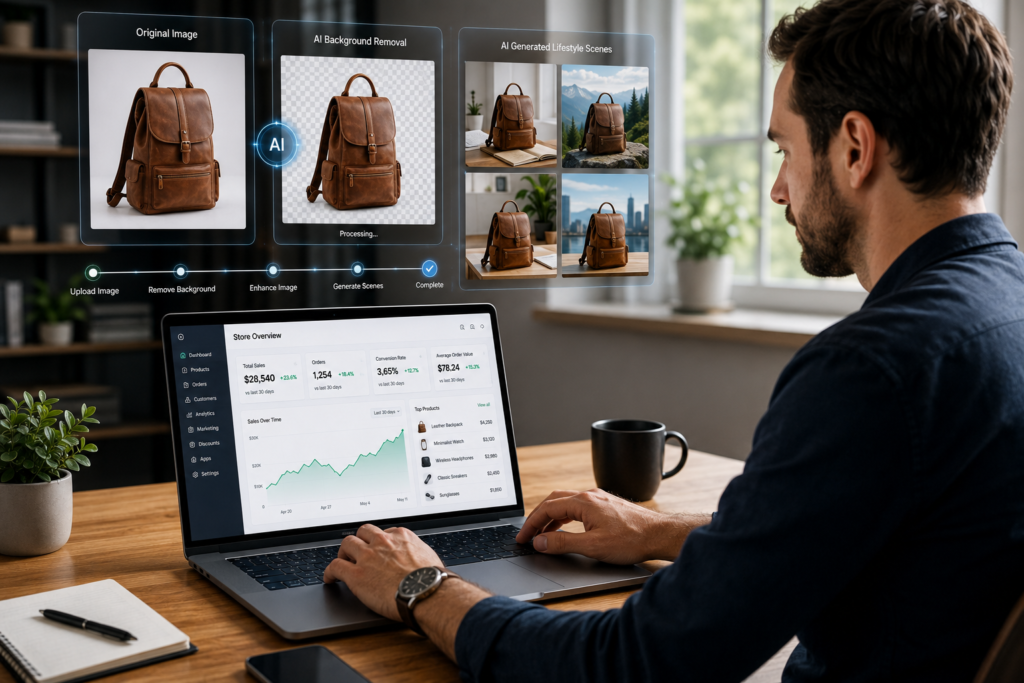
Benefits of Using AI Tools for Ecommerce Product Photography
For years, professional product photography required expensive equipment, studio rentals, editing software, and skilled photographers. Today, AI tools for ecommerce product photography are changing the game by helping businesses create high-quality product images faster, cheaper, and at scale.
Whether you’re launching a new Shopify store, managing hundreds of Amazon listings, or growing an Etsy brand, AI-powered imaging tools can dramatically streamline your content creation workflow while improving visual consistency across your catalog.
How AI Helps Create Professional Product Photos With AI in Minutes
Modern AI platforms can transform an ordinary smartphone photo into a marketplace-ready product image within minutes. Instead of spending hours editing backgrounds, adjusting lighting, and retouching imperfections, sellers can automate most of these tasks with a few clicks.
Today’s leading AI product image generator for online stores can:
- Remove backgrounds instantly
- Create realistic lifestyle scenes
- Improve lighting and shadows automatically
- Generate multiple image variations for A/B testing
- Resize images for Amazon, Shopify, Etsy, and social media
- Enhance image resolution without losing quality
This technology allows businesses to create professional product photos with AI even if they have no photography or graphic design experience.
For example, a Shopify merchant launching a new skincare line can upload a simple product photo and generate multiple premium-looking images for product pages, email campaigns, and paid advertisements in a matter of minutes.
The result is faster product launches, more consistent branding, and significantly less time spent on manual editing.
Reducing Photography Costs While Increasing Conversion Rates
Traditional product photography can quickly become one of the largest expenses for an ecommerce business. Professional photographers, studio setups, post-production editing, and reshoots can cost hundreds—or even thousands—of dollars per product collection.
AI Ecommerce Product Photos eliminate many of these costs while delivering results that are often indistinguishable from professionally staged photography.
Key business benefits include:
- Lower content production costs
- Faster time-to-market for new products
- Consistent branding across product catalogs
- Higher engagement on product pages
- Improved click-through rates from ads
- More scalable content creation
Perhaps the biggest advantage is conversion optimization.
High-quality visuals directly influence buyer trust. When customers can clearly see product details, understand product benefits, and visualize ownership through realistic lifestyle imagery, they are more likely to complete a purchase.
Many sellers combine AI-generated visuals with advanced marketing workflows and AI prompts for product launch campaigns to create highly targeted product launches that attract attention and drive sales from day one.
However, success depends on using AI correctly. Poor prompts and weak image-generation workflows can produce generic results that hurt performance rather than improve it. Before implementing any AI strategy, review Why Most eCommerce Sellers Fail with AI (17 Prompt Mistakes You Must Fix Today) to avoid the common mistakes that prevent many sellers from achieving meaningful results.
As AI product photography for Shopify stores and other ecommerce platforms continues to evolve, businesses that adopt these tools early gain a significant competitive advantage through faster execution, lower operating costs, and stronger conversion-focused visual content.
11 Best AI Tools to Create Professional Ecommerce Product Images in 2026
The demand for AI Ecommerce Product Photos has exploded as online sellers look for faster, more affordable ways to create high-converting product images. Whether you’re running a Shopify store, selling on Amazon, or managing an Etsy shop, the right AI tool can dramatically improve image quality, reduce production costs, and help your products stand out in crowded marketplaces.
Below are the top AI tools for ecommerce product photography that are helping sellers create professional visuals without hiring expensive photographers or graphic designers.
Top AI Product Image Generator for Online Stores
1. Photoroom
Photoroom is one of the most popular AI-powered product photography platforms for ecommerce sellers. It automatically removes backgrounds, generates lifestyle scenes, and creates marketplace-ready images in seconds.
Best For: Small businesses, Shopify stores, Amazon sellers
Key Features:
- One-click background removal
- AI-generated backgrounds
- Batch editing
- Social media-ready templates
Learn More: [official pricing and feature comparison]
2. Pebblely
Pebblely specializes in generating realistic product scenes using artificial intelligence. Upload a simple product image, and the platform creates dozens of professional marketing visuals instantly.
Best For: Ecommerce brands focused on social media and advertising
Key Features:
- AI lifestyle photography
- Multiple scene generation
- Brand-consistent image creation
- Fast content production
Learn More: [official pricing and feature comparison]
3. Flair AI
Flair AI is built specifically for ecommerce businesses that need premium-quality marketing images. The platform allows users to create custom brand scenes and generate advertising-ready visuals.
Best For: DTC brands and growing ecommerce businesses
Key Features:
- Drag-and-drop scene builder
- AI-generated marketing creatives
- Team collaboration features
- Product-focused visual generation
Learn More: [official pricing and feature comparison]
4. Adobe Firefly
Adobe Firefly combines generative AI with Adobe’s industry-leading creative ecosystem. It helps sellers create professional product photos with AI while maintaining complete creative control.
Best For: Advanced marketers and design teams
Key Features:
- Generative fill
- Commercially safe AI content
- Advanced image editing
- Creative Cloud integration
Learn More: [official pricing and feature comparison]
5. Booth AI
Booth AI enables brands to create high-quality product photography simply by uploading product images. The platform generates studio-quality results without traditional photo shoots.
Best For: Fast-growing online stores
Key Features:
- AI-generated product photography
- Marketing-ready visuals
- Multiple style options
- Rapid content creation
Learn More: [official pricing and feature comparison]
Best AI Product Photo Editing Tools for Ecommerce Sellers
While image generators create new visuals, editing tools help optimize existing photos for higher engagement and conversions.
6. Canva AI
Canva has evolved into a powerful AI product photo editing platform. Ecommerce sellers can quickly enhance product images, remove distractions, and generate marketing assets.
Best For: Beginners and small businesses
Key Features:
- Magic Edit
- Background remover
- AI image enhancement
- Ecommerce marketing templates
7. Remove.bg
For sellers who need clean, professional product images, Remove.bg remains one of the fastest solutions available.
Best For: Marketplace product listings
Key Features:
- Instant background removal
- Bulk processing
- API integrations
- High-resolution exports
8. Clipdrop
Clipdrop offers advanced AI-powered image enhancement tools designed to improve product presentation and visual quality.
Best For: Product image optimization
Key Features:
- Background replacement
- Relighting tools
- Upscaling technology
- Object cleanup features
9. Pixelcut
Pixelcut is widely used by ecommerce entrepreneurs who need professional product images without design expertise.
Best For: Mobile-first sellers
Key Features:
- AI image generation
- Product photo enhancement
- Marketing templates
- Batch editing capabilities
10. Luminar Neo
Luminar Neo uses artificial intelligence to automate complex photo editing tasks while preserving image quality.
Best For: Advanced image editing
Key Features:
- AI-powered enhancement
- Lighting correction
- Object removal
- Professional-grade editing controls
11. Fotor AI
Fotor provides an affordable solution for sellers looking to improve product photography at scale.
Best For: Budget-conscious ecommerce businesses
Key Features:
- AI retouching
- Product photo enhancement
- Background editing
- Ecommerce-ready exports
Which AI Tool Is Best for Your Store?
The right choice depends on your business goals.
- Best Overall: Photoroom
- Best for AI Product Scene Generation: Pebblely
- Best for Marketing Creatives: Flair AI
- Best for Advanced Editing: Adobe Firefly
- Best Budget Option: Fotor
- Best Mobile Workflow: Pixelcut
Remember, great product images alone won’t maximize sales. Once you’ve created stunning visuals, pair them with persuasive launch messaging and conversion-focused copy. For that next step, check out our guide on AI prompts for product launch campaigns — 15 Powerful AI Prompts for Product Launch Campaigns That Generate Instant Sales (2026 Guide) — to turn professional product photos into profitable ecommerce campaigns.
By combining the best AI product image generator for online stores with proven marketing strategies, sellers can create professional product photos with AI, improve customer trust, and increase conversion rates throughout 2026 and beyond.
How to Choose the Right AI Product Photography Tool for Your Business
Not all AI product photography platforms are built for the same type of seller. A tool that works perfectly for a new Etsy shop may not have the advanced capabilities needed by a rapidly growing ecommerce brand. The key is matching the software’s features, pricing, and scalability to your business goals.
Best Solutions for Small Businesses and Startups
If you’re a startup, side hustler, or small online seller, your primary focus should be affordability, simplicity, and speed.
The best AI tools for ecommerce product photography at this stage typically offer:
- One-click background removal
- AI-generated lifestyle backgrounds
- Basic image enhancement and retouching
- Marketplace-ready image exports
- Affordable monthly pricing plans
These features allow you to create professional product photos with AI without investing in expensive photography equipment or hiring a professional photographer.
When evaluating beginner-friendly tools, ask yourself:
- How quickly can I generate product images?
- Does the platform support Amazon, Etsy, and Shopify image requirements?
- Can I maintain a consistent visual style across my entire catalog?
- Is the pricing sustainable as my product inventory grows?
For many small businesses, ease of use matters more than advanced editing capabilities. A simple AI product image generator for online stores can often deliver a faster return on investment than a feature-heavy enterprise platform.
Advanced Features Needed by Growing Ecommerce Brands
As your store scales, your visual content needs become more sophisticated. High-growth brands typically require automation, consistency, and deeper customization options.
Look for advanced capabilities such as:
- Bulk image generation and editing
- AI-powered scene creation
- Custom brand templates
- Team collaboration features
- API integrations
- Multi-channel asset management
- Advanced AI product photo editing tools
- A/B testing support for product imagery
Growing brands should also pay close attention to image quality standards. Following recognized [ecommerce image optimization guidelines] helps ensure your product images load quickly, maintain high resolution, and provide a seamless shopping experience across desktop and mobile devices.
Another important consideration is conversion optimization. The most successful ecommerce companies don’t just create attractive images—they build complete sales systems around them. Combining AI-generated visuals with persuasive product messaging can significantly improve engagement and sales performance. That’s why many brands pair their product photography strategy with our guide on [AI prompts for product launch campaigns](15 Powerful AI Prompts for Product Launch Campaigns That Generate Instant Sales (2026 Guide)) to maximize launch-day conversions.
Key Questions to Ask Before Choosing a Tool
Before committing to any platform, evaluate the following:
- Does it fit my current budget?
- Can it grow with my business?
- Does it support my ecommerce platform?
- How realistic are the AI-generated images?
- Will it help improve conversions and customer trust?
- How much time can it save my team each week?
The right AI product photography solution isn’t necessarily the most expensive one. It’s the platform that helps you produce consistent, high-quality product visuals efficiently while supporting your long-term ecommerce growth strategy.
AI Product Photography for Shopify Stores, Amazon Sellers, and Etsy Shops
Not all ecommerce platforms play by the same rules. While AI Ecommerce Product Photos can dramatically improve visual quality and speed up content creation, sellers must ensure their images comply with each marketplace’s requirements. A photo that performs well on Shopify may be rejected on Amazon or fail to attract buyers on Etsy.
Understanding platform-specific standards helps you maximize visibility, improve conversions, and avoid costly listing issues.
Platform-Specific Image Requirements and Best Practices
Shopify: Focus on Brand Storytelling
Shopify gives sellers the most creative freedom. You can use AI tools for ecommerce product photography to create lifestyle images, branded visuals, and unique product presentations that strengthen your store’s identity.
Best practices include:
- Use high-resolution images (at least 2048 pixels on the longest side).
- Create lifestyle scenes that show products in real-world use.
- Maintain consistent colors, backgrounds, and branding across collections.
- Optimize image file sizes for faster page loading.
For better rankings and visibility, combine high-quality visuals with a complete ecommerce SEO strategy that includes optimized product titles, descriptions, image alt text, and structured data.
Amazon: Prioritize Compliance and Clarity
Amazon has stricter image requirements than most platforms. The main product image must accurately represent the item being sold.
Best practices include:
- Use a pure white background for primary images.
- Ensure the product occupies at least 85% of the image frame.
- Avoid excessive text overlays, badges, or promotional graphics.
- Use AI product image generators for secondary lifestyle images rather than main listing photos.
AI-generated enhancements can improve image quality, but misleading visuals may result in suppressed listings or reduced trust.
Etsy: Showcase Creativity and Authenticity
Etsy buyers are looking for unique, handmade, and personalized products. AI product photography for Shopify stores may focus on branding, but Etsy shoppers often respond better to authenticity.
Best practices include:
- Use AI-generated lifestyle scenes to demonstrate product usage.
- Highlight craftsmanship and product details.
- Maintain realistic colors and textures.
- Include multiple angles and close-up shots.
Sellers who balance AI enhancements with authentic product representation often see stronger engagement and higher conversion rates.
Common Mistakes Sellers Make When Using AI-Generated Product Images
AI can save time and money, but using it incorrectly can hurt sales and credibility. Many ecommerce businesses make avoidable mistakes that negatively impact customer trust.
1. Creating Unrealistic Product Images
One of the biggest mistakes is generating images that don’t accurately represent the actual product.
Examples include:
- Incorrect colors
- Unrealistic sizing
- Fake product features
- Overly edited textures
When customers receive something different from what they expected, return rates increase and reviews suffer.
2. Ignoring Marketplace Guidelines
Every platform has image requirements. Uploading AI-generated images without checking those standards can lead to listing rejections or reduced visibility.
Before publishing, always review platform-specific image policies and ensure your visuals meet current requirements.
3. Using Low-Quality AI Outputs
Not every AI product image generator for online stores produces professional results. Low-resolution images, distorted edges, and unnatural shadows can make products look untrustworthy.
Always:
- Review images manually.
- Zoom in to check details.
- Test images across desktop and mobile devices.
- Compare AI outputs against real product photos.
4. Overusing Lifestyle Backgrounds
Lifestyle imagery can boost engagement, but too much creativity can distract shoppers from the product itself.
The goal is to support the product—not overpower it.
A balanced mix of:
- Clean product photos
- Lifestyle images
- Feature-focused close-ups
- Comparison visuals
typically delivers the strongest results.
5. Failing to Connect Images With Marketing Campaigns
Many sellers invest in beautiful visuals but fail to use them strategically throughout their marketing funnel.
Your product images should align with:
- Product launch campaigns
- Email marketing
- Social media promotions
- Paid advertising
- Conversion-focused landing pages
For sellers looking to maximize results, our guide on AI prompts for product launch campaigns provides proven frameworks for turning high-quality product visuals into revenue-generating marketing assets.
Key Takeaway
Whether you sell on Shopify, Amazon, or Etsy, AI Ecommerce Product Photos can significantly improve efficiency, branding, and conversion rates. However, success depends on using AI responsibly, following platform requirements, and creating images that build trust rather than simply attract attention. The sellers who combine compliance, authenticity, and strategic optimization will gain the biggest competitive advantage in 2026 and beyond.
The Future of AI Ecommerce Product Photos in 2026 and Beyond
Artificial intelligence is no longer just a helpful tool for ecommerce sellers—it’s becoming the foundation of how product visuals are created, optimized, and scaled. As AI technology continues to evolve, online businesses will be able to produce higher-quality images faster, cheaper, and with far greater customization than ever before.
For brands competing in crowded marketplaces, AI Ecommerce Product Photos are quickly shifting from a competitive advantage to a business necessity.
Emerging Trends in AI-Generated Product Imagery
The next generation of AI tools for ecommerce product photography is moving far beyond simple background removal and image enhancement. In 2026 and beyond, several major trends are expected to reshape online selling.
1. Hyper-Realistic Lifestyle Image Generation
Modern AI can already place products into realistic environments. Future platforms will generate entire lifestyle scenes tailored to specific customer demographics, seasons, locations, and buying behaviors.
For example:
- A coffee mug can be displayed in a modern New York apartment.
- The same product can instantly appear in a cozy Texas farmhouse kitchen.
- Seasonal variations can be generated for holidays, promotions, and special events.
This level of personalization helps brands connect with shoppers on a deeper emotional level.
2. One-Click Multi-Platform Optimization
Different marketplaces require different image formats and specifications.
Future AI product image generators for online stores will automatically create:
- Amazon-ready product images
- Etsy lifestyle photos
- Shopify banner visuals
- Social media ad creatives
- Email marketing graphics
Instead of creating separate assets manually, sellers will generate an entire content library from a single product photo.
3. AI-Powered Conversion Optimization
The most exciting development is AI’s ability to predict which images are most likely to convert.
Advanced systems are beginning to analyze:
- Customer engagement patterns
- Click-through rates
- Scroll behavior
- Purchase history
Based on these insights, AI can recommend visual styles that maximize sales performance.
If your goal is to improve launches and increase conversions, combining optimized visuals with strategic messaging is essential. That’s why many successful brands pair AI-generated images with proven AI prompts for product launch campaigns 15 Powerful AI Prompts for Product Launch Campaigns That Generate Instant Sales (2026 Guide to create complete high-converting marketing assets.
4. Virtual Product Photography Studios
Virtual studios powered by AI will allow brands to create professional product photos with AI without expensive equipment, photographers, or editing teams.
A smartphone image may soon be all that’s required to generate:
- Studio-quality white-background photos
- Premium lifestyle images
- Product demonstrations
- Seasonal promotional graphics
This trend will significantly reduce content production costs for small businesses and startups.
Will AI Replace Traditional Product Photography?
The short answer is: not completely.
While AI is transforming product imagery at an incredible pace, traditional photography still offers advantages in certain situations.
Where AI Has a Clear Advantage
AI excels when businesses need:
- Fast content creation
- Large-scale image production
- Cost-effective marketing assets
- Marketplace-ready product photos
- A/B testing variations
For many ecommerce brands, AI product photography for Shopify stores and marketplace sellers can reduce production costs by hundreds or even thousands of dollars annually.
Where Traditional Photography Still Wins
Professional photography remains valuable for:
- Luxury products
- High-end fashion brands
- Jewelry and fine details
- Authentic brand storytelling
- Complex product demonstrations
Customers purchasing premium products often expect highly authentic imagery that reflects real-world textures, materials, and craftsmanship.
The Most Likely Future: Hybrid Workflows
Rather than replacing photographers entirely, AI will likely become a powerful extension of traditional photography.
A growing number of brands already use a hybrid workflow:
- Capture a small set of real product photos.
- Upload them into AI software.
- Generate multiple marketing variations.
- Optimize images for different platforms and audiences.
- Test and scale the highest-performing visuals.
This approach combines the authenticity of professional photography with the speed and scalability of AI.
Final Takeaway
The future of AI Ecommerce Product Photos is not about replacing creativity—it’s about amplifying it. Businesses that embrace AI-generated product imagery will gain a significant advantage in speed, efficiency, personalization, and conversion optimization.
As AI continues to improve, the brands that learn how to combine human creativity with intelligent automation will be the ones that dominate ecommerce in 2026 and beyond.
Frequently Asked Questions About AI Ecommerce Product Photos
What Are AI Ecommerce Product Photos?
AI Ecommerce Product Photos are product images that are created, enhanced, or optimized using artificial intelligence. Instead of relying solely on traditional photography equipment and manual editing, AI tools can automatically improve image quality, remove backgrounds, generate realistic scenes, and create multiple variations of a product image.
Modern AI tools for ecommerce product photography analyze your product photos and apply advanced enhancements in seconds. This allows businesses to produce consistent, high-quality visuals at a fraction of the cost of traditional photo shoots. For ecommerce brands, that means faster content creation, lower production expenses, and a more professional online storefront.
Can AI Create Professional Product Photos Without a Photographer?
Yes. Today’s AI-powered solutions can create professional product photos with AI even if you have little to no photography experience.
Many platforms can:
- Remove backgrounds automatically
- Generate realistic lifestyle environments
- Improve lighting and shadows
- Retouch imperfections
- Create multiple image variations for testing
- Produce marketplace-ready product photos
This dramatically reduces the time and effort required to launch new products. AI also helps streamline broader marketing activities by generating visuals that align with advertising campaigns and product launches. For brands looking to maximize launch performance, check out our guide on AI prompts for product launch campaigns (15 Powerful AI Prompts for Product Launch Campaigns That Generate Instant Sales (2026 Guide)).
Which Is the Best AI Product Image Generator for Online Stores?
The best AI product image generator for online stores depends on your specific business needs, budget, and sales channels.
When evaluating AI tools, consider:
- Ease of use and learning curve
- Image quality and realism
- Background generation capabilities
- Ecommerce platform integrations
- Pricing and scalability
- Bulk editing features
- Marketplace compliance support
For most online sellers, the best AI product photo editing tools combine image enhancement, background generation, lifestyle scene creation, and batch processing in one platform. Shopify sellers, Amazon merchants, and Etsy shop owners should prioritize tools designed specifically for ecommerce workflows.
Is AI Product Photography Allowed on Shopify, Amazon, and Etsy?
In most cases, yes. Shopify, Amazon, and Etsy allow AI-enhanced product photography as long as the images accurately represent the product being sold.
However, sellers should review each platform’s policies regarding:
- Product authenticity
- Misleading visual representations
- Main image requirements
- Background standards
- Image editing limitations
Before publishing AI-generated images, always review the platform’s official image requirements and seller guidelines to ensure compliance. Maintaining transparency and accuracy helps avoid listing issues while preserving customer trust.
Do AI Ecommerce Product Photos Improve Conversion Rates?
High-quality product visuals are one of the strongest conversion drivers in ecommerce, and AI Ecommerce Product Photos can significantly improve customer engagement when used correctly.
Professional-looking images help:
- Build trust with shoppers
- Increase click-through rates
- Improve product page engagement
- Reduce purchase hesitation
- Strengthen brand perception
- Support higher conversion rates
For example, a small ecommerce store selling home décor products can use AI-generated lifestyle images to show products in realistic settings. This helps shoppers visualize ownership, making them more likely to complete a purchase.
When paired with strong product descriptions, persuasive offers, and targeted marketing strategies, AI-generated product photography can become a powerful asset for increasing online sales and improving overall ecommerce performance.