
Ever wondered why thousands of new Etsy shops launch every month while so many never make a single sale? The biggest mistake isn’t choosing the wrong product—it’s spending weeks guessing what customers want instead of using smarter tools from day one. Today, artificial intelligence is changing the way new entrepreneurs research products, write listings, and build successful online stores, making it easier than ever for complete beginners to compete.
If you’re wondering how to start an Etsy shop with AI, you’re in the right place. You don’t need design skills, business experience, or a huge budget to get started. With the right strategy and modern AI tools for Etsy sellers, you can identify profitable niches, create compelling product descriptions, optimize listings, and streamline repetitive tasks in a fraction of the time it once took.
Whether your goal is to start an Etsy shop with no experience, build an Etsy business for beginners, or simply understand how to sell on Etsy with AI, this guide will walk you through every essential step. You’ll also discover practical ways to use AI for Etsy product listings without sacrificing originality or quality.
By the end of this guide, you’ll have a clear roadmap to launch your Etsy store confidently, avoid the common mistakes that hold new sellers back, and build a foundation for long-term success in one of the world’s most popular handmade and digital product marketplaces.
How to Start an Etsy Shop with AI: What Every Beginner Should Know
If you’ve been researching how to start an Etsy shop with AI, you’ve probably noticed one thing: selling on Etsy is more competitive than ever. Thousands of new shops launch every month, but the sellers who succeed aren’t necessarily the most experienced—they’re the ones who work smarter. That’s where artificial intelligence gives beginners a real advantage.
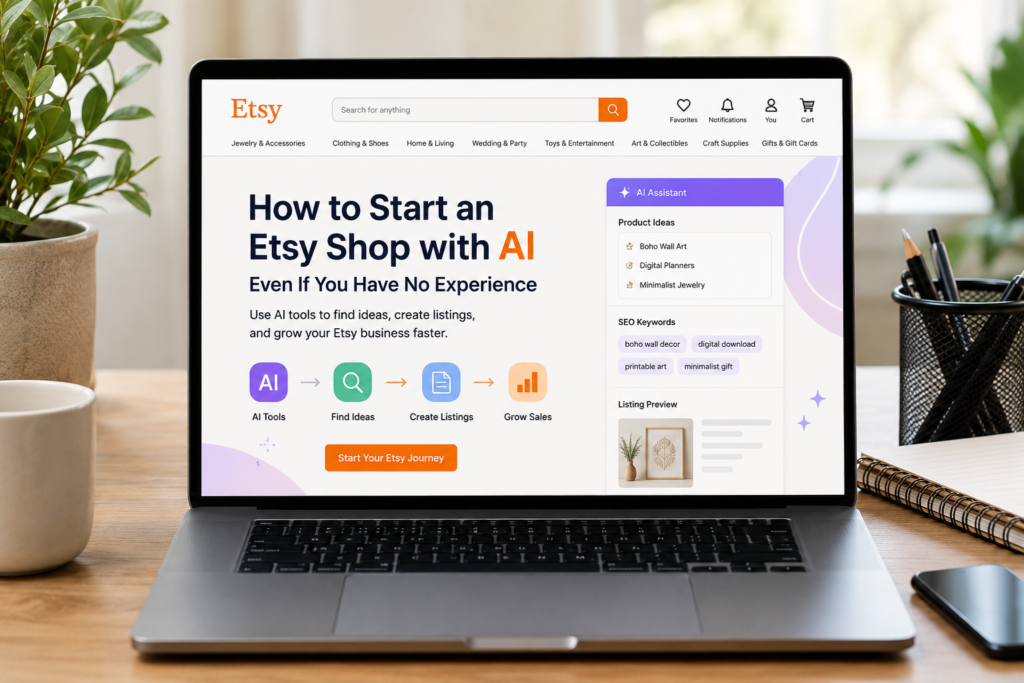
Instead of spending weeks researching products, writing listings, or guessing what shoppers want, AI can help you make faster, data-driven decisions. From market research to content creation, today’s tools reduce the learning curve and allow new sellers to focus on building a profitable business rather than figuring everything out through trial and error.
Why AI Is Transforming Etsy Selling for Beginners
A few years ago, launching an Etsy store required countless hours of research, writing, and manual optimization. Today, AI tools for Etsy sellers can automate many of those tasks while still allowing you to add your own creativity and unique brand voice.
Here’s how AI is changing the game:
- Finds profitable product ideas based on current market demand.
- Helps generate keyword-rich product titles and descriptions.
- Creates optimized tags that improve Etsy search visibility.
- Speeds up competitor and niche research.
- Assists with marketing emails, social media captions, and product launch plans.
- Saves hours of repetitive work so you can focus on growing your shop.
Using AI doesn’t replace your creativity—it enhances it. Successful Etsy sellers use AI to handle repetitive tasks while they focus on creating products customers genuinely want to buy.
If you’re learning how to sell on Etsy with AI, understanding how Etsy’s search algorithm works is just as important as using AI itself. A solid understanding of Etsy SEO helps you choose better keywords, improve listing visibility, and attract qualified buyers. For a deeper explanation, see What Is Etsy SEO? A Beginner’s Guide for 2026.
Can You Start an Etsy Shop with No Experience?
Absolutely. In fact, many successful Etsy entrepreneurs started with zero ecommerce experience. You don’t need to be a graphic designer, marketing expert, or software developer to launch a successful shop.
If your goal is to start an Etsy shop with no experience, focus on learning these core skills first:
- Understand what customers are actively searching for.
- Choose a niche with consistent demand instead of chasing trends.
- Create clear, attractive product listings.
- Learn the basics of Etsy SEO.
- Use AI to improve productivity—not to replace original thinking.
Whether you’re selling digital downloads, print-on-demand products, handmade goods, or craft supplies, AI makes the process significantly easier. Modern tools can help brainstorm product ideas, generate listing drafts, organize keywords, and even identify seasonal opportunities before they become saturated.
Many people assume they need expensive software or years of experience before opening a shop. The reality is that an Etsy business for beginners has never been more accessible. With the right strategy, consistent effort, and responsible use of AI for Etsy product listings, you can build a professional-looking store from day one.
The key isn’t letting AI run your business for you—it’s using AI to make better decisions faster. That’s the difference between simply opening an Etsy shop and creating one that’s positioned for long-term growth.
Set Up Your Etsy Business the Right Way
A strong foundation can make the difference between an Etsy shop that gets buried in search results and one that consistently attracts buyers. If you’re learning how to start an Etsy shop with AI, don’t rush through the setup process. Every decision—from your shop name to your product categories—helps Etsy understand what you’re selling and who should see your listings.
Create Your Etsy Seller Account and Optimize Your Shop Profile
Your Etsy shop profile is often a customer’s first impression. Before you publish a single product, take time to complete every section of your shop. A fully optimized profile builds trust with buyers and gives Etsy more information to categorize your business correctly.
When setting up your shop, focus on these essentials:
- Choose a memorable shop name that’s relevant to your niche.
- Write a keyword-rich shop announcement that explains what you sell.
- Add a professional logo and banner to establish brand credibility.
- Complete your About section with your story and production process.
- Enable shop policies, shipping details, and return information.
If you’re trying to start an Etsy shop with no experience, don’t guess your way through the setup. The official Etsy Seller Handbook provides up-to-date guidance on shop policies, best practices, and seller education that aligns with Etsy’s latest recommendations.
Choose a Profitable Niche Using AI Tools for Etsy Sellers
One of the biggest reasons new shops fail isn’t poor design—it’s choosing products with little demand or overwhelming competition. Instead of relying on instinct, use AI tools for Etsy sellers to identify profitable opportunities backed by search data and customer trends.
Artificial intelligence can help you:
- Discover high-demand, low-competition niches.
- Analyze seasonal buying patterns.
- Generate product ideas based on trending searches.
- Identify long-tail keywords buyers actually use.
- Validate demand before investing time in creating products.
This is where how to sell on Etsy with AI becomes a real competitive advantage. AI can organize market research in minutes, allowing you to spend more time creating products and less time guessing what might sell.
For deeper keyword discovery and niche validation, our guide on best AI prompts for Etsy keyword research explains practical prompt frameworks that simplify research without replacing your own judgment. The article, Chat GPT Prompts for Etsy Sellers: 101 Powerful AI Prompts to Boost Sales, SEO & Shop Growth, also includes reusable prompts for brainstorming product ideas, analyzing competitors, and uncovering buyer intent.
Remember, how to start an Etsy shop with AI isn’t about letting AI build your business for you. It’s about making smarter, data-driven decisions from the beginning. Whether you’re building an Etsy business for beginners or creating your first digital product, combining thoughtful research with AI for Etsy product listings gives you a stronger foundation for long-term growth and helps you avoid many of the costly mistakes new sellers make.
How to Sell on Etsy with AI: Build Listings That Convert
Creating a great product is only half the battle. If your listings aren’t optimized for Etsy’s search algorithm and written with buyers in mind, they’ll struggle to get noticed. One of the biggest advantages of learning how to start an Etsy shop with AI is that you can create professional, SEO-friendly listings in minutes instead of hours.
Create High-Converting Product Titles, Descriptions, and Tags with AI
Successful Etsy sellers don’t rely on guesswork. They research keywords, understand customer intent, and write listings that answer buyers’ questions before they’re even asked. Modern AI tools for Etsy sellers make this process faster while helping you maintain consistency across every product.
Use AI to help you:
- Generate keyword-rich product titles without sounding robotic.
- Write benefit-driven product descriptions that focus on value, not just features.
- Create relevant Etsy tags based on real search intent.
- Identify long-tail keyword opportunities for lower competition.
- Produce multiple title and description variations for A/B testing.
For example, instead of using a generic title like Minimalist Wall Art, AI can generate a more search-friendly version such as:
Minimalist Botanical Wall Art Print | Neutral Home Decor | Digital Download | Modern Living Room Printable
This approach naturally improves keyword relevance while making the listing easier for shoppers to understand.
If you’re learning how to sell on Etsy with AI, remember that AI should support your creativity—not replace it. Always review the generated content, add your brand voice, and verify that product details are accurate before publishing.
AI for Etsy Product Listings: Images, Mockups, and SEO Optimization
Great copy attracts clicks, but strong visuals drive purchases. Buyers often decide within seconds whether to explore a listing, making high-quality images just as important as SEO.
AI can help you improve your listings by:
- Creating lifestyle mockups for digital and print-on-demand products.
- Removing backgrounds and enhancing product photos.
- Generating consistent branding across your entire shop.
- Writing optimized image alt text for accessibility and search visibility.
- Suggesting keyword variations based on your niche.
These improvements work together to create a better shopping experience while strengthening your overall Etsy SEO strategy. As you continue learning how to start an Etsy shop with AI, you’ll discover that optimized visuals and compelling copy consistently outperform listings that rely on basic templates.
If you’re already getting traffic but not enough purchases, reviewing your listing quality is often the fastest way to improve conversions. Our guide on Why Your Etsy Shop Gets Views but No Sales (And How to Fix It) explains the common reasons shoppers leave without buying and complements this Etsy SEO checklist for beginners by helping you identify optimization gaps before they impact your revenue.
Ultimately, mastering AI for Etsy product listings isn’t about automating everything. It’s about using AI strategically to save time, improve SEO, and create listings that earn both clicks and customer trust. That’s one of the smartest ways to start an Etsy shop with no experience while building an Etsy business for beginners that’s designed for long-term growth.
Here’s the next section of your article, optimized for readability, SEO, and a US audience.
Launch and Grow Your Etsy Business for Beginners
Launching your store is where planning turns into real sales. After you’ve learned how to start an Etsy shop with AI, the next step is pricing your products correctly, setting up shipping, and getting your first listing live. Many new sellers focus only on creating products, but long-term success comes from combining smart pricing with consistent marketing. Whether you’re building an Etsy business for beginners or looking for better ways to start an Etsy shop with no experience, these strategies will help you grow faster while avoiding common mistakes.
Price Your Products, Set Shipping, and Publish Your First Listing
Pricing can make or break your Etsy shop. Setting prices too low hurts your profits, while pricing too high can reduce conversions. Instead of guessing, use AI tools for Etsy sellers to research competitor pricing, estimate profit margins, and identify pricing trends within your niche.
When setting your price, include:
- Product production costs
- Etsy fees and payment processing fees
- Packaging and shipping expenses
- Your desired profit margin
- Competitor pricing analysis
If you sell physical products, choose shipping options that balance affordability with reliable delivery times. Digital products eliminate shipping costs entirely, making them an attractive option for new entrepreneurs learning how to sell on Etsy with AI.
Before publishing your first listing, double-check that every element is optimized:
- A keyword-rich title
- High-quality product images or mockups
- A compelling product description
- Relevant Etsy tags
- Clear pricing and shipping details
Using AI for Etsy product listings can speed up writing descriptions and generating SEO-friendly titles, but always review and personalize the final content so it accurately reflects your brand and product.
Promote Your Etsy Shop with AI-Powered Marketing and Social Media
Publishing a listing is only the beginning. Consistent promotion helps drive traffic and build momentum, especially during your first few months on Etsy. As you continue learning how to start an Etsy shop with AI, use automation to save time while maintaining a consistent online presence.
AI can help you:
- Generate Pinterest Pins and Instagram captions
- Create email marketing campaigns
- Write engaging social media posts
- Brainstorm seasonal promotions
- Analyze which products attract the most customer interest
For ongoing visibility, review Etsy’s official Etsy Search Visibility Guide to understand how search ranking factors influence product discovery and how to improve your listings over time.
As your shop grows, consider streamlining repetitive tasks like SEO updates, listing optimization, and customer communication. Our guide on How to Automate Etsy SEO, Listings, and Customer Messages explains practical workflows that help sellers save time while maintaining high-quality customer experiences.
The most successful Etsy shops rarely rely on a single viral product. Instead, they continually optimize listings, monitor customer behavior, test new ideas, and refine their marketing strategy. By combining AI with consistent execution, you’ll build a scalable business instead of chasing one-time sales.
Here is the requested section formatted as a standalone article section.
5. Common Mistakes New Etsy Sellers Make (And How AI Helps You Avoid Them)
Launching your first Etsy store is exciting, but many beginners unknowingly make decisions that limit visibility and sales. The good news? Once you understand how to start an Etsy shop with AI, you can identify and fix these problems before they impact your growth. Instead of relying on guesswork, modern AI tools for Etsy sellers help you make data-driven decisions that align with Etsy’s search algorithm and customer expectations.
Mistakes That Hurt Etsy Search Rankings
One of the biggest misconceptions is that simply publishing a product is enough to generate traffic. In reality, Etsy rewards listings that are optimized for relevance, quality, and customer engagement.
Here are the most common mistakes that prevent new shops from gaining traction:
- Choosing products without validating demand. AI-powered keyword research can uncover what shoppers are actively searching for before you invest time creating products.
- Using weak or generic product titles. AI can generate SEO-friendly titles that naturally include high-value keywords without sounding robotic.
- Writing vague product descriptions. Strong descriptions answer customer questions, highlight benefits, and improve conversion rates. This is where AI for Etsy product listings can save hours of writing while maintaining clarity.
- Ignoring tags and attributes. Etsy uses multiple listing signals to understand your products. AI can suggest relevant long-tail keywords that improve discoverability.
- Uploading low-quality images. Even the best SEO can’t overcome poor visuals. AI image tools can help create professional mockups and improve product presentation.
- Failing to analyze competitors. Successful sellers continuously monitor pricing, keywords, and trends instead of copying listings blindly.
If you’re exploring practical workflows, our editorial guide, I Applied AI Prompts for Etsy Marketing — Here’s What Changed, explains how AI-assisted research and content creation can improve listing quality while saving valuable time.
Your 30-Day Action Plan to Build a Profitable Etsy Shop
If your goal is to start an Etsy shop with no experience, consistency matters more than perfection. Focus on building strong habits during your first month instead of chasing overnight success.
Week 1: Build the Foundation
- Open and optimize your Etsy shop.
- Choose one profitable niche using AI research.
- Research competitors and identify keyword opportunities.
Week 2: Create High-Quality Listings
- Publish 10–20 optimized products.
- Use AI for Etsy product listings to write compelling titles, descriptions, and tags.
- Design professional images and mockups.
Week 3: Improve Visibility
- Review listing performance.
- Refine keywords based on search trends.
- Begin learning how to sell on Etsy with AI by automating repetitive tasks like keyword clustering and content drafting.
Week 4: Scale with Data
- Identify your best-performing listings.
- Expand successful product variations.
- Continue testing new keywords and marketing strategies using trusted AI tools for Etsy sellers.
Learning how to start an Etsy shop with AI isn’t about replacing creativity—it’s about making smarter business decisions. As your shop grows, AI becomes a powerful assistant that helps you research faster, optimize listings more effectively, and spend more time creating products customers actually want. That’s exactly why so many successful creators are using AI to build an Etsy business for beginners into a sustainable source of long-term income.
1 thought on “How to Start an Etsy Shop with AI Even, If You Have No Experience”