
Did you know that nearly 70% of online shopping journeys begin with a search engine, yet thousands of ecommerce stores struggle to get consistent traffic without spending heavily on ads? If you’re tired of watching competitors dominate Google while your products remain hidden, you’re not alone.
The good news is that AI for Ecommerce SEO is changing the game. Today, smart online sellers are using artificial intelligence to uncover profitable keywords, create optimized content, automate tedious SEO tasks, and attract highly targeted visitors without increasing their advertising budget. What once required a full marketing team can now be accomplished faster and more efficiently with the right AI-powered approach.
Whether you run a Shopify store, Etsy shop, WooCommerce website, or another ecommerce business, learning how to get organic traffic with AI can become a major competitive advantage. From advanced keyword research and ecommerce SEO automation to powerful AI SEO strategies for online stores, modern sellers are discovering new ways to increase website traffic using AI while reducing manual work.
In this guide, you’ll learn exactly how successful ecommerce brands leverage the latest AI tools for ecommerce marketing to drive free organic traffic, improve search rankings, and grow sales faster than ever before.
What Is AI for Ecommerce SEO and Why Does It Matter?
The ecommerce landscape has become more competitive than ever. With millions of online stores fighting for visibility, ranking on the first page of Google is no longer just about adding a few keywords to a product page. Today’s successful sellers are using artificial intelligence to make smarter SEO decisions, automate repetitive tasks, and uncover growth opportunities faster than their competitors.
AI for Ecommerce SEO refers to the use of artificial intelligence tools and technologies to improve an online store’s search engine visibility, attract qualified visitors, and increase conversions. From keyword research and content creation to technical optimization and performance analysis, AI helps ecommerce businesses work more efficiently while scaling their organic traffic.
For sellers looking to reduce their dependence on paid advertising, AI has become one of the most powerful competitive advantages available today.
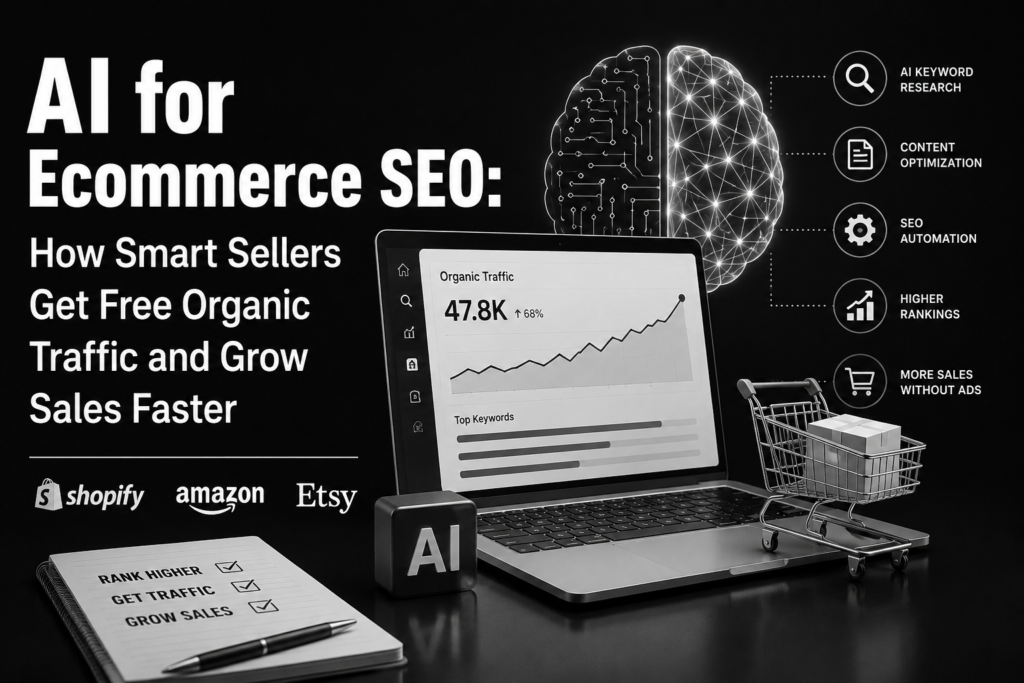
How AI Is Transforming Ecommerce Search Optimization
Traditional SEO often requires hours of manual research, content planning, and ongoing optimization. AI dramatically accelerates these processes by analyzing large amounts of data in seconds and identifying patterns that humans might miss.
Modern AI tools for ecommerce marketing can help sellers:
- Discover high-intent keywords with strong purchase intent
- Generate SEO-friendly product descriptions
- Optimize category and collection pages
- Analyze competitor strategies
- Identify content gaps and ranking opportunities
- Automate routine SEO tasks
For example, an AI-powered platform can instantly identify hundreds of long-tail search terms related to a product category, allowing sellers to create content that aligns with real customer searches.
AI is also changing how product visuals contribute to search performance. High-quality images improve user engagement, conversion rates, and overall site quality signals. If you’re looking to improve product imagery, check out our guide on AI Ecommerce Product Photos: 11 Best AI Tools to Create Professional Product Images in 2026.
Why Organic Traffic Is More Valuable Than Paid Ads in 2026
Paid advertising can generate quick traffic, but it comes with a major limitation: the moment you stop spending, the traffic stops too.
Organic traffic works differently. When your pages rank well in search results, they can continue attracting visitors for months or even years with minimal ongoing costs.
Here’s why smart ecommerce brands prioritize organic growth:
- Lower Customer Acquisition Costs
- Organic traffic reduces dependence on expensive ad campaigns.
- Profit margins improve as marketing costs decrease.
- Higher Buyer Intent
- Users searching Google are actively looking for solutions or products.
- This often leads to better conversion rates than interruption-based advertising.
- Long-Term Growth
- Strong rankings create a sustainable source of traffic.
- Content assets continue generating visibility long after publication.
- Greater Brand Authority
- Appearing consistently in search results builds trust and credibility.
- Consumers are more likely to buy from brands they repeatedly encounter online.
This is why businesses that understand how to get organic traffic with AI are gaining a significant advantage. By combining advanced AI SEO strategies for online stores with smart ecommerce SEO automation, sellers can consistently increase website traffic using AI while building a marketing asset that continues delivering value long into the future.
How to Get Organic Traffic with AI Faster Than Traditional SEO
Traditional SEO can take months of research, content planning, optimization, and testing before meaningful results appear. Today, artificial intelligence is helping ecommerce sellers accelerate that process by identifying opportunities faster, creating optimized content more efficiently, and making smarter data-driven decisions.
Instead of manually analyzing hundreds of keywords and competitors, modern AI-powered platforms can uncover valuable search opportunities in minutes. This allows store owners to focus on growth while reducing the time spent on repetitive SEO tasks.
Using AI to Discover High-Intent Ecommerce Keywords
One of the biggest reasons ecommerce websites struggle to rank is targeting the wrong keywords. Many sellers focus on broad, highly competitive terms that are difficult to rank for, especially when competing against established brands.
AI changes this by identifying high-intent keywords that indicate strong purchase intent. These are the searches potential customers use when they are actively looking for products, solutions, or buying advice.
For example, instead of targeting a generic keyword like:
- Running shoes
AI may uncover more valuable opportunities such as:
- Best running shoes for flat feet
- Lightweight trail running shoes for women
- Affordable running shoes under $100
- Waterproof running shoes for hiking
These long-tail keywords typically have:
- Lower competition
- Higher conversion rates
- More targeted traffic
- Faster ranking potential
To find these opportunities, AI analyzes:
- Search trends
- Customer behavior
- Competitor rankings
- Search intent patterns
- Related keyword clusters
For ecommerce businesses on Shopify, Etsy, or WooCommerce, building content around these keyword clusters can significantly improve visibility and sales.
If you’re new to keyword research, our ecommerce keyword research guide provides a detailed framework for finding profitable search terms that attract ready-to-buy customers.
Creating Search-Optimized Content at Scale with AI
Finding keywords is only half the battle. The next challenge is consistently creating high-quality content that satisfies both search engines and customers.
This is where AI for Ecommerce SEO delivers one of its biggest advantages.
Modern AI tools can help generate:
- Product descriptions
- Collection page content
- Blog articles
- Buying guides
- FAQ sections
- Meta titles and descriptions
More importantly, AI can identify content gaps that competitors are missing, helping you create resources that better answer customer questions.
A practical workflow looks like this:
- Use AI to identify keyword opportunities.
- Group related keywords into topic clusters.
- Create comprehensive content around each topic.
- Optimize headings, metadata, and internal links.
- Continuously update content using AI-driven insights.
However, publishing AI-generated content without human review is a mistake. The most successful ecommerce brands combine AI efficiency with human expertise to create content that is accurate, trustworthy, and genuinely helpful.
Before publishing any content, align it with Google’s SEO content guidelines to ensure you’re creating people-first content that meets modern search quality standards. This approach helps build long-term organic visibility while protecting your site from ranking volatility.
When implemented correctly, AI tools for ecommerce marketing can dramatically reduce content production time while helping online stores increase website traffic using AI and scale organic growth much faster than traditional SEO methods.
How to Get Organic Traffic with AI Faster Than Traditional SEO
Traditional SEO can take months of research, content planning, optimization, and testing before meaningful results appear. Today, artificial intelligence is helping ecommerce sellers accelerate that process by identifying opportunities faster, creating optimized content more efficiently, and making smarter data-driven decisions.
Instead of manually analyzing hundreds of keywords and competitors, modern AI-powered platforms can uncover valuable search opportunities in minutes. This allows store owners to focus on growth while reducing the time spent on repetitive SEO tasks.
Using AI to Discover High-Intent Ecommerce Keywords
One of the biggest reasons ecommerce websites struggle to rank is targeting the wrong keywords. Many sellers focus on broad, highly competitive terms that are difficult to rank for, especially when competing against established brands.
AI changes this by identifying high-intent keywords that indicate strong purchase intent. These are the searches potential customers use when they are actively looking for products, solutions, or buying advice.
For example, instead of targeting a generic keyword like:
- Running shoes
AI may uncover more valuable opportunities such as:
- Best running shoes for flat feet
- Lightweight trail running shoes for women
- Affordable running shoes under $100
- Waterproof running shoes for hiking
These long-tail keywords typically have:
- Lower competition
- Higher conversion rates
- More targeted traffic
- Faster ranking potential
To find these opportunities, AI analyzes:
- Search trends
- Customer behavior
- Competitor rankings
- Search intent patterns
- Related keyword clusters
For ecommerce businesses on Shopify, Etsy, or WooCommerce, building content around these keyword clusters can significantly improve visibility and sales.
If you’re new to keyword research, our ecommerce keyword research guide (Best SEO Tips for Beginners: Complete Step-by-Step Guide for Higher Rankings) provides a detailed framework for finding profitable search terms that attract ready-to-buy customers.
Creating Search-Optimized Content at Scale with AI
Finding keywords is only half the battle. The next challenge is consistently creating high-quality content that satisfies both search engines and customers.
This is where AI for Ecommerce SEO delivers one of its biggest advantages.
Modern AI tools can help generate:
- Product descriptions
- Collection page content
- Blog articles
- Buying guides
- FAQ sections
- Meta titles and descriptions
More importantly, AI can identify content gaps that competitors are missing, helping you create resources that better answer customer questions.
A practical workflow looks like this:
- Use AI to identify keyword opportunities.
- Group related keywords into topic clusters.
- Create comprehensive content around each topic.
- Optimize headings, metadata, and internal links.
- Continuously update content using AI-driven insights.
However, publishing AI-generated content without human review is a mistake. The most successful ecommerce brands combine AI efficiency with human expertise to create content that is accurate, trustworthy, and genuinely helpful.
Before publishing any content, align it with Google’s SEO content guidelines to ensure you’re creating people-first content that meets modern search quality standards. This approach helps build long-term organic visibility while protecting your site from ranking volatility.
When implemented correctly, AI tools for ecommerce marketing can dramatically reduce content production time while helping online stores increase website traffic using AI and scale organic growth much faster than traditional SEO methods.
Best AI Tools for Ecommerce Marketing and SEO Growth
Artificial intelligence has evolved far beyond simple content generation. Today, successful ecommerce brands use AI to streamline SEO workflows, uncover profitable keyword opportunities, analyze customer behavior, and create content that attracts highly targeted organic traffic. The right combination of AI tools can dramatically reduce manual work while helping online stores scale faster.
Whether you’re running a Shopify store, Etsy shop, Amazon storefront, or WooCommerce website, leveraging AI can give you a significant competitive advantage in search rankings and customer acquisition.
AI Tools for Content Creation, Keyword Research, and Optimization
One of the biggest challenges ecommerce sellers face is consistently creating SEO-friendly content that ranks in search results. This is where modern AI tools for ecommerce marketing excel.
AI-powered platforms can help sellers:
- Discover high-intent keywords with strong buying potential
- Generate product descriptions optimized for search engines
- Create blog content that targets customer questions
- Optimize title tags and meta descriptions
- Identify content gaps competitors are overlooking
- Build topical authority around important product categories
For example, instead of spending hours manually researching keywords, AI can quickly identify search terms your target customers are actively using. This makes it easier to implement effective AI SEO strategies for online stores and create content that aligns with search intent.
Many sellers also use AI to automate content briefs, internal linking suggestions, and content optimization recommendations. When combined with human expertise, these tools can significantly improve content quality and search visibility.
To maximize your results, consider exploring our best AI prompts for ecommerce sellers guide, which covers practical AI workflows for content creation, SEO research, and store growth automation.
If you’re new to search engine optimization, reviewing our Best SEO Tips for Beginners: Complete Step-by-Step Guide for Higher Rankings can help you build a stronger foundation before implementing advanced AI-driven strategies.
AI-Powered Analytics and Customer Behavior Insights
Creating content is only one piece of the puzzle. The most successful ecommerce brands use AI to understand how customers discover, interact with, and purchase from their websites.
Modern AI analytics tools can analyze massive amounts of data and reveal insights that would be difficult to uncover manually. This enables store owners to make smarter decisions based on actual customer behavior rather than guesswork.
Key benefits include:
- Identifying top-converting traffic sources
- Understanding customer search patterns
- Predicting purchasing behavior
- Discovering underperforming product pages
- Improving conversion funnels
- Finding opportunities to increase website traffic using AI
AI can also help ecommerce businesses segment audiences based on interests, purchase history, and browsing behavior. This allows sellers to create more personalized content experiences that improve engagement and conversion rates.
Another major advantage is ecommerce SEO automation. AI systems can continuously monitor rankings, track keyword performance, detect technical SEO issues, and recommend optimization opportunities in real time. Instead of reacting to traffic drops after they happen, store owners can proactively address issues before they impact revenue.
The combination of AI-powered content creation, keyword optimization, analytics, and automation creates a scalable growth system that helps ecommerce businesses attract more qualified visitors while spending less time on repetitive SEO tasks.
AI SEO Strategies for Online Stores That Actually Work
Many ecommerce sellers invest in SEO but struggle to see meaningful results because they’re relying on outdated tactics. The most effective AI SEO strategies for online stores focus on improving content quality, search relevance, and site structure while automating repetitive tasks that consume valuable time.
Artificial intelligence helps store owners identify opportunities faster, optimize pages more effectively, and create a stronger user experience—all of which contribute to better search visibility and higher organic traffic.
Optimizing Product Pages with Artificial Intelligence
Product pages are often the biggest untapped SEO asset for online stores. Unfortunately, many ecommerce sites rely on generic manufacturer descriptions that provide little value to search engines or shoppers.
AI can help create unique, keyword-rich product content that improves rankings while increasing conversions.
Here are some ways smart sellers use AI to optimize product pages:
- Generate unique product descriptions at scale.
- Identify high-intent keywords customers actually search for.
- Create compelling product titles and meta descriptions.
- Optimize image alt text for search visibility.
- Analyze competitor listings to uncover content gaps.
- Improve readability and customer engagement.
For example, instead of using a generic description, AI can generate detailed product benefits, use cases, FAQs, and comparison content that better matches user search intent.
If you’re new to search optimization, our Best SEO Tips for Beginners: Complete Step-by-Step Guide for Higher Rankings can help you build a strong SEO foundation before implementing advanced AI strategies.
Building Topic Clusters and Internal Links Using AI
One of the most overlooked ways to increase website traffic using AI is through topic clustering. Search engines increasingly reward websites that demonstrate expertise by covering a subject comprehensively rather than publishing isolated articles.
AI can quickly analyze your niche and identify related topics your audience is searching for. Instead of creating random content, you can build interconnected content hubs that strengthen topical authority.
A typical AI-driven topic cluster might include:
- Ecommerce SEO fundamentals
- AI tools for ecommerce marketing
- Product page optimization techniques
- Ecommerce SEO automation workflows
- Keyword research for online stores
- Internal linking best practices
- AI content creation strategies
Once these articles are published, AI can recommend strategic internal links between pages, helping search engines better understand your site’s structure while guiding visitors toward relevant content.
This approach not only improves crawlability but also increases page views, reduces bounce rates, and strengthens overall SEO performance.
To maximize results, combine AI-generated recommendations with proven SEO ranking factors from trusted industry resources. Understanding how search engines evaluate content quality, relevance, authority, and user experience will help you make smarter optimization decisions and build sustainable organic growth.
When used correctly, AI doesn’t replace SEO expertise—it amplifies it. The combination of intelligent product page optimization, strategic topic clusters, and data-driven internal linking creates a scalable framework for long-term ecommerce success.
Ecommerce SEO Automation: Save Time and Scale Faster
For many ecommerce sellers, SEO isn’t difficult because it’s complex—it’s difficult because it’s repetitive. Writing hundreds of meta descriptions, updating product pages, tracking rankings, and running audits can consume countless hours every month.
That’s where ecommerce SEO automation becomes a competitive advantage. By combining AI-powered tools with automated workflows, online stores can streamline routine SEO tasks, reduce human error, and focus more on growth-oriented activities. The result is faster execution, improved consistency, and a scalable SEO strategy that continues delivering results over time.
Automating Meta Tags, Product Descriptions, and SEO Audits
One of the biggest benefits of AI for Ecommerce SEO is the ability to automate repetitive content optimization tasks without sacrificing quality.
Modern AI tools can generate:
- SEO-friendly title tags
- Compelling meta descriptions
- Optimized product descriptions
- Product category content
- Image alt text
- Structured data recommendations
Instead of manually writing descriptions for hundreds of products, ecommerce sellers can use AI to create optimized drafts in minutes. This is especially valuable for large Shopify, WooCommerce, and Etsy stores with constantly expanding inventories.
AI can also perform routine SEO audits by identifying issues such as:
- Missing meta tags
- Duplicate content
- Broken links
- Slow-loading pages
- Keyword cannibalization
- Crawlability problems
By automating these checks, store owners can quickly spot opportunities that may otherwise go unnoticed for months.
AI Workflows for Continuous SEO Improvement
The most successful ecommerce brands don’t treat SEO as a one-time project. They build automated systems that continuously improve search visibility.
A typical AI-driven workflow may look like this:
- AI discovers new keyword opportunities.
- Content is generated and optimized.
- Product pages are updated automatically.
- Rankings and traffic are monitored.
- AI identifies underperforming pages.
- Content is refreshed based on new search trends.
This ongoing cycle allows businesses to adapt faster than competitors and maintain strong organic visibility throughout the year.
Some advanced AI SEO strategies for online stores even automate internal linking suggestions, content updates, and competitor monitoring. These capabilities help sellers increase website traffic using AI while reducing the manual workload traditionally associated with SEO management.
If you’re just getting started with automation, review our SEO automation checklist (Best SEO Tips for Beginners: Complete Step-by-Step Guide for Higher Rankings) to build a scalable SEO workflow that grows alongside your ecommerce business.
The bottom line is simple: automation doesn’t replace SEO expertise—it amplifies it. When combined with smart strategy, AI-powered automation enables ecommerce sellers to move faster, optimize more pages, and capture more organic traffic than ever before.
How Smart Brands Increase Website Traffic Using AI
The most successful ecommerce brands aren’t using AI to replace their marketing teams—they’re using it to work smarter, move faster, and uncover growth opportunities that would otherwise go unnoticed. By combining AI for Ecommerce SEO with proven content and optimization strategies, businesses can attract more qualified visitors without increasing their advertising spend.
From identifying untapped keywords to automating content optimization, artificial intelligence is helping online stores scale organic traffic more efficiently than ever before.
Real-World Examples of AI-Driven Organic Growth
Many ecommerce businesses are using AI to solve common SEO challenges and accelerate growth.
1. Smarter Keyword Discovery
Instead of manually researching hundreds of search terms, brands use AI-powered tools to identify buyer-intent keywords with lower competition and higher conversion potential.
For example, an online home decor store may discover long-tail phrases that customers are actively searching for, allowing them to create highly targeted content that ranks faster in search results.
2. Faster Content Production
Creating SEO content consistently is one of the biggest challenges for ecommerce sellers. AI helps generate product descriptions, blog outlines, FAQs, and content briefs in a fraction of the time.
This allows businesses to:
- Publish more content consistently
- Target a wider range of keywords
- Capture additional search traffic
- Improve topical authority
As a result, many brands successfully increase website traffic using AI without hiring large content teams.
3. Product Page Optimization at Scale
Large ecommerce stores often manage hundreds or thousands of product pages. AI can analyze product listings and recommend improvements for:
- Titles
- Meta descriptions
- Product features
- Internal linking
- Schema markup opportunities
These enhancements improve visibility in search engines while creating a better shopping experience for customers.
4. Automated SEO Workflows
Modern ecommerce SEO automation tools can monitor rankings, identify technical SEO issues, and recommend optimization opportunities automatically.
If you’re looking to streamline repetitive tasks, check out our guide on Powerful AI Tools for Sellers to Automate Daily Ecommerce Tasks in 2026, which covers practical automation solutions for growing online stores.
Common AI SEO Mistakes Ecommerce Sellers Should Avoid
While AI offers tremendous advantages, relying on it incorrectly can damage your SEO performance. The most successful brands combine automation with human oversight.
Publishing AI Content Without Editing
One of the biggest mistakes sellers make is publishing AI-generated content exactly as it was produced.
Search engines reward content that demonstrates expertise, accuracy, and real-world value. Always review, edit, and enhance AI-generated content before publishing.
Ignoring Search Intent
Many sellers focus solely on keywords and forget why users are searching in the first place.
Effective AI SEO strategies for online stores prioritize customer intent by creating content that answers questions, solves problems, and helps shoppers make informed buying decisions.
Creating Thin or Duplicate Product Content
Using the same AI-generated descriptions across dozens of products can lead to weak content and missed ranking opportunities.
Instead:
- Add unique product benefits
- Include customer-focused language
- Highlight specific use cases
- Answer common buyer questions
Over-Automating SEO Decisions
AI can provide valuable recommendations, but it shouldn’t make every strategic decision.
Successful ecommerce brands still rely on human expertise for:
- Content strategy
- Brand messaging
- Customer research
- Competitive analysis
Neglecting Technical SEO
Even the best AI-generated content won’t perform well if your site has technical issues.
Regularly audit:
- Site speed
- Mobile usability
- Internal linking
- Crawlability
- Indexation
Combining strong technical SEO with AI tools for ecommerce marketing creates a foundation for long-term organic growth.
The bottom line: AI is most effective when it enhances human expertise—not when it replaces it. Smart ecommerce brands use AI to work faster, uncover opportunities, and scale their SEO efforts while maintaining quality, accuracy, and customer focus.
The Future of AI for Ecommerce SEO
Artificial intelligence is no longer a competitive advantage reserved for large brands. It’s quickly becoming a standard part of how successful online stores attract customers, optimize content, and grow organic traffic. As search engines become smarter and consumer expectations continue to rise, ecommerce businesses that embrace AI will be better positioned to scale efficiently while reducing marketing costs.
The next few years will bring even more advanced opportunities for sellers to automate SEO tasks, personalize customer experiences, and uncover growth opportunities that would be difficult to identify manually.
Emerging AI Trends Shaping Online Store Growth
The evolution of AI for Ecommerce SEO is moving far beyond basic content generation. Modern AI systems can now analyze customer behavior, predict search trends, and provide actionable optimization recommendations in real time.
Here are the biggest trends ecommerce sellers should watch:
1. Predictive Keyword Intelligence
Traditional keyword research focuses on current search demand. AI-powered platforms are increasingly identifying emerging trends before they become highly competitive.
Benefits include:
- Discovering profitable niches earlier
- Finding untapped long-tail keywords
- Creating content before competitors enter the market
- Capturing organic traffic faster
This shift is helping sellers learn how to get organic traffic with AI by targeting opportunities before they become saturated.
2. Hyper-Personalized Shopping Experiences
AI is making it possible to deliver personalized content based on user behavior, search intent, purchase history, and browsing patterns.
Examples include:
- Dynamic product recommendations
- Personalized landing pages
- Customized email campaigns
- Search result optimization based on customer preferences
These experiences improve engagement metrics that indirectly support stronger SEO performance.
3. Advanced Ecommerce SEO Automation
Manual SEO processes are becoming increasingly automated.
Modern ecommerce SEO automation tools can now:
- Generate meta titles and descriptions
- Optimize product descriptions
- Identify technical SEO issues
- Suggest internal linking opportunities
- Monitor ranking fluctuations automatically
This allows store owners to spend more time growing their business and less time handling repetitive optimization tasks.
4. AI-Powered Content Clusters
Instead of publishing isolated blog posts, successful brands are using AI to build complete topical authority around specific subjects.
AI can help sellers:
- Identify content gaps
- Create topic clusters
- Develop supporting articles
- Strengthen internal linking structures
This approach aligns perfectly with modern AI SEO strategies for online stores, helping websites establish expertise and improve rankings across multiple related keywords.
5. Smarter Customer Insights and Analytics
One of the most powerful AI tools for ecommerce marketing is advanced analytics.
AI platforms can now identify:
- High-converting traffic sources
- Customer pain points
- Product demand patterns
- Revenue opportunities
- Content performance trends
These insights help businesses make data-driven decisions that consistently increase website traffic using AI while improving conversion rates.
Action Plan to Start Using AI for Ecommerce SEO Today
You don’t need a massive budget or a dedicated SEO team to benefit from AI. The most successful ecommerce sellers start with simple, repeatable workflows and expand from there.
Follow this practical action plan:
Step 1: Audit Your Current SEO Performance
Before implementing AI, establish a baseline.
Track:
- Organic traffic
- Top-performing pages
- Keyword rankings
- Conversion rates
- Product page performance
Knowing your starting point makes it easier to measure improvements.
Step 2: Use AI for Keyword Research
Focus on finding keywords with clear buyer intent.
Look for:
- Product-focused searches
- Long-tail opportunities
- Question-based queries
- Low-competition keywords
This creates the foundation for sustainable organic growth.
Step 3: Optimize Existing Content First
Many stores overlook the fastest SEO win: improving existing content.
Use AI to:
- Refresh outdated articles
- Improve product descriptions
- Expand thin content
- Enhance on-page optimization
Updating proven content often delivers faster results than creating new pages from scratch.
Step 4: Build a Consistent Content System
Create a publishing schedule based on customer questions and search intent.
Aim to publish content that:
- Solves buyer problems
- Answers common questions
- Supports product pages
- Builds topical authority
Consistency remains one of the strongest ranking factors for long-term growth.
Step 5: Automate Repetitive SEO Tasks
Use AI to streamline routine work such as:
- Meta description creation
- Content outlines
- Internal link suggestions
- SEO audits
- Performance monitoring
Automation frees up time for higher-value strategic decisions.
Step 6: Learn From Real-World Results
One of the fastest ways to accelerate your learning curve is to study practical AI workflows used by other ecommerce sellers.
For a real-world example, check out What Happened When I Started Using AI Prompts for Ecommerce Store Tasks (Daily) and see how consistent AI implementation can improve productivity, content creation, and store growth over time.
Final Takeaway
The future of ecommerce growth belongs to sellers who combine human creativity with AI efficiency. While search algorithms and consumer behaviors will continue to evolve, the core goal remains the same: deliver the right content to the right customer at the right time.
Businesses that adopt AI for Ecommerce SEO today will be better prepared to capture organic traffic, streamline operations, and build a sustainable competitive advantage in an increasingly crowded online marketplace.
Frequently Asked Questions (FAQs)
What Is AI for Ecommerce SEO?
AI for Ecommerce SEO refers to using artificial intelligence to improve how online stores rank in search engines and attract organic traffic. Instead of manually analyzing thousands of keywords, optimizing product pages, and auditing technical SEO issues, AI can automate many of these tasks in minutes.
For example, an ecommerce store selling fitness equipment can use AI to identify high-intent keywords, generate optimized product descriptions, improve metadata, and uncover content opportunities that competitors may be missing. AI also helps with technical SEO by identifying broken links, duplicate content, crawl issues, and other factors that impact rankings.
When combined with a solid SEO strategy, AI enables online sellers to improve visibility, attract qualified visitors, and increase sales without relying exclusively on paid advertising.
How Can I Get Organic Traffic With AI?
Getting organic traffic with AI starts with understanding what your target customers are searching for and creating content that matches their intent. Modern AI tools can simplify this process significantly.
Here are some beginner-friendly steps:
- Use AI-powered keyword research tools to discover buyer-focused search terms.
- Create blog content and product descriptions optimized for search intent.
- Improve product pages with AI-generated metadata and FAQs.
- Build internal links between related content and product categories.
- Monitor performance using AI-driven analytics and optimization tools.
If you’re looking to strengthen your keyword strategy, check out our guide on AI keyword research strategies to uncover high-converting search opportunities for your online store.
You can also explore 15 Powerful AI Prompts for Product Launch Campaigns That Generate Instant Sales (2026 Guide) to learn how AI can support both SEO and product marketing efforts.
What Are the Best AI Tools for Ecommerce Marketing?
The best AI tools for ecommerce marketing depend on your goals rather than the software itself. Most successful sellers combine several AI-powered solutions across different areas of their business.
Popular categories include:
- Content Creation Tools – Generate blog posts, product descriptions, email campaigns, and social media content.
- SEO Optimization Platforms – Analyze keywords, content gaps, rankings, and competitor strategies.
- Analytics Tools – Track visitor behavior, conversions, and customer journeys.
- Customer Insight Platforms – Identify buying patterns and audience preferences.
- Automation Software – Streamline repetitive marketing and SEO tasks.
Together, these solutions help businesses increase website traffic using AI while reducing manual workloads.
Can AI Replace Traditional Ecommerce SEO?
No. While AI dramatically improves efficiency, it cannot fully replace traditional ecommerce SEO.
AI excels at processing large amounts of data, generating content drafts, identifying optimization opportunities, and automating repetitive tasks. However, human expertise remains essential for strategic decision-making, brand messaging, quality control, and understanding customer psychology.
The most effective approach combines AI SEO strategies for online stores with human oversight. AI handles execution and analysis, while marketers focus on strategy, creativity, and customer experience.
Think of AI as a powerful assistant—not a complete replacement for SEO expertise.
Is Ecommerce SEO Automation Worth It for Small Businesses?
Absolutely. Ecommerce SEO automation can be a game-changer for small businesses with limited time and resources.
Key benefits include:
- Faster content creation and optimization
- Reduced marketing costs
- Improved productivity and efficiency
- More consistent SEO implementation
- Greater ability to compete with larger brands
Instead of hiring a large marketing team, small ecommerce stores can leverage automation to perform keyword research, optimize product pages, monitor rankings, and identify growth opportunities at scale.
For many growing online businesses, ecommerce SEO automation provides one of the highest returns on investment because it helps generate sustainable organic traffic while keeping operating costs under control.