
You launched your digital products, published them on Gumroad, and waited for the first sale. Then another day passed. And another. Maybe people are viewing your Gumroad product page, but nobody is clicking Buy. Or worse, you're barely getting visitors at all. When digital products aren't selling, it is easy to assume the problem is simply a lack of promotion.
But more traffic is not always the answer. A product can fail because the offer is unclear, the audience is wrong, the price feels disconnected from the value, or the sales page does not give buyers a strong enough reason to act. Sometimes the problem starts even earlier: the digital product itself may not solve a problem people care enough about to pay for.
That is what makes weak digital products sales so frustrating. You can spend hours creating an ebook, template, course, or AI prompt bundle, then spend even more time posting about it without knowing which part of the process is actually broken. More effort won’t necessarily produce better results if you’re fixing the wrong problem.
The good news is that poor sales are not always a verdict on your product. Often, they are a signal that something in your digital product strategy needs adjustment. By identifying the specific bottleneck—from product positioning and buyer psychology to pricing, discoverability, and digital product marketing—you can make smarter changes instead of guessing.
The first step is figuring out whether the problem begins with the product itself or with the way it is being presented to potential buyers.
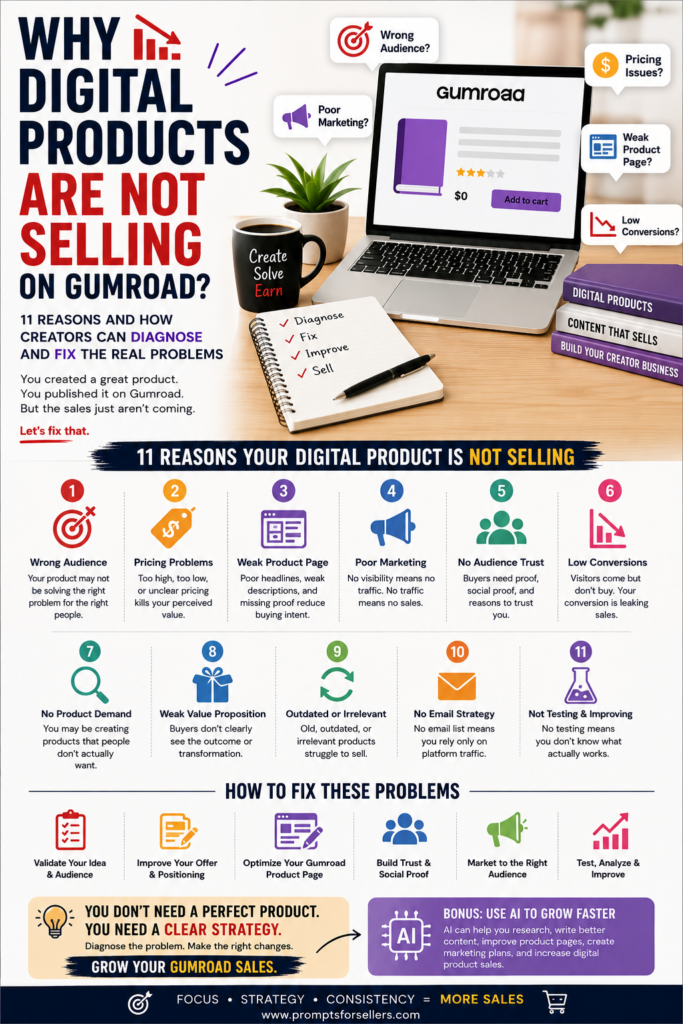
Why Your Digital Products Are Not Selling in the First Place
Creating a digital products is only the production side of the business. Selling it requires a separate chain of decisions: identifying a real buyer, solving a problem that matters, communicating the value clearly, and reaching people who are actually likely to purchase. When one of those pieces is weak, a product can sit on Gumroad with little or no sales even when the creator has put substantial effort into making it.
This is especially common with first-time creators. You may spend weeks building an ebook, template, course, or AI prompt bundle and assume the hardest part is finished once the files are uploaded. But publishing is not the same as creating demand. Gumroad’s own creator resources have repeatedly emphasized understanding your audience, researching their problems, building distribution, and packaging products in a way that makes their value easier to understand.
Your Product Solves a Problem Buyers Do Not Care Enough About
A product can be useful without being compelling enough to buy.
That distinction matters. Someone might agree that your 200-page ebook contains valuable information but still decide not to spend $19 on it. Why? The problem it solves may not feel urgent, the outcome may not be clear, or the buyer may believe they can find a good-enough alternative for free.
Think about the difference between these two offers:
- “50 AI Prompts for Entrepreneurs”
- “50 ChatGPT Prompts to Help Etsy Sellers Write Better Product Listings in Minutes”
The second offer gives a specific audience a specific use case. The buyer can immediately recognize whether it is relevant to them.
Before changing your price or spending more on promotion, ask:
Who specifically needs this product, what problem does it solve, and why would they pay to solve that problem now?
If you cannot answer those questions clearly, more traffic may simply produce more people who look at your product and leave.
You Are Targeting the Wrong Audience
Even a strong product can struggle when it is presented to people who do not have the problem it solves.
For example, an advanced Shopify SEO course may be valuable, but promoting it primarily to people who are just learning what Shopify is creates a mismatch. Likewise, an AI prompt bundle designed for experienced freelance copywriters will have limited appeal to someone who has never used AI for business.
Your audience should influence more than your promotional channels. It should shape:
- The digital products topic
- The language you use
- The examples you include
- The price you can reasonably justify
- The objections you address
- The transformation you promise
- The places where you promote the product
Gumroad has also highlighted the importance of knowing your audience and understanding the problems they need solved rather than treating everyone as a potential customer.
Your Offer Is Too Generic to Stand Out
Another common problem is creating a product that sounds interchangeable with dozens of alternatives.
“Digital Marketing Ebook” is difficult to differentiate.
“30-Day Digital Marketing Plan for Local Service Businesses” immediately communicates a narrower audience, use case, and outcome.
This does not mean every product needs an extremely narrow niche. It means the buyer should quickly understand why this particular product is relevant to them.
The same principle applies to templates and AI prompt products. A generic “100 Business Prompts” bundle gives the buyer very little context. A collection designed around a specific workflow—such as customer research, sales-page optimization, or content planning—can communicate its practical value much more clearly.
The product itself may not need to be completely reinvented. Sometimes the bigger opportunity is improving the positioning: who it is for, what problem it addresses, and what makes the solution useful.
AI Prompt: Identify Buyer Pain Points and Product-Market Fit
Purpose
Use AI as a research assistant to pressure-test your product idea before assuming the problem is marketing or traffic.
Prompt:
Act as a product-market-fit researcher and consumer psychology strategist for digital products.
Analyze the following product:
Product: [PRODUCT NAME]
Product Type: [EBOOK / TEMPLATE / COURSE / AI PROMPT BUNDLE / OTHER]
Target Audience: [TARGET AUDIENCE]
Price: [$PRICE]
Main Problem It Solves: [PROBLEM]
Main Promise or Outcome: [OUTCOME]
Current Sales: [NUMBER OR “NO SALES YET”]
Current Traffic: [APPROXIMATE VISITS IF KNOWN]
Current Marketing Channels: [CHANNELS]
Determine:
- How urgent and valuable the problem is for the target audience.
- Whether the stated audience is specific enough.
- The strongest buyer pain points connected to this problem.
- The likely reasons someone would hesitate to purchase.
- What free alternatives or competing solutions a buyer might consider.
- Whether the product promise is specific and compelling.
- Whether the positioning clearly differentiates the product.
- Three stronger positioning angles I could test.
- Five questions I should ask potential customers before investing more time in promotion.
- The three highest-priority changes I should test first.
Do not assume the product is valuable simply because it contains useful information. Evaluate it from the buyer’s perspective and explain the reasoning behind every recommendation.
How to use it:
Run the prompt before immediately changing your Gumroad product page or increasing your advertising budget. The goal is not to let AI decide whether your product will succeed; it is to uncover assumptions you may not have questioned.
Customize:
- Product type
- Target customer
- Customer problem
- Current price
- Product promise
- Existing traffic
- Sales
- Marketing channels
Once you know that the product addresses a meaningful problem for a defined audience, the next question becomes much more specific: does the offer communicate that value strongly enough for a buyer to act?
11 Reasons Your Gumroad Product Is Not Generating Sales
A Gumroad product can be genuinely useful and still struggle to generate sales. That does not necessarily mean the product is bad. In many cases, the real issue is somewhere between what you’re selling, who you’re selling it to, how you present the offer, and what buyers believe they will get in return.
Before changing your marketing strategy or spending more money on promotion, it helps to diagnose the problem. The three areas below cover several of the most common reasons digital product sales stall: weak positioning, poor perceived value, and a product page that fails to turn interest into action.
Weak Product Positioning and an Unclear Value Proposition
One of the biggest problems with digital products is that creators often describe what the product contains instead of explaining why the buyer should want it.
Consider these two examples:
“A 75-page ebook with 12 chapters about Etsy SEO.”
versus:
“Learn how to optimize your Etsy listings so more qualified shoppers can find your products through search.”
The first describes the product. The second communicates an outcome.
That distinction matters because buyers are rarely purchasing a PDF, template, course, or collection of AI prompts simply because the file exists. They are purchasing a potential solution to a problem.
A creator might spend weeks building an impressive product, but the buyer sees only a few seconds of the sales message before deciding whether it is relevant.
Your positioning becomes weak when:
- The target customer is unclear.
- The problem is too broad.
- The product sounds similar to dozens of alternatives.
- The benefits are buried beneath a list of features.
- The product promises information instead of a meaningful outcome.
- The sales message tries to appeal to everyone.
- The buyer cannot immediately tell whether the product is meant for them.
This is especially important when selling digital products on Gumroad, because the platform gives creators considerable control over how they describe and present their products. Gumroad’s current product setup allows creators to describe products with formatted text and supporting media, making the product description an important part of communicating the offer.
A useful positioning test is simple:
Can your ideal buyer understand who the product is for, what problem it addresses, and what they can accomplish with it within a few seconds?
If the answer is no, improving traffic probably should not be your first priority.
You should also look for a mismatch between the product and the buyer’s level of awareness. A beginner may want a step-by-step solution, while an experienced creator may want templates, shortcuts, advanced frameworks, or implementation tools. The same product can therefore feel valuable to one audience and irrelevant to another.
Another common problem is trying to sell a broad transformation.
For example, “Become successful with AI” is difficult to evaluate because it is vague. A more specific offer such as “Use 50 ready-to-copy AI prompts to create and optimize your Gumroad product listings” gives the buyer a much clearer reason to consider the purchase.
The goal is not to make unrealistic promises. It is to make the value proposition specific enough that the right buyer can recognize the relevance immediately.
Poor Pricing or a Weak Perceived Value
Price can absolutely affect Gumroad sales, but “the product is too expensive” is not always the correct diagnosis.
Sometimes the price is reasonable and the perceived value is too weak.
Imagine two $19 digital products:
- Product A: “100 AI Prompts”
- Product B: “100 AI Prompts for Creating, Marketing, and Selling Your First Digital Product”
The second offer gives the buyer more context. It identifies a use case, an audience, and a practical outcome. Even if both products contain 100 prompts, they do not necessarily create the same perception of value.
This is why lowering your price should not automatically be your first response to poor sales.
Before changing the price, ask:
- Does the product solve a problem worth paying to solve?
- Is the outcome clearly communicated?
- Does the product appear more useful than free alternatives?
- Have you explained what the buyer actually receives?
- Does the offer match the buyer’s level of urgency?
- Is the price consistent with the depth, specificity, and usefulness of the product?
Gumroad currently supports fixed pricing, pay-what-you-want pricing, free products, and different product versions, giving creators several ways to structure an offer.
That flexibility is useful, but it also means you should have a reason for your pricing decision.
For example, a small template may work well as a low-cost entry product, while a specialized course or comprehensive business toolkit may justify a higher price because it provides substantially more depth or implementation support.
If you are unsure whether your product feels overpriced, the issue may actually be that the value is poorly communicated. A buyer cannot accurately judge value if they do not understand:
- What is included
- Who it is designed for
- What problem it solves
- How it will be used
- What makes it different
- What they will save in time, effort, or mistakes
- Why the product is worth paying for instead of finding free information
Pricing also needs to be considered alongside the overall offer. A $9 product with no clear outcome can feel expensive, while a $49 product that solves a specific and expensive problem may feel reasonable to the right customer.
If your pricing decisions are part of the problem, a deeper look at handmade product pricing and why customers may perceive a product as too expensive can help you think about price through the lens of perceived value rather than cost alone.
The key question is not:
“How can I make this cheaper?”
It is:
“Have I given the right buyer enough evidence to understand why this price makes sense?”
Your Gumroad Product Page Does Not Persuade Buyers
You can have the right product, the right audience, and a reasonable price—and still lose the sale because the Gumroad product page does not make the buying decision easy.
This is where many creators focus too heavily on listing features.
A product page that says:
“Includes 10 templates, 5 bonus files, 40 prompts, and a 30-page guide.”
may technically explain what is included. But it does not necessarily answer the buyer’s more important questions:
- Is this for someone like me?
- What problem will this help me solve?
- How exactly will I use it?
- Why should I trust this creator?
- What makes this different from free resources?
- What will I actually get after purchasing?
- Is the result worth the price?
Gumroad’s own guidance on sales-page conversion emphasizes structuring the page around the problem the product solves, the core idea behind the offer, and why the solution is appropriate for the customer.
Your page should therefore move logically from relevance to value to confidence to action.
A practical structure looks like this:
1. Clear promise
Tell the visitor what the product helps them accomplish.
2. Specific problem
Show that you understand the situation they are facing.
3. Product solution
Explain how your product addresses that problem.
4. What is included
Show the actual contents, formats, templates, lessons, prompts, or resources.
5. Use cases
Give concrete examples of how the buyer can apply the product.
6. Differentiation
Explain why your approach is different or more useful than generic alternatives.
7. Trust signals
Use legitimate reviews, examples, previews, credentials, or demonstrations where available.
8. Clear purchase path
Make it obvious what the buyer should do next.
Gumroad currently supports product descriptions with rich media and preview content, while its product-page features also include sections, ratings and reviews, related products, and email collection options.
That gives creators opportunities to reduce uncertainty before asking for the purchase.
For example, if you’re selling an ebook, show a few representative pages or explain the specific problems each section addresses. If you’re selling templates, demonstrate what the finished template looks like and explain how it saves the buyer time. If you’re selling AI prompts, show an example of the input and the type of output the prompt is designed to produce.
The objective is not to make the page longer.
It is to remove the questions that stop a qualified visitor from becoming a buyer.
A useful way to diagnose your page is to imagine that a potential customer has never heard of you. Read the page from their perspective and ask:
“What would I need to know before I felt comfortable paying for this?”
Every unanswered question represents potential friction.
AI Prompt: Diagnose the Biggest Sales Problems With a Gumroad Product
Purpose
Use AI as a structured diagnostic assistant before changing your price, rewriting your product page, or spending more on promotion. The goal is to identify the most likely weaknesses in your offer, positioning, perceived value, and conversion strategy.
Prompt:
Act as a senior digital product strategist, Gumroad conversion copywriter, buyer-psychology specialist, and CRO analyst.
I want you to diagnose why my Gumroad digital product may not be generating enough sales.
Do NOT assume that the problem is traffic. Separate traffic problems from product, positioning, pricing, offer, trust, and conversion problems.
Here are my product details:
Product name: [PRODUCT NAME]
Product type: [ebook / template / course / AI prompt bundle / toolkit / membership / other]
Price: [$PRICE]
Target customer: [DESCRIBE THE IDEAL BUYER]
Problem the product solves: [DESCRIBE THE CUSTOMER’S PROBLEM]
Main promised outcome: [DESCRIBE THE OUTCOME]
What is included: [LIST THE MAIN CONTENT, FEATURES, TEMPLATES, PROMPTS, BONUSES, ETC.]
What makes the product different:
[DESCRIBE YOUR DIFFERENTIATOR]
Current traffic sources: [GOOGLE / PINTEREST / INSTAGRAM / YOUTUBE / EMAIL / DIRECT / OTHER]
Approximate monthly product-page visitors: [NUMBER IF KNOWN]
Current sales: [NUMBER OF SALES OR CONVERSION DATA IF KNOWN]
Current customer reviews or testimonials: [PASTE THEM OR WRITE “NONE”]
Gumroad product-page copy: [PASTE THE CURRENT PRODUCT PAGE COPY]
Now analyze the product using these categories:
1. Product-market fit
2. Target-audience clarity
3. Problem urgency
4. Product positioning
5. Value proposition
6. Offer strength
7. Pricing and perceived value
8. Product-page clarity
9. Buyer objections
10. Trust and proof
11. Conversion friction
12. Traffic quality
For each category, provide:
– Risk level: Low / Medium / High
– What may be wrong
– Evidence from the information I provided
– Why it could reduce sales
– One specific improvement to test
Then identify the TOP 3 most likely reasons the product is not selling.
Rank them by:
1. Potential impact on sales
2. Confidence based on the available evidence
3. Ease of testing
Finally, create a 7-day optimization plan that prioritizes the highest-impact changes first.
Do not recommend increasing traffic until you determine whether the existing traffic appears relevant and whether the offer can reasonably convert that traffic.
Do not invent customer data, conversion rates, market research, or competitor information.
Clearly label any assumption you make.
How to use it:
Paste your actual Gumroad product information into the brackets. If you have traffic or sales data, include it. If you do not have data, leave those fields blank rather than guessing.
The most useful part is the final ranking. Instead of changing five things simultaneously, you get a prioritized starting point for testing your offer.
Customize:
- Product type
- Target customer
- Product price
- Main customer problem
- Desired outcome
- Product contents
- Current Gumroad product-page copy
- Traffic sources
- Visitor and sales data
- Existing reviews or testimonials
The objective is not to let AI decide whether your product will succeed. It is to use AI to organize the evidence, expose weak assumptions, and identify which parts of your digital product strategy deserve attention first.
Once the fundamental problem is identified, the next step is to strengthen the offer itself so the product gives the right buyer a clearer and more compelling reason to purchase.
How to Fix Your Digital Product Offer Before Spending More on Marketing
Before you spend another dollar on ads, publish another dozen social posts, or create a new email campaign, step back and examine the offer itself.
A weak offer can make good marketing look ineffective. If people do not immediately understand what your product helps them accomplish, why that outcome matters, and why your specific product is worth paying for, sending more traffic to the same offer usually will not solve the underlying problem.
This is especially important when selling digital products on Gumroad. Gumroad makes it relatively straightforward to create and publish digital products, courses, ebooks, and other products, but the platform does not automatically create demand for what you sell. You still need a clear product concept, a defined audience, and an offer that communicates meaningful value. Gumroad’s own product-creation guidance gives creators control over the product description, pricing, additional information, previews, and other elements that shape how customers understand the offer.
The goal here is not to make your product sound more impressive. It is to make its value easier for the right buyer to recognize.
Define the Specific Transformation Your Product Provides
One of the biggest problems with struggling digital products is that creators describe what the customer gets instead of what the customer can do after buying it.
Consider these two descriptions:
“A 75-page ebook about Etsy SEO.”
versus:
“A practical Etsy SEO guide that helps new sellers optimize their listings, identify stronger keywords, and build a repeatable optimization process.”
The first describes an asset. The second describes a potential outcome.
That distinction matters because buyers are rarely purchasing a PDF, spreadsheet, template, course, or prompt bundle simply because the file exists. They are purchasing the possibility of solving a problem, saving time, avoiding mistakes, learning a skill, or reaching a specific outcome.
A useful way to clarify your offer is to complete this sentence:
“After using this product, my ideal customer will be able to ______.”
Make the answer specific.
For example:
- An ebook → understand how to complete a specific process
- A template → complete repetitive work faster
- A course → perform a task they previously could not perform confidently
- An AI prompt bundle → generate a particular type of output more efficiently
- A spreadsheet → track, calculate, or plan something without building the system themselves
Gumroad’s own creator guidance has emphasized understanding your audience’s problem and creating a solution for that audience rather than treating everyone as the target customer.
Your transformation also needs to be realistic. Do not promise “build a six-figure business” when your product is a 30-page beginner guide. A stronger promise might be “build your first repeatable product research process.”
The more credible the outcome, the easier it becomes to build trust around the offer.
A simple transformation framework is:
Current situation → Product intervention → Desired outcome
For example:
Current situation:
“I have an idea for an ebook but don’t know whether anyone will buy it.”
Product intervention:
“A product-validation workbook with research questions, positioning exercises, and a launch checklist.”
Desired outcome:
“I can evaluate my idea and make a more informed launch decision before spending weeks creating the product.”
That is a much stronger foundation for digital product sales than simply saying the workbook contains “50+ pages of valuable information.”
And this is where product pricing becomes easier to evaluate, too. A product’s price should make sense in relation to the value the buyer expects to receive—not simply the number of pages, templates, or files included. For a deeper look at why buyers sometimes perceive a product as expensive, the psychology behind perceived value is particularly important in pricing decisions. Handmade Product Pricing: Why It Feels Too Expensive
Make Your Product Benefits More Concrete and Relevant
Once you know the transformation, turn it into benefits that a potential buyer can immediately understand.
This is where many product descriptions become too vague.
Words such as:
- Comprehensive
- Powerful
- Ultimate
- Actionable
- Valuable
- Step-by-step
- All-in-one
may sound positive, but they do not tell the buyer enough.
Instead, connect each feature to a meaningful benefit.
| Feature | Weak Benefit | Stronger Benefit |
| 100-page ebook | Lots of information | Helps readers follow a defined process without piecing information together |
| 50 Canva templates | Professional templates | Gives sellers ready-to-customize assets for specific promotional tasks |
| 200 AI prompts | Hundreds of prompts | Helps creators reduce repetitive prompting and generate consistent outputs |
| 6-hour course | Detailed training | Walks beginners through a specific workflow from setup to execution |
| Spreadsheet dashboard | Advanced tracking | Helps sellers see important numbers in one place and make better decisions |
The distinction is simple:
Features explain what is included. Benefits explain why the buyer should care.
Your offer should contain both, but the benefits deserve more attention.
For example, instead of:
“Includes 150 ChatGPT prompts for digital product sellers.”
Try:
“Use 150 ready-to-adapt prompts to speed up product research, sales-page copy, customer research, and promotional content.”
The second version gives the buyer context. They can picture where the product fits into their workflow.
You should also prioritize benefits according to the buyer’s actual problem.
A beginner creator may care about:
- saving time
- avoiding expensive mistakes
- knowing what to do first
- getting a clear process
- reducing overwhelm
An experienced creator may care more about:
- improving conversion
- increasing efficiency
- automating repetitive work
- refining positioning
- scaling an existing workflow
The same product can therefore require different messaging depending on the audience.
Gumroad allows creators to describe products directly on their product pages and add images, quotes, videos, and other media. Those elements should support the core offer rather than overwhelm it with information.
A useful test is to remove the product name and features from your description and ask:
“Would a potential buyer understand what problem this solves and what changes after they use it?”
If the answer is no, more traffic is unlikely to fix the problem.
Differentiate Your Ebook, Template, Course, or AI Prompt Product
A buyer rarely compares your product only with another Gumroad product.
Your real competition may include:
- Free YouTube videos
- Blog posts
- Reddit discussions
- Free templates
- ChatGPT or other AI tools
- Existing courses
- Books
- Spreadsheets people can build themselves
- Doing nothing at all
That means “I have more content” is not necessarily a compelling reason to buy.
Your product needs a clear reason to exist.
For example, an AI prompt seller could position a product as:
“500 AI prompts.”
That is easy to understand, but it is also easy to compare with free prompt lists.
A stronger positioning might be:
“A structured AI prompt system for digital product sellers, organized by product research, listing creation, customer research, marketing, and optimization.”
Now the differentiation is not simply quantity. It is organization, context, and workflow.
The same principle applies to other product types.
Ebook:
Do not compete only on page count. Compete on clarity, specificity, framework, examples, or the particular problem addressed.
Template:
Do not compete only on design. Explain what work the template eliminates or simplifies.
Course:
Do not compete only on video hours. Define the skill or workflow the student will be able to perform.
AI prompt bundle:
Do not compete only on the number of prompts. Show the workflow, use cases, inputs, outputs, and decision-making system surrounding those prompts.
Freelance resource:
Do not compete only on the number of documents or files. Show how the resource helps the buyer complete a professional task faster or more consistently.
Gumroad’s own guidance around product development makes a similar strategic point: a good idea still needs to be packaged correctly so that its value is easy for the intended audience to consume.
A useful differentiation test is:
- Who is this specifically for?
- What painful or valuable problem does it solve?
- What outcome does it help the buyer achieve?
- What does it do better or differently than obvious alternatives?
- Why should someone buy this instead of using a free alternative?
- Why is this creator or this particular framework credible?
If you cannot answer those questions clearly, your marketing may be trying to compensate for a positioning problem.
The answer also does not have to be “add more.”
Sometimes differentiation means removing unnecessary content and making the product more focused.
A 40-page guide specifically designed for first-time Gumroad creators may be more attractive to a beginner than a 250-page “complete digital marketing encyclopedia.” The smaller product may feel easier to understand, easier to finish, and more directly relevant to the buyer’s immediate problem.
The objective is not to make your product look bigger.
It is to make the right buyer feel that the product was designed for their specific situation.
AI Prompt: Improve Digital Product Positioning and Offer Clarity
Purpose:
Use AI to identify weak positioning, clarify the buyer’s desired outcome, strengthen the value proposition, and create a more differentiated offer before investing additional effort in digital product marketing.
Prompt:
Act as a senior digital product strategist, conversion copywriter, and buyer psychology specialist.
I sell a digital product and want to improve its positioning before spending more time or money on marketing.
PRODUCT INFORMATION
Product name: [PRODUCT NAME]
Product type: [EBOOK / TEMPLATE / COURSE / AI PROMPT BUNDLE / TOOL / OTHER]
Current price: [$ PRICE]
Target customer: [SPECIFIC AUDIENCE]
Primary problem the product solves: [PROBLEM]
Current product promise: [CURRENT PROMISE]
What the buyer receives: [LIST THE MAIN FEATURES, FILES, MODULES, TEMPLATES, PROMPTS, ETC.]
Expected buyer outcome: [DESIRED OUTCOME]
Current product description: [PASTE DESCRIPTION]
Main alternatives buyers may consider: [FREE CONTENT / AI TOOLS / COMPETITORS / DIY / OTHER]
Analyze this offer from the buyer’s perspective.
Do not assume the product is valuable simply because it contains a lot of content. Evaluate whether the offer communicates a specific problem, audience, outcome, and reason to buy.
Return the analysis in this structure:
1. Ideal Buyer
– Identify the most specific buyer who is likely to benefit from this product.
– Explain what they are trying to accomplish.
– Identify their strongest pain points and buying motivations.
2. Current Positioning
– Explain what the product appears to promise now.
– Identify anything vague, generic, confusing, or overly broad.
3. Core Transformation
Rewrite the product’s transformation as:
Current situation → Product intervention → Desired outcome
4. Value Proposition
Create 3 concise value propositions focused on buyer outcomes rather than product features.
5. Feature-to-Benefit Conversion
Convert the most important product features into specific buyer benefits.
6. Differentiation
Identify 5 realistic ways this product could be positioned differently from free content, generic AI tools, DIY solutions, or competing digital products.
Do not invent unique features that the product does not actually contain.
7. Buyer Objections
List the 7 strongest reasons the target buyer might hesitate before purchasing.
8. Objection Solutions
For each objection, recommend a practical way to address it through the offer, product page, proof, examples, positioning, or messaging.
9. Positioning Statements
Create 5 positioning statements using this structure:
“For [specific audience] who struggle with [specific problem], [product] helps them [specific outcome] by [distinct mechanism or approach].”
10. Recommended Offer
Based on the analysis, recommend the strongest positioning direction.
Explain what should be emphasized, what should be reduced, and what should not be claimed.
Important rules:
– Do not make income guarantees.
– Do not invent testimonials, statistics, credentials, or customer results.
– Do not exaggerate the product’s capabilities.
– Prioritize specificity over hype.
– Focus on why the right buyer would pay for this product.
– Use natural American English.
How to use it:
Paste your actual product information into the placeholders. Then compare the AI’s recommendations with the product you really deliver. Keep the suggestions that improve clarity without making promises your product cannot support.
Customize:
- Product type
- Target audience
- Main customer problem
- Product outcome
- Current price
- Existing product description
- Features and deliverables
- Known alternatives
- Buyer objections
- Your genuine expertise or differentiator
The goal is not to make the offer sound bigger. It is to make the value clearer, more specific, and more relevant to the buyer who is most likely to need it. Once that foundation is strong, marketing can amplify a better offer instead of trying to rescue a weak one.
How to Turn Gumroad Product Page Visitors Into Buyers
Getting someone to visit your Gumroad product page is only the beginning. The harder part is giving that visitor enough clarity, relevance, and confidence to move from “This looks interesting” to “This is worth paying for.”
A product page is not simply a place to describe what you created. It is where the buyer evaluates the offer, compares the perceived value with the price, looks for reasons to trust you, and decides whether the product is relevant to their specific problem. Gumroad allows creators to add product descriptions, images, videos, summaries, additional details, and previews, so the page itself can do much more than display a Buy button.
That distinction matters because a Gumroad product not selling does not automatically mean the product is bad. If people are reaching the page but leaving without buying, the problem may be the way the offer is communicated.
Write a Product Headline That Communicates the Outcome
Your headline has one job: help the right visitor understand what they can get from the product as quickly as possible.
A weak headline focuses on the format:
The Ultimate Etsy SEO Ebook
A stronger headline focuses on the buyer’s desired outcome:
A Practical Etsy SEO System for Getting More Qualified Traffic to Your Listings
The difference is subtle but important. The first tells the visitor what the product is. The second begins to explain why they might want it.
This is particularly important for digital products because buyers cannot physically inspect an ebook, template, prompt bundle, or course before purchasing. They are evaluating the expected outcome based on your messaging, presentation, proof, and perceived value.
A useful headline should answer at least one of these questions:
- What problem does this solve?
- Who is it for?
- What outcome does it help create?
- What makes the product different?
- Why should the buyer care now?
Avoid trying to squeeze every feature into the headline. Features can come later. The headline should establish relevance first.
For example:
Weak:
500 ChatGPT Prompts for Small Business Owners
Stronger:
500 Ready-to-Use ChatGPT Prompts to Save Small Business Owners Hours of Repetitive Work
The second version connects the product to a practical benefit.
This approach also aligns with Gumroad’s own guidance around structuring a sales page around a clear value proposition, the customer’s problem, and the solution.
Once the headline earns attention, the product description has to answer the buyer’s next question: “Is this actually worth paying for?”
Use Product Descriptions to Overcome Buyer Objections
A product description should not read like a table of contents or a list of everything inside the download.
Its purpose is to reduce uncertainty.
A potential customer may be thinking:
- Is this really for someone like me?
- Will this solve my specific problem?
- What exactly do I receive?
- Is the product beginner-friendly?
- How much time will it save me?
- Is it different from free information online?
- Can I use it immediately?
- What happens after I purchase?
Your description should address those questions before the buyer has to ask them.
A simple structure is:
Problem → Outcome → What’s included → Who it’s for → Why it is different → What happens after purchase
For example, instead of writing:
“This ebook contains 75 pages about Etsy SEO, keywords, titles, tags, and descriptions.”
Try:
“If you’re getting Etsy views but struggling to turn those views into qualified shoppers, this guide walks you through a practical SEO process for improving keyword targeting, listing titles, tags, and descriptions. It is designed for sellers who want a repeatable workflow rather than another collection of disconnected SEO tips.”
The second version gives the buyer context. It tells them who the product is for, what problem it addresses, and what they can expect to accomplish.
Gumroad currently allows creators to use formatted descriptions and include elements such as images, quotes, code blocks, videos, and other media. It also provides fields for summaries and additional product information.
Use those elements strategically rather than decorating the page.
For an ebook, show:
- What the reader will learn
- Who should buy it
- What problem it addresses
- The major practical outcomes
- A few preview pages
For a template, show:
- What the template looks like
- What is included
- How it works
- Who it is designed for
- What the buyer needs to customize
For an AI prompt bundle, show:
- The type of tasks covered
- Example inputs and outputs
- The AI tools it works with
- Who will benefit from it
- How much customization is required
The goal is to make the purchase feel understandable rather than mysterious.
Build Trust With Proof, Examples, and Risk Reduction
Even when a visitor understands your offer, they may still hesitate.
That hesitation is especially common with digital products because the buyer is paying for something intangible. They cannot hold an ebook, test every template, or know in advance whether a prompt library will actually fit their workflow.
Trust therefore becomes part of the conversion process.
One of the strongest forms of trust is specific proof.
If customers have purchased and used the product, consider incorporating legitimate evidence such as:
- Verified ratings
- Customer reviews
- Testimonials
- Screenshots of real outcomes
- Product previews
- Before-and-after examples
- Sample pages
- Sample templates
- Demonstration videos
- Clear creator credentials or relevant expertise
Gumroad currently supports product ratings and written reviews, and creators can add selected reviews directly to product descriptions. Gumroad also supports cover images, videos, and preview files that allow potential customers to see more of the product before purchasing.
Do not manufacture social proof if you do not have it.
If your product is new and you have zero reviews, that does not mean the page has to look empty. You can reduce uncertainty in other ways.
For example, an ebook seller could provide:
Inside the guide:
Chapter 1: Finding buyer-focused keywords
Chapter 2: Building listing titles
Chapter 3: Improving product descriptions
Chapter 4: Measuring SEO performance
A template seller could show several screenshots of the actual template.
An AI prompt seller could demonstrate a real prompt and explain what the user can expect as an output.
A course creator could provide a short lesson preview.
These examples give the buyer something concrete to evaluate.
There is another important trust signal: honest limitations.
Instead of promising:
“This system will guarantee more sales.”
Say:
“This framework helps you identify weaknesses in your offer, messaging, and product page so you can make more informed optimization decisions.”
That may sound less dramatic, but it is more credible.
Risk reduction also means answering practical questions before checkout. Make it clear what the buyer receives, what format the files are in, how the product is delivered, and what level of experience is expected.
Your goal is not to pressure the visitor into buying. It is to remove unnecessary uncertainty so that a qualified buyer can make an informed decision.
AI Prompt: Write a High-Converting Gumroad Product Page
Purpose:
Use AI to evaluate and rewrite your Gumroad product-page messaging around the buyer’s problem, desired outcome, objections, and perceived value.
Prompt:
Act as a senior conversion copywriter specializing in digital products and Gumroad sales pages.
I want you to improve the messaging for my Gumroad product without using hype, fake urgency, exaggerated income claims, or unsupported promises.
Product information:
- Product name: [PRODUCT NAME]
- Product type: [EBOOK / TEMPLATE / COURSE / AI PROMPT BUNDLE / OTHER]
- Target buyer: [IDEAL CUSTOMER]
- Main problem they have: [PROBLEM]
- Desired outcome: [DESIRED OUTCOME]
- Current price: [$PRICE]
- What is included: [PRODUCT CONTENT]
- Key features: [FEATURES]
- Main benefits: [BENEFITS]
- What makes this product different: [DIFFERENTIATOR]
- Current product-page headline: [HEADLINE]
- Current product description: [DESCRIPTION]
- Available proof: [REVIEWS / TESTIMONIALS / PREVIEWS / NONE]
- Common buyer objections: [OBJECTIONS]
First, diagnose the existing positioning. Identify:
- Whether the headline communicates a clear buyer outcome.
- Whether the product is clearly positioned for a specific audience.
- Whether the description focuses too heavily on features instead of benefits.
- Which buyer objections remain unanswered.
- Whether the perceived value is clearly communicated.
- Which parts of the page could create confusion or hesitation.
Then create an improved Gumroad product-page structure containing:
- A clear outcome-focused headline
- A supporting subheadline
- A concise problem statement
- A compelling value proposition
- Benefit-focused product details
- A clear “what’s included” section
- Ideal customer section
- Buyer objection section
- Proof/credibility section using ONLY the evidence I provided
- Product preview recommendations
- A concise call to action
Keep the copy specific, credible, conversational, and written in natural American English. Do not invent testimonials, statistics, customer results, credentials, guarantees, or product features.
For every major copy change, briefly explain why it should make the offer clearer or reduce buyer hesitation.
How to use it:
Paste your existing Gumroad product information into the placeholders, including your current headline and description. If the product already has traffic but few sales, include that context so the AI can focus more heavily on conversion friction rather than simply rewriting the copy.
Customize:
- [PRODUCT NAME]
- [PRODUCT TYPE]
- [IDEAL CUSTOMER]
- [PROBLEM]
- [DESIRED OUTCOME]
- [$PRICE]
- [PRODUCT CONTENT]
- [FEATURES]
- [BENEFITS]
- [DIFFERENTIATOR]
- [HEADLINE]
- [DESCRIPTION]
- [REVIEWS / TESTIMONIALS / PREVIEWS / NONE]
- [OBJECTIONS]
The important distinction is that AI should not simply make your page “sound better.” It should help you determine whether the page communicates the right value to the right buyer.
If visitors are reaching your Gumroad product page but still not buying, resist the temptation to immediately increase your promotion budget or publish more social posts. First examine what those visitors see when they arrive. A clearer headline, stronger explanation of the outcome, useful previews, credible proof, and better objection handling can turn the product page itself into a much stronger part of your digital product conversion strategy.
Why More Traffic Will Not Always Increase Your Digital Product Sales
Getting more people to see your offer sounds like the obvious solution when sales are slow. But traffic only helps when the right people are arriving with enough interest and intent to buy. If your digital products are reaching the wrong audience, sending more visitors to the same offer can simply produce more people who leave without purchasing.
This distinction matters because traffic and conversion are two different problems. A creator with 50 highly relevant visitors and a strong offer may be closer to a sale than a creator with 1,000 casual visitors who have no reason to buy. Before increasing your promotion budget or publishing more content, identify where the actual bottleneck exists.
Diagnose Whether You Have a Traffic Problem or a Conversion Problem
Start by separating visibility from buyer behavior.
A traffic problem means the right potential buyers are not reaching your offer in sufficient numbers. A conversion problem means people are reaching your offer but aren’t taking the next step.
Use the pattern below as a starting point:
| What you’re seeing | Possible problem | What to investigate |
| Very few visitors | Traffic or audience problem | Search visibility, content distribution, social reach, referrals |
| Visitors come from unrelated audiences | Targeting problem | Content topics, keywords, communities, promotional channels |
| Relevant visitors but almost no purchases | Conversion problem | Offer, positioning, price, trust, product page |
| Strong engagement but weak sales | Buyer-intent problem | Whether content attracts buyers or merely attracts attention |
| Sales from one channel only | Distribution risk | Whether you can reproduce sales from other relevant channels |
| Sales initially, then a sharp slowdown | Audience or offer fatigue | New angles, updated positioning, new content, follow-up |
The goal is not to chase a specific conversion rate benchmark. There is no universal number that tells every creator whether a product page is “good.” Instead, compare your own funnel from attention → product-page visit → purchase and look for the largest drop.
For example, imagine you sell a $19 Canva template bundle. Your social posts receive plenty of impressions, but almost nobody visits the Gumroad product page. The first problem is probably not the checkout page. Your content may be reaching people who enjoy the topic but have no immediate need for the template.
Now consider a different situation: 300 people visit the product page, spend time reading the offer, and still nobody buys. In that case, generating another 1,000 visitors may not solve the underlying issue. The offer, positioning, price, proof, or buyer objections deserve closer attention.
Gumroad gives creators tools to interact with customers and audiences, view sales data, grow followers, and use Discover for additional product discovery. That makes it possible to think about distribution as a system rather than relying on one promotional channel.
A useful rule is simple:
If the wrong people are seeing your product, improve targeting. If the right people are seeing it but not buying, improve conversion.
Once you know which problem you actually have, you can stop treating every sales issue as a marketing problem.
Build the Right Audience Before Increasing Promotion
Audience size is a poor substitute for audience relevance.
A creator selling a detailed Notion template for freelance project management does not necessarily need a huge audience. They need people who actually manage client projects and have a reason to improve their workflow.
The same principle applies to ebooks, courses, AI prompt packs, spreadsheets, design assets, and other digital products.
Think about your audience in terms of problem, context, and buying motivation:
- Problem: What frustrating situation are they trying to solve?
- Context: When does that problem occur?
- Desired outcome: What would make the problem worth paying to solve?
- Current alternative: What are they using instead?
- Buying motivation: Why would they act now rather than later?
This is where product positioning and audience building overlap. If your content attracts one group while your product is designed for another, your traffic numbers can look healthy while your Gumroad sales remain disappointing.
For example, suppose you sell an ebook about starting a freelance business. If your social content focuses mostly on “motivational quotes for entrepreneurs,” you may attract aspiring entrepreneurs who enjoy motivational content but are not actively looking for a practical freelance guide. A post explaining how to price a first freelance project is much closer to the problem your product solves.
That difference matters because buying intent develops around problems, not just topics.
Gumroad’s own creator guidance has emphasized understanding the audience and paying attention to the problems people are actively trying to solve.
You can also use Gumroad’s product categories and descriptive tags to improve product discovery. Gumroad specifically recommends thinking about how customers search for a product and using specific, descriptive tags rather than relying on vague labels.
Before increasing promotion, ask yourself:
- Who is most likely to buy this product?
- What specific problem brings them to the topic?
- Does my content attract people experiencing that problem?
- Does my product page use the same language buyers use to describe it?
- Am I measuring interested visitors, or just impressions and followers?
If you cannot answer these questions clearly, more promotion may amplify the wrong message instead of improving digital product sales.
Use Content, Email, and Social Media to Create Buying Intent
Effective digital product marketing does more than announce that a product exists. It gradually moves people from problem awareness to solution awareness to purchase intent.
A useful content system can look like this:
Problem-focused content → educational content → proof or demonstration → product offer
For example, an AI prompt seller could publish:
- A post showing why generic AI prompts produce weak results
- A tutorial demonstrating how to structure a better prompt
- A before-and-after example using a real workflow
- A product offer containing a larger, organized prompt library
The promotional post then feels like a natural next step rather than an interruption.
Social media is useful for discovery and attention, but you should avoid building your entire sales strategy around the assumption that every follower is a potential customer. A person can follow your content for months without having a buying need.
Email can be particularly useful because it gives you a direct communication channel with people who have voluntarily shown deeper interest. Gumroad currently supports subscribers, customer audiences, email updates, and automated Workflows, allowing creators to communicate with different audience groups rather than treating every contact identically.
That enables a more intentional sequence:
1. Attract:
Publish useful content around a specific problem.
2. Capture:
Give interested readers a reason to follow or subscribe.
3. Educate:
Show them how to think about the problem and what mistakes to avoid.
4. Demonstrate:
Use examples, previews, tutorials, or product samples to make the solution tangible.
5. Offer:
Present the paid product when the connection between the problem and your solution is clear.
6. Follow up:
Address objections and remind interested people about the outcome the product is designed to provide.
For creators who are building an audience from scratch, this approach is usually more sustainable than repeatedly posting, “My new product is live—buy it.”
Your content should earn attention before your product asks for money.
And your promotional channels should work together. A social post can introduce a problem. A longer article can explain it. An email can address an objection. A product page can present the complete solution.
That creates a buying journey rather than a collection of disconnected marketing activities.
AI Prompt: Build a Digital Product Marketing Strategy for the Right Audience
Purpose
Use AI to identify the right audience for your digital product, separate traffic problems from audience-quality problems, and create a practical content and promotion strategy designed to attract people with genuine buying intent.
Prompt:
Act as a senior digital product marketing strategist and customer research specialist.
I sell a digital product through Gumroad and want to attract the RIGHT audience rather than simply increase traffic.
PRODUCT INFORMATION
Product name: [PRODUCT NAME]
Product type: [EBOOK / TEMPLATE / COURSE / AI PROMPT PACK / TOOLKIT / OTHER]
Price: [$PRICE]
Main problem it solves: [PROBLEM]
Primary outcome for the buyer: [OUTCOME]
Current product positioning: [POSITIONING]
What makes the product different: [DIFFERENTIATOR]
CURRENT AUDIENCE
Who currently sees my content: [CURRENT AUDIENCE]
Main platforms: [INSTAGRAM / YOUTUBE / PINTEREST / X / LINKEDIN / BLOG / EMAIL / OTHER]
Current content topics: [TOPICS]
Current traffic sources: [TRAFFIC SOURCES]
What is currently working: [WHAT WORKS]
What is not working: [WHAT IS NOT WORKING]
CUSTOMER INFORMATION
Ideal customer: [IDEAL CUSTOMER]
Their biggest frustrations: [PAIN POINTS]
Their desired outcomes: [DESIRED OUTCOMES]
Alternatives they currently use: [ALTERNATIVES]
Common objections to buying: [OBJECTIONS]
TASK
1. Define my highest-potential customer segment.
2. Identify 3–5 specific problems that indicate strong buying intent.
3. Distinguish high-intent topics from low-intent topics I should avoid.
4. Identify whether my current audience appears aligned with my product.
5. Identify likely gaps between my content, audience, and offer.
6. Create 5 content pillars designed to attract potential buyers.
7. For each pillar, provide:
– 5 specific content topics
– the buyer problem addressed
– the likely stage of buyer awareness
– the appropriate CTA
8. Create a simple journey from:
awareness → interest → trust → purchase
9. Recommend how I should use social content, long-form content, email, and my Gumroad product page together.
10. Give me a 30-day promotion plan focused on qualified traffic rather than vanity metrics.
11. Identify the 5 assumptions I should test before increasing my promotional effort.
12. Recommend the first 3 changes I should make based on the information provided.
Do not recommend tactics merely because they generate more traffic.
Prioritize audience relevance, buyer intent, problem-solution fit, trust, and realistic conversion opportunities.
If information is missing, clearly label the assumption instead of inventing data.
How to use it:
Give the AI as much real information as possible, especially customer questions, comments, search terms, existing content topics, traffic sources, and product-page data. The more evidence you provide, the more useful the resulting audience and marketing strategy will be.
Customize:
- Product type
- Product price
- Target customer
- Customer pain points
- Desired outcome
- Current traffic sources
- Social platforms
- Existing content
- Email audience size
- Common buyer objections
- Current Gumroad sales or conversion data
The objective is not to make your audience as large as possible. It is to make the path from the right person’s problem to your product’s solution as clear as possible.
Conclusion
When digital products are not selling, the answer is rarely as simple as “you need more traffic.” A lack of sales can come from several different bottlenecks: weak product-market fit, unclear positioning, the wrong audience, poor perceived value, ineffective pricing, a confusing Gumroad product page, or a marketing strategy that reaches people who are not ready to buy.
The important thing is to diagnose the problem before changing everything at once. If people are not finding your product, focus on visibility and audience building. If they are visiting but not buying, examine your offer, messaging, trust signals, pricing, and conversion experience. If you are getting occasional sales but cannot repeat them, your digital product strategy may need a more reliable marketing and testing process.
You also do not necessarily need to rebuild the entire product. Sometimes a clearer promise, stronger positioning, better examples, more specific benefits, or a more relevant audience can change how buyers perceive the same product.
For Gumroad creators, the goal should be to treat every failed sale as useful information. Look at where potential buyers are dropping off, identify the most likely friction point, make one meaningful improvement, and measure what happens next. That approach is far more productive than repeatedly creating new products and hoping one eventually takes off.
Your next sale may not require a completely different digital product. It may require a clearer understanding of why the right buyer should want the product you already created.