
What if your product pages could rank on Google weeks faster without hiring an expensive SEO agency or spending countless hours optimizing every listing manually?
That’s the challenge facing thousands of ecommerce store owners today. Competition is fiercer than ever, and simply publishing product pages is no longer enough. If your listings aren’t optimized for search intent, keywords, and user experience, they can easily get buried beneath competitors who are using smarter technology to gain an edge.
This is where AI SEO Tools for Ecommerce are changing the game. Modern AI-powered platforms can automate keyword research, optimize product descriptions, identify ranking opportunities, and streamline technical SEO tasks that once required an entire marketing team. From advanced AI tools for product page SEO to sophisticated ecommerce SEO automation tools, businesses are leveraging artificial intelligence to improve visibility and drive more organic traffic.If you’re running a Shopify store, Amazon business, or any online shop, understanding how today’s AI-powered SEO for online stores works is essential. In this guide, we’ll explore the most effective Shopify SEO AI tools and the best AI SEO software for product listings, helping you rank faster, attract qualified buyers, and stay ahead of the competition.
Why AI SEO Tools for Ecommerce Are Becoming Essential in 2026
The ecommerce landscape has never been more competitive. In 2026, simply publishing product pages and hoping they rank is a losing strategy. With millions of online stores competing for the same buyers, businesses need smarter ways to optimize their content, improve visibility, and attract qualified traffic.
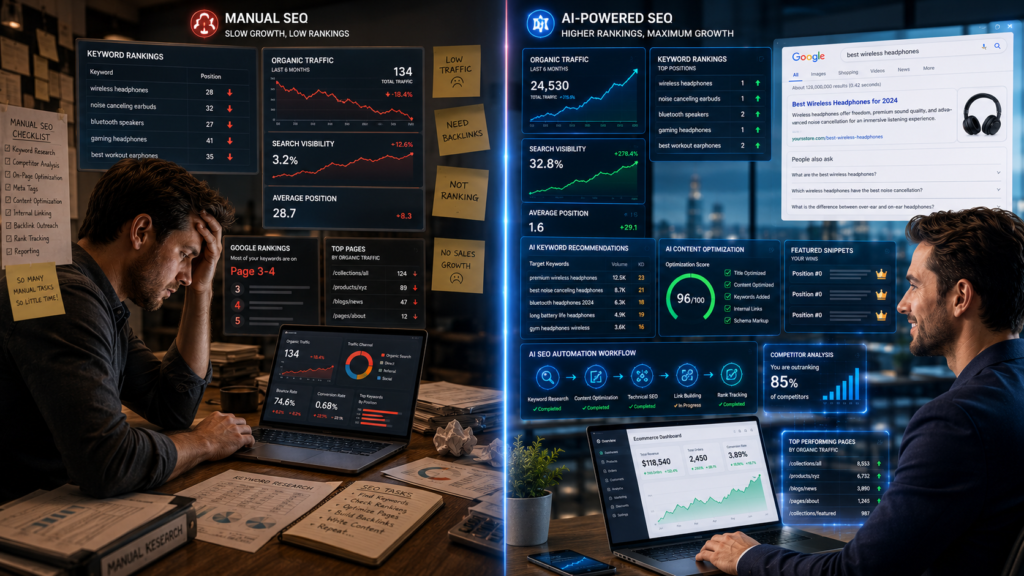
This is exactly why AI SEO Tools for Ecommerce have become a critical part of modern digital marketing. They help online sellers automate complex SEO tasks, uncover ranking opportunities, and optimize product pages at a scale that would be nearly impossible to achieve manually.
The Growing Challenge of Ranking Product Pages on Google
A few years ago, adding a keyword to a product title and writing a decent description was often enough to earn visibility in search results. Today, Google’s algorithms evaluate hundreds of signals, including content quality, user intent, page experience, engagement metrics, structured data, and topical relevance.
For ecommerce brands, the challenge is even greater.
Many online stores face issues such as:
- Thin or duplicate product descriptions
- Poor keyword targeting
- Missing metadata and schema markup
- Slow optimization processes
- Large product catalogs requiring constant updates
As competition increases, ranking a single product page can require hours of research and optimization. Multiply that by hundreds or thousands of products, and the workload becomes overwhelming.
Consider a typical Shopify merchant with 500 products. Updating titles, meta descriptions, image alt text, and product copy manually could take weeks. That’s why more businesses are adopting AI tools for product page SEO to streamline these processes.
Content quality also plays a major role in rankings. If you’re looking to improve product copy and increase conversions, check out our guide on 17 AI Tools For High-Converting Product Descriptions Automatically, which explores how AI can generate persuasive, SEO-friendly descriptions at scale.
Visual optimization is another frequently overlooked ranking factor. High-quality images can improve user engagement and conversion rates, making our guide on How to Improve Etsy Product Photos: 17 Proven Tips to Increase Clicks & Sales a valuable next step for sellers focused on organic growth.
How AI-Powered SEO for Online Stores Changes the Game
Artificial intelligence is transforming how ecommerce businesses approach SEO. Instead of spending countless hours on repetitive tasks, store owners can use AI-powered SEO for online stores to automate research, content creation, optimization, and performance monitoring.
Modern ecommerce SEO automation tools can analyze thousands of keywords, identify content gaps, and generate optimization recommendations within minutes.
Some of the most valuable capabilities include:
Automated Keyword Discovery
AI tools can identify:
- High-intent buyer keywords
- Long-tail search opportunities
- Emerging search trends
- Competitor keyword gaps
This helps businesses target keywords that are more likely to drive sales rather than just traffic.
Smarter Product Content Optimization
Many best AI SEO software for product listings solutions can:
- Generate optimized product descriptions
- Improve product titles
- Create compelling meta descriptions
- Suggest semantic and LSI keywords
- Optimize image alt text
The result is more relevant content that aligns with Google’s understanding of user intent.
Scalable SEO for Large Catalogs
One of the biggest advantages of AI is scalability.
Instead of optimizing product pages one by one, businesses can apply SEO improvements across entire catalogs. This is particularly valuable for Shopify, WooCommerce, Amazon, and multi-channel sellers managing hundreds or thousands of SKUs.
Better Data-Driven Decision Making
Advanced Shopify SEO AI tools don’t just automate tasks—they provide insights.
These platforms can reveal:
- Which products have the highest ranking potential
- Pages losing traffic
- Underperforming keywords
- Technical SEO issues affecting visibility
This allows store owners to focus their efforts where they’ll generate the highest return.
For sellers running paid and organic campaigns together, our guide on Powerful Amazon PPC Optimization Strategies That Actually Work in 2026 explains how combining SEO and PPC data can accelerate product visibility and sales growth.
As Google’s search ecosystem becomes more sophisticated, businesses that rely solely on manual SEO processes risk falling behind. AI is no longer a competitive advantage—it’s quickly becoming a necessity for ecommerce brands that want faster rankings, increased organic traffic, and sustainable long-term growth.
Key Features to Look for in AI Tools for Product Page SEO
Not all AI SEO platforms are created equal. Some tools focus on content generation, while others specialize in keyword intelligence, technical SEO, or product page optimization. If your goal is to improve rankings and drive more qualified traffic, choosing the right features is often more important than choosing the most expensive software.
The best AI SEO Tools for Ecommerce combine data analysis, automation, and content optimization to help online stores compete more effectively in search results. Below are the features that matter most.
Automated Keyword Research and Search Intent Analysis
Traditional keyword research can take hours, especially when you’re managing dozens or hundreds of product pages. Modern AI tools for product page SEO streamline this process by analyzing massive amounts of search data in minutes.
Instead of simply finding high-volume keywords, advanced AI platforms identify:
- Buyer-intent keywords that drive conversions
- Long-tail search terms with lower competition
- Seasonal keyword opportunities
- Semantic and related keyword variations
- Competitor keyword gaps
For example, a customer searching “wireless noise-canceling headphones for travel” has a much different intent than someone searching “best headphones.” AI can detect these nuances and recommend content that matches what shoppers actually want.
High-performing ecommerce SEO automation tools also analyze search intent by categorizing keywords into:
- Informational Searches
- Commercial Investigation Searches
- Transactional Searches
- Navigational Searches
This allows store owners to create product pages that align with Google’s understanding of user intent.
Many successful sellers combine AI keyword research with proven prompt frameworks. If you’re looking for practical examples, check out I Tested ChatGPT Prompts for Ecommerce — Here’s What Actually Worked to see how AI-generated keyword strategies can improve product page performance.
What to Look for in Keyword Research Features
When evaluating AI SEO software, prioritize tools that offer:
- Real-time keyword suggestions
- Search intent classification
- Competitor keyword analysis
- SERP difficulty scoring
- Product-specific keyword recommendations
- Trend forecasting capabilities
These features help ensure your optimization efforts target keywords that can realistically generate traffic and sales.
Product Description Optimization and Content Enhancement
Product descriptions are one of the most overlooked ranking factors in ecommerce SEO. Many stores still rely on manufacturer-provided copy, resulting in duplicate content that struggles to rank.
Today’s AI-powered SEO for online stores can transform basic product descriptions into search-optimized, conversion-focused content that appeals to both Google and potential buyers.
The best AI SEO software for product listings typically helps with:
- SEO-friendly product titles
- Keyword-rich product descriptions
- Feature-to-benefit conversion
- Readability improvements
- Meta description generation
- Product schema recommendations
For example, instead of writing:
“Waterproof hiking backpack with multiple compartments.”
AI can generate:
“Stay organized on every adventure with this waterproof hiking backpack featuring multiple storage compartments, ergonomic shoulder straps, and weather-resistant materials designed for serious outdoor enthusiasts.”
The second version naturally includes more context, semantic relevance, and buyer-focused language.
Content Enhancement Features That Matter Most
Look for AI platforms that can:
- Identify missing content elements
- Improve content readability
- Optimize heading structure
- Generate unique descriptions at scale
- Suggest related keywords naturally
- Maintain a consistent brand voice
For visual ecommerce platforms such as Etsy, pairing optimized descriptions with high-converting images creates a powerful ranking advantage. Learn more in How to Improve Etsy Product Photos: 17 Proven Tips to Increase Clicks & Sales.
Likewise, Amazon sellers can combine AI-generated listing optimization with paid advertising strategies for even greater visibility. Our guide on [Powerful Amazon PPC Optimization Strategies That Actually Work in 2026] explains how to maximize both organic and paid traffic.
Ultimately, the most effective Shopify SEO AI tools and ecommerce optimization platforms don’t just help pages rank—they help visitors convert. By combining intelligent keyword research with advanced content enhancement, AI can turn ordinary product pages into high-performing assets that attract traffic, increase engagement, and drive more sales.
Best AI SEO Software for Product Listings: Top Tools Compared
Choosing the right AI SEO platform can be the difference between a product page that sits on page five of Google and one that consistently generates qualified organic traffic. Today’s AI SEO Tools for Ecommerce do far more than generate content—they help businesses uncover ranking opportunities, optimize listings at scale, and automate repetitive SEO tasks that consume valuable time.
However, not all solutions are created equal. Enterprise retailers need powerful automation and advanced analytics, while smaller ecommerce stores often prioritize affordability, ease of use, and quick implementation.
Enterprise-Level AI SEO Platforms for Large Ecommerce Brands
Large ecommerce brands managing thousands—or even millions—of product pages need AI platforms capable of handling SEO at scale. Manual optimization simply isn’t practical when inventory changes daily and competition is constantly evolving.
The most effective enterprise-grade AI tools for product page SEO typically offer:
- Advanced keyword clustering and topic modeling
- Automated product description optimization
- Technical SEO auditing across large catalogs
- AI-powered internal linking recommendations
- Competitor analysis and SERP monitoring
- Automated schema markup generation
These features allow enterprise teams to identify ranking opportunities faster and deploy updates across entire product categories without extensive manual work.
For example, a national retailer with 50,000+ SKUs can use ecommerce SEO automation tools to optimize metadata, product descriptions, and structured data in a fraction of the time required by traditional workflows.
What Enterprise Brands Should Prioritize
When evaluating platforms, focus on:
- Scalability across large product catalogs
- Integration with existing ecommerce platforms
- Data accuracy and AI-driven recommendations
- Custom reporting and forecasting capabilities
- Multi-user collaboration features
The goal isn’t simply automation—it’s using AI to make smarter SEO decisions at scale.
Budget-Friendly Solutions for Small Businesses and Shopify Stores
Small ecommerce businesses don’t need enterprise-level software to compete effectively. In fact, many affordable Shopify SEO AI tools now provide features that were once available only to major retailers.
For startups, niche brands, and independent Shopify store owners, the best solutions typically focus on:
- Product description generation
- Keyword research automation
- Meta title and meta description optimization
- SEO audits and error detection
- Content suggestions based on search intent
Many store owners find that combining AI-powered optimization tools with proven prompt strategies delivers impressive results. If you’re experimenting with AI-generated content, check out I Tested ChatGPT Prompts for Ecommerce — Here’s What Actually Worked to learn which approaches actually improve product page performance.
Best Use Cases for Small Ecommerce Stores
Budget-conscious businesses often see the highest ROI when using AI for:
- Launching new product listings faster
- Refreshing outdated product descriptions
- Identifying low-competition keyword opportunities
- Improving category page optimization
- Creating SEO-friendly metadata at scale
Store owners should also remember that rankings depend on more than text alone. Product imagery plays a major role in user engagement and conversion rates. For practical optimization tips, see [How to Improve Etsy Product Photos: 17 Proven Tips to Increase Clicks & Sales].
Likewise, businesses selling through multiple marketplaces can strengthen overall visibility by combining SEO with paid acquisition strategies. Our guide on Powerful Amazon PPC Optimization Strategies That Actually Work in 2026 explains how successful sellers integrate organic and paid traffic growth.
Which Option Is Right for You?
If you’re managing a large ecommerce operation with thousands of SKUs, investing in enterprise-level AI-powered SEO for online stores can deliver substantial efficiency gains and long-term revenue growth.
If you’re running a Shopify store, niche ecommerce brand, or small online business, affordable platforms often provide more than enough functionality to improve rankings, streamline workflows, and compete effectively in search results.Ultimately, the best AI SEO software for product listings is the one that aligns with your catalog size, growth goals, budget, and SEO maturity level. The right tool won’t replace strategy—but it can dramatically accelerate execution and help product pages rank faster on Google.
How Shopify SEO AI Tools Improve Product Page Rankings
For many Shopify store owners, ranking product pages consistently on Google can feel like an uphill battle. Between keyword research, metadata optimization, schema markup, and content updates, SEO quickly becomes overwhelming as product catalogs grow.
This is where modern Shopify SEO AI tools provide a major advantage. By automating repetitive optimization tasks and uncovering hidden ranking opportunities, these tools help merchants improve visibility without spending hours manually editing every product page.
AI-Driven Metadata, Titles, and Schema Optimization
Google relies heavily on metadata and structured data to understand product pages. Unfortunately, many ecommerce stores either overlook these elements or use duplicate templates that weaken search performance.
Advanced AI tools for product page SEO can automatically generate optimized:
- Product titles
- Meta titles
- Meta descriptions
- Product tags
- Image alt text
- Product schema markup
Instead of guessing which keywords matter, AI analyzes search trends, competitor pages, and user intent to create metadata that aligns with what shoppers are actually searching for.
For example, a generic product title like:
“Wireless Earbuds”
can become:
“Bluetooth Wireless Earbuds with Noise Cancellation – 30-Hour Battery Life”
This approach helps search engines better understand page relevance while improving click-through rates from search results.
Many leading AI SEO Tools for Ecommerce also automate structured data implementation. Product schema helps Google display rich results such as:
- Product ratings
- Price information
- Stock availability
- Product reviews
- Shipping details
These enhanced search listings often attract more clicks and qualified buyers compared to standard search results.
Scaling SEO Across Hundreds or Thousands of Products
One of the biggest challenges for growing ecommerce businesses is scale.
Optimizing 20 product pages manually is manageable.
Optimizing 2,000 product pages is a completely different story.
This is where ecommerce SEO automation tools become essential.
Instead of manually updating each listing, AI can:
- Generate optimized product descriptions in bulk.
- Create unique metadata across large catalogs.
- Detect duplicate content issues.
- Recommend keyword opportunities.
- Monitor ranking changes automatically.
- Suggest content updates based on search trends.
For stores with large inventories, this level of automation can save hundreds of work hours annually while maintaining consistent SEO standards across every product page.
The best AI-powered SEO for online stores platforms also analyze customer search behavior to identify emerging keyword opportunities before competitors capitalize on them.
For sellers expanding beyond Shopify, improving visual assets can further boost conversion rates. Our detailed guide on How to Improve Etsy Product Photos: 17 Proven Tips to Increase Clicks & Sales explains how better product imagery supports both SEO and sales performance.
Similarly, businesses selling across multiple marketplaces can combine organic search optimization with paid acquisition strategies. Check out Powerful Amazon PPC Optimization Strategies That Actually Work in 2026 to maximize product visibility across channels.
The bottom line is simple: as product catalogs grow, manual SEO becomes increasingly inefficient. Modern best AI SEO software for product listings allows ecommerce brands to scale optimization efforts, improve search visibility, and compete more effectively in crowded markets without dramatically increasing marketing costs.
Ecommerce SEO Automation Tools That Save Time and Increase Traffic
Managing an ecommerce store today means juggling hundreds—or even thousands—of product pages. Manually optimizing every title, description, image, and technical SEO element simply isn’t scalable. That’s why modern ecommerce SEO automation tools have become essential for online retailers looking to grow organic traffic without expanding their marketing team.
The biggest advantage of automation isn’t just saving time. It’s creating a consistent SEO process that can be applied across an entire catalog, helping product pages rank faster and more effectively on Google.
Automating On-Page SEO Tasks
One of the most powerful uses of AI SEO Tools for Ecommerce is automating repetitive on-page optimization tasks. Instead of spending hours updating individual product pages, AI can analyze content, identify optimization opportunities, and implement recommendations at scale.
Common on-page SEO tasks that AI can automate include:
- Product title optimization
- Meta title and meta description generation
- Keyword placement recommendations
- Product description enhancement
- Image alt text creation
- Internal linking suggestions
- Structured data and schema implementation
For example, many AI tools for product page SEO can scan an entire catalog and instantly identify missing keywords, duplicate content, or under-optimized product listings. This helps store owners focus on strategy rather than repetitive editing.
AI also improves content quality by matching product descriptions to search intent. Instead of stuffing keywords into listings, advanced systems create content that answers customer questions and aligns with how shoppers search online.
Benefits of Automated On-Page SEO
Businesses using AI-powered SEO for online stores often experience:
- Faster optimization across large inventories
- More consistent SEO implementation
- Reduced human error
- Better keyword targeting
- Improved user experience
- Increased organic visibility
When every product page follows SEO best practices, search engines can crawl, understand, and rank your content more efficiently.
Using AI for Technical SEO and Site Audits
Technical SEO is often where ecommerce sites struggle the most. Large stores frequently deal with crawl errors, duplicate pages, broken links, slow-loading images, and indexing issues that quietly damage rankings.
Fortunately, modern best AI SEO software for product listings can identify these problems automatically before they impact performance.
AI-powered site audit tools continuously monitor factors such as:
- Broken internal and external links
- Duplicate content issues
- Missing metadata
- Crawlability problems
- Slow page speed
- Mobile usability errors
- Indexing and sitemap issues
- Schema markup validation
Rather than waiting for rankings to drop, AI alerts store owners to issues in real time and often provides step-by-step recommendations for fixing them.
For stores focused on visual search and conversion optimization, combining technical SEO with better product imagery can deliver even stronger results. See our guide on [How to Improve Etsy Product Photos: 17 Proven Tips to Increase Clicks & Sales] to learn how image quality influences both user engagement and search performance.
How AI Site Audits Improve Traffic Growth
AI-driven audits help ecommerce brands:
- Discover hidden SEO issues faster
- Improve website crawl efficiency
- Strengthen site architecture
- Increase indexing rates
- Enhance Core Web Vitals performance
- Protect rankings during site updates
For Amazon sellers, SEO automation works even better when paired with paid acquisition strategies. Our article on Powerful Amazon PPC Optimization Strategies That Actually Work in 2026 explains how combining organic and paid visibility can maximize product exposure.
The bottom line is simple: automation doesn’t replace SEO strategy—it amplifies it. By using intelligent Shopify SEO AI tools and advanced ecommerce SEO automation tools, businesses can spend less time fixing technical issues and more time driving revenue, customer acquisition, and long-term organic growth.
Common Mistakes to Avoid When Using AI SEO Tools for Ecommerce
Artificial intelligence can dramatically improve your SEO workflow, but it’s not a magic button for instant rankings. Many ecommerce store owners adopt powerful AI SEO tools for ecommerce and expect automated success, only to see disappointing results. The problem usually isn’t the software—it’s how it’s being used.
Understanding the most common mistakes can help you maximize the value of AI-powered SEO while avoiding penalties, poor user experiences, and stagnant rankings.
Over-Automation and Generic Content Risks
One of the biggest mistakes ecommerce businesses make is relying too heavily on automation. While modern AI tools for product page SEO can generate descriptions, meta titles, FAQs, and keyword recommendations in seconds, publishing AI-generated content without review can hurt your brand and search visibility.
Google’s algorithms are becoming increasingly effective at identifying thin, repetitive, and low-value content. If every product description follows the same template, customers may lose trust and search engines may struggle to find unique value on your pages.
Common over-automation mistakes include:
- Publishing AI-generated product descriptions without editing
- Using identical templates across hundreds of products
- Ignoring customer intent and real-world buying questions
- Stuffing keywords into content unnaturally
- Automatically generating metadata without quality checks
For example, many store owners use ecommerce SEO automation tools to create hundreds of product pages at once. While this saves time, it often results in generic content that fails to answer the specific questions shoppers have before making a purchase.
Instead of treating AI as a replacement for content creation, use it as a starting point. Generate the first draft, then enhance it with:
- Unique product benefits
- Real customer pain points
- Industry expertise
- Brand-specific messaging
- Original examples and use cases
Balancing AI Efficiency with Human SEO Expertise
The most successful ecommerce brands don’t choose between AI and human expertise—they combine both.
AI-powered SEO for online stores excels at processing data, identifying keyword opportunities, and automating repetitive tasks. However, human marketers still outperform AI when it comes to strategy, creativity, customer psychology, and brand positioning.
Think of AI as your SEO assistant rather than your SEO manager.
The best-performing teams use AI for:
- Keyword research and clustering
- Product page optimization suggestions
- Competitor analysis
- Content outlines
- Technical SEO recommendations
Meanwhile, human experts focus on:
- Search intent analysis
- Conversion-focused copywriting
- Brand voice consistency
- User experience improvements
- Strategic content planning
This balance is especially important when using Shopify SEO AI tools and the best AI SEO software for product listings. The software can identify opportunities, but human judgment determines which opportunities align with your business goals.
A practical approach is to follow a “human review required” rule. Before publishing any AI-assisted content, verify that it:
- Answers the customer’s actual question.
- Provides unique value beyond competitors.
- Matches your brand voice.
- Reads naturally to human visitors.
- Supports your conversion goals.
For store owners new to SEO, our Best SEO Tips for Beginners: Complete Step-by-Step Guide for Higher Rankings explains how to combine automation with proven SEO fundamentals.
You can also explore What Happened When I Started Using AI Prompts for Ecommerce Store Tasks (Daily) to see real-world examples of AI implementation, and Powerful Amazon PPC Optimization Strategies That Actually Work in 2026 if you’re looking to combine organic search growth with paid acquisition strategies.
Ultimately, AI can help product pages rank faster, but rankings are rarely achieved through automation alone. The winning formula is simple: let AI handle the heavy lifting while humans provide the strategy, creativity, and customer understanding that search engines increasingly reward.
Choosing the Right AI SEO Tool for Your Online Store
Not all AI SEO platforms are built for the same type of ecommerce business. A tool that works perfectly for a startup Shopify store may be overkill for an enterprise retailer managing thousands of SKUs. The key is matching the software’s capabilities to your store size, growth stage, and budget.
The best AI SEO Tools for Ecommerce should help you save time, improve product page visibility, and uncover ranking opportunities without creating unnecessary complexity.
Decision Framework Based on Store Size and Budget
Before investing in any platform, evaluate your business using these four criteria:
1. Store Size
Small Stores (Under 100 Products)
- Focus on content optimization and keyword research.
- Look for affordable AI tools for product page SEO that automate titles, meta descriptions, and product copy.
- Prioritize ease of use over advanced enterprise features.
Medium Stores (100–5,000 Products)
- Choose solutions with bulk optimization capabilities.
- Look for automated internal linking, schema generation, and SEO auditing features.
- Consider specialized Shopify SEO AI tools if you’re operating on Shopify.
Large Ecommerce Brands (5,000+ Products)
- Invest in enterprise-grade platforms offering predictive analytics, automation workflows, and large-scale SEO management.
- Advanced reporting and AI-driven content recommendations become increasingly valuable at scale.
2. Budget Considerations
A higher price tag doesn’t automatically mean better SEO results.
Use this framework:
| Budget Range | Recommended Focus |
| Under $50/month | Keyword research, product descriptions, basic optimization |
| $50–$200/month | Automation features, content optimization, technical audits |
| $200+/month | Enterprise automation, advanced analytics, large-scale SEO management |
3. Automation Needs
Some store owners want complete automation, while others prefer maintaining manual control.
The most effective ecommerce SEO automation tools typically automate:
- Keyword clustering
- Product description optimization
- Meta title generation
- Technical SEO audits
- Internal linking suggestions
- Structured data implementation
4. Platform Compatibility
Always verify integration capabilities before purchasing.
Ask yourself:
- Does it work with Shopify?
- Does it support WooCommerce?
- Can it scale as my catalog grows?
- Does it integrate with analytics and marketing tools?
Choosing software that aligns with your current and future needs prevents costly migrations later.
Final Recommendations for Faster Google Rankings
If your goal is to rank product pages faster, don’t focus solely on AI-generated content. The highest-performing stores combine artificial intelligence with a clear SEO strategy.
For most online retailers, prioritize tools that offer:
- Automated keyword research
- Product page optimization
- Technical SEO monitoring
- Internal linking recommendations
- Performance tracking and reporting
Remember, even the best AI SEO software for product listings cannot compensate for weak product offerings, poor user experience, or slow website performance. AI should enhance your SEO strategy—not replace it.
To strengthen your overall ecommerce SEO approach, consider reading:
- I Tested ChatGPT Prompts for Ecommerce — Here’s What Actually Worked
- Best SEO Tips for Beginners: Complete Step-by-Step Guide for Higher Rankings
- What Happened When I Started Using AI Prompts for Ecommerce Store Tasks (Daily)
- Powerful Amazon PPC Optimization Strategies That Actually Work in 2026
When used correctly, AI-powered SEO for online stores can significantly reduce manual work, improve optimization consistency, and help product pages gain visibility faster in Google’s increasingly competitive search results. The winning formula is simple: choose the right tool, automate intelligently, and continuously refine your strategy based on real performance data.
Frequently Asked Questions (FAQs)
What Are AI SEO Tools for Ecommerce?
AI SEO tools for ecommerce are software platforms that use artificial intelligence to help online stores improve their visibility in search engines like Google. Instead of manually analyzing thousands of keywords, optimizing product descriptions, and auditing technical SEO issues, these tools automate much of the process.
Modern AI SEO Tools for Ecommerce can help with:
- Keyword research and search intent analysis
- Product title and description optimization
- Meta tag generation
- Internal linking suggestions
- Technical SEO audits
- Competitor analysis
For Shopify merchants, Amazon sellers, and independent online retailers, AI can dramatically reduce the time spent on SEO while helping product pages become more search-friendly. Many businesses now use AI-powered SEO for online stores to scale optimization across hundreds or even thousands of products.
Can AI Tools Help Product Pages Rank Faster on Google?
Yes—but with an important caveat.
AI can accelerate SEO implementation and optimization, but it cannot guarantee higher rankings. Google’s algorithm still evaluates content quality, relevance, authority, user experience, and many other ranking signals.
What AI does exceptionally well is speed up tasks such as:
- Finding high-intent keywords
- Optimizing product descriptions
- Improving title tags and meta descriptions
- Identifying content gaps
- Detecting technical SEO issues
Many AI tools for product page SEO can also optimize important ranking factors including page relevance, keyword placement, content structure, internal linking opportunities, image optimization recommendations, and schema markup implementation.
The result is a faster and more efficient SEO workflow that helps product pages become competitive sooner.
What Is the Best AI SEO Software for Product Listings?
The best AI SEO software depends on your store size, budget, and growth goals.
For example, a small Shopify store may prioritize content optimization and keyword research, while a larger ecommerce brand may need enterprise-level automation, site auditing, and advanced analytics.
When evaluating best AI SEO software for product listings, look for features such as:
- AI-powered keyword research
- Product description generation
- SEO scoring and recommendations
- Technical site audits
- Content optimization workflows
- Ecommerce SEO automation tools
- Competitor tracking
Are Shopify SEO AI Tools Worth the Investment?
For many Shopify merchants, the answer is yes.
SEO often becomes difficult to manage as product catalogs grow. Updating titles, descriptions, metadata, image alt text, and internal links manually can consume dozens of hours every month.
Shopify SEO AI tools help by:
- Automating repetitive optimization tasks
- Improving consistency across product pages
- Identifying new keyword opportunities
- Reducing content creation costs
- Supporting faster product launches
The potential return on investment comes from increased organic traffic, improved product visibility, and higher conversion opportunities. Growing ecommerce businesses often use AI to maintain SEO quality without continuously expanding their marketing teams.
Do AI SEO Tools for Ecommerce Replace SEO Experts?
No. AI is a powerful assistant, but it does not replace experienced SEO professionals.
AI can analyze data, generate content suggestions, and automate repetitive tasks. However, it cannot fully understand brand positioning, customer psychology, long-term business goals, or the nuances of creating content that truly connects with human buyers.
Successful ecommerce brands typically combine AI efficiency with human expertise.
Human SEO professionals are still responsible for:
- SEO strategy development
- Brand voice consistency
- Content quality control
- User experience optimization
- Conversion-focused decision-making
- Competitive positioning
According to [Google’s Helpful Content and Search Quality Guidelines – External Link], content should primarily be created to help people rather than manipulate search rankings. The most effective approach is using AI as a productivity tool while maintaining human oversight to ensure accuracy, quality, and trustworthiness.
For additional foundational SEO knowledge, read Best SEO Tips for Beginners: Complete Step-by-Step Guide for Higher Rankings and Powerful Amazon PPC Optimization Strategies That Actually Work in 2026 to build a more comprehensive ecommerce growth strategy.