
Have you ever wondered why some brands seem to dominate every search result, social feed, and customer conversation while others struggle to get noticed? The difference isn’t always a bigger budget—it’s often how effectively they use AI marketing platforms to automate, optimize, and personalize their marketing efforts. As competition continues to grow across every industry, businesses that rely solely on traditional marketing methods risk falling behind faster than ever.
Today’s AI marketing tools for businesses can analyze customer behavior, create high-performing content, automate campaigns, and uncover insights that would take marketing teams hours—or even days—to find manually. Whether you’re a startup, an eCommerce brand, or an established company, choosing the best AI marketing platforms can significantly improve your visibility, attract qualified prospects, and help you build a recognizable brand in crowded markets.
If you’re already investing in digital marketing, you may also find our guide on [Internal Link: AI Content Marketing Tools for Business Growth] helpful for expanding your strategy.
In this guide, you’ll discover how AI tools for brand visibility, AI digital marketing software, and modern AI marketing automation platforms work together to increase brand awareness, improve campaign performance, and maximize marketing ROI. We’ll also compare the most effective solutions, key features to prioritize, pricing considerations, and practical tips backed by industry best practices and insights from [External Link: trusted marketing research and industry reports], helping you confidently choose the right platform for your business goals.
What Are AI Marketing Platforms and Why Do They Matter?
Artificial intelligence has become a core part of modern marketing, not just a competitive advantage. AI marketing platforms help businesses automate repetitive tasks, analyze customer behavior, personalize experiences, and make smarter decisions using real-time data. Instead of relying on guesswork, marketers can use AI to identify trends, predict customer intent, and optimize campaigns across multiple channels.
Whether you’re running a small business, an eCommerce store, or a growing enterprise, today’s AI marketing tools for businesses simplify complex workflows while improving efficiency and measurable results.
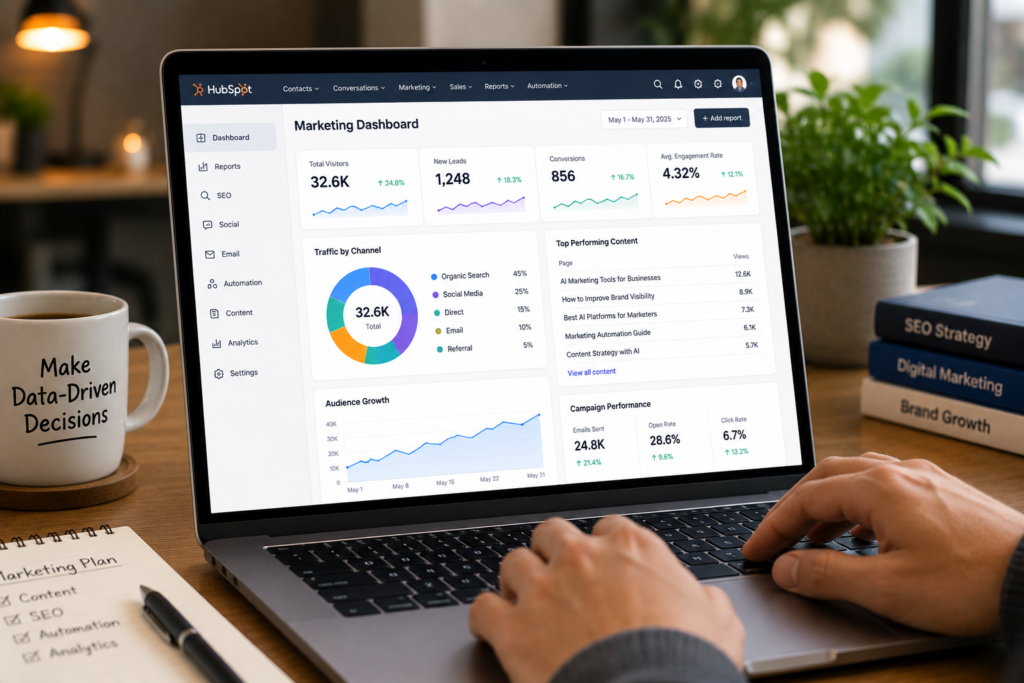
How AI Marketing Platforms Are Transforming Modern Marketing
The marketing landscape has changed dramatically over the past few years. Consumers expect personalized experiences, faster responses, and relevant content wherever they interact with a brand. Meeting those expectations manually is becoming increasingly difficult.
That’s where AI marketing platforms make a difference. They combine machine learning, automation, predictive analytics, and customer insights into a single ecosystem that helps businesses market more effectively.
Instead of spending hours on repetitive tasks, marketing teams can use AI digital marketing software to:
- Generate content ideas based on search trends
- Automate email marketing campaigns
- Personalize customer experiences
- Optimize SEO and paid advertising
- Analyze campaign performance in real time
- Predict customer behavior using historical data
For example, an online retailer can use AI to recommend products based on browsing history, while a B2B company can automatically score leads and prioritize high-value prospects. These capabilities help businesses reach the right audience with the right message at the right time.
One of the biggest advantages of AI is its ability to convert large volumes of marketing and sales data into meaningful insights. Businesses looking to improve reporting workflows can also benefit from Best ChatGPT Prompts for Sales Analytics & Reporting which demonstrates practical ways to analyze performance, identify trends, and make more confident business decisions.
Key Benefits of AI Marketing Tools for Businesses
Investing in the right AI marketing tools for businesses offers more than automation—it creates opportunities to improve visibility, customer engagement, and return on investment.
Some of the biggest advantages include:
- Improved brand visibility through AI-powered SEO, content optimization, and social media recommendations.
- Smarter marketing decisions using predictive analytics and customer behavior insights.
- Higher productivity by automating repetitive tasks such as email campaigns, reporting, scheduling, and audience segmentation.
- Better customer personalization through dynamic content, product recommendations, and tailored messaging.
- Lower marketing costs by reducing manual work and optimizing advertising budgets.
- Faster campaign optimization with real-time performance tracking and AI-driven recommendations.
Many of the best AI marketing platforms also integrate seamlessly with CRM systems, email marketing software, social media management tools, and analytics platforms. This allows businesses to create connected marketing workflows without constantly switching between different applications.
As AI technology continues to evolve, AI tools for brand visibility are becoming essential rather than optional. Businesses that adopt intelligent automation can respond faster to market changes, improve customer experiences, and build stronger brand recognition. Choosing the right AI marketing automation platforms today can provide a lasting competitive advantage in an increasingly crowded digital marketplace.
How AI Marketing Platforms Increase Brand Visibility
Today’s consumers interact with brands across multiple digital channels before making a purchase. They might discover a business through Google, engage with it on social media, and later convert after receiving a personalized email. AI marketing platforms help businesses create a consistent, data-driven experience across every touchpoint, making it easier to increase visibility, build trust, and drive meaningful engagement.
Using AI Tools for Brand Visibility Across Search, Social, and Email
One of the biggest advantages of modern AI marketing platforms is their ability to connect marketing efforts across channels instead of treating each one separately. Rather than guessing what content will perform, businesses can use AI to identify audience interests, optimize messaging, and publish content when engagement is most likely.
For search marketing, AI tools for brand visibility analyze keyword trends, search intent, and content performance to help marketers create pages that align with what users are actively searching for. Many businesses also combine these insights with AI content marketing tools to streamline content planning, improve topical authority, and publish optimized articles more efficiently. [Internal Link: AI Content Marketing Tools]
Social media is another area where AI delivers measurable results. Instead of manually testing dozens of post variations, AI marketing tools for businesses can:
- Recommend high-performing captions and headlines
- Identify the best times to publish content
- Suggest trending topics relevant to your audience
- Repurpose long-form content into platform-specific posts
- Predict which campaigns are likely to generate the highest engagement
Email marketing has also become significantly smarter with AI. Rather than sending identical campaigns to every subscriber, AI marketing automation platforms segment audiences based on behavior, purchase history, and engagement patterns. This allows businesses to deliver personalized emails that improve open rates, click-through rates, and customer retention.
For eCommerce brands, combining AI-powered content optimization with SEO automation can significantly increase organic visibility. For example, businesses focused on online retail often integrate these strategies with AI for Ecommerce SEO: How Smart Sellers Get Free Organic Traffic and Grow Sales Faster to strengthen product discovery and improve long-term search performance.
How AI Marketing Automation Platforms Improve Customer Engagement
Customer engagement depends on delivering the right message at the right time. AI marketing platforms continuously analyze user behavior, allowing businesses to automate interactions without making them feel impersonal.
Modern AI digital marketing software can automatically trigger personalized recommendations, abandoned cart reminders, onboarding sequences, and loyalty campaigns based on real-time customer activity. Instead of relying on one-size-fits-all messaging, AI adapts communication to individual preferences, creating more relevant experiences throughout the customer journey.
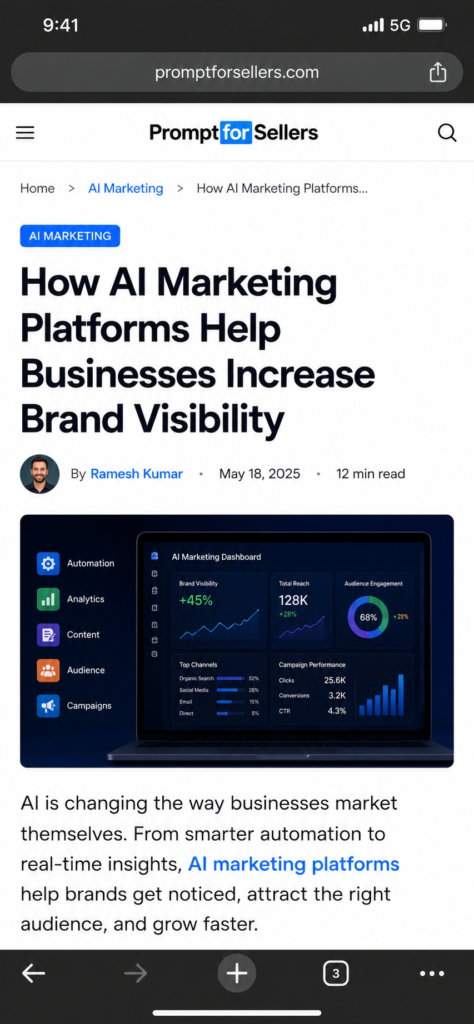
As customer data grows, best AI marketing platforms also provide predictive analytics that help marketers identify high-value audiences, forecast campaign performance, and allocate budgets more effectively. The result is stronger brand recognition, higher engagement rates, and marketing campaigns that continuously improve through data-driven optimization rather than trial and error.
Best AI Marketing Platforms Compared
Choosing from today’s AI marketing platforms isn’t just about finding the tool with the most features—it’s about selecting software that aligns with your marketing goals, budget, and growth stage. Whether you’re running a startup, managing multiple client accounts, or leading an enterprise marketing team, the right platform should streamline workflows, improve campaign performance, and provide actionable insights without adding unnecessary complexity.
Features to Look for in AI Digital Marketing Software
Not every solution offers the same capabilities. Before investing in AI digital marketing software, evaluate the features that will have the greatest impact on your team’s productivity and long-term ROI.
Look for these essential capabilities:
- Content generation and optimization: Create blog posts, email campaigns, ad copy, and social media content while maintaining consistent brand messaging.
- Marketing automation: The best AI marketing automation platforms automate repetitive tasks such as email sequences, customer segmentation, lead nurturing, and campaign scheduling.
- Predictive analytics: AI-powered forecasting helps identify customer trends, optimize budgets, and improve conversion rates.
- SEO and keyword intelligence: Strong platforms include keyword research, content optimization, competitor analysis, and performance tracking.
- Cross-channel campaign management: Manage email, paid advertising, social media, and website campaigns from a centralized dashboard.
- CRM and third-party integrations: Seamless connections with platforms like Salesforce, HubSpot, Shopify, and Google Analytics reduce manual work and improve data accuracy.
- Reporting and insights: Real-time dashboards make it easier to measure engagement, attribution, and overall marketing performance.
Businesses that also sell online often combine these capabilities with AI-powered creative tools. For example, teams producing product catalogs can benefit from our guide on AI Ecommerce Product Photos: 11 Best AI Tools to Create Professional Product Images in 2026, which explains how AI-generated visuals can improve product presentation while supporting broader marketing campaigns.
Industry adoption continues to accelerate as organizations integrate AI into everyday marketing operations. According to industry AI adoption research, businesses increasingly rely on AI to improve customer engagement, automate workflows, and make faster, data-driven decisions.
Top AI Marketing Platforms for Small Businesses, Agencies, and Enterprises
The best AI marketing platforms vary depending on the size and needs of your organization.
For small businesses
- Affordable pricing with simple setup
- Built-in content creation and automation
- Easy-to-understand reporting dashboards
For marketing agencies
- Multi-client workspace management
- Team collaboration and approval workflows
- Advanced reporting and white-label capabilities
For enterprise organizations
- Enterprise-grade security and compliance
- Deep CRM, ERP, and analytics integrations
- Advanced AI models, predictive insights, and scalable automation
When comparing AI marketing platforms, avoid focusing solely on the number of features. Instead, prioritize ease of use, integration options, scalability, customer support, and measurable business outcomes. The most effective AI marketing tools for businesses simplify complex marketing processes while helping teams produce better campaigns with less manual effort.
Ultimately, the right platform is one that fits your current needs while supporting future growth. By evaluating features, pricing, automation capabilities, and integration options, businesses can confidently select AI tools for brand visibility that strengthen customer engagement and deliver sustainable marketing results.
How to Choose the Right AI Marketing Platform for Your Business
Choosing among today’s AI marketing platforms can feel overwhelming. With hundreds of options promising better automation, smarter analytics, and faster growth, it’s easy to get distracted by flashy features. Instead of focusing on what’s trending, evaluate each platform based on your business goals, existing workflows, and long-term scalability. The right solution should help your team work more efficiently while delivering measurable improvements in brand visibility and marketing performance.
Essential Features That Deliver Long-Term ROI
The most successful businesses don’t choose software based solely on price. They invest in AI marketing platforms that solve real marketing challenges and continue delivering value as their business grows.
When comparing AI marketing tools for businesses, prioritize these essential features:
- Marketing automation: Automate email campaigns, lead nurturing, social media scheduling, and repetitive marketing tasks.
- Content generation and optimization: Look for AI-powered writing, SEO recommendations, and content performance insights.
- Advanced analytics: The best platforms provide real-time dashboards, conversion tracking, and predictive reporting.
- CRM and third-party integrations: Ensure the software connects seamlessly with your CRM, email provider, advertising platforms, and analytics tools.
- Personalization capabilities: Effective AI marketing automation platforms can tailor content, recommendations, and messaging based on customer behavior.
- Scalability: Select software that can support future growth without requiring a complete platform migration.
Many of the best AI marketing platforms combine automation, analytics, content creation, and customer insights into a single ecosystem, reducing the need for multiple disconnected tools.
Common Mistakes Businesses Make When Selecting AI Marketing Software
Many companies invest in AI digital marketing software expecting immediate results, only to realize later that the platform doesn’t match their needs. Avoiding a few common mistakes can save both time and money.
Here are the biggest pitfalls to watch for:
- Choosing features you don’t actually need. More features don’t always mean better results. Focus on tools that align with your marketing objectives.
- Ignoring ease of use. A complicated platform can reduce team adoption and slow implementation.
- Overlooking integration options. Your AI solution should fit naturally into your existing marketing technology stack.
- Failing to evaluate customer support. Responsive onboarding, documentation, and technical assistance become critical as your usage grows.
- Not considering long-term costs. Review subscription tiers, usage limits, and potential upgrade expenses before committing.
The most effective AI marketing platforms aren’t necessarily the most expensive—they’re the ones that help your business automate repetitive work, improve decision-making, and strengthen brand visibility over time. By carefully evaluating features, usability, and scalability, you can confidently choose a platform that delivers sustainable growth and a strong return on investment.
Best Practices for Maximizing Results with AI Marketing Platforms
Choosing the right AI marketing platforms is only the first step. To generate measurable business growth, you need a strategy that integrates AI into your existing workflows, tracks meaningful performance metrics, and continuously optimizes campaigns. Businesses that combine automation with human creativity consistently outperform those relying on AI alone.
Integrating AI with Your Existing Marketing Stack
The most effective AI marketing tools for businesses don’t replace your current marketing ecosystem—they enhance it. Whether you’re using a CRM, email marketing platform, social media scheduler, or analytics solution, modern AI marketing automation platforms are designed to integrate seamlessly and eliminate repetitive tasks.
When evaluating AI marketing platforms, prioritize solutions that offer native integrations or API support for the tools your team already uses. A connected workflow helps reduce manual work, improve data accuracy, and create a more consistent customer experience across every touchpoint.
Here are a few best practices to follow:
- Connect AI with your CRM to personalize customer interactions.
- Sync AI with email marketing software for smarter segmentation and automated campaigns.
- Use AI-powered content tools alongside your SEO workflow to optimize articles before publishing.
- Integrate AI with social media management platforms to schedule content at optimal engagement times.
- Centralize campaign data in one dashboard for easier reporting and decision-making.
For eCommerce businesses, automation becomes even more valuable when AI supports daily operational tasks such as product optimization, keyword research, and listing improvements. For example, our guide on Powerful AI Tools for Sellers to Automate Daily Ecommerce Tasks in 2026 explains how AI can streamline routine workflows while improving overall marketing efficiency.
Measuring Brand Visibility Using AI Analytics and Performance Metrics
Successful marketing isn’t based on assumptions—it’s driven by data. The best AI marketing platforms provide advanced analytics that help businesses understand how their brand performs across search engines, social media, paid advertising, and content marketing.
Instead of focusing only on traffic, monitor metrics that directly reflect brand growth and audience engagement, including:
- Organic search visibility
- Branded keyword impressions
- Website engagement and session duration
- Social media reach and audience growth
- Email open and click-through rates
- Conversion rates and customer acquisition cost
- Share of voice compared to competitors
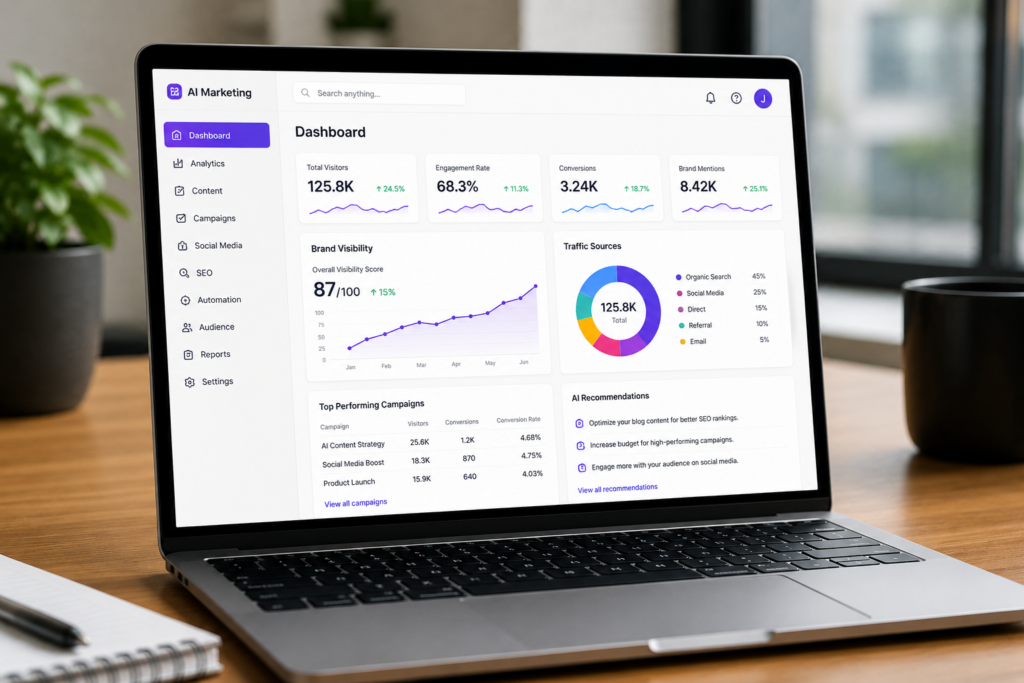
Many AI digital marketing software solutions also use predictive analytics to identify trends before they impact campaign performance. This allows marketers to adjust budgets, refine messaging, and improve targeting based on real-time insights rather than historical reports.
Remember that AI should support—not replace—high-quality content creation. Search engines continue to reward original, helpful, and user-focused content. Following Google’s Search Essentials ensures your AI-assisted content aligns with established quality guidelines while remaining valuable to readers. By combining authoritative content with data-driven optimization, AI tools for brand visibility become significantly more effective over time.
The businesses achieving the strongest results with AI marketing platforms treat AI as a strategic partner. They continuously measure performance, refine campaigns, and use analytics to make informed decisions that strengthen brand visibility and deliver sustainable long-term growth.
Final Thoughts: Are AI Marketing Platforms Worth the Investment?
Businesses no longer compete solely on product quality or price—they compete on visibility, customer experience, and speed. The right AI marketing platforms can help companies automate repetitive tasks, uncover actionable insights, and deliver personalized experiences that strengthen brand recognition across multiple channels. However, the platform itself isn’t the competitive advantage. Success depends on choosing a solution that aligns with your goals, budget, and existing marketing strategy.
Key Takeaways Before Choosing a Platform
Before investing in any AI marketing platform, focus on long-term business value rather than flashy features. The best AI marketing platforms should simplify your workflow, improve campaign performance, and provide measurable results instead of adding unnecessary complexity.
Use the following checklist before making a decision:
- Identify your primary marketing objective, whether it’s SEO, content creation, paid advertising, email marketing, or social media.
- Compare automation capabilities, reporting dashboards, and integration with your current CRM and marketing stack.
- Look for AI marketing automation platforms that can scale alongside your business instead of limiting future growth.
- Evaluate pricing carefully, including subscription costs, feature restrictions, and user limits.
- Prioritize platforms that offer reliable customer support, strong documentation, and frequent product updates.
- Choose AI digital marketing software with built-in analytics so you can measure ROI, customer engagement, and brand visibility over time.
Remember that even the most advanced AI marketing platforms deliver the best results when combined with high-quality content, strategic planning, and consistent optimization.
As your marketing strategy evolves, AI can also improve other parts of your business. For example, practical prompt engineering can significantly improve product pages and customer messaging, as discussed in How AI Prompts for Ecommerce Conversion Optimization Fixed My Store’s Low Conversion Problem, where AI-assisted optimization is applied to increase conversion rates rather than simply generate more traffic.
Next Steps to Build a Stronger Brand with AI
Once you’ve selected the right solution, focus on implementation instead of trying to automate everything at once. The most successful businesses gradually expand their AI capabilities while continuously measuring performance and refining their strategy.
A practical roadmap includes:
- Start with one or two high-impact marketing workflows, such as content creation or email automation.
- Use AI tools for brand visibility to identify content opportunities, optimize campaigns, and reach the right audience.
- Monitor key performance indicators like organic traffic, branded search volume, engagement, lead quality, and conversion rates.
- Test different campaigns, messaging, and automation workflows to determine what performs best.
- Review performance regularly and adjust your strategy based on real customer behavior and business goals.
Ultimately, AI marketing platforms are an investment in efficiency, smarter decision-making, and sustainable growth—not a replacement for creativity or strategy. Businesses that combine the right technology with thoughtful execution are better positioned to build lasting brand visibility, strengthen customer relationships, and stay competitive in an increasingly AI-driven marketplace.